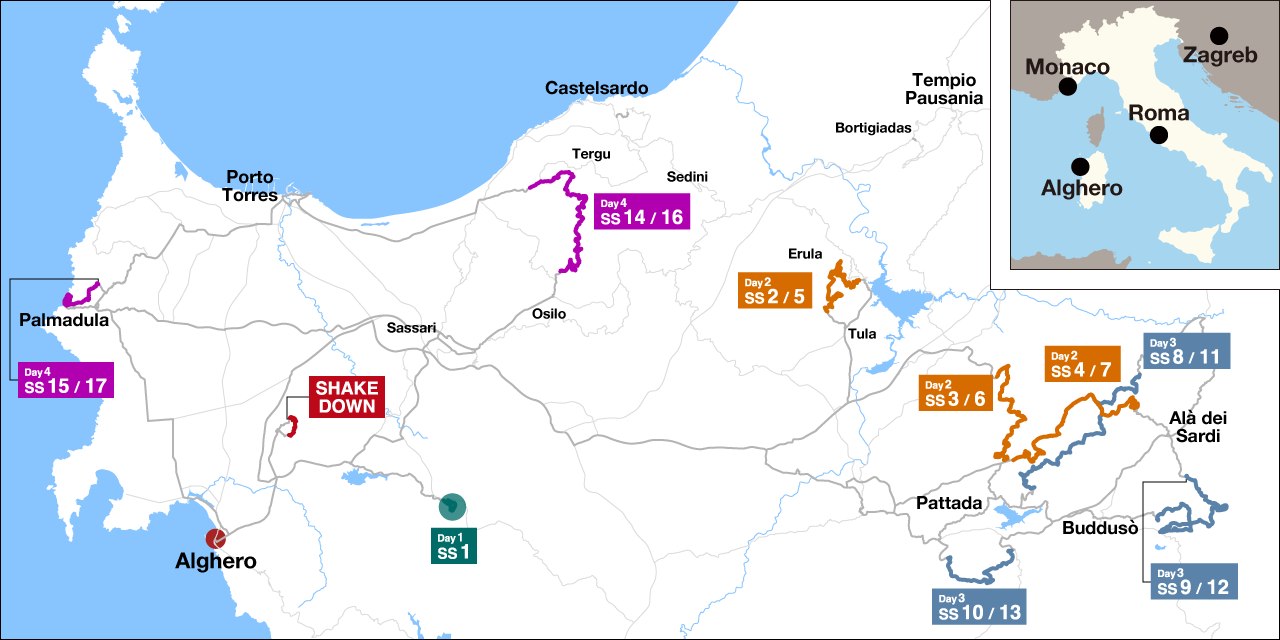
The 2026 WRC Rally Italia Sardegna will take place from 1 to 4 October. WRC’s pre-event release published on 30 September confirms that round 13, also the season finale, comprises 17 special stages and 307.02 competitive kilometres. Special stages are timed tests on closed roads; 307.02 km is their combined length. Elfyn Evans, Sami Pajari and Oliver Solberg will each be chasing a first WRC drivers’ world title.
The four-day route: inland gravel and northwestern stages on Sunday
The rally begins on Thursday evening, local time, with the Ittiri Arena spectator stage. According to Toyota’s official preview published on 25 September, Friday features three stages northeast of Alghero, each run twice, with a return to service at midday. Saturday follows a similar format, with the new Solorche stage at the end of each loop.
Sunday moves northwest of Alghero, with two stages each run twice for a total of four tests. The final pass through Sassari–Argentiera also serves as the Power Stage, listed in WRC’s release at 7.10 km. Toyota’s route description also confirms a tyre-fitting zone before the final stage.
Road conditions and starting order: the sweeping effect depends on the weather
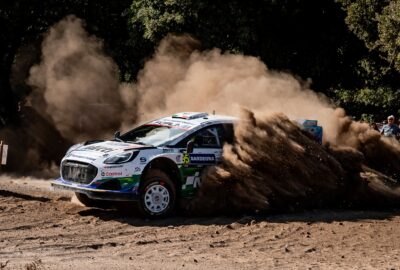
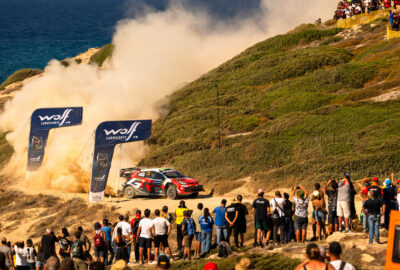
Sardinia’s roads are narrow, with an abrasive rocky base. Toyota notes that passing cars clear the loose surface gravel, gradually exposing the road underneath. This is known as road sweeping: earlier starters clear away loose gravel, so later cars encounter different surface conditions. Moving the event from its usual early-summer slot to October could bring lower temperatures and more variable weather, but the narrow roads and rocks will continue to test the tyres.
Evans leads Pajari by 17 points and Solberg by 21, but must run first on the road on Friday. He said rain was more likely at this time of year and might reduce the sweeping effect, although he was still preparing for a difficult rally. His Toyota team-mate Takamoto Katsuta said starting sixth on Friday could offer favourable conditions if it stayed dry. Evans’s championship lead therefore does not give him a more advantageous road surface on Friday, and rain could change the relative merits of starting early or late.
How points are awarded: separate overall, Sunday and Power Stage classifications
The FIA’s 2026 WRC Sporting Regulations state in Article 3.3 that the top ten in the overall classification receive regular points, with the first three earning 25, 17 and 15 respectively. The overall order at the end of Saturday remains an intermediate result; Sunday’s competition still counts towards the final standings.

Super Sunday points are awarded according to the separate cumulative classification for Sunday, including time penalties incurred in that part of the event. The top five receive 5, 4, 3, 2 and 1 points. The Power Stage is ranked separately using the final stage time and any time penalties for that stage, with the top five receiving the same points allocation. The combined times from Sunday’s four stages and the time from the final stage therefore represent two different comparisons.
Article 50.4 of the FIA regulations also requires drivers to appear in the rally’s final classification to receive Power Stage points. WRC’s preview states that a maximum of 35 points is available and that 19 points would guarantee Evans the title. Ogier will also pursue his sixth Sardinia victory, while the Hyundai and M-Sport Ford crews can influence the various classifications.
INKA SPORTS analysis: how the route and road conditions shape points-scoring at the finale
What the same rainfall means for earlier and later starters
Evans is concerned about the time lost sweeping the road as first car, while Katsuta hopes to benefit from starting sixth in dry conditions. Both are considering the same change in the surface: once earlier cars have cleared the loose gravel, those following can make better use of the cleaned line. If rain reduces the sweeping effect, Evans may lose less time, while the later-starting advantage Katsuta hopes for may also diminish. Rain could therefore alter the difference in conditions between Friday’s starting positions, affecting the contenders’ initial pursuit of a strong overall result.
Reassessing grip and wear on the second pass
On a second pass through the same stage, drivers have experience from the first run, but the road has also been changed by the preceding cars. Less loose gravel makes it easier to use the cleaned line; the exposed, more abrasive rocky base places additional demands on the tyres. With both effects present, the second loop requires fresh judgements about braking, acceleration and tyre use based on actual conditions. Friday’s midday service offers an opportunity to adjust the car using feedback from the first loop. Saturday’s new Solorche stage adds a task for which previous years’ competition experience cannot simply be reused.
The final tyre change can help on the last stage, but the first three still count
The tyre-fitting zone before the final stage allows drivers to prepare for the Power Stage based on the condition of their tyres after the first three tests. A fast final stage can earn stage-specific bonus points while also improving Sunday’s cumulative result and the overall rally time. However, time already spent on the first three stages still counts towards Sunday’s classification. Pushing only on the final stage may not be enough to score heavily in the cumulative Sunday standings. The rules also link Power Stage points to appearing in the rally’s final classification, so drivers must bring the car home while attacking the last test.
The 19-point title threshold makes Sunday’s points a concrete part of the championship calculation
WRC’s 19-point threshold means Evans can reach his target through a combination of the overall result and the two bonus-points categories. For example, third overall earns 15 points; another four combined from Sunday’s cumulative classification and the Power Stage would take him to 19. Even if Pajari scored the maximum 35, he would gain only 16 points on Evans at the event, less than the pre-rally deficit of 17. Evans therefore does not need to win the rally to secure the championship. If his overall result brings fewer than 19 points, Sunday’s two bonus allocations could make up the shortfall, giving weight to both sustained performance over all four stages and a final-stage push.
Conclusion
Sardinia’s finale begins shaping the title battle on Friday: weather affects road-sweeping losses, while repeated stages combine growing familiarity with the route and tyre wear. On Sunday, the final tyre-fitting zone helps preparation for the Power Stage, but the cumulative times across all four stages still matter. Evans can reach his 19-point target through different combinations, while his two pursuers need to recover ground in both the overall result and the bonus points. The championship outcome depends on the overall classification produced over four days and the combined award of Sunday’s two extra sets of points.