
Why do the cars not start together?
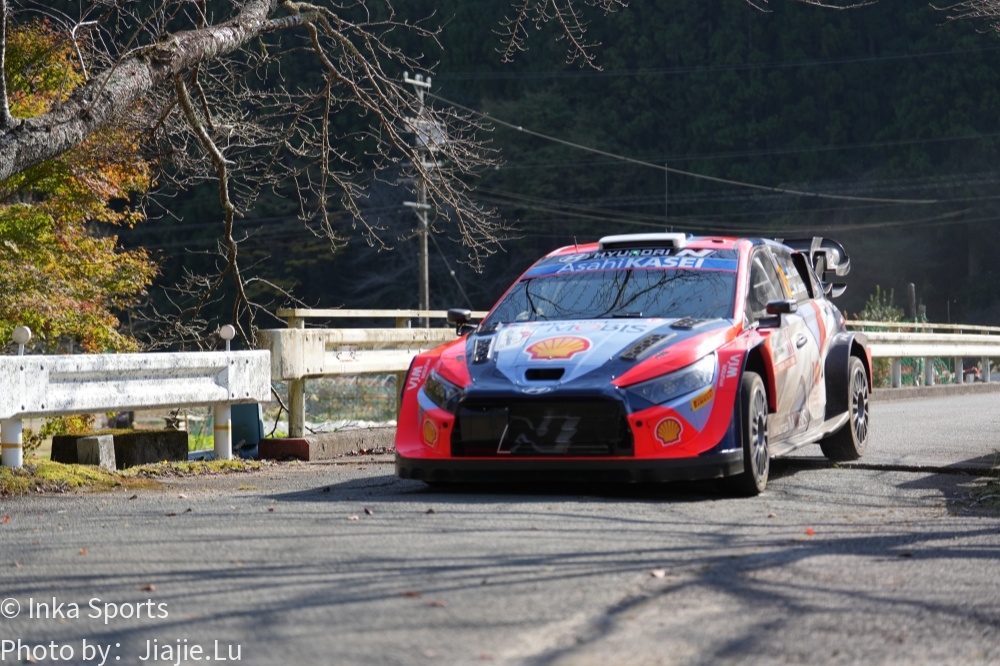
WRC is the World Rally Championship. Each rally is divided into closed timed stages. Crews normally start one by one at intervals and try to complete the same route in less time. The final overall classification adds stage times and applicable penalties; the crew with the lowest cumulative time leads.
The order of cars on camera therefore need not match the overall order. Even if one car catches another on a stage, the picture alone cannot establish that it now leads the rally.
A speed test on a closed road whose time counts towards the result. SS1 and SS2 normally identify stage numbers.
These connect stages, service parks and other locations. Crews follow the itinerary and traffic requirements rather than treating them as flat-out racing sections. Breaches or lateness can incur penalties.
Source: FIA 2026 WRC regulations (road sections, special stages, results and time controls)
How do reconnaissance, shakedown and the rally differ?
Reconnaissance (recce) is for learning the route and checking pace notes within prescribed times and conditions. It is not an early competition for results. Shakedown checks the car and its set-up. Being fastest there does not mean already leading the rally.
Rallies often run from Thursday to Sunday, but dates, stage counts and running orders are not identical at every event. A route may also be used more than once, with different road and tyre conditions on the second pass.
What are Rally1 and WRC2?
Cars from different classes can compete in the same rally. Rally1 is WRC's top category of car. WRC2 mainly uses Rally2 cars and has its own entry and scoring rules. Before reading a table, check whether it shows the overall classification or a particular class.
Source: official WRC glossary (Recce, Shakedown, Rally2); FIA's introduction to the 2026 WRC and its categories
The person talking beside the driver is the co-driver
A crew consists of a driver and a co-driver. The driver controls the car. Using the pace notes they prepared together, the co-driver calls corners, distances and road hazards in advance, and helps with the itinerary, time card and other duties. This is not someone finding an improvised route with a phone's navigation app.
Suppose you hear 'right, into left, don't cut'. Start by understanding that successive direction changes are coming and that an inside line somewhere should not be taken as a shortcut. This is an invented beginner's example, not driving instructions for any real stage.
Real pace notes use numbers, abbreviations and expressions agreed by the crew. Numbering systems can differ, so one number does not represent a universal speed or gear. When first watching onboard footage, listen for how calls match the corners ahead to understand the partnership.
Source: official WRC glossary (Co-driver, Pace notes, Time card)
First ask: which result table is this?
Stage results compare who was fastest on that stage; overall standings compare cumulative times so far. Split times reveal changes within a stage, but its final time is not known until the crew reaches the finish.
A, B, C and all figures are fictional. Assume two stages have been completed without penalties.
| Position | Crew | SS2 time | Gap to first |
|---|---|---|---|
| 1 | B | 7:58.0 | — |
| 2 | A | 8:00.0 | +2.0 |
| 3 | C | 8:01.0 | +3.0 |
B won SS2. But B took 10:05.0 on SS1, 5 seconds slower than A's 10:00.0. Recovering 2 seconds here still leaves B 3 seconds behind A overall.
| Crew | SS1 | SS2 | Total |
|---|---|---|---|
| A | 10:00.0 | 8:00.0 | 18:00.0 |
| B | 10:05.0 | 7:58.0 | 18:03.0 |
| C | 10:08.0 | 8:01.0 | 18:09.0 |
When you see '+3.0', check its reference: is it the gap to the leader or the crew immediately ahead? Real events can include penalties, cancelled stages or assigned times. You cannot simply add a few live timing figures you happen to see.
Source: FIA 2026 WRC regulations (official classification, timing and penalties); the table is an example devised by INKA Sports.
Why do gravel, asphalt and snow look like different competitions?
Grip differs on asphalt, gravel, snow and ice, so crews choose suitable tyres and set-ups. Rain, temperature changes and ruts left by earlier cars alter the conditions that follow. One jump or slide is not enough to judge which car has the best overall result.
Starting order can also influence times. On loose gravel, for example, earlier cars may sweep away the surface layer and leave different conditions for those behind. Rain, ruts and other factors can change that effect. Consider road conditions and starting order together instead of assuming that an early start is always an advantage.
Why do drivers change their own tyres after a problem?
Team mechanics work mainly at designated service locations and within permitted time windows; they cannot follow the car and repair it whenever needed. On a stage or road section, the driver and co-driver may use onboard tools and spare parts themselves. Lost time affects the result, and outside assistance is restricted by the rules.
How can a car that retired yesterday return today?
A crew unable to continue on one day may restart after an overnight regroup if the rules allow it, the car is repaired and the required checks are passed. Missed stages bring times and penalties under the rules; returning does not erase the losses. Crews retiring from a section on the final day are not included in the final classification.
Source: FIA 2026 WRC regulations, 54, 55 and 56; official WRC glossary (Service, Service Park, Set-up); WRC's Rally Portugal surface guide
Why keep fighting for seconds on the final day?
For 2026, normal full driver points come from three components: the final overall classification, Sunday's separate cumulative classification and the Power Stage result. They measure different parts of the rally, so the rally winner does not necessarily top the other two tables.
| Scoring component | Scoring positions | Points |
|---|---|---|
| Overall rally result | Top ten | 25, 17, 15, 12, 10, 8, 6, 4, 2, 1 |
| Sunday cumulative result | Top five | 5, 4, 3, 2, 1 |
| Power Stage | Top five | 5, 4, 3, 2, 1 |
Sunday points cover the designated Sunday competitive section and its penalties, not just the final stage. The Power Stage is a designated stage awarding extra points. Finishing first in all three components gives a driver a maximum of 25+5+5=35 points; this system does not award separate Saturday points.
Assume the driver meets all scoring eligibility requirements and normal full points are awarded. This is not the actual championship table.
A shortened rally may use a different points allocation, and other classes have their own scoring requirements. This explains 2026 driver points in the top-level world championship; do not apply the table directly to WRC2 or to a manufacturer's whole-team score.
Ten questions from first-time viewers
1. Why compare positions when cars start separately?
They compare times over the same timed route and do not need to start together. Official timing and applicable penalties determine the order.
2. Does winning SS5 mean leading the rally?
Not necessarily. That crew was fastest on this stage, but gaps accumulated earlier may remain. Check the overall standings after SS5 as well.
3. Does the fastest shakedown time earn points?
Shakedown is not a points-scoring competitive rally stage. Being fastest does not mean earning rally points or leading the overall result.
4. Are SSS and Power Stage the same thing?
No. SSS describes a super special stage format; Power Stage identifies a designated stage awarding extra points. The word 'Stage' in both names does not make them the same concept.
5. Is the co-driver finding the route on the spot?
No. The crew prepares and adjusts its pace notes during the prescribed recce before the rally. During competition, the co-driver reads the route ahead at the right rhythm.
6. Does a number heard onboard mean a fixed speed?
There is no universal rule of that kind. A number may be a crew's agreed corner description. Systems differ between crews, and the number is not necessarily a gear either.
7. Why can some cars run today after retiring yesterday?
Where the rules permit, a crew can return after meeting repair, inspection and restart requirements. Missed stages still bring the corresponding times and penalties.
8. Why does the rally winner not always score all 35 points?
The overall winner normally receives 25 points. The other ten come from the Sunday and Power Stage classifications, which need not both be won by the same driver.
9. Am I watching the wrong event if Rally2 appears in the overall standings?
No. Different classes can enter the same rally, with both an overall classification and separate class results. First identify which table you are reading.
10. Where should I stand on my first visit?
Use the spectator areas announced by the event and follow marshals' instructions. Do not enter closed stages or cross the route on your own just because no car is in sight.
Terminology and rules sources: official WRC glossary and the FIA 2026 regulations cited above. The suggested viewing order is INKA Sports' advice.
Pick a stage, then check the overall standings
Watch onboard footage and listen to the co-driver. After the stage, check its time and then see whether the overall order has changed. On the final day, follow the Sunday standings and Power Stage separately too.
View the WRC schedule and results →