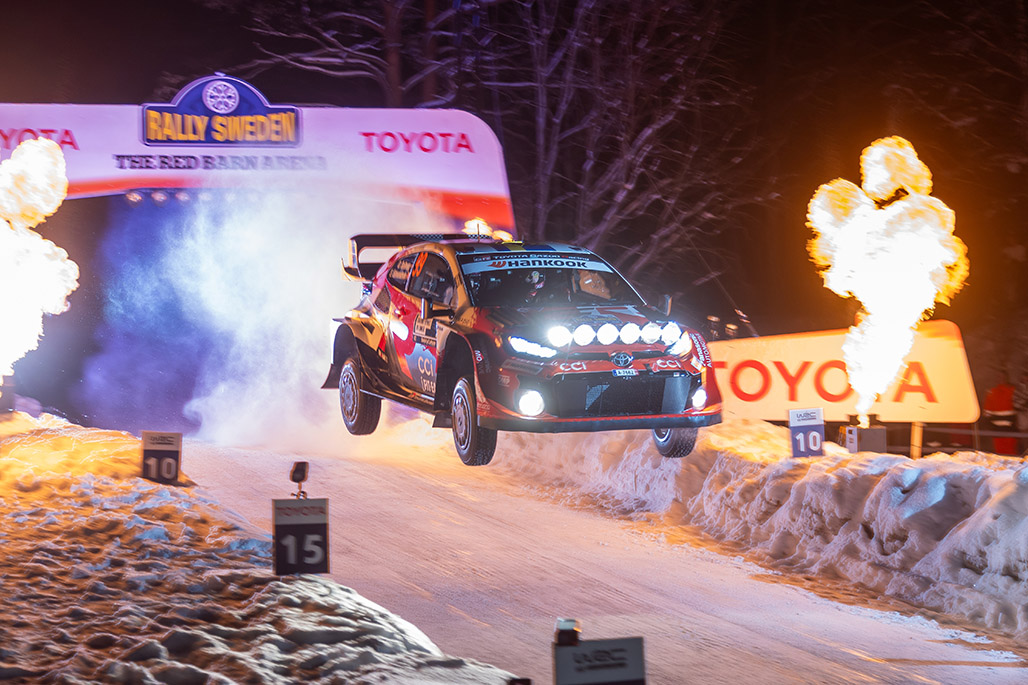
Home driver Oliver Solberg and co-driver Elliott Edmondson led the overall standings after Rally Sweden’s opening competitive special stage on Thursday night. Toyota’s classification for the day showed that the pair completed the 10.23-kilometre Umeå stage in 5 minutes 53.1 seconds, 3.8 seconds ahead of Elfyn Evans, with Takamoto Katsuta and Sami Pajari following in third and fourth. This was the competitive start of the season’s only rally run entirely on snow and ice, not a pre-event test classification. With just one stage run on the day, gaps of a few seconds could not tell the whole story of the contest over the next three days.
Earlier in the day, the crews completed the 3.44-kilometre shakedown alongside the Umeå river. Pajari was fastest on the first pass, Katsuta set the fastest time of the second pass, and Evans led on the third. The shakedown standings continued to change as other drivers made further runs. Shakedown is used to check car set-up, tyres and driving feel, and does not count towards the official overall classification. Keeping the daytime test separate from the night-time SS1 explains why Solberg, rather than one of the drivers who topped shakedown, became the rally’s first leader.
According to Toyota’s post-stage report, the night stage comprised forest roads and the outdoor Red Barn Arena, where many spectators had gathered. Solberg described the opening stage in darkness as technical and easy to make small mistakes on. Solberg, running first on the road as the championship leader, set the fastest time in front of his home crowd. Evans was 3.8 seconds behind, Katsuta was just 0.6 seconds behind Evans, and Pajari was another 1.2 seconds behind Katsuta. Toyota’s top-four lockout did not mean all four crews enjoyed equally comfortable margins.
Evans felt there had been more grip than expected and that he had been a little conservative on his opening stage. Katsuta’s impressions highlighted a different risk: he sensed signs of declining grip, while there was less snow than in previous years, smaller snowbanks and roads that looked wider. The underlying ice was still there, but with less substantial snowbanks to support the cars, drivers could not necessarily count on the same bounce back if they touched the edges in fast corners. Information like this from a short stage would influence driving and tyre choices on Friday’s longer sections.
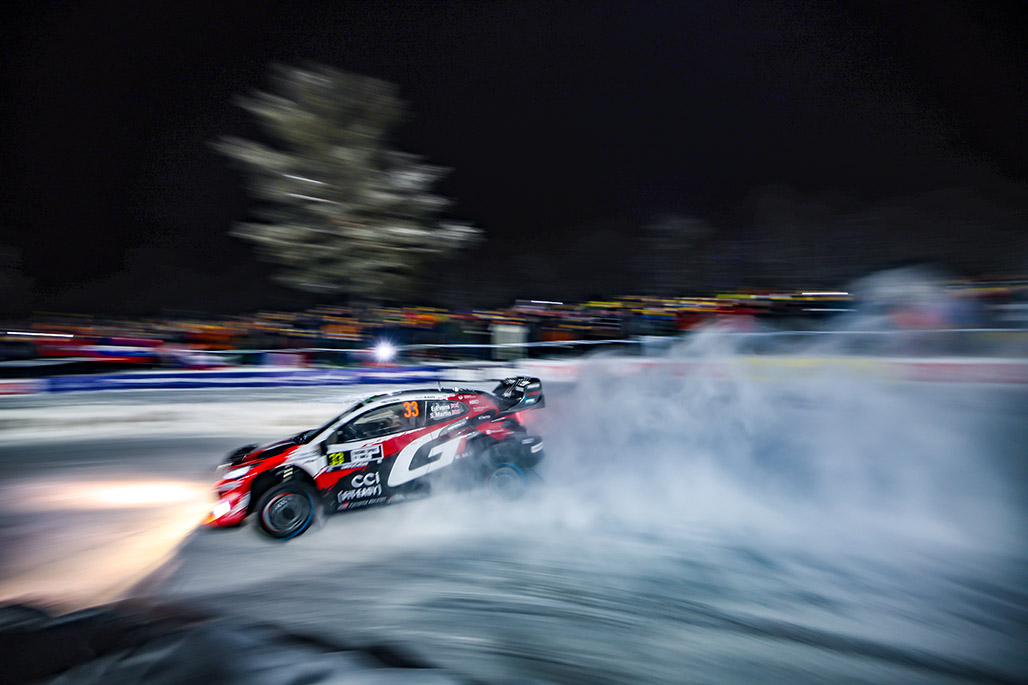
Hyundai driver Thierry Neuville was fifth, 6.7 seconds behind Solberg, with Adrien Fourmaux and Esapekka Lappi sixth and seventh. M-Sport Ford’s Josh McErlean and Mārtiņš Sesks were inside the top nine, while Toyota customer programme driver Lorenzo Bertelli was tenth. The gaps among the top ten crews already ranged from several seconds to more than 20 seconds after a single stage. But with Rally Sweden comprising 18 stages and more than 300 competitive kilometres, the night-stage order offered clues to the opening exchanges rather than a definitive verdict on the manufacturers’ strength.
Solberg will be first into the forests on Friday. The first car may clear loose snow from the road on the opening pass, while ruts subsequently formed by different types and classes of car will alter the grip again on the second pass. Leading the championship could therefore bring a road-sweeping disadvantage. Toyota team principal Latvala specifically noted that the usable line could become narrower on the repeat runs in the afternoon, determining whether drivers could maintain their earlier pace. Sweden’s roads may appear to be snow and ice throughout, but the surface changes after each group of cars passes through. A first-day lead of 3.8 seconds was not enough to provide a strategic cushion.
Friday is the rally’s longest day, with 124.88 competitive kilometres: Bygdsiljum, Andersvattnet and Bäck will each be run twice, with a midday service in Umeå, before the day ends with the shorter Umeå Sprint. Crews will need to manage tyre-stud wear over the longer forest stages while avoiding getting bogged down in loose snow as they push for speed. The first 10 entries below are based on Toyota’s SS1 results as of 20:30 local time on Thursday. The 11th row, for Jon Armstrong and Shane Byrne, is supplemented from Rally-base’s SS1 RC1 results, explicitly labelled “Unofficial results”; their position is 11th in RC1, not 11th overall. Shakedown times are not included.
Results for all Rally1 crews after SS1 on Thursday
| Rally1 position | Car number | Rally1 crew | Team | Total time | Gap to class leader | Classification point |
|---|---|---|---|---|---|---|
| 1 | 99 | Oliver Solberg / Elliott Edmondson | Toyota | 00:05:53.1 | — | After SS1 |
| 2 | 33 | Elfyn Evans / Scott Martin | Toyota | 00:05:56.9 | +3.8 seconds | After SS1 |
| 3 | 18 | Takamoto Katsuta / Aaron Johnston | Toyota | 00:05:57.5 | +4.4 seconds | After SS1 |
| 4 | 5 | Sami Pajari / Marko Salminen | Toyota | 00:05:58.7 | +5.6 seconds | After SS1 |
| 5 | 11 | Thierry Neuville / Martijn Wydaeghe | Hyundai | 00:05:59.8 | +6.7 seconds | After SS1 |
| 6 | 16 | Adrien Fourmaux / Alexandre Coria | Hyundai | 00:06:01.0 | +7.9 seconds | After SS1 |
| 7 | 4 | Esapekka Lappi / Enni Mälkönen | Hyundai | 00:06:02.2 | +9.1 seconds | After SS1 |
| 8 | 55 | Josh McErlean / Eoin Treacy | M-Sport Ford | 00:06:08.8 | +15.7 seconds | After SS1 |
| 9 | 22 | Mārtiņš Sesks / Renārs Francis | M-Sport Ford | 00:06:11.3 | +18.2 seconds | After SS1 |
| 10 | 37 | Lorenzo Bertelli / Simone Scattolin | Toyota | 00:06:19.2 | +26.1 seconds | After SS1 |
| 11 | 95 | Jon Armstrong / Shane Byrne | M-Sport Ford | 00:06:38.2 | +45.1 seconds | After SS1 |