After Mexico City qualifying, a technical ruling invalidated Liam Lawson’s original eighth place, while Lando Norris explained McLaren’s fall from the top of Q2 to sixth in Q3. The FIA’s penalty and separate permission to race define Lawson’s new position. Official times and Norris’s corner-by-corner feedback offer a closer reading of McLaren’s performance.
Lawson permitted to race from the provisional back row
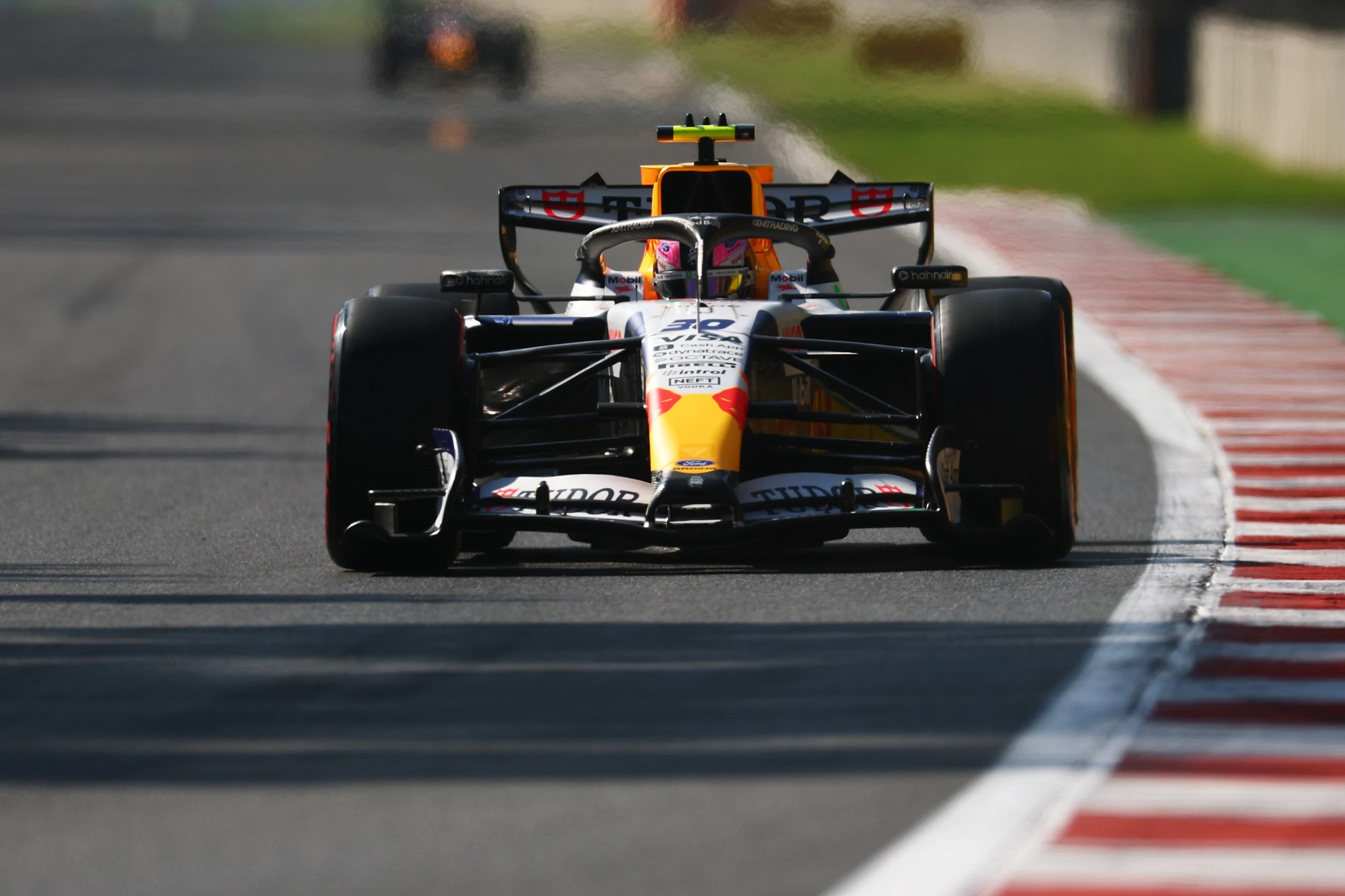
The stewards’ Document 57 found Racing Bulls’ car 30 in breach of Articles C5.12.6 and C5.12.7 of the F1 Regulations. The issue concerns the MGU-K, the kinetic motor-generator that can recover energy and use electrical energy to help drive the car. The infringement occurred during the reduction in electrical deployment after Lawson crossed the control line at the end of his fastest Q2 lap.
The decision first records that Lawson did not lift off the power immediately after the line, so the required deployment step down was not achieved. Technical Delegate’s Report 53 further finds that the subsequent rates of reduction in both the driver’s maximum power demand and the actual DC electrical power of the kinetic energy recovery system, ERS-K, exceeded the permitted rates. The issue involves both when power starts to fall and how quickly it falls, rather than only its final level.
Racing Bulls disclosed the breach and argued that it provided no performance advantage. The stewards acknowledged that disclosure but stressed that a car must comply with the Technical Regulations throughout an event. An absence of performance advantage does not excuse non-compliance.
Lawson had originally qualified eighth and already faced a one-place grid penalty from an FP2 incident. The new decision applies to his entire qualifying result: Final Qualifying Classification 59 lists him separately as disqualified, rather than retaining eighth and simply adding another grid drop.
Disqualification from qualifying does not itself prohibit a race start. Document 58 separately permits Lawson to compete, and Provisional Starting Grid 60 places him last among the 22 drivers. Any subsequent official grid documents remain relevant before the race.

Norris explains an exceptional Q2 lap
In an interview published by Formula1.com on November 1, Norris said he did not believe an assured opportunity had slipped away in Q3. He considered his Q2-leading lap an exceptional effort in the car available to him and was therefore not entirely unhappy with sixth.
His assessment was that McLaren remained too slow and that an ideal lap was difficult to repeat. Occasionally the conditions could align to produce an encouraging peak, but he felt that peak had not carried consistently into Q3.
Norris used Turn 12 to illustrate the variation. In his account, a headwind in Q2 helped the car grip and delivered roughly 0.15 seconds; attempting a similar entry speed on the next lap instead brought a loss of rear grip and around 0.1 seconds.
He also identified Turns 1, 2 and 3 as a particular weakness, estimating a deficit of about 0.2 seconds through that opening sequence on each lap. He described Turn 7 as the corner where he felt competitive. That account explains more specifically why he did not regard the Q2 headline as a dependable indication of pole-contending pace.
INKA SPORTS Analysis: Why leading Q2 did not establish pole-winning pace
Final Classification 59 puts the change in perspective. Norris recorded 1:16.728 in Q2 and 1:16.824 in Q3, a deterioration of 0.096 seconds. Hamilton’s Q3 pole time was 1:16.514, 0.310 seconds quicker than Norris in Q3. Even as a numerical comparison alone, Norris’s Q2 lap remained 0.214 seconds slower than that pole time. Leading Q2 describes a relative position in that segment; it does not establish the speed eventually required for pole.
Attributing sixth entirely to Norris failing to reproduce one good lap would therefore miss the different benchmark in the final segment. His account of changing headwinds and losses in the opening three corners also explains why he describes both difficulty repeating an ideal lap and an overall shortage of speed. Wind, track and tyre conditions are not identical across the segments, however. These times cannot reconstruct a hypothetical grid position or attribute the entire 0.310-second gap to one corner or a gust of wind.
Summary
McLaren’s task in Mexico is both to reproduce its occasional strong laps and to reach the competitive standard of the final segment. First place in Q2 alone does not show that pole-contending pace is already available. The evidence supports that qualifying assessment, but does not establish long-run race pace. Lawson’s separate technical ruling meanwhile means his original eighth place is no longer the basis for calculating his starting position.