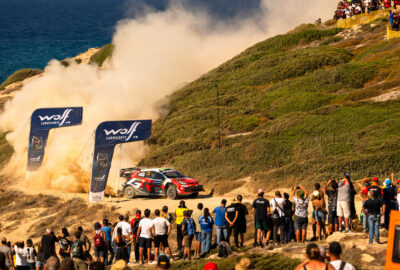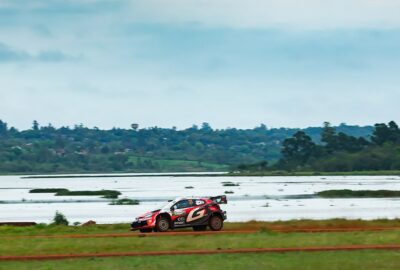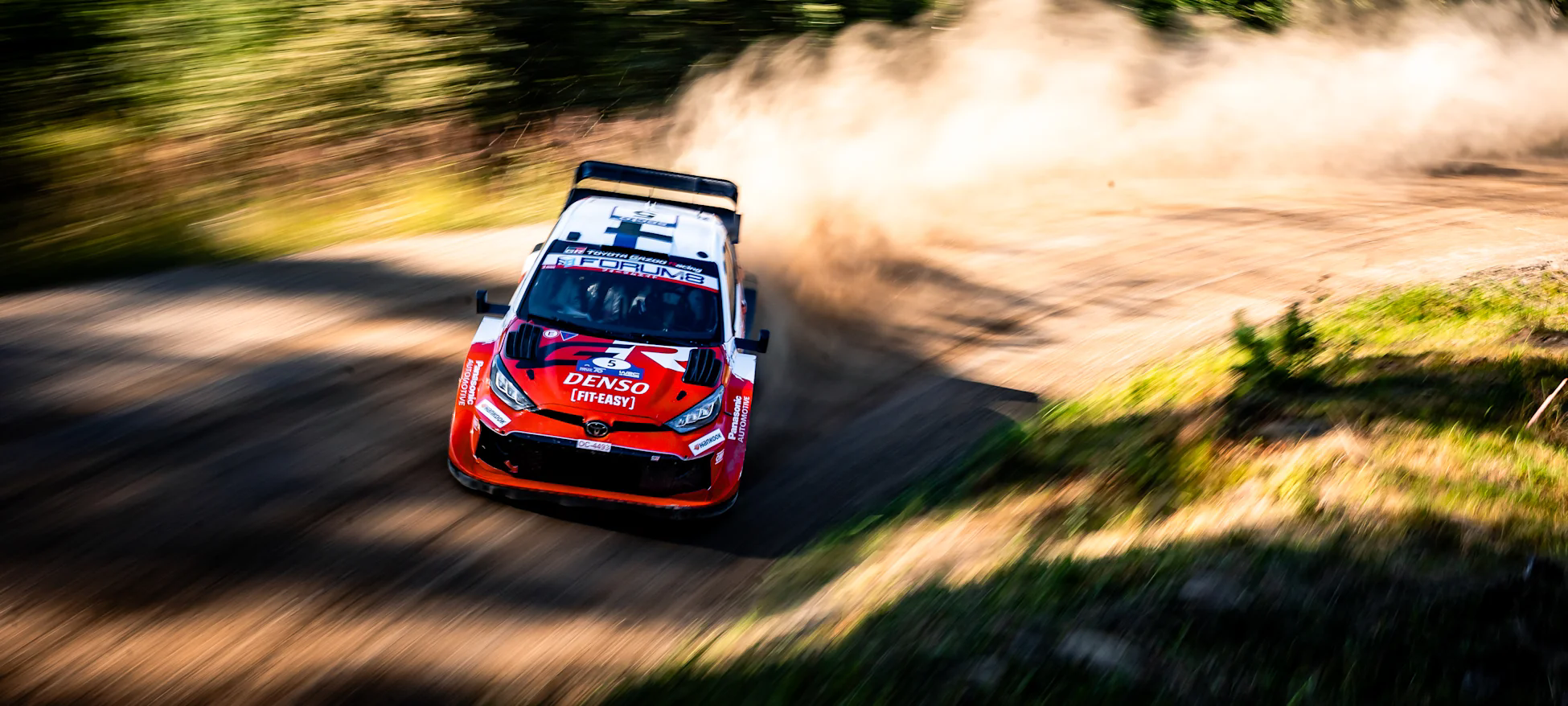
The lead changed hands at Rally Finland on Saturday. Ogier and Ingrassia went off the road and rolled at a sequence of high-speed corners on SS17. Both got out of the car unaided before undergoing medical checks and being kept in hospital for observation; they retired from the rally. They had led since Friday’s first forest stage and still held a 20.9-second advantage over Pajari before the accident. Pajari and Salminen took over the lead and ended Saturday with a total time of 2h 00m 38.0s, 46.4 seconds ahead of Solberg. The change in the standings resulted from the leading crew’s retirement and should not be described as Pajari making up 20 seconds on pace alone on SS17.
Evans was first to attack on Saturday morning, winning the opening Parkkola stage and cutting his deficit to Ogier from 16.3 seconds to 11.6 seconds. Near the finish of Leustu, the fourth stage of the morning, he went off the road and rolled several times. With help from spectators, he returned to the road, but finished the stage 1m 49s slower than Ogier. The team repaired the car at midday, and Evans continued in the afternoon without receiving any additional time penalty as a result. His accident turned what could have been an intra-team fight for victory into a recovery drive towards the podium, illustrating the impact a single mistake on these high-speed roads can have on the overall standings.
After Evans rolled, Ogier held a 22.7-second lead over Pajari. Each won a stage in the afternoon, with Ogier maintaining an advantage of around 20 seconds until the SS17 accident brought their intra-team contest to an end. Toyota subsequently confirmed that Ogier and Ingrassia had been able to get out of the car unaided and that the results of their medical checks were positive, but they would remain in hospital overnight for observation because of the force of the impact. Reporting on the accident should make clear the timing of the sporting developments and medical updates. A hospital stay for observation should not be taken to imply any specific injury, nor should the post-accident leaderboard be misread as showing that Ogier finished the rally.
Having just claimed his maiden victory in Estonia, Pajari returned to his home event in Finland initially aiming to chase down Ogier. After inheriting the lead, he safely completed the final stage and headed into Sunday with a 46.4-second advantage. Solberg was second, while Evans recovered to third in his repaired car, 1m 36.3s behind Pajari. Hyundai’s Fourmaux was just 3.8 seconds behind Evans, leaving the final podium place very much in contention. Katsuta was fifth and, after losing two minutes because of restricted visibility on Friday, was focusing on setup adjustments and targeting points on Sunday.
Neuville suffered damage to his left-front tyre on Västilä and ended Saturday provisionally sixth, just 1.5 seconds ahead of McErlean. Sesks rolled his Ford on the morning run through Leustu and retired for the day. Both crew members were unhurt and were expected to restart on Sunday under the regulations. Armstrong had already restarted on Saturday after becoming stuck in a ditch on Friday. His large cumulative time in the FIA classification reflects the prescribed time penalties for uncompleted stages and should not be treated as the time taken to complete the full route normally. Lappi did not restart after rolling on Friday, while Ogier was a new retirement on Saturday.
Saturday’s two passes over four forest roads pushed both speed and consistency to the limit. Evans closed in during the morning but rolled; Ogier was still leading in the afternoon but retired at a sequence of high-speed corners, leaving Pajari with a substantial advantage after a mistake-free run. These were not identical errors, nor can they be explained simply by saying that “Finnish roads are fast”: on the second pass through the same stage, the lines, landing points, visibility and condition of the cars all change. In a classification restricted to the top category, Rally2 drivers do not displace the Rally1 crews provisionally placed eighth and below, even if they reach the top 10 in the combined overall standings.
Only two runs through the 30.02 km Himos–Jämsä stage remain on Sunday. The second is the Power Stage, while performance across the day carries a separate allocation of bonus points. Pajari needs to manage a lead of nearly 47 seconds, while Solberg, Evans and Fourmaux can still weigh up both their overall rally positions and Sunday’s points. Evans and Fourmaux are separated by 3.8 seconds, and there is enough stage distance for that order to change. The loss Ogier faces in the drivers’ standings following his retirement will also influence their approach to risk. No winner had been decided at the end of Saturday, and the outcome should certainly not be treated as settled before the two runs through the rally’s longest stage.
Cumulative Rally1 standings after Saturday’s stages
| Rally1 position | Car number | Driver / Co-driver | Team | Total time | Gap | Status |
|---|---|---|---|---|---|---|
| 1 | 5 | Sami Pajari / Marko Salminen | Toyota | 2:00:38.0 | — | Provisional |
| 2 | 99 | Oliver Solberg / Elliott Edmondson | Toyota | 2:01:24.4 | +46.4s | Provisional |
| 3 | 33 | Elfyn Evans / Scott Martin | Toyota | 2:02:14.3 | +1m 36.3s | Provisional |
| 4 | 16 | Adrien Fourmaux / Alexandre Coria | Hyundai | 2:02:18.1 | +1m 40.1s | Provisional |
| 5 | 18 | Takamoto Katsuta / Aaron Johnston | Toyota | 2:03:32.5 | +2m 54.5s | Provisional |
| 6 | 11 | Thierry Neuville / Martijn Wydaeghe | Hyundai | 2:04:30.9 | +3m 52.9s | Provisional; includes a time penalty of 20.0 |
| 7 | 55 | Josh McErlean / Eoin Treacy | M-Sport Ford | 2:04:32.4 | +3m 54.4s | Provisional |
| 8 | 22 | Mārtiņš Sesks / Renārs Francis | M-Sport Ford | 2:51:44.2 | +51m 6.2s | Retired after rolling on Leustu on Saturday; provisionally classified under the restart regulations |
| 9 | 95 | Jon Armstrong / Shane Byrne | M-Sport Ford | 3:21:35.6 | +80m 57.6s | Restarted on Saturday |
| Retired | 1 | Sébastien Ogier / Julien Ingrassia | Toyota | — | — | Retired after rolling on SS17 on Saturday; not listed in the final classification |
| Retired | 4 | Esapekka Lappi / Enni Mälkönen | Hyundai | — | — | Retired after rolling on Friday; not listed in the day’s classification |