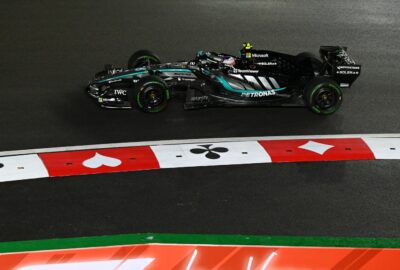
Lewis Hamilton followed up his first-practice lead with a 1:29.018 under the lights in Jeddah. The second session of the inaugural Saudi Arabian Grand Prix began at 20:00 local time on Friday, 3 December, and ended with Mercedes first and second.
Valtteri Bottas was 0.061 seconds behind his team-mate. AlphaTauri-Honda’s Pierre Gasly was another 0.020s back in third.
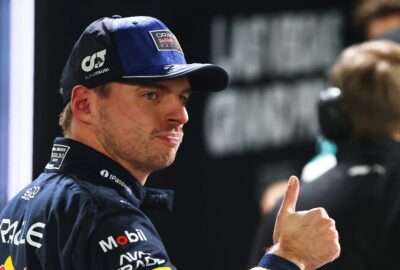
Max Verstappen, Hamilton’s title rival, placed fourth for Red Bull-Honda, 0.195s off the lead.
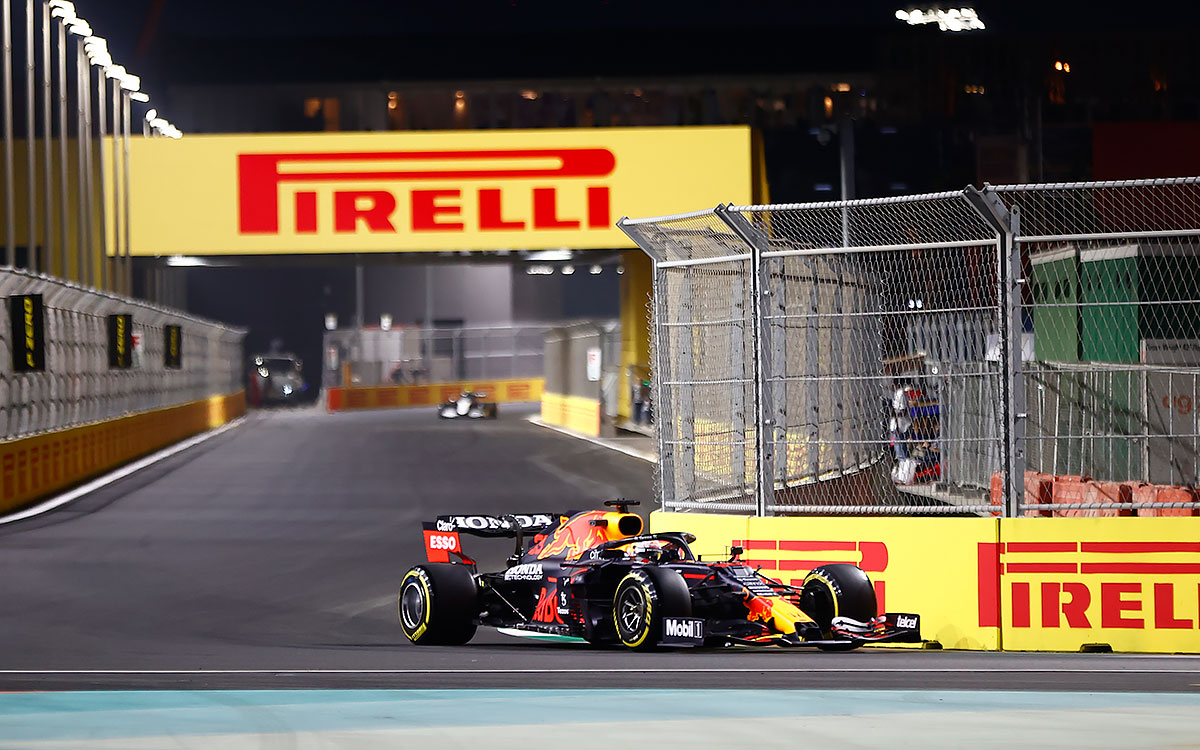
The evening running gave the teams conditions closer to those expected for qualifying and the race. It was dry, with the air at 28°C and the track at 31°C. The air temperature was much the same as in FP1, but the asphalt had cooled since sunset and floodlights now lit the circuit.
Hamilton had led FP1 on soft tyres. In FP2 both Mercedes drivers set their best laps on mediums, while Gasly and Verstappen set theirs on softs. Each team still had work to do before Saturday’s qualifying session.
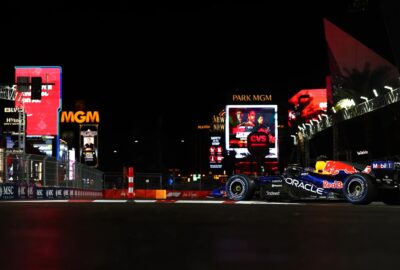
Verstappen again rode the kerbs hard enough for his mechanics to be concerned about possible diffuser and floor damage. He struggled to get the front soft tyres into their working range and his RB16B repeatedly ran wide.
Midway through the session Hamilton had to take avoiding action when he came across a slow Haas exiting Turn 10. Nikita Mazepin also spun at Turn 2 later on. Running continued until a red flag with less than five minutes left brought the session to an early end.
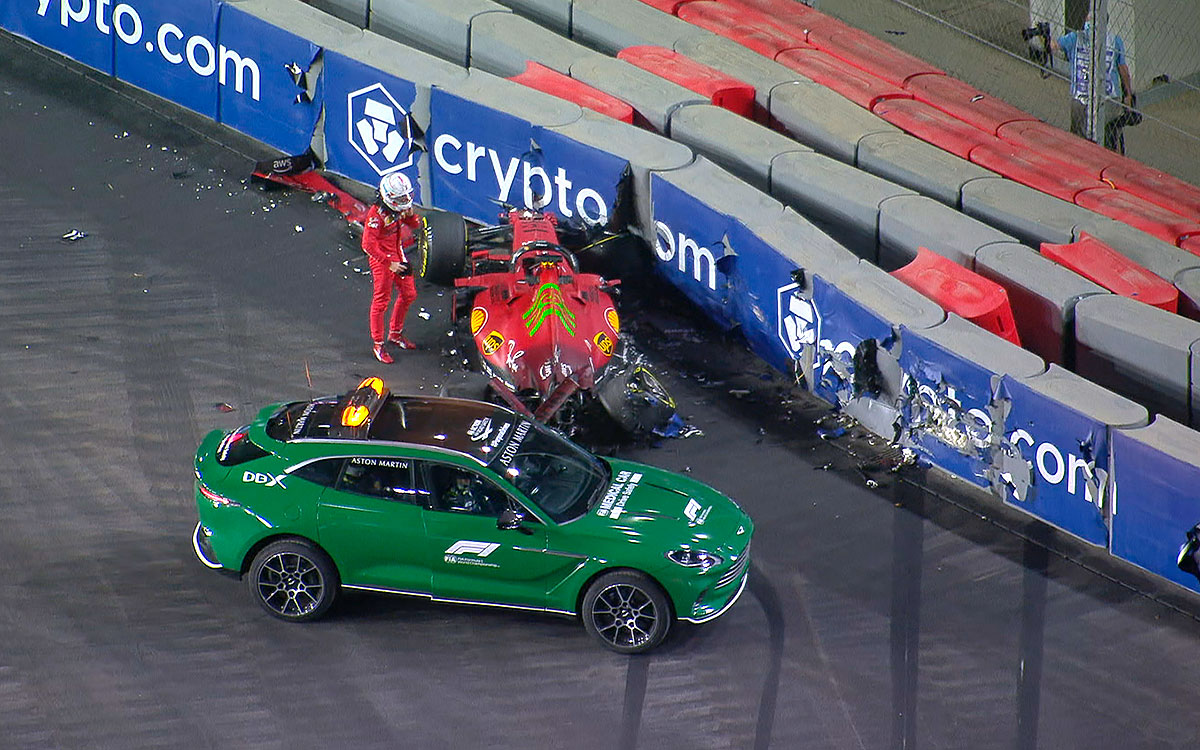
Charles Leclerc had lost the rear of his Ferrari in the high-speed Turn 22–23 sequence and slid hard into the outer TecPro barrier. The SF21 suffered extensive damage, particularly to the right front and rear. Leclerc climbed out unaided and got into the Aston Martin DBX medical car, sporting the event’s Saudi colours.
Debris was scattered across the track. Ferrari faced a substantial repair job that evening, raising the prospect of work extending into the overnight curfew.
AlphaTauri’s Yuki Tsunoda was the only driver in the top ten to set his best time on hard tyres. He was eighth, just 0.008s behind Ferrari’s Carlos Sainz.
Sergio Perez improved from 11th in FP1 to ninth. His deficit to Verstappen narrowed from 1.118s to 0.555s, putting all four Honda-powered cars in the top nine.
Both Alpine drivers moved up the order. After setting their FP1 times on hards, Fernando Alonso and Esteban Ocon set their best laps on softs to take fifth and sixth.
Several drivers had to abandon flying laps in the narrower sections of the track. On preparation laps they sometimes had to slow almost to a stop to let faster cars through, making it difficult to keep heat in the tyres.
With overtaking expected to be difficult in the race, qualifying looked particularly important. Finding a gap in Q1 traffic would be one of the first challenges.
Third practice was scheduled for Saturday, 4 December at 17:00 local time, or 22:00 in Beijing.
| Pos. | Driver | Team | Time / gap (s) | Laps |
|---|---|---|---|---|
| 1 | Lewis Hamilton | Mercedes | 1:29.018 | 22 |
| 2 | Valtteri Bottas | Mercedes | +0.061 | 23 |
| 3 | Pierre Gasly | AlphaTauri Honda | +0.081 | 22 |
| 4 | Max Verstappen | Red Bull Racing Honda | +0.195 | 20 |
| 5 | Fernando Alonso | Alpine Renault | +0.423 | 21 |
| 6 | Esteban Ocon | Alpine Renault | +0.537 | 22 |
| 7 | Carlos Sainz | Ferrari | +0.571 | 24 |
| 8 | Yuki Tsunoda | AlphaTauri Honda | +0.579 | 20 |
| 9 | Sergio Perez | Red Bull Racing Honda | +0.750 | 22 |
| 10 | Charles Leclerc | Ferrari | +0.754 | 23 |
| 11 | Daniel Ricciardo | McLaren Mercedes | +0.950 | 22 |
| 12 | Lando Norris | McLaren Mercedes | +0.986 | 19 |
| 13 | Antonio Giovinazzi | Alfa Romeo Racing Ferrari | +1.092 | 23 |
| 14 | Kimi Räikkönen | Alfa Romeo Racing Ferrari | +1.258 | 24 |
| 15 | Lance Stroll | Aston Martin Mercedes | +1.424 | 22 |
| 16 | Sebastian Vettel | Aston Martin Mercedes | +1.484 | 22 |
| 17 | George Russell | Williams Mercedes | +1.488 | 24 |
| 18 | Mick Schumacher | Haas Ferrari | +1.634 | 20 |
| 19 | Nicholas Latifi | Williams Mercedes | +2.021 | 23 |
| 20 | Nikita Mazepin | Haas Ferrari | +2.611 | 20 |