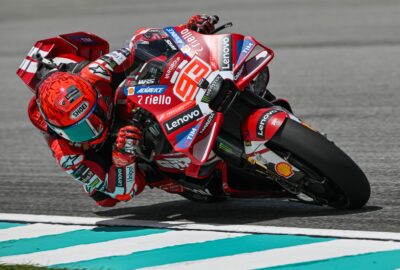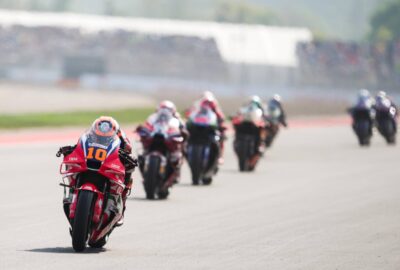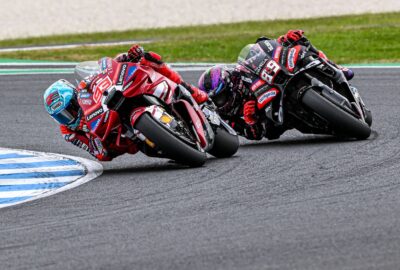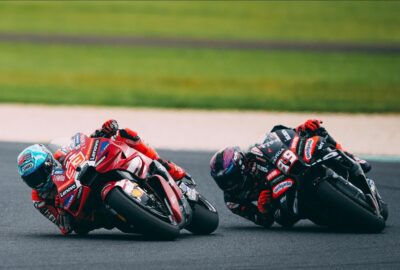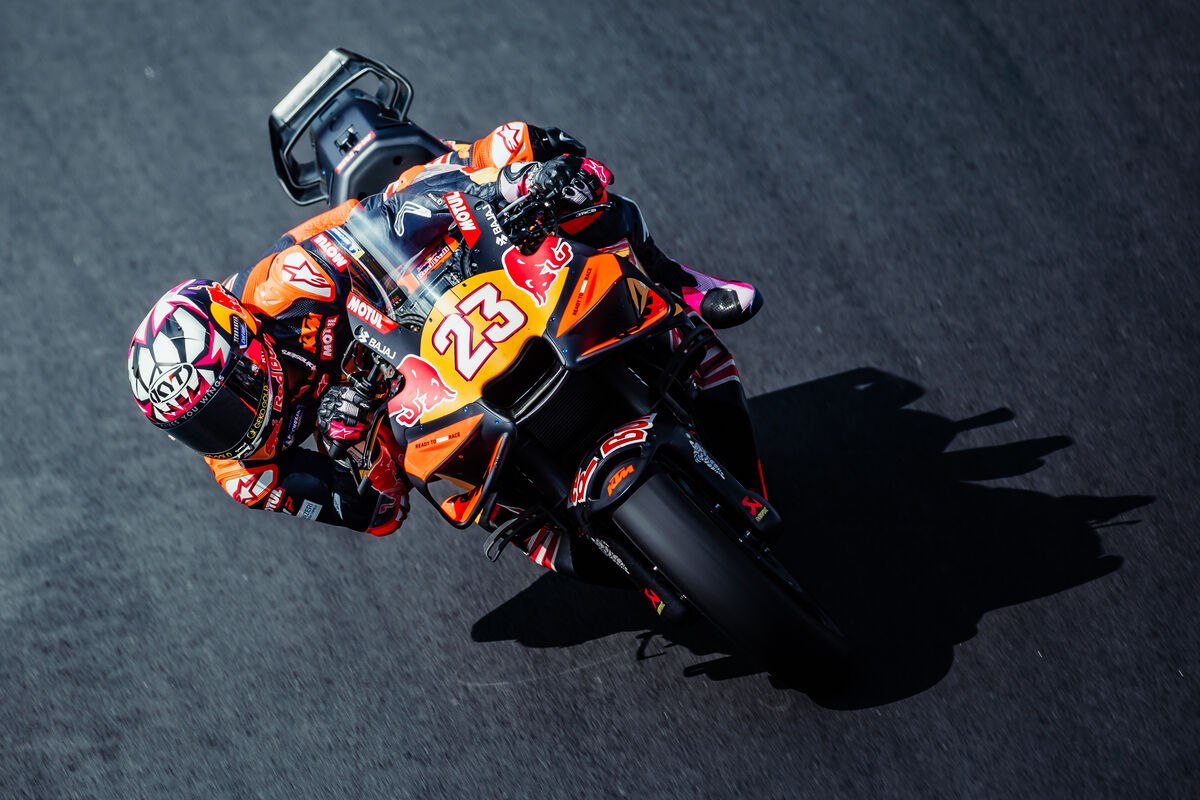
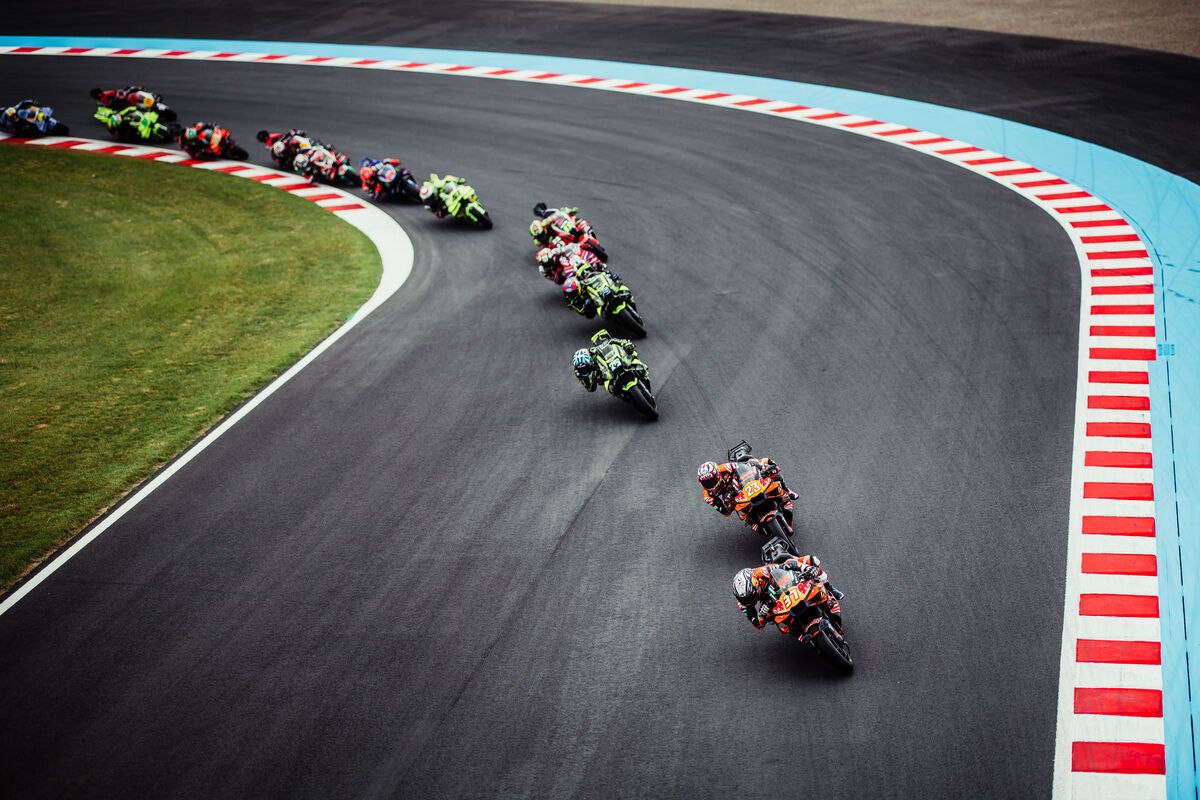
Round 16 of the MotoGP season, the Japanese Grand Prix, concluded at Motegi on October 4. Red Bull KTM Tech3’s Enea Bastianini started seventh and finished fourth, just 0.078 seconds behind third-placed Marco Bezzecchi. It was his best Grand Prix result of the season, surpassing his two sixth places in the Americas and the Netherlands. All four KTM riders scored points, but each faced different problems despite using the hard rear tyre. Full results are in the Japanese Grand Prix race report.
From about 1.9 seconds to 0.078: speed still has to become an overtake
The official results put Bastianini 2.330 seconds behind the winner and Bezzecchi 2.252 seconds adrift, a difference of 0.078 seconds. Their late battle decided the final podium place.
According to MotoGP’s official race report, Bastianini was still about 1.9 seconds behind third at the start of lap 15. He reduced that to 0.078 seconds at the flag, recovering about 1.8 seconds. Official lap timing shows him successively lowering the race’s fastest lap on laps 20 to 23, setting the ultimate fastest time of 1 minute 43.041 seconds on lap 23.
Calculations from the cumulative official lap times show that the pair remained 0.343 seconds apart entering lap 24. On the final lap Bastianini recorded 1 minute 43.473 seconds to Bezzecchi’s 1 minute 43.738 seconds, recovering 0.265 seconds and finishing 0.078 seconds short.
The same hard rear tyre, but four different challenges
MotoGP’s official report confirmed that every rider chose the hard rear tyre despite having spent little time on it during the weekend. KTM’s report noted that the abrasive resurfaced track had already challenged tyre durability in Saturday’s Sprint. Bastianini said he had not expected the hard tyre to feel so good from the first lap. Passing Pedro Acosta early on cost him some time, but from the middle of the race he was able to keep pushing harder.
Red Bull KTM Factory Racing’s Acosta started third and finished seventh. He felt the bike and tyre had not worked together as expected, making it difficult to slow smoothly on corner entry and to accelerate on exit. KTM also noted that he needed time early on to bring the harder tyres up to temperature. Acosta wanted to compare data with another KTM to identify the differences.
Brad Binder climbed from seventeenth to eleventh, taking 5 points. He said he had reduced his pace to protect the tyres, only to conclude afterwards that they could have lasted for more race distance. He also acknowledged that crashing in the first qualifying session, Q1, had made the whole weekend harder: a poor grid position compromised the start of his race, while an overly cautious judgement on tyre preservation affected his pace during it.
Maverick Viñales returned after missing the previous four Grands Prix with a left-shoulder problem, advancing from nineteenth to fourteenth for 2 points. He said his understanding of the bike improved as the weekend progressed, while Motegi’s heavy braking tired his arm. Completing the 24-lap race tested his readjustment to a full race distance.
Red Bull KTM Factory Racing team manager Aki Ajo welcomed points for all four riders but said the factory team had expected a podium based on Acosta’s pace earlier in the weekend. They needed to analyse why that had not materialised. Bastianini’s fourth place offered a reference from the same race as the factory team investigated the differences.
KTM’s four riders: race performance compared
| Rider | Team | Grid position | Finish | Net position change | Gap to winner |
|---|---|---|---|---|---|
| Enea Bastianini | Red Bull KTM Tech3 | 7 | 4 | Gained 3 places | +2.330 seconds |
| Pedro Acosta | Red Bull KTM Factory Racing | 3 | 7 | Lost 4 places | +16.928 seconds |
| Brad Binder | Red Bull KTM Factory Racing | 17 | 11 | Gained 6 places | +25.853 seconds |
| Maverick Viñales | Red Bull KTM Tech3 | 19 | 14 | Gained 5 places | +33.995 seconds |
Grid positions, finishing positions and gaps to the winner are from MotoGP’s official starting grid and race classification. Net position change is the starting position minus the finishing position; it is not a count of on-track overtakes.
INKA SPORTS analysis: what kept the podium out of reach, and what the factory team must examine
Bastianini’s repeated improvements in lap time show that his late pace could sustain a pursuit of the podium. Yet he still needed to recover 0.343 seconds entering the final lap and gained only 0.265 seconds, leaving no further race distance in which to make the pass. Reviewing this chase should focus on how to reach third place’s rear wheel earlier. His account of time lost passing Acosta early on belongs alongside those late lap times: strong closing pace needs fewer early losses to leave a real opportunity to fight for the position.
Acosta struggled to slow on corner entry and accelerate on exit, whereas Binder liked the feel of the hard rear tyre but believed he had ridden too conservatively to preserve it. Their adjustments therefore need to go in different directions. Acosta needs to investigate how the bike and tyre work together under braking and acceleration; Binder needs to reassess how hard the tyre can be pushed. Reducing seventh and eleventh places to a single shared problem would overlook the distinction between their feedback.
The abrasion from the new surface had already challenged tyre durability on Saturday, providing a reason for Binder’s caution. On Sunday, however, Bastianini kept accelerating from mid-race onwards, and Binder also felt the tyres could have covered more distance. This comparison suggests the team should reassess the degree of tyre preservation against actual race feedback. Bastianini’s positive feel from the opening lap also gives the factory team a reference against Acosta’s early warm-up phase, helping identify when their experiences diverged.
Viñales’s fourteenth place answered a different question: whether he could withstand a full 24-lap race after missing four rounds. Arm fatigue under heavy braking was a difficulty he explicitly identified on his return. Completing the race and improving his feel for the bike session by session provide the basis for increasing his speed. Assessing the comeback also requires considering physical strain alongside bike performance.
Conclusion
KTM’s gains at Motegi were Bastianini turning his late pace into a sustained podium pursuit and all four riders scoring points. The factory team’s next priorities are specific: help Acosta improve the connection between slowing on entry and accelerating on exit, and help Binder judge tyre preservation more accurately. Controlling early losses while retaining late speed would give KTM a chance to turn this near-podium into a better finishing position.
KTM riders’ championship points after Japan
According to KTM’s post-race report, Acosta stood fourth on 243 points, Bastianini eleventh on 116, Binder thirteenth on 99 and Viñales twenty-second on 12.