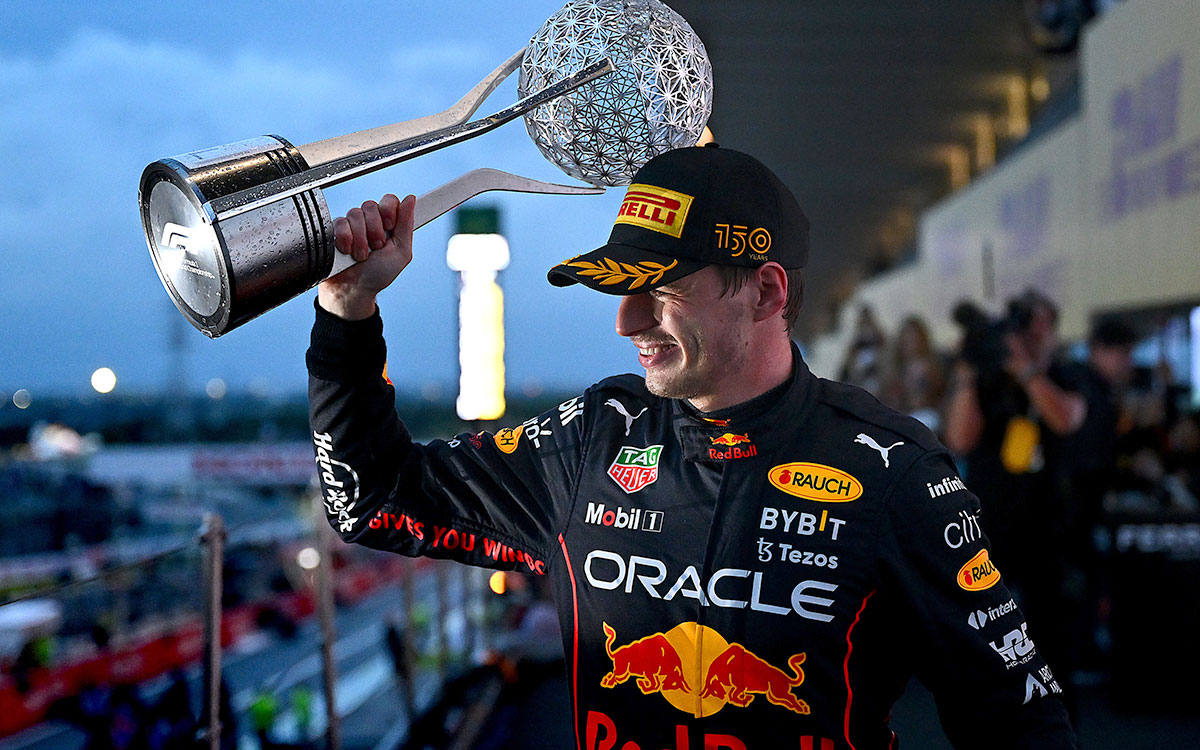
In the afternoon of October 9 Beijing time, round 18 of the 2022 Formula 1 season, the Japanese Grand Prix, took place at Suzuka. Red Bull’s Max Verstappen crossed the line 26.763 seconds ahead of Charles Leclerc, the second driver to finish, and converted pole position into victory to seal his second consecutive Drivers’ Championship.
The first Formula 1 Japanese Grand Prix at Suzuka in three years was hit by rain. Shortly after the start, the race was suspended under a red flag for more than two hours. The scheduled 53 laps could not be completed, and the chequered flag was shown on lap 28.
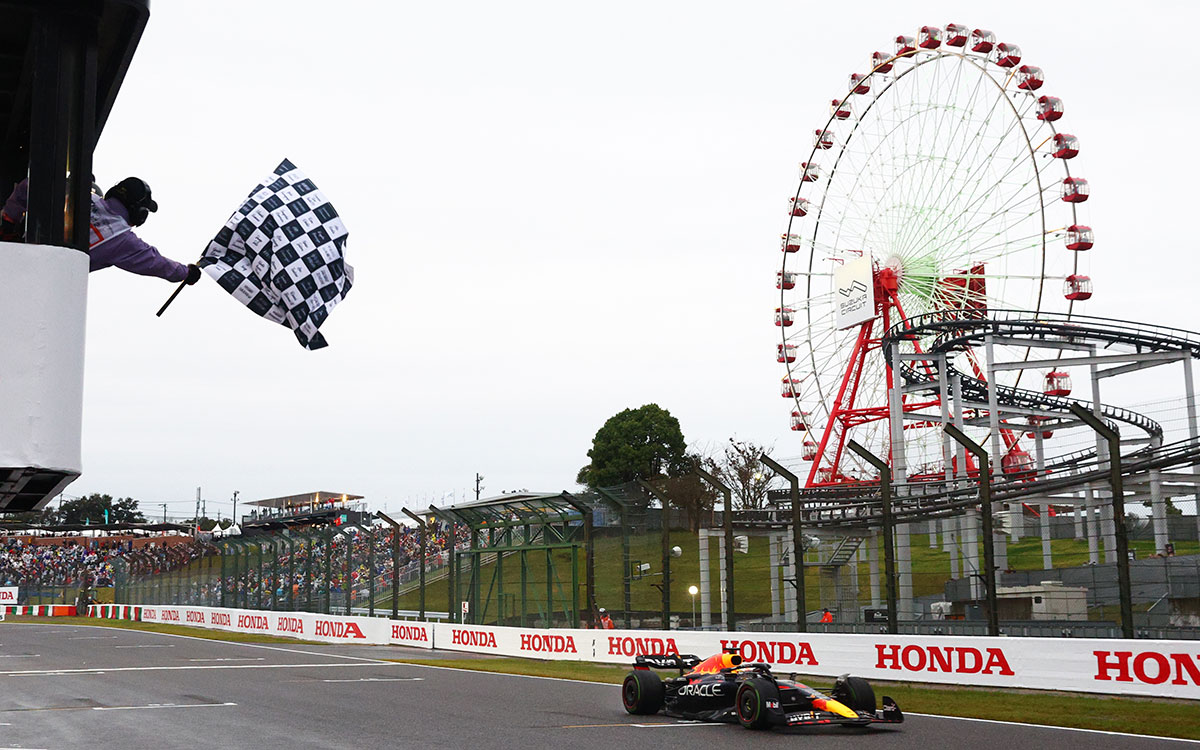
Ferrari’s Charles Leclerc crossed the line second, closely followed by Red Bull’s Sergio Perez in third. Leclerc then received a five-second penalty, reversing their positions and giving Red Bull a one-two finish.
Leclerc ran off the track at the final chicane on the last lap. By cutting the chicane, he kept his position ahead of Perez and was judged to have left the track and gained an advantage.
With the full race distance not completed, reduced championship points had widely been expected. However, the reduced-points provisions applied only to a race that was suspended and could not be resumed, so full points were awarded. Verstappen consequently secured the championship.
Had Perez not kept up the pressure and Leclerc avoided the mistake to retain second, the title would have had to wait until at least the next round, the United States Grand Prix. Suzuka was not the season finale, yet Verstappen clinched the title amid last-lap drama for the second year in succession.
Alpine’s Esteban Ocon was best of the rest in fourth. He spent the race defending against sustained attacks from Mercedes’ Lewis Hamilton but held his position to the finish.
Sebastian Vettel of Aston Martin, whose affection for Suzuka ran deep, finished sixth in his final race at the circuit. His strong performance earned him Driver of the Day.
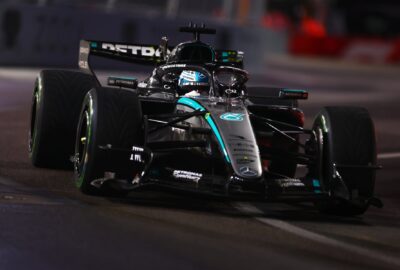
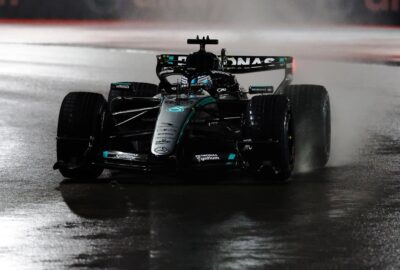
Alpine’s Fernando Alonso missed sixth place by just 0.011 seconds and finished seventh. Mercedes’ George Russell recovered with impressive overtaking moves through the uphill section to take eighth.
Williams’ Nicholas Latifi, who, like Vettel, gained heavily from an early switch from full wets to intermediates ahead of the restart, finished ninth. McLaren’s Lando Norris took the final point in tenth.
AlphaTauri’s Yuki Tsunoda was the first home driver to contest the Japanese Grand Prix since Kamui Kobayashi in 2014. He briefly climbed to ninth but finished 13th, outside the points.
Team mate Pierre Gasly, who had qualified only 17th, started from the pit lane after changes to his rear wing, front-wing ballast and rear-suspension settings breached parc ferme restrictions. He finished 18th.
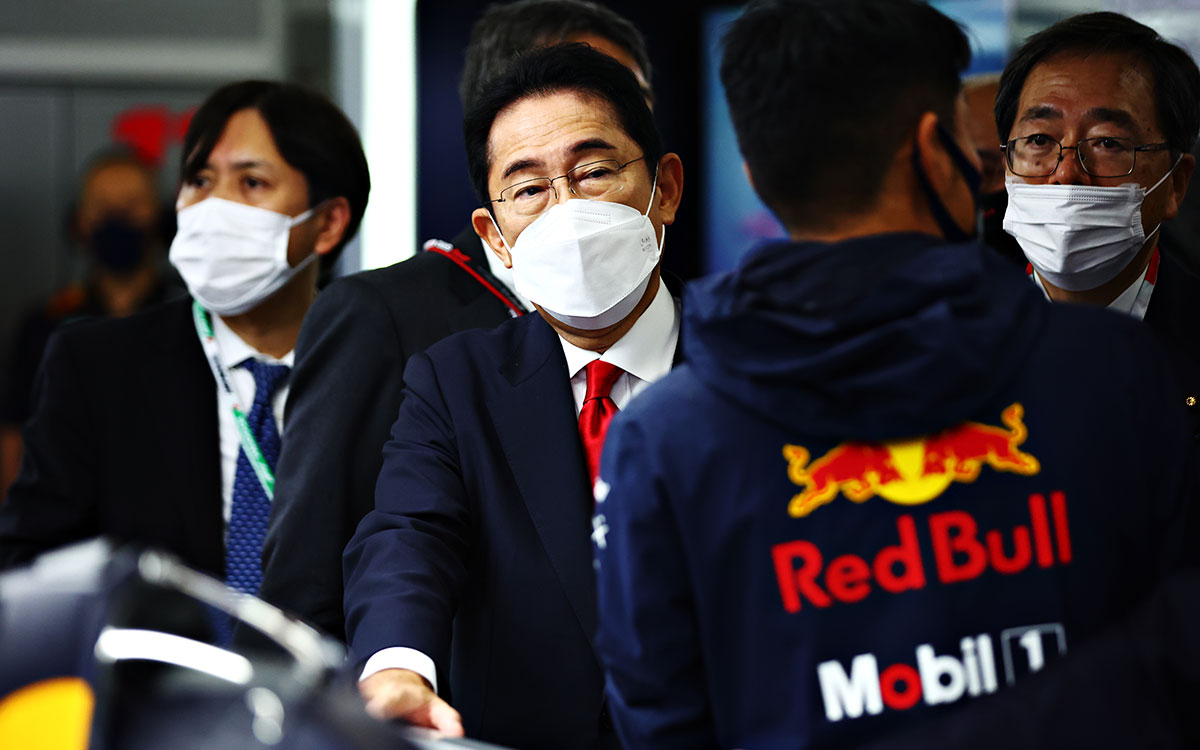
The race started at 14:00 Japanese local time on October 9 and ultimately covered 28 laps of the 5,807-metre Suzuka circuit. Japanese Prime Minister Fumio Kishida attended the pre-race ceremony, and Nana Mizuki sang the national anthem.
Rain fell over Suzuka, and the formation lap for the points-paying race began in wet conditions, with air temperature at 17.5°C, track temperature at 21.8°C, humidity at 78% and atmospheric pressure at 1,015.7 hPa.
Official tyre supplier Pirelli brought the hardest range of slick compounds, C1 to C3, but they were never used in the race. Every car took its place on the grid on intermediate tyres.
Hamilton used a set of intermediates that had completed just one lap. In his view, tyres that had already been scrubbed in on a wet surface offered better grip.
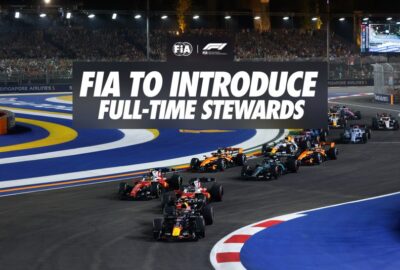
The opening lap after the standing start was full of incidents, with crashes and spins in quick succession. Before lap three, Race Control first deployed the Safety Car (SC) and then suspended the race with a red flag.
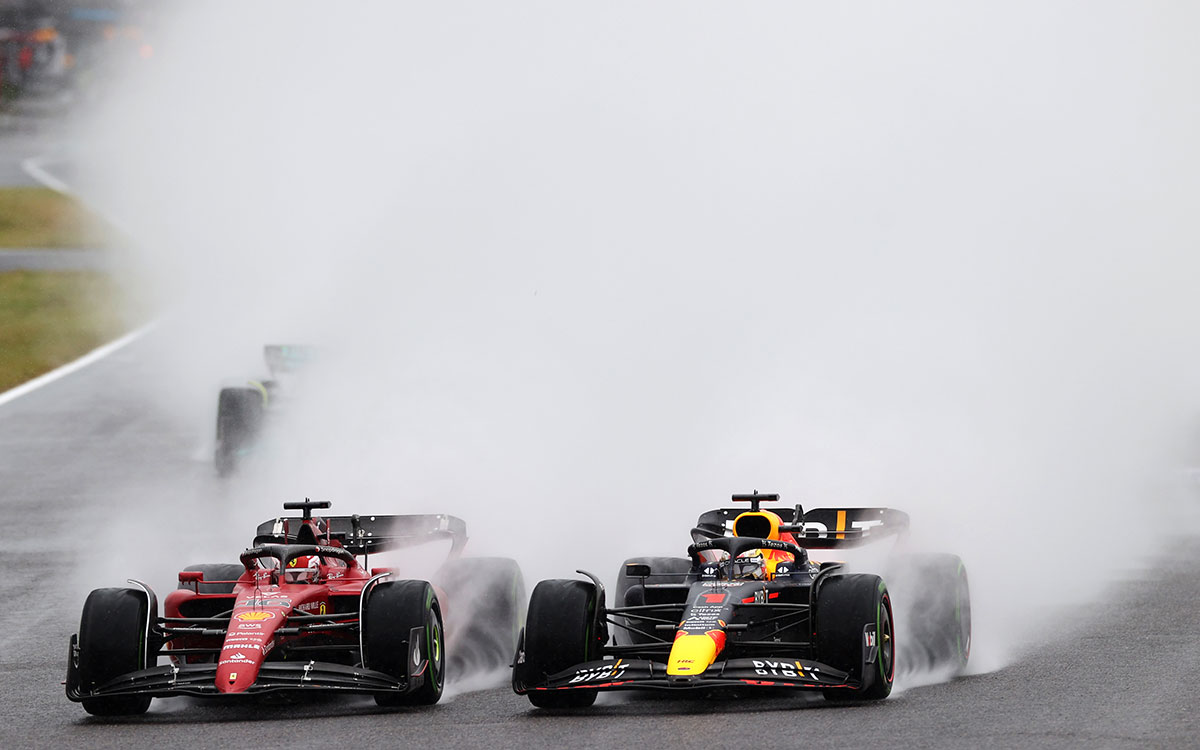
Immediately after the start, Verstappen and Leclerc arrived at Turn 1 side by side. Verstappen took the risk of staying on the outside and showed the determination needed to defend his starting position.
Vettel made contact with Alonso on the run to Turn 1, went off the track and dropped to the back.
Zhou Guanyu of Alfa Romeo spun on his own at the hairpin. Williams’ Alex Albon retired with a technical problem caused by contact with Magnussen.
Carlos Sainz of Ferrari, who had qualified third, crashed at 200R. Further behind, Gasly collected an advertising board that had been dislodged onto the track on the nose of his car, forcing an additional pit stop.
Many drivers, including Gasly, also criticised the recovery tractor that entered the track during the Safety Car period.
As rivals ran into trouble, Tsunoda gained four positions to climb to ninth. Haas’ Mick Schumacher gained five places to reach tenth. Neither, however, ultimately finished in the points.
Race Control deployed the Safety Car before showing the red flag. After a stoppage of more than two hours, the 18 remaining cars, excluding the retired Sainz and Albon, returned to the track on full wets at 16:15 Japanese local time. Following laps behind the Safety Car, the race resumed with a rolling start on lap six.
With the three-hour rule in force, the restarted race was governed by a countdown to the time limit instead of the remaining scheduled laps.
Vettel and Latifi rushed into the pits ahead of the restart to switch from full wets to intermediates. The decision paid off and helped both score points.
Leader Verstappen pitted for intermediates at the end of lap seven, and the cars behind also came into the pits in succession. Schumacher alone persisted on full wets before finally stopping for intermediates at the end of lap 11.
Verstappen pulled away from Leclerc, who was struggling with front-tyre wear, by more than a second per lap and effectively settled the fight for the race victory early.
Perez rapidly closed on the tyre-troubled Leclerc in the closing stages, bringing their fight to within a second.
Overtaking at Suzuka remained difficult, and Perez appeared set to finish third. But just a few hundred metres from the chequered flag, Leclerc ran off the track and received a five-second penalty for gaining an advantage. Perez moved up to second, settling Verstappen’s championship.
| Position | Driver | Team | Gap | Points |
|---|---|---|---|---|
| 1 | Max Verstappen | Red Bull | 3:01:44.004 | 25 |
| 2 | Sergio Pérez | Red Bull | +27.066 | 18 |
| 3 | Charles Leclerc | Ferrari | +31.763 | 15 |
| 4 | Esteban Ocon | Alpine | +39.685 | 12 |
| 5 | Lewis Hamilton | Mercedes | +40.326 | 10 |
| 6 | Sebastian Vettel | Aston Martin | +46.358 | 8 |
| 7 | Fernando Alonso | Alpine | +46.369 | 6 |
| 8 | George Russell | Mercedes | +47.661 | 4 |
| 9 | Nicholas Latifi | Williams | +70.143 | 2 |
| 10 | Lando Norris | McLaren | +70.782 | 1 |
| 11 | Daniel Ricciardo | McLaren | +72.877 | 0 |
| 12 | Lance Stroll | Aston Martin | +73.904 | 0 |
| 13 | Yuki Tsunoda | AlphaTauri | +75.599 | 0 |
| 14 | Kevin Magnussen | Haas | +86.016 | 0 |
| 15 | Valtteri Bottas | Alfa Romeo | +86.496 | 0 |
| 16 | Zhou Guanyu | Alfa Romeo | +87.043 | 0 |
| 17 | Mick Schumacher | Haas | +92.523 | 0 |
| 18 | Pierre Gasly | AlphaTauri | +108.091 | 0 |
| DNF | Carlos Sainz | Ferrari | DNF (retired) | 0 |
| DNF | Alex Albon | Williams | DNF (retired) | 0 |