
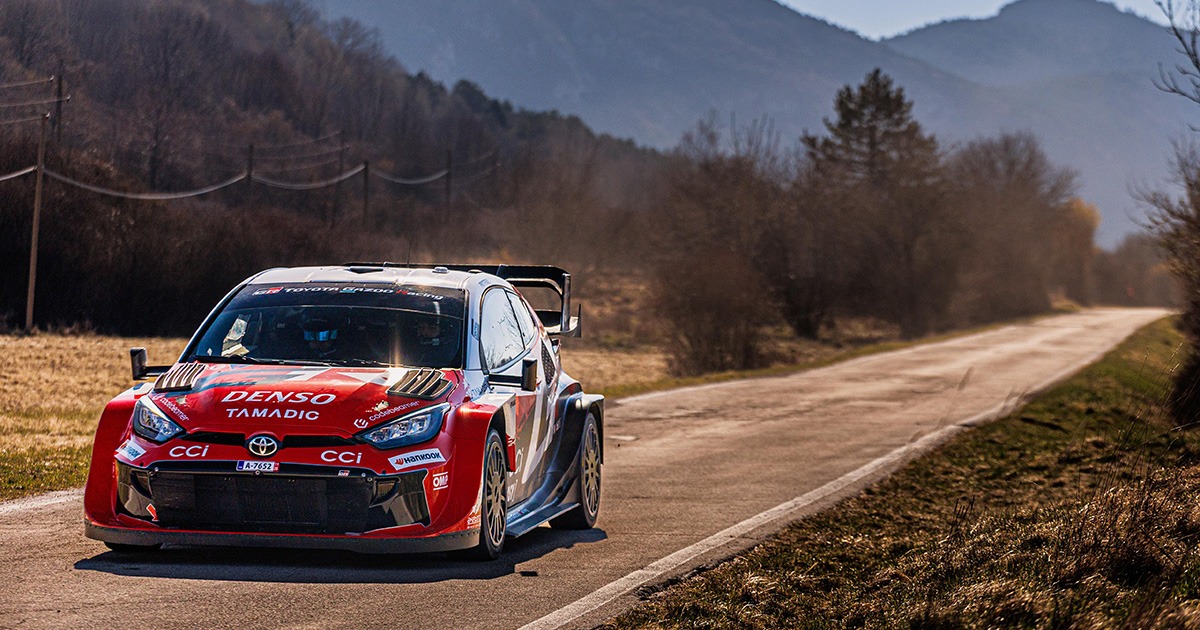
Team Profile
From classic rally cars to a modern manufacturer team
Toyota’s WRC history predates today’s GR Yaris. The brand claimed its first WRC rally victory in 1975 and its first manufacturers’ world title in 1993. After its original manufacturer programme ended in 1999, Toyota returned in 2017 as TOYOTA GAZOO Racing WRT, beginning a new era that would take it from the Yaris WRC to the GR Yaris Rally1.
Following its return, the team won the manufacturers’ title in 2018, took five consecutive titles from 2021 to 2025, and secured a sixth straight crown at Rally Chile in 2026. These results demonstrate its competitiveness across different technical regulations and reflect the combined efforts of multiple drivers, co-drivers and engineering teams.
The 2026 line-up and the relationship between the main and second teams
The main team’s line-up comprises Elfyn Evans, Sébastien Ogier, Oliver Solberg and Takamoto Katsuta. Evans and Katsuta continue their long associations with Toyota, while Solberg steps up as the 2025 WRC2 champion to a full-season Rally1 seat. Ogier continues with a partial-season programme, bringing the team experience spanning multiple championship-winning seasons.
Sami Pajari also drives a Toyota GR Yaris Rally1, but is entered under Toyota’s second team, WRT2. The brand, car model and entrant are three distinct concepts: both teams are part of Toyota’s operation, but they can be listed separately in the standings. The main team’s four-driver line-up also does not mean that four crews score points for the same entrant at every round.
How the GR Yaris Rally1 adapts to different surfaces
The GR Yaris Rally1 uses a 1.6-litre turbocharged engine and four-wheel drive and was developed for top-level rallying. Rally1 dropped hybrid systems from 2025, and the 2026 model continues under those regulations. Gravel, asphalt, and snow and ice events place different demands on tyres, ride height and suspension settings, so the same car’s performance characteristics can vary from round to round.
Why manufacturers’ points cannot simply be combined
Drivers and co-drivers compete for their respective annual titles, while manufacturers’ points are calculated according to entries, nominations and the applicable scoring rules. Pajari’s individual results can be outstanding, but WRT2’s points must be considered under its separate entry and cannot simply be added to the main team’s total. Understanding Toyota’s collective performance means looking both at the overall rally results and at whether each crew was nominated to score manufacturers’ points at that round.
What to watch
Editorial analysis: Toyota’s line-up combines experienced champions with young crews making breakthroughs. Their stage times on the same surface can be compared, but starting order also needs to be considered: crews running first on gravel may have to sweep loose material from the road. Road conditions, punctures and time lost to repairs must all be considered together to distinguish driver performance, car pace and the quality of execution across the whole rally.
Driver Line-up
Last checked: 1 October 2026 · Historical statistics and current points are maintained separately