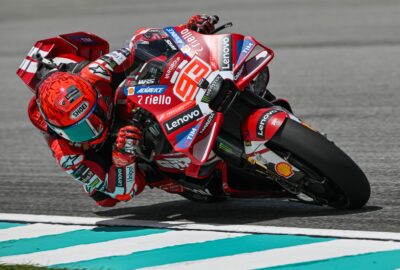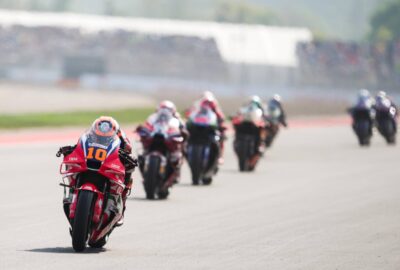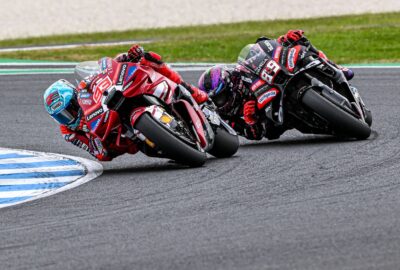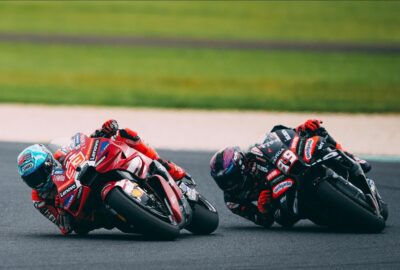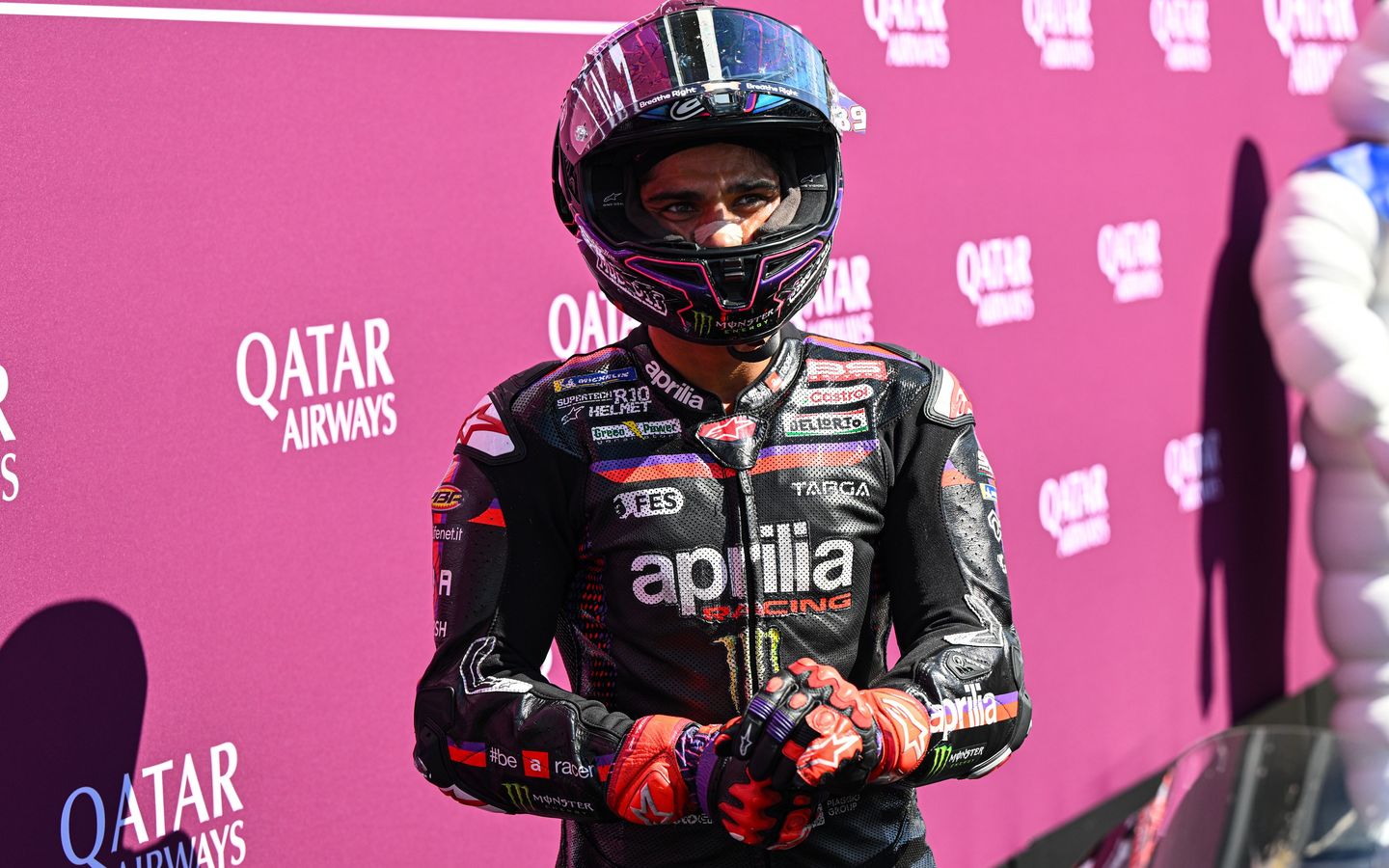
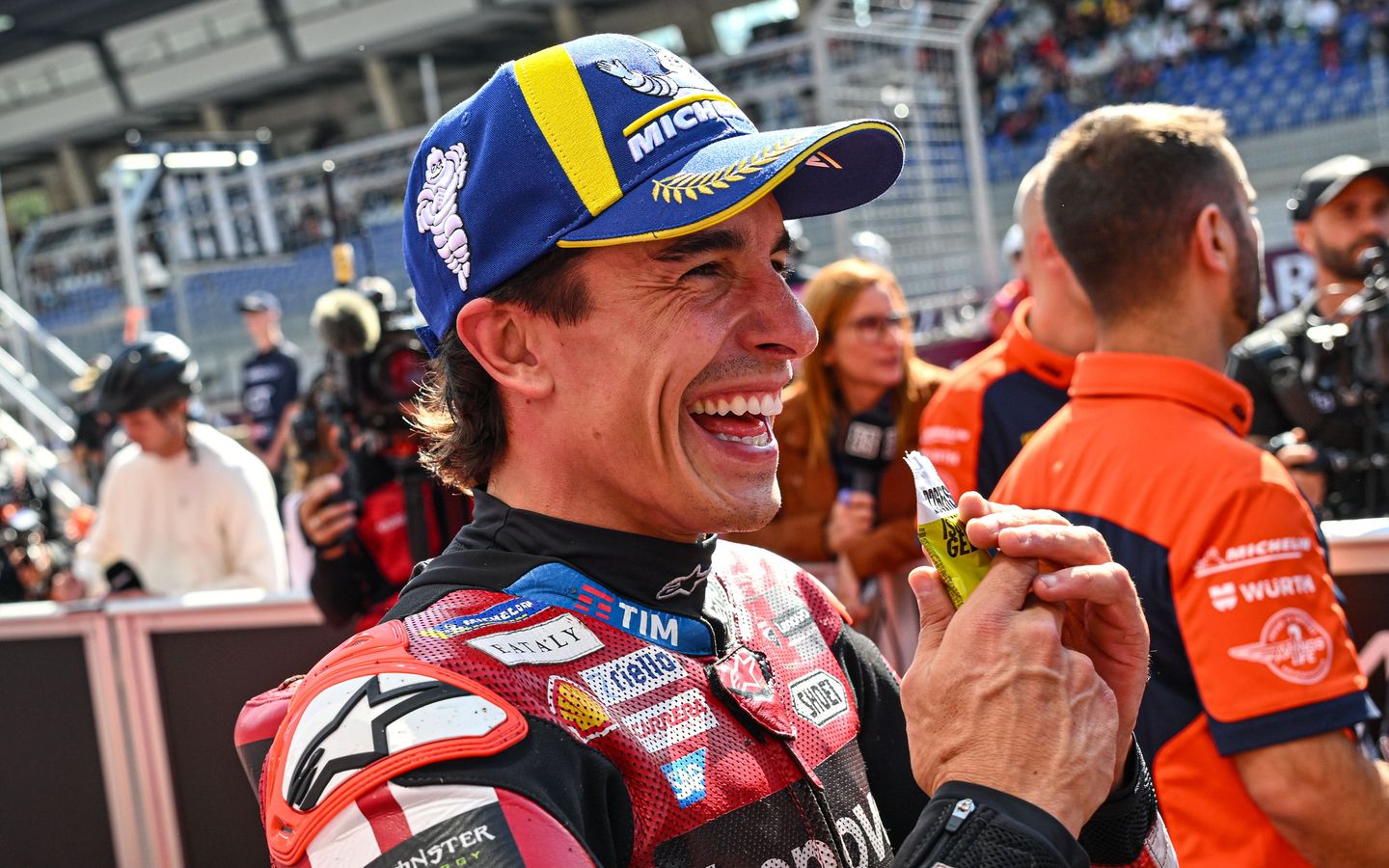
According to MotoGP’s official qualifying report and the Q1 and Q2 results, Jorge Martin took pole for the Austrian Grand Prix on 19 September with a 1 minute 27.917 second lap. Marc Marquez was just 0.015 seconds slower and Pedro Acosta 0.071 seconds behind, completing the front row. Martin and Marc Marquez were level in the riders’ standings, and this single-lap contest gave the Aprilia rider the higher starting position of the pair.
Late improvements decide pole as yellow flags limit the final opportunity
After the first timed runs in Q2, Acosta led at KTM’s home event, followed by Marc Marquez and Alex Marquez. Martin and team-mate Marco Bezzecchi were still trying to catch up. The order after the first runs had not yet settled who would take pole.
Martin then improved to go fastest before finding further time on his next push, ultimately lowering the benchmark to 1 minute 27.917 seconds. Marc Marquez also improved his personal best to 1 minute 27.932 seconds but remained 0.015 seconds short, while Acosta was third on 1 minute 27.988 seconds. The official Q2 classification showed all three setting their best times on their respective seventh laps.
Late in the session, Alex Marquez crashed at Turn 1, bringing out yellow flags. MotoGP’s report recorded that with little time remaining and the yellow flags interrupting opportunities to set a time, riders had just one final attempt. Neither Acosta nor Marc Marquez improved again. Martin retained pole with his existing time, while Alex Marquez kept sixth on his earlier lap and was reported as OK after the crash.
Bezzecchi was fourth with a 1 minute 28.166 second lap, 0.249 seconds from pole. Ogura’s 1 minute 28.450 seconds put him fifth, giving Aprilia three places in the top five. The other second-row rider, Alex Marquez, recorded 1 minute 28.473 seconds, just 0.023 seconds behind Ogura.
Identical Q1 times secure progression before Q2 sets their starting positions
In Q1, Johann Zarco and Francesco Bagnaia both recorded 1 minute 28.753 seconds. The official classification placed them first and second respectively, with both progressing to Q2. Raul Fernandez was third on 1 minute 28.871 seconds, 0.118 seconds behind the time shared by the two qualifiers, leaving him 13th in the complete starting order. Pol Espargaro followed him in 14th.
In Q2, Bagnaia took seventh with a 1 minute 28.527 second lap, followed by Fabio Di Giannantonio and Fabio Quartararo in eighth and ninth. Zarco was tenth on 1 minute 28.632 seconds, with Brad Binder and Fermin Aldeguer 11th and 12th. The table below lists Q2 best laps for the top 12 and Q1 best laps for those who did not progress, retaining the complete order of all 22 riders.
Complete starting order
| Position | Rider | Team | Lap time |
|---|---|---|---|
| 1 | Jorge Martin | Aprilia Racing | 1:27.917 |
| 2 | Marc Marquez | Ducati Team | 1:27.932 |
| 3 | Pedro Acosta | Red Bull KTM Factory Racing | 1:27.988 |
| 4 | Marco Bezzecchi | Aprilia Racing | 1:28.166 |
| 5 | Ai Ogura | Trackhouse Racing | 1:28.450 |
| 6 | Alex Marquez | Gresini Racing | 1:28.473 |
| 7 | Francesco Bagnaia | Ducati Team | 1:28.527 |
| 8 | Fabio Di Giannantonio | VR46 Racing Team | 1:28.612 |
| 9 | Fabio Quartararo | Yamaha Team | 1:28.623 |
| 10 | Johann Zarco | Castrol Honda LCR | 1:28.632 |
| 11 | Brad Binder | Red Bull KTM Factory Racing | 1:28.729 |
| 12 | Fermin Aldeguer | Gresini Racing | 1:28.862 |
| 13 | Raul Fernandez | Trackhouse Racing | 1:28.871(Q1) |
| 14 | Pol Espargaro | Red Bull KTM Tech3 | 1:28.972(Q1) |
| 15 | Luca Marini | Honda Team | 1:29.110(Q1) |
| 16 | Diogo Moreira | Honda LCR | 1:29.154(Q1) |
| 17 | Enea Bastianini | Red Bull KTM Tech3 | 1:29.165(Q1) |
| 18 | Takaaki Nakagami | Honda Team | 1:29.442(Q1) |
| 19 | Franco Morbidelli | VR46 Racing Team | 1:29.554(Q1) |
| 20 | Alex Rins | Yamaha Team | 1:29.663(Q1) |
| 21 | Jack Miller | Pramac Racing | 1:29.689(Q1) |
| 22 | Toprak Razgatlioglu | Pramac Racing | 1:30.056(Q1) |
INKA SPORTS Analysis: How small lap-time gaps separate starting positions
The closeness of this qualifying session appeared both in the pole battle and in the midfield starting positions. Martin was 0.015 seconds faster than Marc Marquez, with just 0.071 seconds covering the top three. Bagnaia and Zarco were separated by 0.105 seconds in Q2, yet Di Giannantonio and Quartararo fitted between them, leaving them seventh and tenth. A small time gap can correspond to different numbers of positions depending on the distribution of other riders’ times. The size of the gap alone cannot describe a rider’s starting situation.
Reading the combined table also requires distinguishing the thresholds in the two qualifying sessions. Thirteenth-placed Raul Fernandez’s lap was only 0.009 seconds slower than twelfth-placed Aldeguer’s, but that was not his deficit for progressing to Q2. His target was the 1 minute 28.753 second time shared by the two Q1 qualifiers, and he was 0.118 seconds slower in that same session. The top 12 times come from Q2 and the final ten from Q1. A gap across sessions cannot replace the actual qualifying deficit. This also explains why Bagnaia and Zarco, who progressed from Q1 on identical times, ultimately occupied different starting positions.
Conclusion
Martin secured pole with his best lap after two improvements, while Marc Marquez and Acosta kept the entire front row within 0.071 seconds. The result established the starting advantage earned in this qualifying session: the front-row contest was close, and small midfield time gaps also covered multiple positions. The next question was whether those positions could be retained after the start. Single-lap times alone could not yet answer questions about sustained race pace or changes in position.