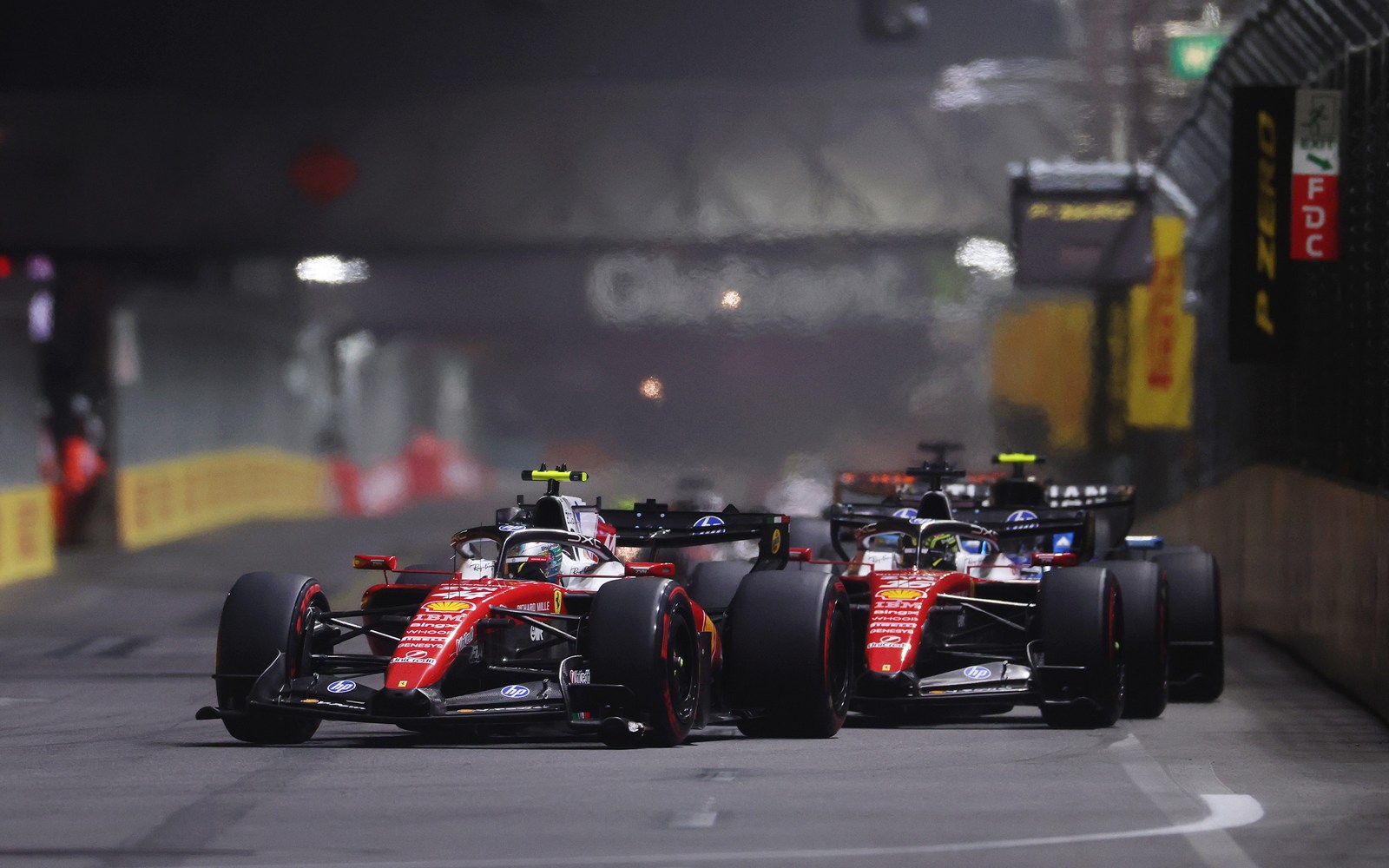
Charles Leclerc went down Lewis Hamilton’s inside on Lap 38 of the Las Vegas Grand Prix. The Ferraris made contact at Turn 7. Leclerc said afterwards that, with Hamilton fighting a McLaren ahead, he saw an opening and thought there was room to make the move. He accepted the ten-second penalty and apologised to his team.
What Leclerc saw on entry
Both Ferraris went out in Q2 and gained ground in the race. Hamilton was back ahead late in the Grand Prix. As Leclerc approached Turn 7 from behind, he thought the angle of Hamilton’s car might have kept him out of his team-mate’s mirrors. By the apex, the gap he had seen on entry had narrowed. The cars touched and Hamilton spun.
Leclerc said he would review the footage to see what he could have done differently. He also drew a distinction with the earlier clash in Mexico City. In his view, both drivers had pushed their fight too far there. In Las Vegas he thought he had a genuine opening. He still considered contact between team-mates unacceptable.

INKA SPORTS Analysis and Summary: How the opening became a ten-second penalty
After reviewing trackside and onboard video, the stewards found that Car 16 launched its move from well behind. At the apex, its front axle had yet to draw level with the mirror of Car 44. That position was central to their decision that Leclerc had no right to the inside and bore full responsibility. Leclerc described the space he saw on entry. The stewards judged how far alongside he actually was at the apex.
The ten seconds were added after Leclerc crossed the line. His unpenalised time was 7.554 seconds off the winner and put him ahead of Franco Colapinto on the road. With the penalty applied, Colapinto, Hamilton, Carlos Sainz and George Russell were all classified ahead of him. Sixth was worth eight points. Tenth paid one.
That gives Leclerc something specific to look for on the replay. An opening can appear on entry while the car ahead is still turning in. What matters is how much overlap the chasing car can establish before it reaches the apex. The key interval begins with his decision to commit to the inside and ends with the contact.