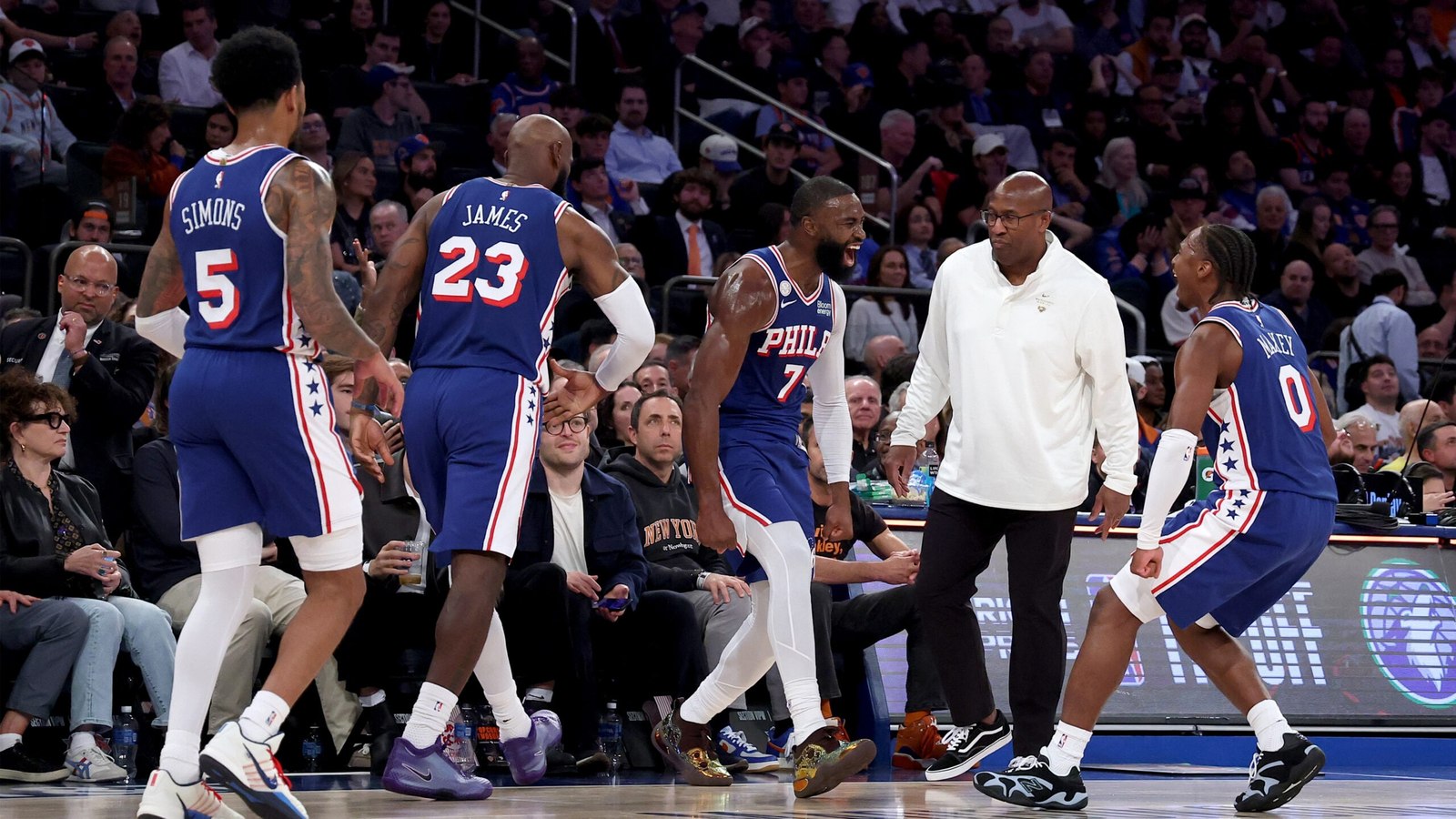
Philadelphia beat New York 106–100 at Madison Square Garden on October 21, China Standard Time (UTC+8), winning its 2026–27 NBA opener. LeBron James' 76ers debut produced fourteen points, nine rebounds and seven assists; Tyrese Maxey led with 28 points. Rather than how four stars would share the ball, the clearest immediate explanation came late: repeated defensive rotations stopped the Knicks overturning the game again.
Behind at halftime, ahead after the third
New York won the first two quarters 25–23 and 33–31 for a 58–54 halftime lead. Philadelphia took the third 29–18 to enter the fourth ahead 83–76. Jaylen Brown had nineteen points, eight rebounds and six assists; Joel Embiid thirteen points, eleven rebounds, six assists and three blocks. With Maxey's five assists, all four leading players contributed to organization.
The fourth was not smooth throughout. Karl-Anthony Towns hit a long three with 4:37 left to cut the deficit to one. New York then scored on only two of its final eight possessions as Philadelphia handled threatened mismatches through pre-switches, ball traps and weak-side cover.
Avoid the mismatch first, then cover space left by the trap
NBA reporter John Schuhmann's possession analysis noted New York repeatedly using the player guarded by Embiid to screen for Brunson, seeking to draw Embiid outside. On a possession after Towns' three, Brown first switched onto Towns, then took Brunson when the screen arrived, forcing a difficult isolation shot.
New York subsequently brought Embiid into a pick-and-roll, but he stepped up to trap. Towns appeared free to pop out, yet James rotated to block the passing lane. The initial local advantage disappeared, and Maxey then intercepted OG Anunoby's pass and dunked to extend the lead to six. On another possession, James rotated from the weak side to contest Mikal Bridges' layup.
Schuhmann counted fourteen opportunities in which Embiid's man set at least one on-ball screen for Brunson, producing only five Knicks points, about 0.36 per opportunity. The same measure was 1.24 in their playoff meeting five months earlier. These figures concern that screening action, not the efficiency of every Knicks possession.
Multiple stars contribute to one possession through screens
Philadelphia showed connected offense immediately: Brown set an off-ball screen for James, Embiid then screened on the ball for him, and Maxey screened Embiid's defender before popping for an open three. Often called Spain pick-and-roll, this lets stars without the ball stretch defenses through screens and movement rather than each waiting for an isolation.
| Player | Points | Rebounds | Assists |
|---|---|---|---|
| Maxey | 28 | 4 | 5 |
| Jaylen Brown | 19 | 8 | 6 |
| James | 14 | 9 | 7 |
| Embiid | 13 | 11 | 6 |
| Brunson | 21 | 5 | 3 |
| Towns | 19 | 12 | 1 |
INKA SPORTS analysis: Defensive gains depend on connections, not one player
The late defense was valuable because Philadelphia did more than either protect Embiid or leave him alone outside. Brown pre-switched to reduce unfavorable matchups; when unavoidable, Embiid trapped, James covered the pop pass and Maxey attacked the subsequent lane. Each step depended on the next teammate taking over in time, preventing space left by the trap from becoming an easy shot.
Embiid shot four of fifteen and the team eleven of forty from three, so the offense was not yet highly efficient. Yet the four leaders totaled 24 assists, showing cooperation beyond individual scoring. The late success supplies a collaborative example, not proof of 48 minutes at that intensity. Against faster ball movement, a second rotation after initial cover remains a specific test.
Conclusion
The first win showed two connections within a multi-star lineup: screening for one another on offense and collectively handling targeted matchups on defense. Linking defensive choices into complete possessions after the one-point gap was the opener's strongest outcome. Shooting and one opponent's performance still limit conclusions: cooperation worked here, but the system is not thereby established as mature.