
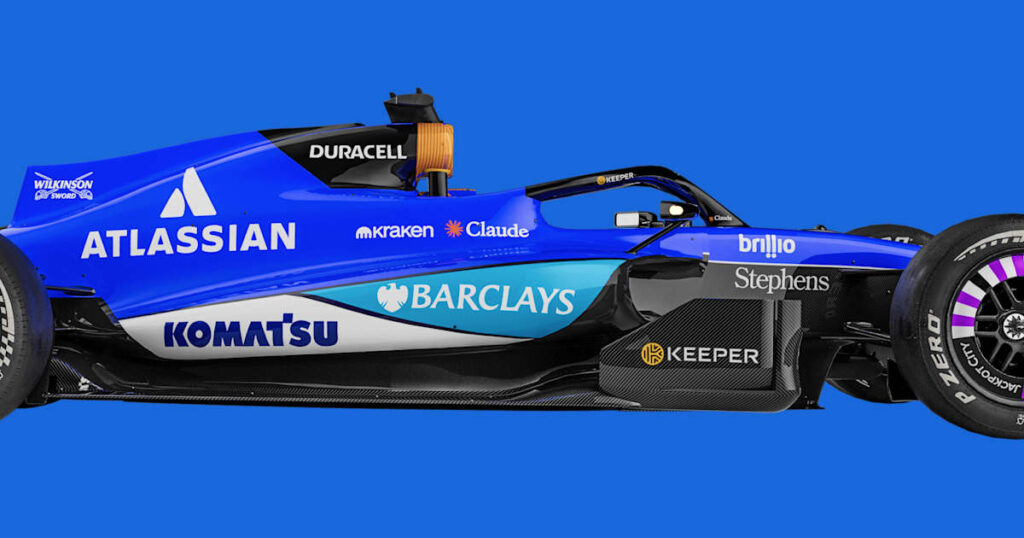
Team profile
Williams is based in Grove, UK, and is a leading example in the history of independent F1 teams. The engineering tradition established by Frank Williams and Patrick Head brought nine constructors’ championships in the 1980s and 1990s. In 2026, Albon and Sainz drive the FW48 under James Vowles’ leadership, continuing with Mercedes power.
Origins and team history
Understanding Williams requires distinguishing Frank Williams’ earlier operation from the later team he established with Patrick Head. The formation phase in 1977 and the first self-built F1 car’s appearance in 1978 must also remain separate concepts. Its first victory at the 1979 British Grand Prix opened a championship era, followed by partnerships with different power suppliers. Car design and active suspension made Williams a defining force in the 1990s. In the new century it still achieved wins and podiums, but gradually experienced declining resources and competitiveness.
Key years and milestones
- 1977—1980The modern Williams team was established and introduced its own car, took its first win in 1979 and first won both championships in 1980.
- 1980—1987Jones, Rosberg and Piquet successively won drivers’ titles as the team accumulated honours with Ford and Honda power.
- 1992—1997Mansell, Prost, Damon Hill and Villeneuve each won titles; the team took its ninth constructors’ championship in 1997.
- 2012—2015Maldonado won the 2012 Spanish round; Mercedes power and improved competitiveness brought consecutive third places in the constructors’ standings in 2014 and 2015.
- 2020—2025Rebuilding advanced after the ownership change. Sainz joined in 2025 and took two podiums, with the team finishing fifth for the year.
2026 season snapshot
The following figures were checked against official F1 pages on 2026-9-23. They are a snapshot, not live standings or the final season result.
- Season position
- Position 9
- Season points
- 11
- Official Grand Prix count
- 14
- Grand Prix wins
- 0
- Grand Prix podiums
- 0
- Grand Prix poles
- 0
- Sprint points
- 0
- Sprint wins
- 0
Season points already include Sprint points and must not be added again. Grand Prix and Sprint wins are listed separately; the season position here and historical honours at the top have different statistical scopes.
Car and technical partnerships
The FW48 continues the Mercedes power partnership, but Williams’ progress is better measured by whether its chassis works at a broader range of circuits. Strong straight-line speed alone may reflect low drag at the expense of cornering performance and tyre life. Meaningful progress means moving from scoring at specific venues to competing across different circuit types. Investment in the factory, tools and organisation must ultimately be validated on track; spending cannot be treated directly as a lap-time gain.
How to read the racing
Albon knows recent Williams cars well, while Sainz brings experience from several teams and has won races with Ferrari. For a rebuilding team, comparing both cars is valuable not just for internal ranking but for assessing upgrades and repeatable setups. The recovery in 2025 also does not guarantee continuation in 2026: new rules can reshape the competitive order, so the current season should still be assessed using the latest race data.
This section is editorial interpretation based on career history and racing patterns, intended to help viewers understand the action. It does not represent published team setup or telemetry findings.
Results and statistical scope
Within this page’s statistical scope, the verification date records 865 Grand Prix entries, 3779 points, 114 Grand Prix wins, 245 in the official podium count, 128 poles and 9 constructors’ world championships. The highest finish is position 1 (114 times).
This page retains 9 constructors’ titles. An F1 summary page had displayed 8, but Williams’ official history and F1’s year-by-year history both explicitly identify 1997 as the ninth title, so the figure must not be mechanically overwritten with 8. Team formation, the first self-built chassis and the first appearance of predecessor entry assets use different definitions.
Related profiles and frequently asked questions
In which years were the nine constructors’ titles won?
1980, 1981, 1986, 1987, 1992, 1993, 1994, 1996 and 1997. In 1994 the team won the constructors’ championship despite not taking the drivers’ title.
Last verified: 2026-09-23