
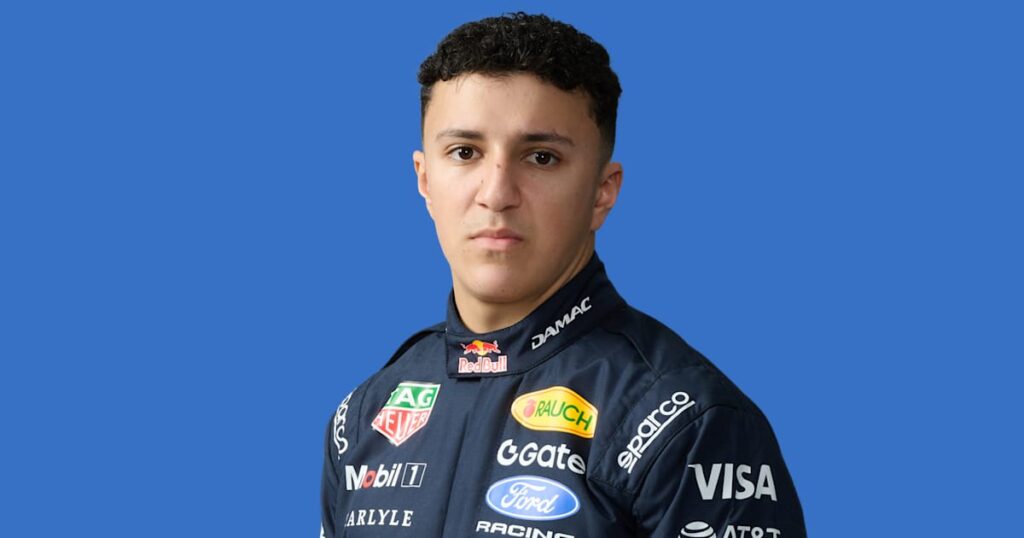
Driver profile
Born in Paris, France, Hadjar reached F1 through the Red Bull junior programme. He completed his rookie season with Racing Bulls in 2025 and scored a podium, then moved up to Red Bull in 2026 to partner Verstappen with car number 6. His junior career was not an uninterrupted sequence of titles; race performances at several levels earned him promotion.
Early development and progression
Hadjar progressed from French F4 to Formula Regional and F3. In 2022, he took three F3 wins and finished fourth in the championship before moving up to F2. His first F2 season was difficult, but four wins and a title challenge followed in his second year, ending with the runner-up position in 2024. That progression shows that a difficult first season need not end a driver’s route upwards; the key is whether measurable progress follows at the next stage.
Career timeline
- 2022Raced in F3, taking three wins and fourth in the championship, and joined the Red Bull junior programme.
- 2023—2024Contested two successive F2 seasons, winning four times and finishing runner-up in the second.
- Early 2025Failed to start his F1 debut for Racing Bulls after a formation-lap accident in Australia.
- 2025 Dutch roundTook his first F1 podium, an important turning point in his rookie season.
- 2026Moved up to Red Bull to partner four-time world champion Verstappen.
2026 season snapshot
The following figures were checked against official F1 pages on 2026-9-23. They are a snapshot, not live standings or the final season result.
- Season position
- Position 8
- Season points
- 71
- Official Grand Prix count
- 11
- Grand Prix wins
- 0
- Grand Prix podiums
- 1
- Grand Prix poles
- 0
- Sprint points
- 0
- Sprint wins
- 0
Season points already include Sprint points and must not be added again. Grand Prix and Sprint wins are listed separately; the season position here and historical honours at the top have different statistical scopes.
Defining period: from a debut setback to a Zandvoort podium
The failure to start in Australia and the podium in the Netherlands came in the same rookie season, illustrating fluctuations in early career performance. The former must be recorded accurately, but should not obscure the latter. The Zandvoort result showed he could convert an opportunity provided by the team into a podium. Promotion to the senior team, however, changed the car, internal benchmark and expectations; the junior team’s working methods cannot be assumed to transfer unchanged.
How to read the racing
Hadjar’s next assessment should focus on successive weekends: can he reduce mistakes, build pace close to his teammate across different circuits and turn feedback into stable setups? For a young driver, one excellent qualifying session is a positive sign, but insufficient on its own to judge a whole season. The number of appearances in current official statistics should also be checked as published, rather than filled in independently to match the team’s race count.
This section is editorial interpretation based on career history and racing patterns, intended to help viewers understand the action. It does not represent published team setup or telemetry findings.
Results and statistical scope
Within the statistical scope used on this page, the record as of verification comprises 34 Grand Prix entries, 122 points, 0 Grand Prix wins, 2 podiums in the official count, 0 poles and 0 drivers’ world titles. The best finish is position 3 (2 times).
Career figures include results from previous teams, rather than belonging only to the current team. Grand Prix entries are not the same as actual starts or finishes. Cumulative points are affected by changes to scoring systems over the years and are unsuitable as a standalone basis for ranking drivers across eras.
Related profiles and frequently asked questions
Is he an F2 champion?
No. Hadjar finished runner-up in F2 in 2024, with Bortoleto taking the title. The path to F1 is not determined solely by whether a driver wins a particular junior championship.
Last verified: 2026-09-23