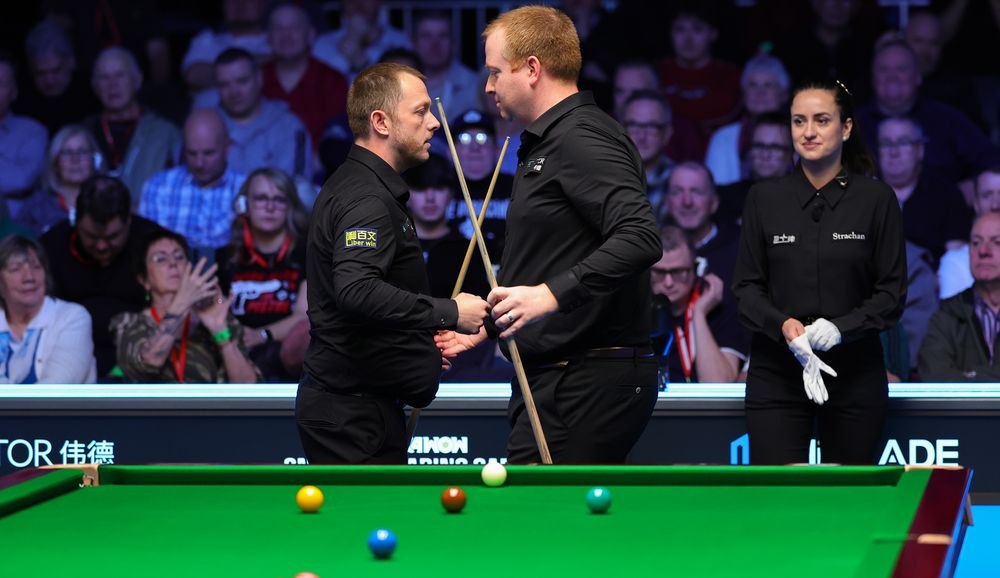
Upsets continued in the Northern Ireland Open first round in Belfast. On October 20, local time, world No. 1 Zhao Xintong lost four consecutive frames from 2–0 up against Gao Yang, while Mark Allen's first appearance of the season ended 4–2 against Jordan Brown. WST's October 20 report counted eleven of the top sixteen eliminated in round one.
Zhao opens with a century before Gao takes four straight
Zhao began with breaks of 129 and 64 for two frames. Gao then took control with contributions including 71, 112 and 71 to advance 4–2. The all-Chinese match combined Zhao's high-scoring start with Gao's sustained later chances, so the opening two frames alone do not describe the contest.
Chang Bingyu against Ryan Day produced two marked reversals. Day led 3–0 with breaks including 108 and 82, then missed a relatively close pink while approaching a 4–1 win. Chang took that frame, made 91 to level at 3–3 and led the decider 55–0. Day ultimately cleared with 63 to win 4–3.
Allen discusses his future as Brown also seeks survival points
Allen had not competed this season because of personal issues before facing friend Brown at his home event. WST relayed his post-match TNT Sports interview, in which he said he could not currently see a future in snooker and suggested this might be an opportunity to say goodbye. Those were comments about his situation and future, rather than a formal retirement announcement.
Brown made breaks of 53 and 80 to reach the last 32 and face Michael Holt. He said seeing Allen play again mattered most, while also acknowledging pressure to retain his own professional status. Ranked 65th at the time, Brown's win combined friendship with competitive objectives; the atmosphere should not obscure his pursuit of ranking points.
Two October 19 deciders precede further first-round shocks on October 20
The day before, Hong Kong, China's Cheung Ka Wai came from 3–1 down with breaks of 88, 77 and 60 to win the final three frames and beat Ronnie O'Sullivan 4–3. O'Sullivan had built the lead with 56, 138 and 72, but a missed red in frame five and blue in the decider gave his opponent opportunities.
The same day, Martin O'Donnell beat Judd Trump 4–3 after losing all eight previous meetings. Trump made 94 to draw level at 3–3, but O'Donnell took the decider 87–5. Zhang Anda beat Liam Pullen 4–2 and Pang Junxu defeated Alfie Burden 4–2. On October 20, Zhou Yuelong lost 4–1 to Holt.
| Key first-round matches | Final score (frames) |
|---|---|
| Gao Yang—Zhao Xintong | 4-2 |
| Jordan Brown—Mark Allen | 4-2 |
| Ryan Day—Chang Bingyu | 4-3 |
| Cheung Ka Wai—Ronnie O'Sullivan | 4-3 |
| Martin O'Donnell—Judd Trump | 4-3 |
| Zhang Anda—Liam Pullen | 4-2 |
| Pang Junxu—Alfie Burden | 4-2 |
| Michael Holt—Zhou Yuelong | 4-1 |
INKA SPORTS analysis: A high-scoring start is different from closing the match
Several matches highlight the difference between gaining and finishing an advantage in best-of-seven play. Zhao's opening scores did not stop Gao's later sequence. O'Sullivan led 3–1 but was repeatedly caught as chances changed hands. Chang's 55–0 decider lead is the clearest example: it was not yet enough to secure the frame, and Day's 63 clearance changed the result.
Break quality and the final outcome cannot simply be equated. The frame in which chances arise and whether a recoverable table is left after taking a lead matter too. These matches do not establish a general decline among higher-ranked players, nor can Allen's personal circumstances be applied to other losers. Later judgments should return to frame-by-frame performance and key chances rather than treating one round's upsets as one common cause.
Conclusion
The round's important change was several leaders failing to convert advantages into the last frame, while pursuers repeatedly took late chances. Gao, Cheung and O'Donnell advanced through distinct sequences, while Chang's defeat shows a clear decider lead still needs finishing. Allen's future should follow his actual subsequent decisions, not be written in advance as a completed career.