
Expand the Chapter List
- From American Racing to the Other Side of the World
- First Full Season, First-Race Victory
- Relaxed Arms: Another Form of Control
- Rainey Arrives, and Racing Takes on a Personal Weight
- Hockenheim's Final Lap: Start with the Earlier Pass
- Why Six Wins Might Still Not Be Enough
- The First Half of 1993: Change Was Already Happening
- After Misano, an Inescapable Shadow over the Title
- The Final Win at Donington: A Body Already Paying the Price
- Why No. 34 Is Easier to Remember Than a Trophy
- After Retirement, Still Learning to Ride Well
- Looking Again at That Late-Braking Move
- Timeline
- Career Record
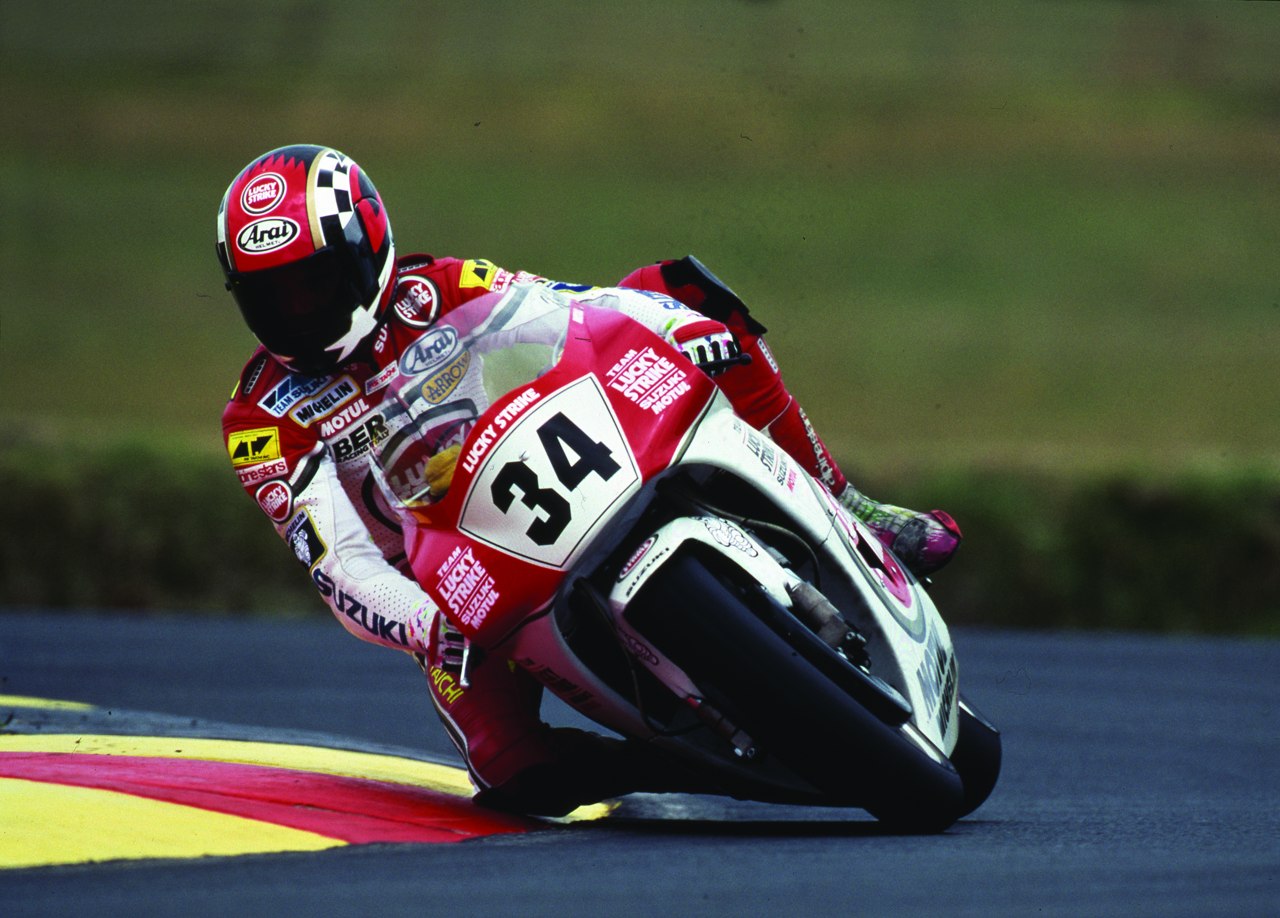
On the final lap of the 1991 German Grand Prix, Kevin Schwantz and Wayne Rainey reached the Hockenheim straight leading into the stadium section. Schwantz had already passed for the lead, but Rainey used the slipstream to go back past him. By the usual logic of racing, the next braking zone would decide who carried the advantage into the final sequence of corners.
Schwantz did not finish the contest according to the usual logic. Years later, he recalled that Rainey had already braked very late and that he himself was still in the Yamaha's slipstream, so he first had to move out to avoid hitting him. The Suzuki squirmed under heavy braking. While correcting it and changing down, he even selected first gear by mistake for a corner normally taken in second.
He still held the pass and won the race. It became one of the most famous images of No. 34. Yet seeing Schwantz only as the man prepared to brake later than anyone else misses the most important change of his career: learning how to turn many brilliant moments into a world championship.
From American Racing to the Other Side of the World
Born in Texas in 1964, Schwantz encountered motorcycles very early and later moved from off-road and other riding experiences into road racing. By the mid-1980s, he was attracting attention rapidly in American Superbike competition and becoming an important rider for Yoshimura Suzuki. Production-based racing machines provided his most significant schooling before grands prix.
Those races already revealed his strong appetite for attack. Riders had to fight for lines at close quarters, manage heavier machines and complete overtakes within limited opportunities. The Schwantz later familiar to world grand prix audiences did not emerge suddenly on a 500cc bike: his physical habits and racing judgement carried the marks of his earlier experience.
He made his grand prix debut at Assen in 1986. Before beginning a full 500cc campaign in 1988, he had gained some experience in European competition, but still had to adapt to a new calendar, circuits and opponents. The difficulty was not merely a higher standard of racing: his whole way of living and working was changing.
American Superbikes and 500cc grand prix machines were different mechanical environments. The lighter, more sensitive two-strokes demanded a new understanding of power, grip and chassis movement. Schwantz brought experience, but also had to keep revising it. His later recollections of his famous riding style repeatedly concerned not simple courage, but how to make body and motorcycle work better together.
In 1985, Schwantz made his first AMA Superbike national appearance for Yoshimura Suzuki and won both races at Willow Springs. At the 1986 Daytona 200, he finished second behind Eddie Lawson. His route towards grands prix was already built on direct contests with America's leading riders, rather than easy victories at local events.
Fighting Rainey for the 1987 American Superbike title, he won five of the last six races but still finished runner-up. It was a preview of the later grand prix rivalry: strong speed in the closing stages does not automatically reorder a season's points according to recent form. Points lost earlier remain in the final accounting.
First Full Season, First-Race Victory
In 1988, Schwantz first won the Daytona 200, then went to Suzuka for the opening round of the 500cc season and took his maiden grand prix victory. For a rider beginning his first full premier-class campaign, it was hard to imagine a stronger introduction. Suzuki's No. 34 immediately became an opponent the champions had to take seriously.
A common confusion needs clearing up here: Suzuka was not his first grand prix appearance, but the opening round of his first full 500cc season. His earlier occasional starts belonged to the same career path. Describing that first victory accurately does not diminish its impact; it shows how earlier learning came together on one crucial weekend.
He won again that year in the wet at the Nürburgring. Rain made the relationship between tyre and road hard to read, requiring constant probing and adjustment rather than merely smaller versions of dry-weather inputs. Schwantz later recalled nearly crashing several times, including a scare on the final lap. Winning did not mean the entire race had been completely under his control.
This was part of the early Schwantz's appeal. His races were full of visible movement and change: a pass could appear suddenly, with danger close behind. In his hands, Suzuki often found more competitiveness than expected. But each time he pushed the boundary further, there was no guarantee that the next attempt would produce the same result.
Relaxed Arms: Another Form of Control
Schwantz once told journalist Mat Oxley about an experience at Daytona in 1986. The bike was weaving at speed, and he instinctively tensed his body, trying to hold the bars still with his arms. After watching him, Yoshimura staff warned that excessive tension might make the problem harder to settle. He subsequently learned to allow the bike some freedom to move, rather than use his upper body as an extra rigid brace.
The story explains an often-overlooked part of his riding. On camera, Schwantz moved dramatically and the bike seemed constantly to struggle, making it easy to assume that brute strength was his only means of control. Experience taught him otherwise: sometimes he had to reduce unnecessary input and let the machine regain stability. Looking intense did not mean every joint should exert maximum force.
The lightness and sensitivity of 500cc two-strokes made that distinction crucial. Tyres, suspension and frame were already processing changes in load, and the rider's movements entered the same process. The body was both the operator and a part of the whole dynamic system. An overly rigid input could upset a balance that might otherwise have recovered.
Schwantz's development was therefore not a journey from fear to fearlessness. It was learning to distinguish, through many practical reactions, when to impose control and when to let the motorcycle move. That learning often came from testing, mechanics' observations and analysis after crashes. It was far more complex than a widely repeated boast.
Rainey Arrives, and Racing Takes on a Personal Weight
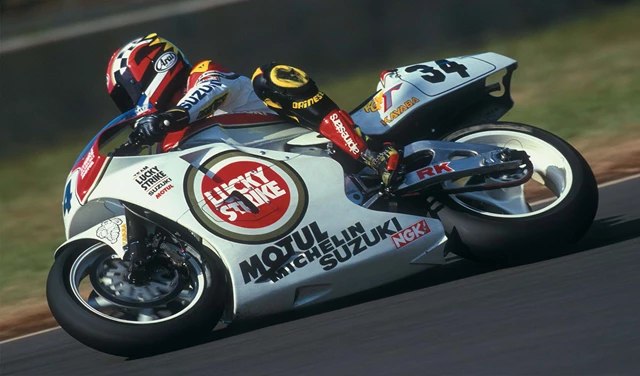 Photo: bikes.suzuki.co.uk
Schwantz and Rainey's rivalry had already formed in America. In world grands prix, they again fought near the front, now representing Suzuki and Yamaha. Their familiarity meant they were judging not only another motorcycle, but a person they had faced many times. Where each liked to attack, and what each might save for the last lap, became part of the race.
Rainey went on to win three consecutive 500cc world titles in 1990, 1991 and 1992. Schwantz won many races in the same period without taking the crown. He finished runner-up in 1990, already a world-class achievement. But for a rider often able to beat Rainey directly, the distinction was especially clear: being fastest in one race did not entirely coincide with scoring most effectively over a season.
That does not mean their styles can simply be divided into “impulsive” and “rational”. Rainey could fight fiercely, and Schwantz did calculate risks. The meaningful differences lie in the results of individual races: which weekends converted speed into points, which lost them through accidents, mechanical trouble or physical condition, and how those outcomes changed the title picture over several months.
MotoGP's retrospective on Schwantz's career notes that their personal relationship had improved by 1993. The long rivalry remained, but hostility was no longer its only component. The tragedy that followed would change how that rivalry was understood. Before it, they were still professional riders trying to beat each other every weekend.
Hockenheim's Final Lap: Start with the Earlier Pass
That famous late-braking move did not appear from nowhere at the end of a straight. In Schwantz's later account of the 1991 German Grand Prix, he first planned to gain an advantage through the fast right-hander in the latter part of the circuit, pass Rainey through the following straight and chicane, and get the best possible exit. His initial aim was the combined benefit of a whole sequence of track.
Next, he considered which side Rainey might use to counterattack and placed his bike on the right. Yet the right-hand corner entering the stadium was normally approached from the left, creating a conflict between defending the straight and preparing for turn-in. As he moved left, Rainey used the slipstream to pass on the right, rapidly changing their relative positions.
At the braking point, Schwantz found himself still in Rainey's slipstream. As the bike ahead began braking, the gap closed rapidly. He first had to move off that line, then reduce speed as hard as possible. This was not a beautiful, predetermined manoeuvre needing only execution; it was a chain of reactions after his earlier plan had changed.
The Suzuki moved around; he adjusted the brake and clutch, then shifted down one gear too far. When he opened the throttle on exit, the engine's response revealed the mistake. He shifted back to second and looked behind. The glance spectators saw gained a more specific explanation from his own later account. It was not a victory pose, but a check on whether Rainey was about to come past again.
He won. The greatness lay in correcting a succession of imperfect actions in time and still keeping his opponent behind. Writing it as a flawless miracle from beginning to end removes the most compelling part: at high speed, elite ability also means recovering a situation when the unexpected happens.
Why Six Wins Might Still Not Be Enough
Schwantz won six grands prix in 1989 without winning the championship. In the following years, he remained one of the most dangerous contenders. Victories are easy for spectators to remember; lost points are scattered across different places and weekends, making them harder to assemble into an equally powerful image.
A rider may win impressively at a circuit that suits him, then try to win the same way on an unfavourable weekend. If the bike, tyres or physical condition cannot support that choice, the probability of failure rises. A championship requires every weekend to be placed within a longer time frame, rather than judged only by the final corner immediately ahead.
The performance relationship between Suzuki, Honda and Yamaha was also shifting. Schwantz often had to exploit particular sections and braking zones to compensate for deficits elsewhere. In interviews, he explained that on fast circuits, failing to complete a pass in time could cost him the chance to gain an advantage through the next sequence of corners. Risk sometimes arose from the bike's competitive circumstances, not simply personal preference.
His later improvement should therefore not be described as “finally stopping taking risks”. Winning still demanded attack; the question was choosing risks worth taking. Third place can be a disappointment after losing a win, or the most valuable result available that weekend. Distinguishing between the two gives speed a chance to survive on the season's points table.
The points system changed in 1993, awarding 25, 20 and 16 points to the top three. Those gaps gave repeated second and third places practical value: second cost only five points compared with a win, whereas a retirement could erase the whole weekend's score. The difference between podium positions was a very different loss from the difference between scoring and scoring nothing.
Of course, riders cannot negotiate every corner solely by consulting the points table. Positions change, rivals attack, and a plan to accept second can turn into an opportunity when the leader makes a mistake. Schwantz needed sharper judgement: when was a genuine winning chance available, and when did another attack merely put an already secured result back at risk?
The First Half of 1993: Change Was Already Happening
In 1993, Schwantz won in Australia, Spain, Austria and the Netherlands. More importantly, he finished on the podium at all of the first nine rounds. That consistency meant his points no longer depended solely on the most spectacular victories, and made it difficult for rivals simply to wait for him to throw away an advantage.
Those nine podiums included wins, seconds and thirds. Accepting second or third did not mean losing speed or fighting spirit; it meant adopting a more complete racing objective. When someone else was stronger on a given day, bringing home the best available result kept him in a favourable position for the next round. The season-long contest was finally working in the same direction as his ability in individual races.
That process is easily obscured by the accident later in the season. Accounts of 1993 often jump straight to Rainey's injury at Misano and miss the work Schwantz had already completed. The championship did not begin taking shape only at the moment of the crash; the speed and consistency of the first half had already made him a genuine contender.
Leading did not guarantee a trouble-free season. A retirement in Britain and a poor Czech round allowed Rainey to move ahead in the standings before Misano. Their contest was still open, with neither assured of the outcome. That is why the accident carried such weight: it ended a battle still in progress, one that should have continued to find its answer through racing.
The opening four rounds gradually unfolded the rivalry. Schwantz won the Australian opener; Rainey then won in Malaysia and Japan; in Spain, Schwantz beat him again. They took turns converting speed into maximum points, while the other usually remained on the podium. Building a lead required doing well yourself and also having your opponent lose enough ground.
Victory in Austria helped Schwantz extend his advantage, and the Netherlands brought his fourth win. Other riders were part of the fight too: Daryl Beattie, Mick Doohan and Luca Cadalora were all capable of winning. The 1993 season was not a closed contest between two bikes. The title rivals had to maintain their positions repeatedly within a genuinely deep field.
After Misano, an Inescapable Shadow over the Title
At the 1993 San Marino Grand Prix, Rainey suffered a severe crash at Misano and could no longer continue his grand prix career as a rider. For Schwantz, it meant more than the removal of his principal title rival. A man who had long helped define racing alongside him had suddenly left the circuit.
Schwantz eventually became world champion with 248 points to Rainey's 214. The numbers settled the official title, but could not express the change in their relationship. Battles long seen as fierce hostility now revealed another side: a rival was also someone against whom to measure yourself, someone who pushed you and shared the same professional life.
Before the accident, Schwantz had already won four times and finished consistently on the podium in most races; Rainey's injury then altered the final phase of the title contest. The former shows that Schwantz was already performing at championship level. The latter denied their rivalry the chance to settle the season's outcome on the track.
The world championship did not bring an entirely happy ending. MotoGP's official profile notes that Rainey's accident took away the joy from this long-awaited title. For years, they had fought over every pass. When Schwantz finally became champion, his most important opponent could no longer challenge him on the grid.
At the Jarama finale, Suzuki was still pursuing the manufacturers' title. Barros won, but Yamaha rider Garcia finished seventh, earning nine points that allowed Yamaha to retain first place for the season by 269 to 264. Schwantz's riders' crown did not also become a Suzuki manufacturers' crown. A season often abbreviated as “Suzuki won the title” left different answers on the two standings.
The distinction also makes Schwantz's individual achievement clearer. He won the championship he had to keep working for; it was not proof that his manufacturer held an advantage in every circumstance. The competitive environment created with other riders both limited his opportunities and provided a measure of his speed. The title's value comes from that real competition, without needing every other result painted in the same colour.
The Final Win at Donington: A Body Already Paying the Price
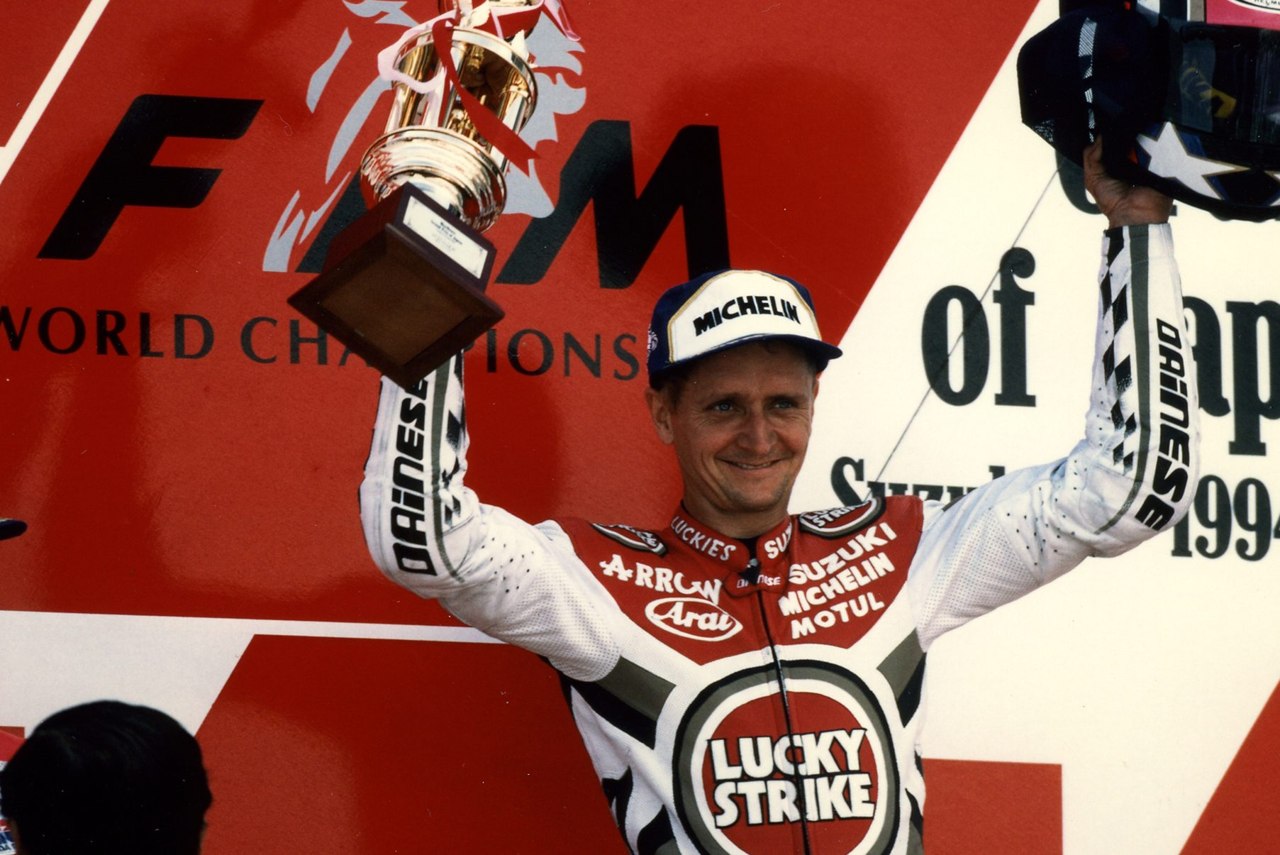 Photo: suzukipress.co.uk
Schwantz raced on as defending champion in 1994, but injuries, including those to his wrist, increasingly affected him. That year's British Grand Prix became his last 500cc victory, and that weekend too included a crash. Winning and physical wear were not two separate phases of his career.
He later recalled trying to improve his qualifying time on a new tyre whose one side had not reached the necessary working condition. When he accelerated again, he suffered a violent highside. Being thrown into the air, landing and facing the risk of the bike following him were real dangers of the period. Placing that experience before the win helps explain that his spectacular performances never came without a cost.
Injuries for an elite racer are not simply a matter of tolerating pain. Braking, changing direction, controlling the throttle and holding a riding position for long periods all require precise movement. A wrist that cannot move fully may directly change how a rider can operate the motorcycle. Pain and loss of function are related, but neither can stand in for the other.
Schwantz finished fourth in the 1994 standings and announced his retirement early in the 1995 season. He did not wait until his speed had disappeared. It can be harder to accept a rider stopping while spectators still expect great things than a natural decline in results. Ultimately, however, that career decision belongs to the person who bears its physical consequences.
Why No. 34 Is Easier to Remember Than a Trophy
Schwantz remained closely linked to Suzuki. The red-and-white bike, No. 34, his distinctive movements and the repeatedly replayed battles formed an unmistakable image. Viewers did not need to remember every season's points total to recognise him instantly on screen.
His number received a special tribute after retirement and became an important symbol in grand prix history. A number can preserve memory, but should not freeze a person into an icon capable only of attacking. The consistency of 1993, the search for better technique with his mechanics and the decisions made in the face of injury also belong to No. 34.
He won only one 500cc world championship and cannot be equated in every statistic with riders who won more. But sporting influence has more than one measure. Some riders change technical direction, some establish lasting dominance, and others let spectators feel the tension of competition in an unusually direct way.
Schwantz belongs to the last group, but not only that group. His world title proves that spectacle and effectiveness can meet in the same season, while the disappointments of earlier years show how difficult that combination was to achieve. Precisely because every year was not successful, the transformation of 1993 carries real narrative weight.
After Retirement, Still Learning to Ride Well
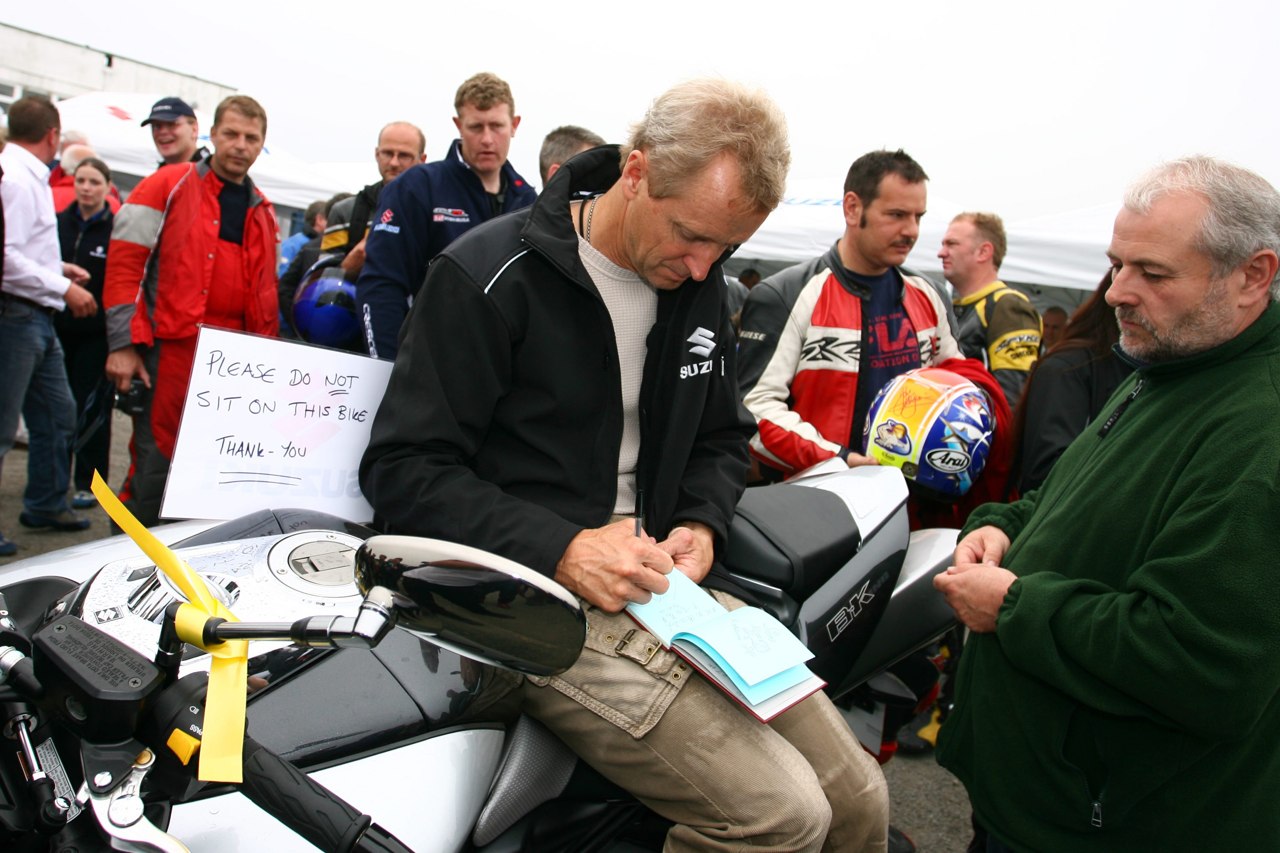 Photo: suzukipress.co.uk
Retirement did not take Schwantz completely away from motorcycles. He continued with riding instruction, brand events and racing-related work, passing on experience developed in professional competition. These activities also made the once-distant No. 34 someone the public could meet, talk with and learn from.
Suzuki later invited him to British Grand Prix activities, riding with fans, signing autographs and reuniting with former racing machines. These events should not be passed off as scenes from his 1990s racing career, but they demonstrate another kind of continuity: a motorcycle no longer fighting for that year's title can still help different generations of fans understand its era.
Teaching requires a different ability from racing. Actions a rider once completed rapidly through experience must be broken down into steps others can understand: how to read a line, how to use the brakes, and why the body can add unnecessary disturbance to the motorcycle. Turning “I know how” into “I can explain why” is another form of professional work.
In these recollections and lessons, Schwantz is willing to discuss mistakes, misjudgements and moments when he nearly lost control. That makes the legend more useful. Readers see not an idol who never failed, but an elite rider whose ability also developed through feedback, correction and accumulated experience.
In 2022, Suzuki arranged a display of championship-winning bikes at the London Motorcycle Show. Schwantz's 1993 RGV500 appeared alongside the title machines of Sheene, Lucchinelli, Uncini, Roberts Jr and Mir. Bringing bikes from different decades together made it easier to see that Suzuki's seven premier-class riders' crowns spanned different engines, chassis and team environments.
Preserved racing bikes can also correct impressions created by images. The bodywork is narrow, yet the rider must keep moving within that limited space. A stationary RGV500 scarcely looks like the machine capable of those famous moments. Restoration, preservation and display give history a tangible form to examine, leaving clues beyond photographs for later generations to understand the technology.
Looking Again at That Late-Braking Move
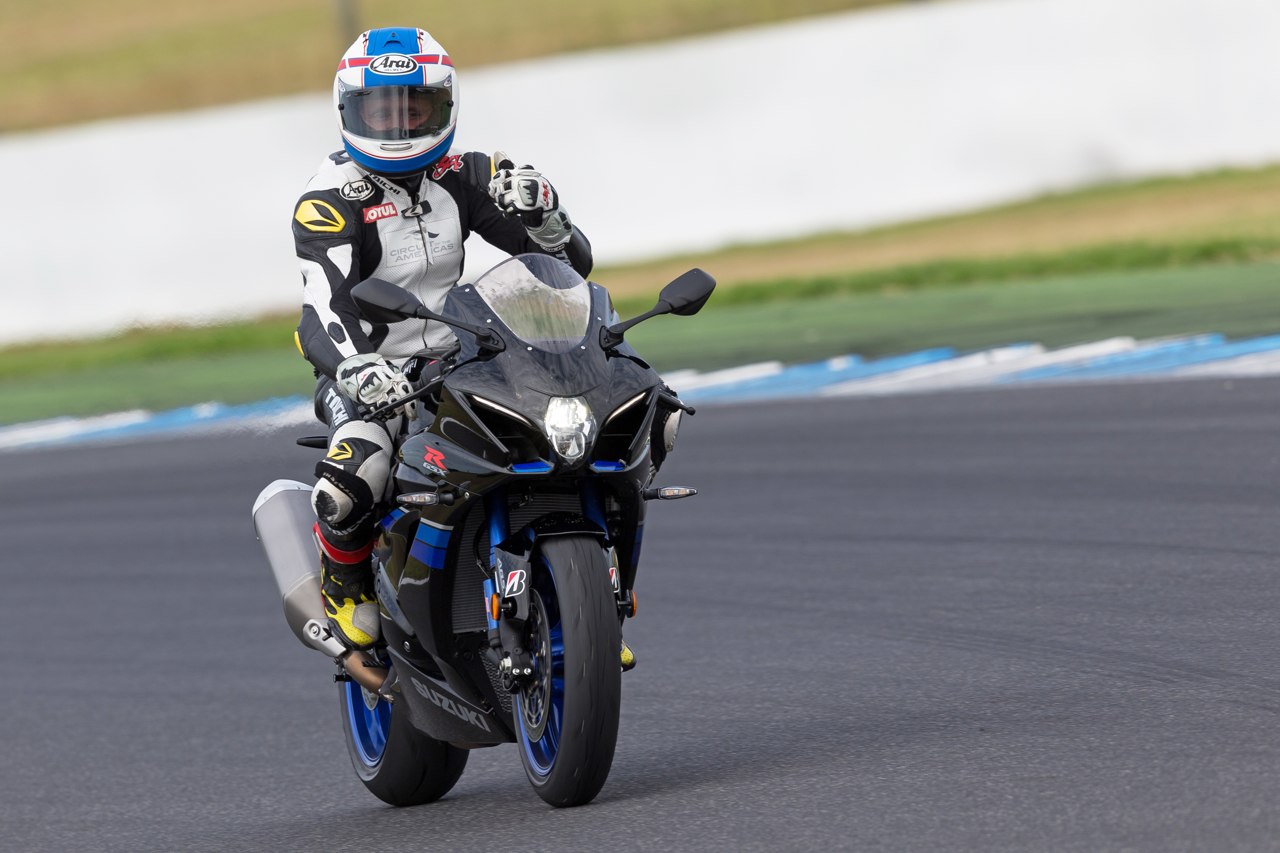 Photo: suzukipress.co.uk
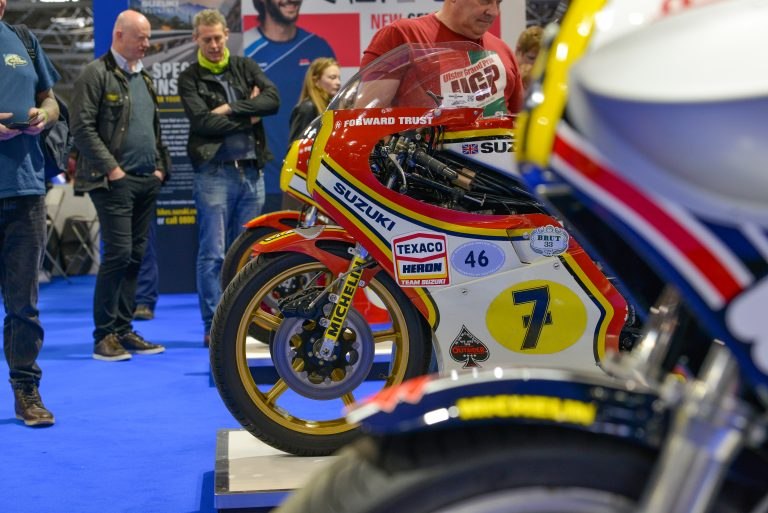 Photo: suzukipress.co.uk
Rewatching the final lap at Hockenheim in 1991 now reveals more than it first seemed to contain. It is not merely one man braking later than another. It includes the preparation through the preceding corners, compromises in defending the straight, judgement of distance in the slipstream and a succession of corrections after the unexpected.
It is watched repeatedly partly because planning and surprise coexist in the action. Schwantz did not complete the final lap exactly as intended, but kept finding solutions as circumstances changed. Body control, mechanical feel and judgement of the opponent worked in succession within seconds, leaving a result difficult to explain through slow-motion stills alone.
The deepest change in Schwantz's career happened between those famous images. He did not lose his attacking ability; he gradually learned to place it within a longer season. Accepting second or third in the present could be the way to finish first at the end. That transformation had no single image as vivid as Hockenheim's braking zone, yet it ultimately brought a world championship.
The 25 wins and the 1993 trophy are the competitive record. Rainey, Suzuki, injuries, retirement and the work afterwards make up the whole career of a person. Seen together, No. 34 stands for more than daring. It also represents how a gifted rider paid a price, adjusted himself and finally found a way to win an entire year.
Timeline
| Year | Key Milestone |
|---|---|
| 1964 | Born in Texas, United States |
| Mid-1980s | Emerged in American road racing and the Yoshimura Suzuki programme |
| 1986 | Grand prix debut at Assen |
| 1988 | Won the Daytona 200; first full 500cc season, with wins at Suzuka and the Nürburgring |
| 1989 | Six 500cc wins in one season |
| 1990 | Runner-up in the 500cc championship |
| 1991 | Beat Rainey on the final lap at Hockenheim |
| 1993 | Four wins and 248 points to become 500cc world champion |
| 1994 | Final grand prix win in Britain; fourth in the championship |
| 1995 | Retired early in the season; No. 34 became an important commemorative symbol |
Career Record
| Category | Record and Definition |
|---|---|
| Premier-Class World Championships | 1, in 500cc in 1993 |
| Premier-Class Grand Prix Wins | 25, all in the 500cc era |
| The 1993 Season | Four wins; podiums in each of the first nine rounds; 248 total points |
| First / Last Grand Prix Win | 1988 Japan, Suzuka / 1994 Britain, Donington |
| Main Manufacturer Partner | Suzuki |
| Other Major Honours | 1988 Daytona 200 winner; not included in the 25 grand prix wins |
| Statistical Scope | World titles and grand prix wins are counted in the premier 500cc class; the Daytona 200 is listed separately |
Sources and Further Reading
- MotoGP™ Riders | Kevin Schwantz
- Kevin Schwantz
- Kevin Schwantz: How I rode, Part 2 - Motor Sport Magazine
- 1993 - Racing Information | Yamaha Motor Co., Ltd.
- Ride to the British Grand Prix at Silverstone with Kevin Schwantz | Suzuki Press
- Suzuki icons past and present headline London Motorcycle Show | Suzuki Press
 Photo: globalsuzuki.com
Suzuki: Still Winning at the Final Race, So Why Did the Champion Team Leave?
From the RG500 to the GSX-RR: seven premier-class riders' titles, and victory and farewell at the final race of 2022.
Continue Reading · About 20 Minutes →