
Expand chapter contents · 11 chapters
- Two smaller-class titles came before Rossi’s premier-class career
- From NSR500 to RC211V: more than a bigger engine
- The move to Yamaha in 2004: the most convincing answer came at the first race
- After losing the title: back on top in 2008 and 2009
- Two close-quarters duels: Laguna Seca and Barcelona
- 2010: when his body first changed “keep fighting for the title” into “get back first”
- Two years at Ducati: even a legendary rider can struggle to find answers
- Back at Yamaha: the gap between winning again and becoming world champion again
- Five points in 2015: a pursuit close to success and full of controversy
- From the last win to the last lap: why is leaving so hard?
- After number 46: turning experience into someone else’s starting point
A yellow grandstand can make even someone unfamiliar with the riders remember one number: 46. Rossi’s influence has this immediately visible side; his colours, helmets and celebrations made him easy to recognise. But stopping at those symbols misses the most interesting part: this apparently ever-familiar rider was constantly confronting unfamiliar bikes, unfamiliar opponents and unfamiliar versions of himself.
He progressed from 125cc to 500cc, lived through the premier class’s move from two-strokes to four-stroke MotoGP, and won titles with both Honda and Yamaha. Later, the Ducati years failed to bring the success imagined, and returning to Yamaha no longer meant automatically becoming champion. Connecting these chapters turns the story of number 46 from that of a long-winning idol into that of an athlete learning to withstand change.
Two smaller-class titles came before Rossi’s premier-class career
Rossi was born in Urbino, Italy, in 1979 and grew up in Tavullia. He entered the 125cc world championship in 1996 and won the title on an Aprilia in 1997; after moving to 250cc, he won that class in 1999. Calling both trophies “MotoGP titles” today would erase the stages through which he actually developed.
Smaller-displacement racing also demands judgement of the highest quality. With limited engine power, riders particularly need to maintain corner speed and lose as little momentum as possible on exit; when close to a rival, the moment of leaving the slipstream or applying the brakes can change a position. These requirements are not identical to those of the larger bikes that followed, but they help explain how a rider gradually builds a racing toolkit.
In 2000, Rossi joined Honda and confronted the two-stroke 500cc machine directly. The class placed new demands on a rookie’s control of power and tyres. In his second season, 2001, he won the 500cc world championship. It was the last premier-class championship run under the old 500cc formula, permanently placing his record across two technical eras.
The 2000 British GP at Donington was the first time that progression truly broke into the premier class’s leading group. Rossi beat Kenny Roberts Jr and Jeremy McWilliams to take his first victory, while Roberts Jr still went on to win that year’s title. Separating the win from the season’s outcome gives a clearer view of Rossi then: he had proved he could win, but was still evolving from an explosive newcomer into a contender capable of managing a whole campaign.
The race’s impact went beyond points. British audiences were then highly interested in the Superbike World Championship, and Rossi’s Grand Prix win and distinctive image gave the discipline a memorable new face. His yellow leathers, number 46 and post-race celebrations made people want to watch him first, then gradually learn about the racing in which he competed. An idol is not created by promotion alone; the breakthrough on track gave those symbols a credible core.
From NSR500 to RC211V: more than a bigger engine
The four-stroke MotoGP era began in 2002. Honda’s RC211V became a defining bike of that phase, and Rossi won consecutive championships in 2002 and 2003. Together with his 2001 500cc crown, he now had three successive premier-class titles; beneath those three trophies, however, lay a major change of machinery.
The RC211V used a 990cc V-five engine, with a chassis and rear suspension designed to work with it. It was not simply an NSR500 with a larger engine: power delivery, responses under deceleration, and the way the chassis and tyres worked all demanded fresh understanding from the rider. Rossi had to translate the control he had learned on a two-stroke into actions suited to this four-stroke package.
This also raised a question that recurs in motorsport: does a championship come from the rider or the bike? It is an appealing question, but the two are hard to separate in practice. Without strong machinery, a rider struggles to sustain a title challenge; without someone able to develop and use it, a technical advantage may never deliver. Rossi’s next move gave observers another angle from which to examine that relationship.
The 2003 Australian GP offers a more concrete example than the word “dominance”. Rossi received a ten-second penalty for a yellow-flag infringement during the race, but stretched his lead at the finish to more than fifteen seconds and still won after the penalty was applied. Two times need to be understood here: the visible gap between the bikes and the adjusted margin used to determine the result were not the same figure.
That does not mean he could ignore the rules; on the contrary, the penalty remained and he had to recover its cost through actual lap times. Honda’s retirement retrospective also records that he reached the podium in all sixteen Grands Prix in 2003. One remarkable chase explains a particular Sunday; never falling outside the top three all season explains why he won a third title for Honda. Individual speed and the bike’s competitiveness operated at both scales.
Viewed across his Honda years, the hat-trick also involved two different tasks. First, he beat his rivals within the mature NSR500 system; then he turned the RC211V of a technical transition into a championship-winning bike. The first tested mastery of existing machinery, the second required adapting to a new set of feedback. Changing bikes did not wipe out past experience; it meant identifying which lessons remained useful and which actions needed to be learned again.
The move to Yamaha in 2004: the most convincing answer came at the first race
Rossi joined Yamaha in 2004. The M1 had not been a championship benchmark and had gone through the 2003 season without a race win. The move therefore posed a clear question: could he bring his proven ability to a project that needed improvement?
The first answer came at Welkom in South Africa. Starting from pole, Rossi repeatedly exchanged the lead with Honda-mounted Biaggi as the pair pulled clear. This was not a win inherited through a mass retirement of rivals, but a direct contest: Rossi won his first Grand Prix for Yamaha, turning the question of whether he could win with a new manufacturer into an established fact.
But winning the opener did not remove the development problems. Rossi later recalled that Yamaha let him compare different engine versions, and his choice was driven not simply by maximum horsepower but by smoother, more readable delivery. For an ordinary rider, “more power” may seem to mean “faster”; racing at the limit also asks where and with how much confidence the rider can deploy that power.
Smoother delivery does not mean conservative riding. It can help a rider build trust in the rear tyre earlier while the bike is leaned over, organise corner exits more consistently and preserve attention for lines and opponents. This gives rider feedback a concrete value: the rider need not draw the engine plans personally, but must accurately communicate how the alternatives differ on track.
The championship was not formally settled until the Australian round. After an intense fight with Gibernau, Rossi won by 0.097 seconds and secured the 2004 title with one round to spare. He finished that year with nine wins, then won eleven races and retained the title in 2005. South Africa proved that switching manufacturers could bring an immediate victory; the full-season results showed that the partnership could do more than make one brilliant debut.
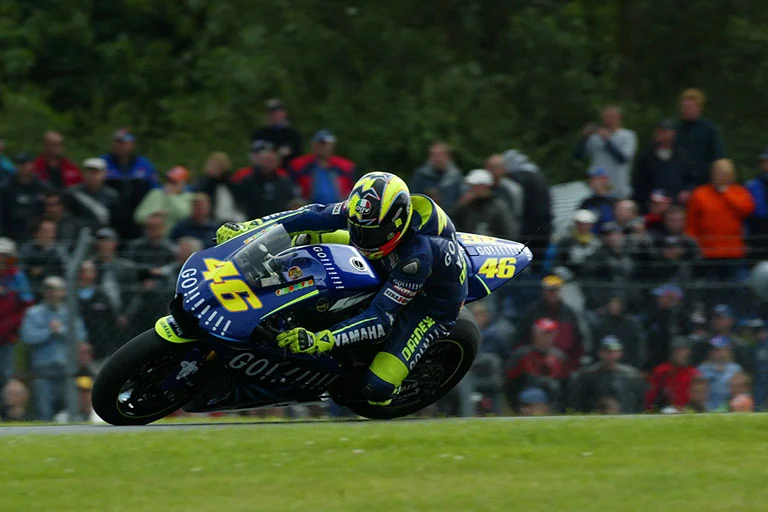 Photo: Yamaha official
After losing the title: back on top in 2008 and 2009
Valencia in 2006 ended his run of five titles. Rossi took pole in qualifying, but fell back after the start and crashed under braking on lap five. He rejoined and kept chasing, but it was not enough to stop Hayden winning the title. Pole showed that he had single-lap speed; the final championship order was determined by the entire season and the result actually achieved that day.
In 2008, Rossi switched to Bridgestone tyres and Yamaha welcomed the young Lorenzo. Teammates using different tyres complicated the team’s development and operations. Rossi regained the world title and retained it in 2009. What mattered in those years was not simply “rediscovering his form”, but rebuilding a complete, competitive way of racing after losing his advantage.
The tyre switch in 2008 was not a button that delivered instant success. At the Qatar opener, Rossi led for a time but finished only fifth, while teammate Lorenzo took second on Michelins. His partnership with bike and tyres gradually matured as the season progressed, and he sealed the title in Japan. Even in the same racing environment, changing one major technical element forces a rider to recalibrate braking, corner speed and race rhythm.
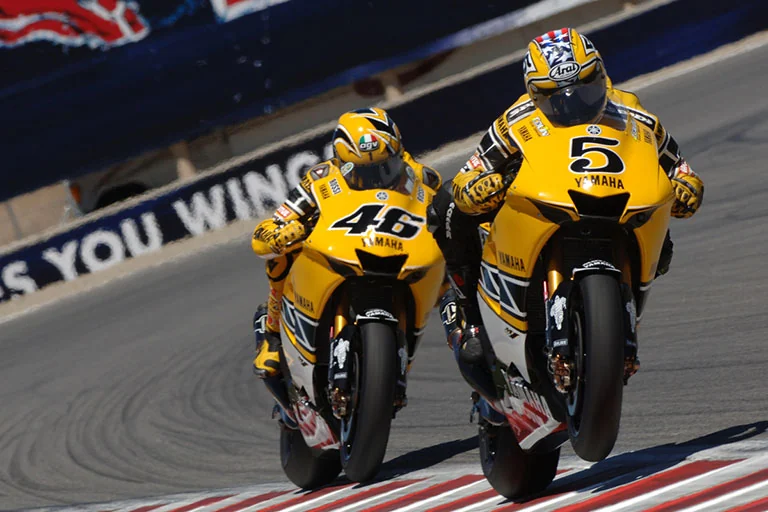 Photo: Yamaha official
Two close-quarters duels: Laguna Seca and Barcelona
Rossi’s fight with Stoner at Laguna Seca in 2008 became one of the season’s defining images. The hillside Corkscrew, two bikes repeatedly converging and intense attack and defence made the race much more complex than the brief verdict “Rossi won”. His opponent had speed; Rossi had to prevent the race becoming a solo time trial in which Stoner could freely set his rhythm.
His Yamaha retrospective lists it among his most important victories. For a rider who had just gone two seasons without a title, beating the reigning champion had a specific meaning: he was once again able to fight the strongest opponent head-on. There is no need to invent either man’s thoughts; their exchanges of position on track are enough to show how close the competition was.
At Catalunya in 2009, the challenge was his teammate Lorenzo. Both rode for the same manufacturer, so the result could hardly be explained simply by one bike having an advantage. Rossi passed at the final corner of the final lap to win a race repeatedly recalled by Yamaha riders and engineers. There was too little distance left to wait another lap; the braking and turn-in decision had to work at the first attempt.
These two cases make “experience” visible. It is not merely the number of years spent racing, but knowing when to hold a position, when to change line and when there is no second chance left. Nor does it guarantee victory: rivals learn too, and a veteran’s previously successful move may be blocked in advance next time. Rossi’s 2008 and 2009 titles were won amid precisely these changing encounters.
2010: when his body first changed “keep fighting for the title” into “get back first”
An injury at Mugello in 2010 interrupted Rossi’s season. For a rider long accustomed to fighting near the front at every round, injury changed more than his points total: his training schedule, the physical load of riding and confidence in approaching the limit all had to be rebuilt. His target changed accordingly. The immediate problem was how to complete a race again; only then could he discuss returning to the title fight.
On his return at the German GP, he could already fight for a podium again, but Stoner passed him at the last corner and he finished fourth. That result has more layers than a simple “return of the king”: the competitiveness was certainly there, but returning to the grid and regaining control of a race are different things. Neither his body nor his opponents stopped making demands because of his past titles.
He left Yamaha at the end of the season. Seven years together had brought four premier-class titles, along with complex memories of competing against Lorenzo within the team. The Ducati venture that followed was therefore not an utterly dominant champion casually changing colours, but a major change of direction after injury, internal rivalry and a shift in career stage.
Two years at Ducati: even a legendary rider can struggle to find answers
In 2011, Rossi left Yamaha for Ducati. Pairing an Italian rider with an Italian manufacturer invited great expectations, but the reality was difficult. Across two seasons, Rossi won no races and reached the podium only three times. Earlier success did not automatically transfer to this bike.
This experience should not be reduced to one person’s failure. A bike’s power, chassis, tyre behaviour and the rider’s habits are interlinked; changing one element often affects the others. Rossi’s previous titles at both Honda and Yamaha did not prove that he could quickly find the same feel within any technical system.
Why could this move not repeat Yamaha in 2004? At least one overly convenient explanation can be ruled out: being a world champion is not an ability to bypass a machine’s characteristics. Front-end feedback, the bike’s attitude approaching the apex, corner-exit grip and its willingness to follow the intended line all influence whether a rider can consistently approach the limit. Solving one of those problems does not guarantee that the others disappear.
It is equally unfair to work backwards from the result and say “they should have known it would fail”. At the time of the move, people knew he had won titles with two manufacturers, but could not know in advance where the new pairing would lead. Three podiums in two years show that the project did not meet its objectives; they do not, by themselves, prove that one rider or engineer should bear all responsibility. Acknowledging failure without inventing a single cause is the right measure for this chapter.
Back at Yamaha: the gap between winning again and becoming world champion again
Returning to Yamaha in 2013, Rossi faced a changed paddock. Lorenzo had already won world titles there and Márquez was Honda’s rookie; the situation awaiting him was no longer one he could simply resume commanding. He needed to readjust to a familiar bike and accept that he now had to share limited opportunities with younger rivals.
Victory at Assen ended a long winless spell and proved he could still win. Yet qualifying position, performance across different circuits and consistent scoring still separated one victory from season-long competitiveness. Returning to the top step gave him a reason to continue; the subsequent championship standings would test how long that competitiveness could last.
Finishing championship runner-up in three successive seasons, 2014, 2015 and 2016, gave the comeback its true weight. This was not a former champion occasionally finding favourable conditions; he could still compete at the very highest level for long periods. But “still fighting for the title” also meant accepting that he might fall just short: neither experience nor supporters could turn second place into first for him.
Five points in 2015: a pursuit close to success and full of controversy
In 2015, Rossi and Lorenzo took the title fight to the final round. Penalised over the Malaysian GP incident, Rossi started last at Valencia, in twenty-sixth place; Lorenzo started from pole. Although the teammates rode for the same manufacturer, their tasks at the start were almost entirely different.
Rossi reached fifteenth on the opening lap, then continued through the midfield to finish fourth. But the three riders ahead had already pulled away, and the chase had taken its toll on his tyres. He could no longer change the outcome through his own finishing position alone. Lorenzo held off the two Hondas behind him, won the race and took the championship by five points.
Controversies in the closing rounds have kept that season in fan discussions ever since. Rossi publicly expressed his disappointment, while the official result remained Lorenzo as champion and Rossi as runner-up. Coming so close to a tenth title across all classes intensified the regret; it also showed that a rider in his thirties could keep the championship in doubt until the final race day.
The finale also exposed the real costs of chasing. Passing a rider may require a different line, later braking and another acceleration, all using tyres and time. Climbing from twenty-sixth to fourth was already a major gain, but did not mean he could keep closing on the leading three at the same rate. The most visibly dramatic position changes and the gap that actually decides a championship sometimes occur in two different areas of the track.
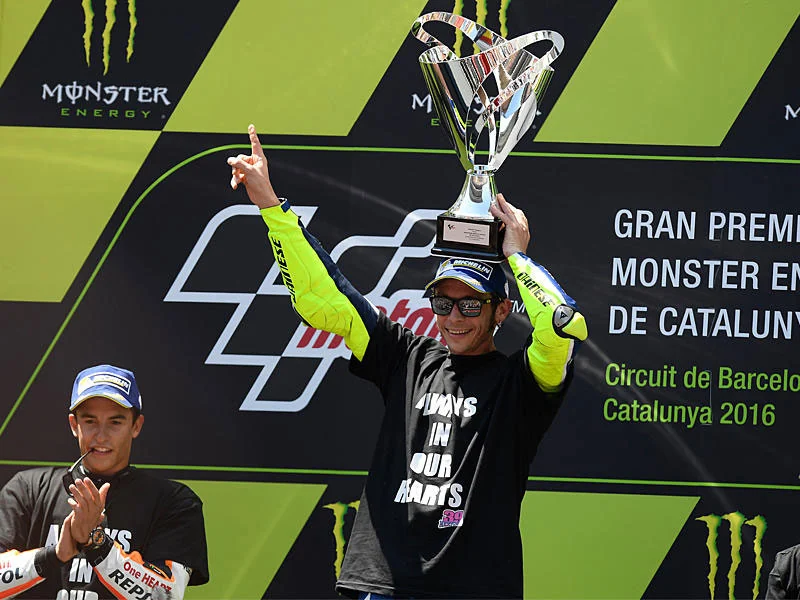 Photo: Yamaha official
From the last win to the last lap: why is leaving so hard?
His last premier-class win, at Assen in 2017, was far from easy. Petrucci challenged him in the closing stages, while rain drops affected the circuit. Petrucci later recalled using his acceleration advantage to get ahead before being repassed, then encountering lapped riders on the final lap. The race demanded simultaneous judgement of grip and opponents, rather than cruising to the finish at a fixed lap time.
Only later did people know it was Rossi’s last premier-class Grand Prix win. At the time, he was still seeking a result for that season, not writing his career’s ending on track. Looking back makes it easy to load every image with portents, but real races provide no such cues. That is precisely why the final win and final start deserve to be remembered separately.
Assen in 2017 became the last Grand Prix victory of Rossi’s career. Podiums and fine duels followed, but no further wins. Those who had followed him for years began to confront a slower, less obvious change: the familiar number 46 was still on the grid, but the leading roles in races increasingly belonged to the next generation.
In 2021, he moved to Yamaha’s satellite team and ended his motorcycle Grand Prix career at Valencia. He departed with 89 premier-class wins and 199 premier-class podiums; including 125cc and 250cc brought the totals to 115 Grand Prix victories and nine world titles. Both sets of figures are valid; they answer different questions.
The closing phase of such a long career also showed spectators that leaving racing cannot be done at the press of a button. Racing had organised a person’s entire schedule: training, travel, testing and waiting for the start all revolved around it. Rossi did not leave the paddock after exiting the premier class, but devoted more and more energy to developing the next generation of riders.
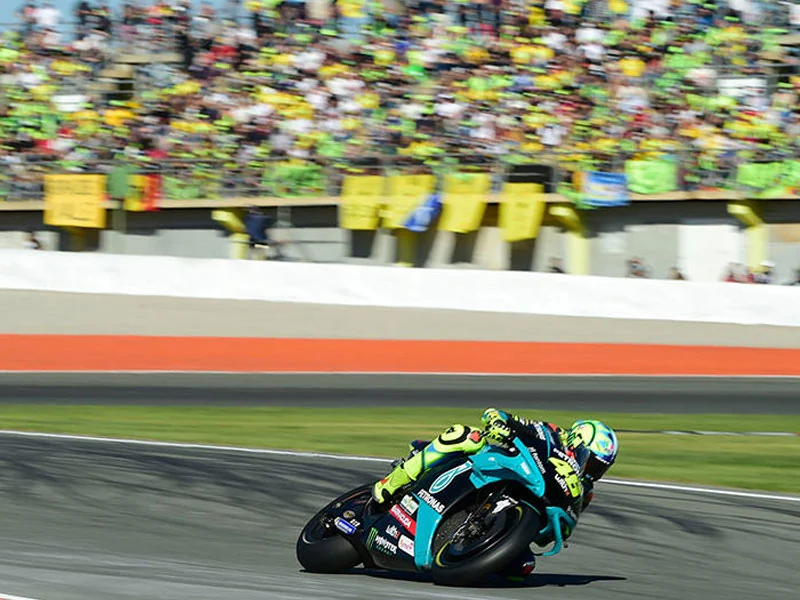 Photo: Yamaha official
| Statistical scope | World titles | Race wins |
|---|---|---|
| Premier class: 500cc + MotoGP | 7 | 89 |
| All classes: 125cc + 250cc + 500cc + MotoGP | 9 | 115 |
After number 46: turning experience into someone else’s starting point
The VR46 Riders Academy was formally founded in 2014. The young riders named in its launch announcement included Bagnaia, Morbidelli and Luca Marini. The programme extended beyond riding practice to fitness, mental preparation, technical support and career development: reaching a world championship grid requires a young rider to manage far more than one-lap speed.
This change added another scale to the latter part of Rossi’s story. As a rider, his results were determined by his own finish line; as a mentor, his work would gradually become visible through other people’s progress. Grandstands could still gather for number 46, while younger names in the paddock began to connect with his training system.
Seven premier-class championships are enough to place Rossi among the most important riders in history. But after reading his career, what deserves to stay with us is what happened between those seven titles and after them: changing manufacturers, losing an advantage, a poor match, returning and ultimately passing experience to others. The yellow did not disappear with retirement because this story no longer belonged only to a champion still racing.
The academy’s founding announcement also set out support beyond riding: mental preparation, fitness and career development were all included. This makes “passing on experience” observable work, rather than a retired champion’s parting words. A young rider may have speed without yet knowing how to plan long-term training, communicate with a team or begin again after a bad weekend.
Rossi’s own racing career has a clear endpoint, but the work of the academy and team need not be measured by the same results sheet. Young riders’ achievements may demonstrate the value of that support, but their own labour and judgement should not all be credited to their teacher. The yellow number 46 remains in the paddock by providing opportunities and experience, allowing another group to keep racing under their own names.
View sources · 21 entries
- Yamaha: Rossi’s career profile through 2010
- MotoGP: Valentino Rossi rider profile
- MotoGP: first premier-class win at Donington in 2000
- MotoGP: the 2000 British GP and Rossi’s first generation of fans
- Honda: Rossi retirement retrospective, the NSR500 and RC211V years
- Honda technical archive: the RC211V’s 990cc V5 engine and bike layout
- Yamaha: GP history in the 2000s
- Yamaha: 2004 South African GP, victory on his debut after switching manufacturers
- Yamaha: Rossi looks back on 2004–2010, engine choices and classic races
- Yamaha: announcement of the title secured at the 2004 Australian GP
- Yamaha: 2006 season archive and the Valencia defeat
- Yamaha: the 2008 season and tyre switch
- Yamaha engineers: Welkom, Laguna Seca and Barcelona
- MotoGP: Rossi career retrospective
- MotoGP: 2010 German GP comeback, losing the podium at the last corner
- FIM: the 2015 Valencia finale and championship
- FIM: Rossi penalty decision at the 2015 Malaysian GP
- FIM: Rossi inducted into the MotoGP Hall of Fame
- MotoGP: Márquez and Rossi’s seven-title statistics
- MotoGP: Petrucci recalls the closing stages at Assen in 2017
- VR46: formal launch of the Riders Academy in 2014
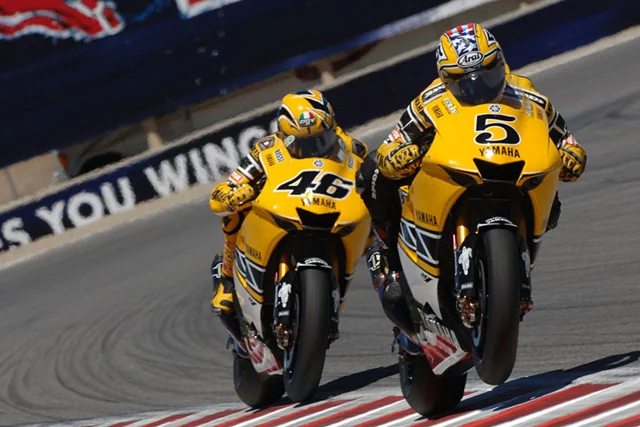 Photo: Yamaha official
Yamaha: Champions change, but how do you build a bike riders trust to go fast?
Continue reading · 14 minutes →