
Expand chapter contents · 11 chapters
- First, a distinction: Yamaha the manufacturer is not the factory team’s name in any given year
- Agostini’s move: opening a door into the two-stroke era
- Roberts, Lawson and Rainey: three kinds of champion
- Suzuka 1987: a mismatched rear wheel brings a home victory
- 1992: how did Rainey claw his way back to a third title?
- Understanding the YZR500: translating a rider’s discomfort into engineering
- The M1 and Rossi: turning a bike that suits its rider into title-winning speed
- 2006 and 2007: choosing a new direction after two title defeats
- One garage, two champions: a test of speed and management
- Quartararo in 2021: a new champion emerges from another garage
- By 2025, even tradition faces a new test
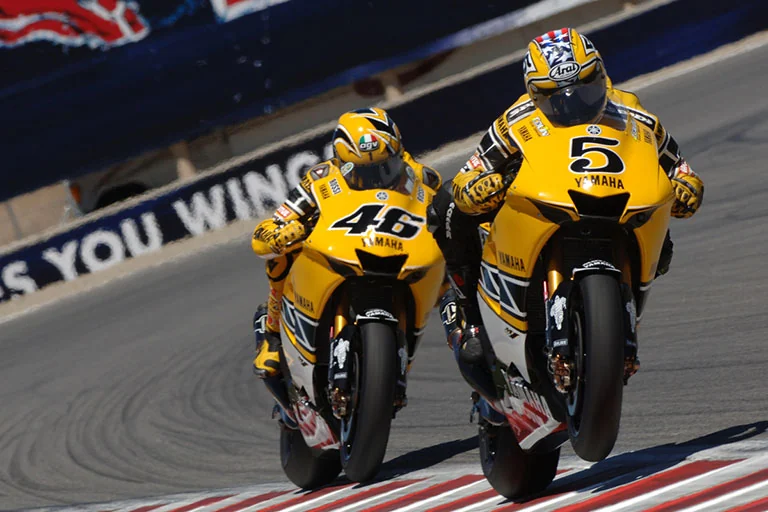
A photograph of a yellow-and-black racing bike is a good place to begin understanding Yamaha. Some will think of Kenny Roberts; others of Rossi’s anniversary livery at the United States GP. The same colours spanned the two-stroke and four-stroke eras, but the technology did not stay the same: riding techniques, tyres, engines and electronics had all changed enormously.
That is what gives a manufacturer’s history more lasting interest than the record of a single champion. Champions arrive and leave; lessons learned by one generation of bikes cannot necessarily be carried unchanged into the next. Yamaha keeps answering the same concrete question: how can a machine’s potential become speed that a rider can feel, trust and willingly use again and again?
First, a distinction: Yamaha the manufacturer is not the factory team’s name in any given year
Yamaha began racing in the motorcycle world championship in 1961. Its early efforts focused on smaller-displacement classes; only after moving into the premier 500cc class did it gradually build the succession of champions familiar to fans today. Treating the brand’s first year of competition as the founding year of a MotoGP factory team would conflate different classes and the organisational arrangements of different eras.
In 1973, Yamaha returned to Grand Prix racing as a factory team and entered 500cc. Jarno Saarinen won on the YZR500 at the opening round in France, but subsequently died in an accident in the 250cc race at Monza, dealing a heavy blow to that year’s factory programme. Its premier-class beginnings thus contained both a technical breakthrough and an inescapable loss.
Looking back, it is also necessary to distinguish the manufacturer, the factory team and the other teams using Yamaha bikes. The organisation that designs and builds a machine does not always correspond directly to the one that enters and operates it in a particular season. Yamaha’s accumulated titles reflect both its ability to supply bikes and technology over many years and the work of different teams in actually taking them racing.
Yamaha’s three levels of involvement in the paddock
Sponsor names and operating partners change; the brand’s honours and those of an individual team need to be considered separately.
Agostini’s move: opening a door into the two-stroke era
In 1974, Giacomo Agostini joined Yamaha after building a formidable reputation at MV Agusta. For spectators used to associating his name with Italian four-stroke machinery, the move meant an already successful rider choosing a different technical path. In 1975, he won Yamaha’s first 500cc riders’ world title.
The power response of a two-stroke racing bike places heavy demands on tyres and rider control. Development therefore concerns more than peak horsepower: it also involves helping riders use the power earlier and more consistently. Agostini’s title opened the way for Yamaha’s long-term involvement in premier-class competition; the Americans who followed would change the riding techniques and culture along that path.
Hideo Kanaya’s role gave “team support” a concrete meaning. He won the Austrian round in 1975, but then returned to Japan to focus on bike development in support of Agostini’s title challenge. Being less visible on podiums in the latter part of the season did not mean that his work had disappeared from the championship programme.
Yamaha had already won the 500cc manufacturers’ title in 1974; the riders’ title came in 1975. Keeping those years separate also helps distinguish the brand’s overall results from an individual rider’s season. Agostini’s move gave new technology an experienced user, while developers and testing work made that partnership last to the end of the season.
Roberts, Lawson and Rainey: three kinds of champion
Kenny Roberts brought his American dirt-track background to Grand Prix racing, winning three consecutive 500cc world championships from 1978 to 1980. The yellow-and-black livery and his conspicuous movement off the bike in corners created a powerful visual memory. Meanwhile, Yamaha was using technologies such as exhaust valves to improve the usability of its two-stroke engines. Changes in riders and changes in machinery drove each other forward.
Eddie Lawson then won titles for Yamaha in 1984, 1986 and 1988. Wayne Rainey’s championships followed from 1990 to 1992. These three generations of American riders cannot simply be assigned the same style; their battles with rivals also forced the engineering department to keep seeking a better balance between stability, power and tyre use.
In 1993, Rainey suffered severe injuries in an accident at Misano, forcing a change in his career. Yamaha still had outstanding riders and memorable victories afterwards, but it never won another riders’ title in the 500cc era. That gap shows why developing the next champion and keeping a bike competitive must happen together; after losing a pivotal figure, even a successful team can struggle for years to recover its former rhythm.
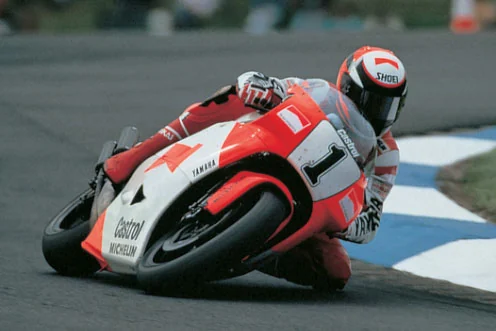 Photo: Yamaha official
Suzuka 1987: a mismatched rear wheel brings a home victory
The Japanese Grand Prix returned to the calendar after twenty years, taking place at Suzuka in 1987 and bringing the 500cc world championship to Japan for the first time. In practice, Yamaha rider Randy Mamola tried a rear wheel and tyre prepared for wildcard Norihiko Fujiwara. He liked the feel and kept the blue rear wheel for the race.
Its colour did not quite match the rest of the livery, but that did not stop it doing its job. In the wet, Mamola took the lead on the opening lap and eventually beat Wayne Gardner by around 42 seconds. For team boss Kenny Roberts, what mattered most was whether the rider could trust the tyre, not whether every patch of colour in the photographs matched a single visual scheme.
This small episode in technical history reveals how specific trackside work can be. Beyond tyre brands and specifications, riders need to find the right feel in real conditions; engineering and management must judge when that feedback is sufficient to justify a decision. Yamaha’s home victory thus left behind a rear wheel that remains recognisable in photographs.
1992: how did Rainey claw his way back to a third title?
Mick Doohan won repeatedly at the start of 1992 and built a substantial points lead. After being injured at round eight, he missed the next four rounds as Rainey steadily closed the gap. By the finale at Kyalami in South Africa, Doohan led by only two points. What had seemed a secure position in the first half of the year had become a championship battle in which every finishing position at the last race had to be calculated.
Rainey finished third and Doohan sixth, giving the Yamaha rider his third consecutive title. That outcome encompassed both Rainey’s pursuit and the fact that his rival’s injuries had changed the conditions of competition. Keeping both elements in view explains the reversal over the season without depicting it as a sudden loss of ability on either side.
At the same time, the YZR500’s engine firing intervals were changed during the season. Yamaha’s technical history identifies this adjustment as an important development that year: engineers were trying to improve the way power acted on the tyres so riders could use the performance more effectively. Points decide a championship, but physical condition, race judgement and mechanical development all work behind those points.
Understanding the YZR500: translating a rider’s discomfort into engineering
Yamaha developed V4 two-stroke engines and the Deltabox frame in the eighties, then gained further experience with data logging in the nineties. An easily overlooked point matters here: Yamaha did not always build only inline-four premier-class bikes. The later M1’s inline-four tradition should not obscure the YZR500’s technical history.
When riders say they lack confidence in the front end or cannot bring themselves to open the throttle earlier on corner exit, engineers must turn those words into mechanical questions that can be tested. Frame stiffness, mass distribution, suspension movement and engine response all affect the same corner. Data logging helps make comparisons, but it cannot replace the rider’s sense of a tyre approaching its limit.
For new viewers assessing a bike’s quality, it is worth watching whether it lets the rider repeat similar actions lap after lap. One exceptionally quick lap may come from a risk; consistent speed over many laps relies more on the bike’s feedback. Yamaha’s technical retrospectives repeatedly show how designers incorporate “what it feels like to ride” into development, instead of merely comparing the highest numbers on a specification sheet.
The YPVS exhaust-valve system offers an accessible example. It changes the position of a valve near the exhaust port according to engine speed, aiming to improve pulling power at low and medium revs while retaining high-rev performance. For the rider, the value is not in learning another acronym, but in whether power arrives in a more manageable way when accelerating again after a slow corner.
The introduction of monoshock suspension followed a similar logic. Yamaha brought ideas from off-road racing to road-racing bikes, then adapted travel, damping and mounting arrangements to the application. Technology does not circulate only within a single racing environment: an idea can come from another form of competition and, through redesign, become a tool that Grand Prix riders want to use.
By 1989, Rainey’s YZR500 used a thirty-channel data logger recording information such as engine speed, throttle opening, brake pressure and tyre slip. A rider’s comment that “something is wrong in this corner” could now be compared with a corresponding section of data. It did not make every decision for the rider, but it meant the garage no longer had to rely solely on memory to reconstruct what the bike had just done.
The following year’s YZR500 brought further changes to power and frame geometry, and Rainey took fourteen podiums and seven wins in fifteen rounds to secure his first title. This path from recording to improvement deserves as much attention as engine specifications: how performance is discovered, interpreted and repeatedly verified is also part of a championship-winning bike.
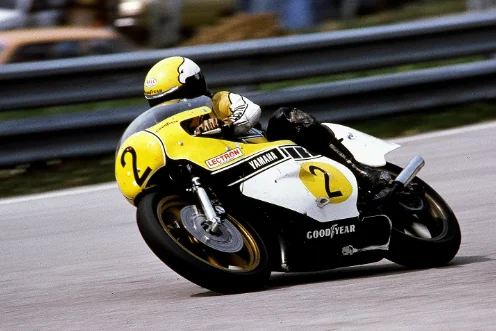 Photo: Yamaha official
The M1 and Rossi: turning a bike that suits its rider into title-winning speed
The four-stroke MotoGP era began in 2002, and Yamaha introduced the YZR-M1. It did not immediately become the strongest bike: Biaggi could win, but overall performance still lagged behind the main rival; in 2003 there were no race wins at all. When Rossi arrived in 2004, he faced a project that needed improving together, not a bike already prepared to carry a champion.
Yamaha’s official technical history records the testing and selection of different engine concepts at the time. One key direction was finding the right relationship between power characteristics and rider feel. Rossi won his first race after joining, at Welkom in South Africa, and took consecutive titles in 2004 and 2005. It demonstrated the quality of an outstanding rider, and the engineering team’s ability to respond to problems.
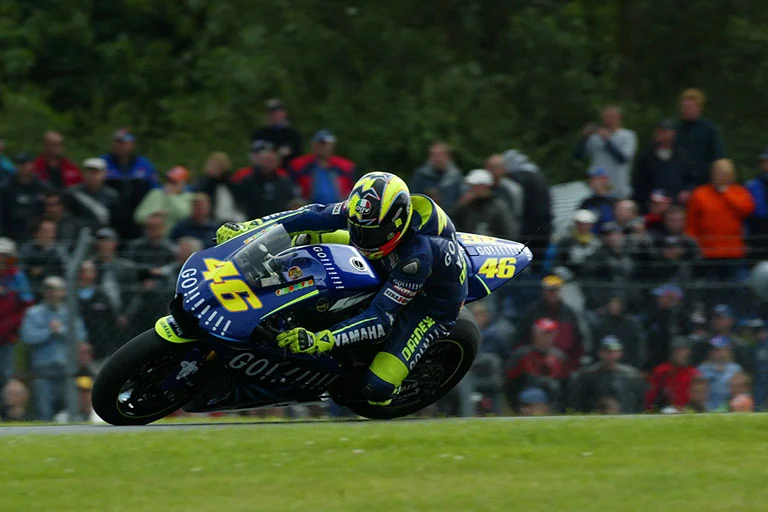 Photo: Yamaha official
2006 and 2007: choosing a new direction after two title defeats
Rossi won consecutive titles in 2004 and 2005, but Yamaha could not sustain that advantage indefinitely. In 2006 there were bike and tyre problems as well as his crash at the Valencia finale; Honda’s Nicky Hayden ultimately took the championship. When the 800cc era began in 2007, Stoner and Ducati became the strongest combination, and Yamaha had to confront a new performance deficit.
Two successive seasons without the title gave the changes in 2008 a clear context. Rossi switched to Bridgestone tyres while new teammate Lorenzo stayed with Michelin, requiring one factory team to meet the demands of two tyre packages separately. Sharing the M1 name did not mean either side of the garage could copy the other’s setup; with different tyres, the way the bike gave feedback to its rider had to be explored anew.
Rossi went on to win in 2008 and 2009, with Lorenzo becoming champion in 2010. Yamaha had shown that the M1 could support different riders through a successful full season. A “revival” in team history does not erase the preceding two years of failure; it means understanding more clearly what needs to change after those setbacks, then testing the changes across an entire season.
One garage, two champions: a test of speed and management
Lorenzo’s development meant Yamaha no longer revolved around a single superstar. In 2012, he won the title with exceptional consistency, taking 16 podiums in 18 rounds. Seasons like this should not be read only for the excitement of last-lap overtakes; repeatedly bringing home the best available result is also racing ability at the highest level.
Technology did not stand still either. Developments such as the seamless gearbox aimed to reduce the disturbance that gear changes caused to the bike’s attitude and power delivery. These improvements were often less visible to television viewers than a new livery; for a rider spending dozens of laps close to the limit, small gains in stability could change how far they dared to push the brakes and throttle.
By 2015, the direct contest between Rossi and Lorenzo had made matters more complex again. At the finale, Lorenzo needed to turn pole into victory, while Rossi came from last on the grid to fourth. The two sides of the garage faced different tasks on the same day, and the final championship margin was just five points. Having two title contenders demonstrates a manufacturer’s strength, but sustaining such a partnership also means enduring continuous internal pressure.
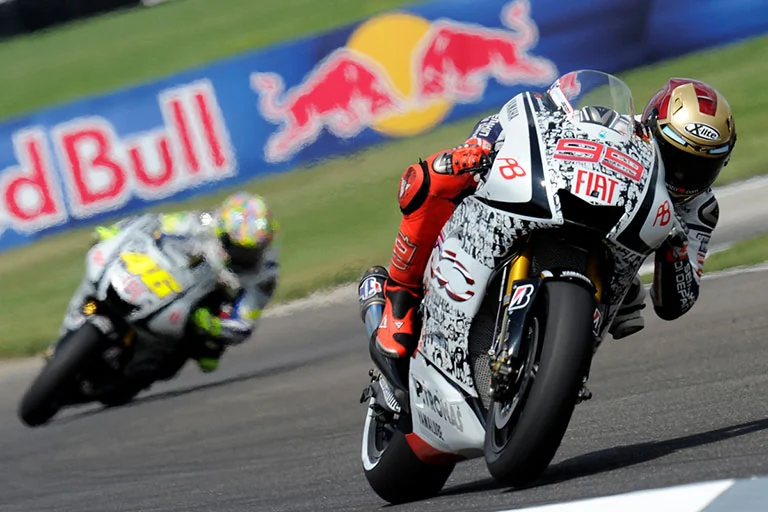 Photo: Yamaha official
Quartararo in 2021: a new champion emerges from another garage
Quartararo entered MotoGP with a Yamaha satellite team in 2019, took his first win in 2020 and moved to the factory team in 2021, winning the world championship. His path makes the value of a manufacturer supporting other teams tangible: more bikes on the grid provide not only data but also opportunities for young riders who have yet to establish a championship-winning record.
In 2021, he sealed the championship at the Emilia-Romagna round with races to spare, ending Yamaha’s wait for a riders’ title since 2015. It was also Yamaha’s 18th premier-class riders’ championship. Compared with Roberts, Rainey and Rossi in earlier years, he rode a machine shaped by different electronics, tyres and aerodynamics, yet still needed to build reliable points-scoring form across an entire season.
Explaining this success simply as a fixed “Yamaha riding style” would erase differences between people. A more useful question is whether the team can identify what a young rider does genuinely well and provide an environment in which those abilities can flourish. Moving from satellite team to factory team to champion, Quartararo offered a successful example of that development path.
Quartararo’s development contrasts with Rossi’s arrival in 2004. Rossi came to Yamaha with proven world championship ability, while Quartararo first showed his potential in another team using Yamaha bikes before entering the factory structure. A brand needs both established riders who can lead immediately and a route through which young riders can gradually assume greater responsibility.
The eighteenth title was therefore the accumulated work of several generations. Agostini’s one, Roberts’ three, Lawson’s three and Rainey’s three, together with Rossi’s four, Lorenzo’s three and Quartararo’s one, make up this article’s table of premier-class championships. Each rider’s honours with other brands remain part of his individual record and are not transferred to Yamaha.
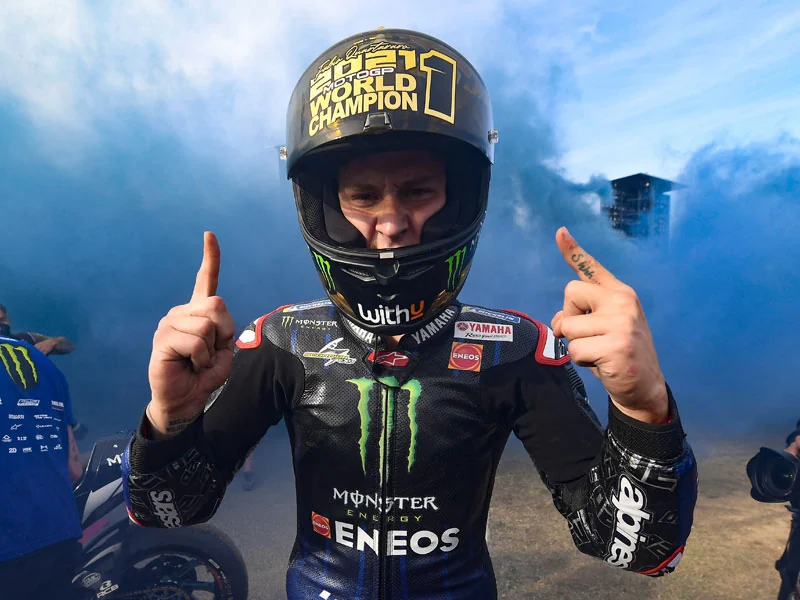 Photo: Yamaha official
By 2025, even tradition faces a new test
Competition did not become easier after the title. MotoGP’s aerodynamics, tyres and overall bike requirements continued to change, and familiar strengths might no longer offset deficits elsewhere. At the end of 2025, Yamaha confirmed that the M1 would switch to a V4 engine from the 2026 season, ending the inline-four direction it had maintained throughout the four-stroke MotoGP era.
That decision makes a fitting pause in this history. The M1’s inline-four approach helped Rossi, Lorenzo and Quartararo win eight riders’ championships, but success does not require it to remain unchanged forever. Choosing a new layout is not itself a guarantee of a title: the new engine still needs to work with the chassis, tyres, electronic controls and rider to become an improvement on track.
Returning to that yellow-and-black photograph, what Yamaha can truly pass on may be less an eternally fixed configuration than a commitment to addressing the problems riders raise. The champions’ names have changed from Agostini to Quartararo, the machines from YZR500 to M1, but the story keeps asking: when a rider leans into the next corner, can he trust the bike beneath him?
| Rider | Premier-class title years with Yamaha | Total |
|---|---|---|
| Giacomo Agostini | 1975 | 1 |
| Kenny Roberts | 1978、1979、1980 | 3 |
| Eddie Lawson | 1984、1986、1988 | 3 |
| Wayne Rainey | 1990、1991、1992 | 3 |
| Valentino Rossi | 2004、2005、2008、2009 | 4 |
| Jorge Lorenzo | 2010、2012、2015 | 3 |
| Fabio Quartararo | 2021 | 1 |
View sources · 11 items
- Yamaha: GP history in the 1970s
- Yamaha: GP history in the 2010s
- Yamaha: GP history in the 1980s
- Yamaha: GP history in the 1990s
- Yamaha: GP history in the 2000s
- Yamaha: Rossi’s career profile through 2010
- Yamaha: 2006 season archive
- Yamaha: 2008 season archive
- FIM: the 2015 Valencia finale and championship
- Yamaha: 2021 season review and 2022 racing plans
- MotoGP: Yamaha confirms V4 switch for 2026
 Photo: Yamaha official
Valentino Rossi: From teenage champion to paddock elder, how did number 46 span the eras?
Continue reading · 17 minutes →