
Expand the Chapter List
- An aviation company first built a small motorcycle for the road
- The first world title came in 125cc
- Surtees took MV to the top of 500cc
- From Hocking to Hailwood, the champion's seat stayed occupied
- How a three-cylinder racer became the image of an era
- 1967: the title was not decided in the most famous race
- Five years of double titles: factory strength met superb execution
- After the Count's death, Read secured the last two premier-class titles
- The two-stroke challenge changed the questions facing the whole motorcycle
- Victory at the Nürburgring did not turn back time
- The riders and classes behind seventy-five titles
- From a racing programme to an enduring, recognizable memory
- Timeline
- Honours record
In 1976 at the Nürburgring, Giacomo Agostini rode an MV Agusta to victory in the 500cc German Grand Prix. By then he had already won world titles for Yamaha, and Suzuki had become a new centre of the title fight. MV's red-and-silver machine could still reach the finish first, but it would never win another premier-class Grand Prix.
That victory marked a seam between eras. It belonged to a rider who had experienced different factories and engine generations, and to an Italian manufacturer that had made annual titles a long-standing habit. From 1958 to 1974, MV riders won the 500cc world championship for seventeen consecutive years. Add the first title in 1956, and its history contains eighteen premier-class riders' crowns.
Starting with small-capacity motorcycles, MV took Surtees, Hailwood, Agostini and Read to the premier-class championship podium. Champion riders changed, yet the factory kept winning. As Japanese two-stroke racers caught up, however, the most successful partnerships gradually came apart. This rise and decline connects the expansion of the post-war motorcycle industry with a shift in racing technology.
An aviation company first built a small motorcycle for the road
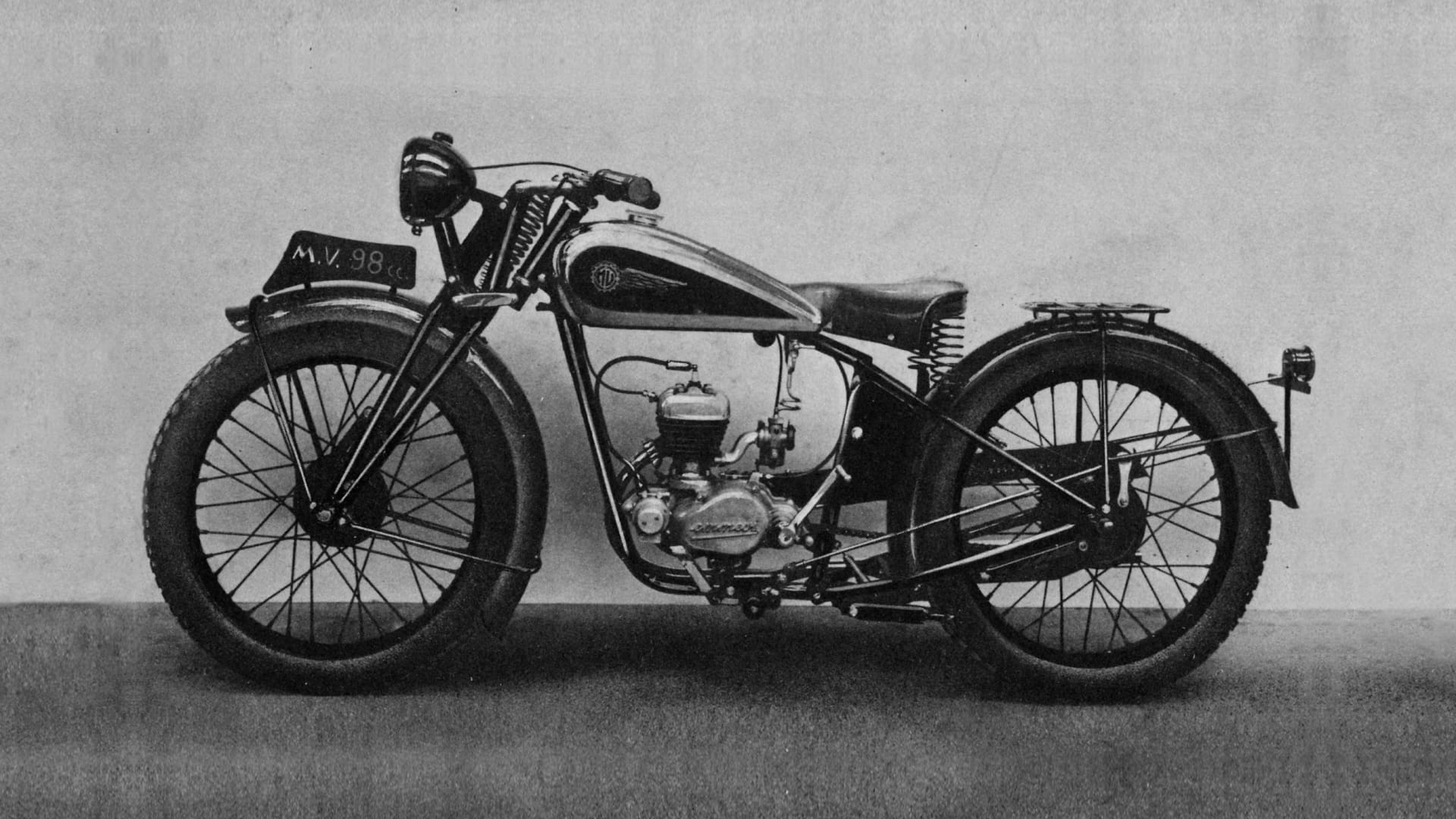 Image source: MV Agusta
The name MV comes from Meccanica Verghera and is linked to the Agusta family. Around the end of the Second World War, restrictions on its aviation business prompted the family to turn to motorcycles. The MV 98 introduced in 1945 was far removed from the formidable large-capacity racers that followed: its first task was to help people get moving again.
The aviation background provided machining expertise and experienced personnel, but it did not deliver world titles directly. The factory still had to learn to build motorcycles that could be used on roads, sold and maintained. Racing then introduced another set of questions: whether engine, frame, transmission and brakes could work together under sustained high-speed running was much harder to answer than anything in a static display.
Domenico Agusta placed racing at the centre of the brand's development. Winning could give an unfamiliar motorcycle credibility, while riders gave the public a way to recognize the marque. The Agusta Museum's retrospective treats this approach as an important element of early brand-building: performance on track and the consumer's imagination were becoming closely connected.
Racing and road products nevertheless remained two connected but distinct jobs. A machine that could sustain high power in a race did not naturally become cheap, quiet and easy to maintain. Much of MV's later appeal came from that distance: people bought road motorcycles while hoping to approach the speed represented by the factory racers.
The first world title came in 125cc
MV's world championship story began with Cecil Sandford. In 1952, the British rider won the 125cc title on an MV. The world championship was only a few years old, and manufacturers were establishing their place in an emerging international system. Success in the small-capacity class was no footnote to the premier-class story; it was part of the factory's education in winning an entire season.
Leslie Graham was another important figure in this period. He had won the inaugural 500cc world championship for AJS in 1949 before joining MV. The factory's large-capacity programme therefore gained a rider familiar with competition at the highest level: as its smaller racers began winning titles, MV was also preparing people and machines for a 500cc challenge.
The factory also recruited technical staff from other Italian racing programmes. Piero Remor and Arturo Magni had worked at Gilera before contributing to MV's early racing efforts. Remor designed MV's early 500cc and four-stroke 125cc racers. Such movements of people meant a new manufacturer did not have to work through every mechanical problem from the beginning on its own.
In a retrospective interview with Motor Sport, Sandford said he had first seen the MV only after arriving on the Isle of Man, and first ridden it in TT practice. That preparation was very different from today's image of lengthy pre-season testing. A rider had to understand a machine quickly through limited time on it, while the factory had to place its trust in someone who did not yet know the bike completely.
Carlo Ubbiali joined MV in 1953 and regained the 125cc title in 1955. In 1956 he won both the 125cc and 250cc championships, repeating the double in 1959 and 1960. Small-capacity machines, so often overlooked by spectators, thus became a major pillar of MV's trophy cabinet.
Ubbiali won eight world titles with MV. With his 1951 125cc crown for Mondial, his personal total reached nine. Five MV titles in 125cc and three in 250cc made him the core of the brand's small-capacity effort. When Surtees later began winning repeatedly in the larger classes, Ubbiali was still accumulating victories for the factory elsewhere.
Small-capacity racing is a particular reminder that speed is about more than displacement. With less power, momentum lost in a corner is harder to recover on the straight. Riders must keep their lines flowing, while engines must deliver consistently from limited capacity. That experience did not lose its value merely because faster premier-class machines later appeared.
Surtees took MV to the top of 500cc
John Surtees moved from Norton to MV in 1956 and won the 500cc world title in his first season. Trained in mechanical engineering, he understood how machines worked as well as how to ride them. Bringing track impressions back to the garage and discussing improvements with technicians was a central part of factory development at the time; Surtees could understand both languages.
Surtees' first title also coincided with a changing competitive landscape. Gilera star Geoff Duke had been suspended by the FIM for supporting a riders' strike and missed some races. MV seized the opportunity to put its name on the 500cc riders' championship roll for the first time, although a lost title still separated that breakthrough from the long dominance to follow.
Surtees could not defend his title in 1957. At the end of that year, the Italian motorcycle industry made a collective decision to withdraw from Grand Prix racing. Gilera, Mondial and Moto Guzzi stopped their factory efforts; MV ultimately chose to continue. The impact of inexpensive cars on motorcycle sales was now affecting decisions over racing resources.
After Gilera and the others left, MV remained a principal factory force in the larger classes. It could maintain its personnel and development while the opposition had contracted markedly. From 1958, Surtees turned those favourable conditions into a sustained run of championship results.
For the next three years he won both the 350cc and 500cc world titles. For MV this was more persuasive than a single first championship: the factory could now keep one rider competitive across whole seasons in two large-capacity classes. Both machine performance and the rider's execution had to remain consistent to make that continuity possible.
Surtees began racing in F1 in 1960, left motorcycle racing at the end of the year and later won the 1964 F1 world championship for Ferrari. MV was losing no ordinary rider, but a man who had just completed three successive championship doubles. The next question was concrete: the machines remained, but could the winning method keep working with someone else aboard?
Surtees left with four 500cc titles and three in 350cc. His successor inherited a motorcycle refined over several seasons of competition, but still had to turn that accumulated work into fresh results through his own riding. MV's run of championships also became a history of rider succession.
From Hocking to Hailwood, the champion's seat stayed occupied
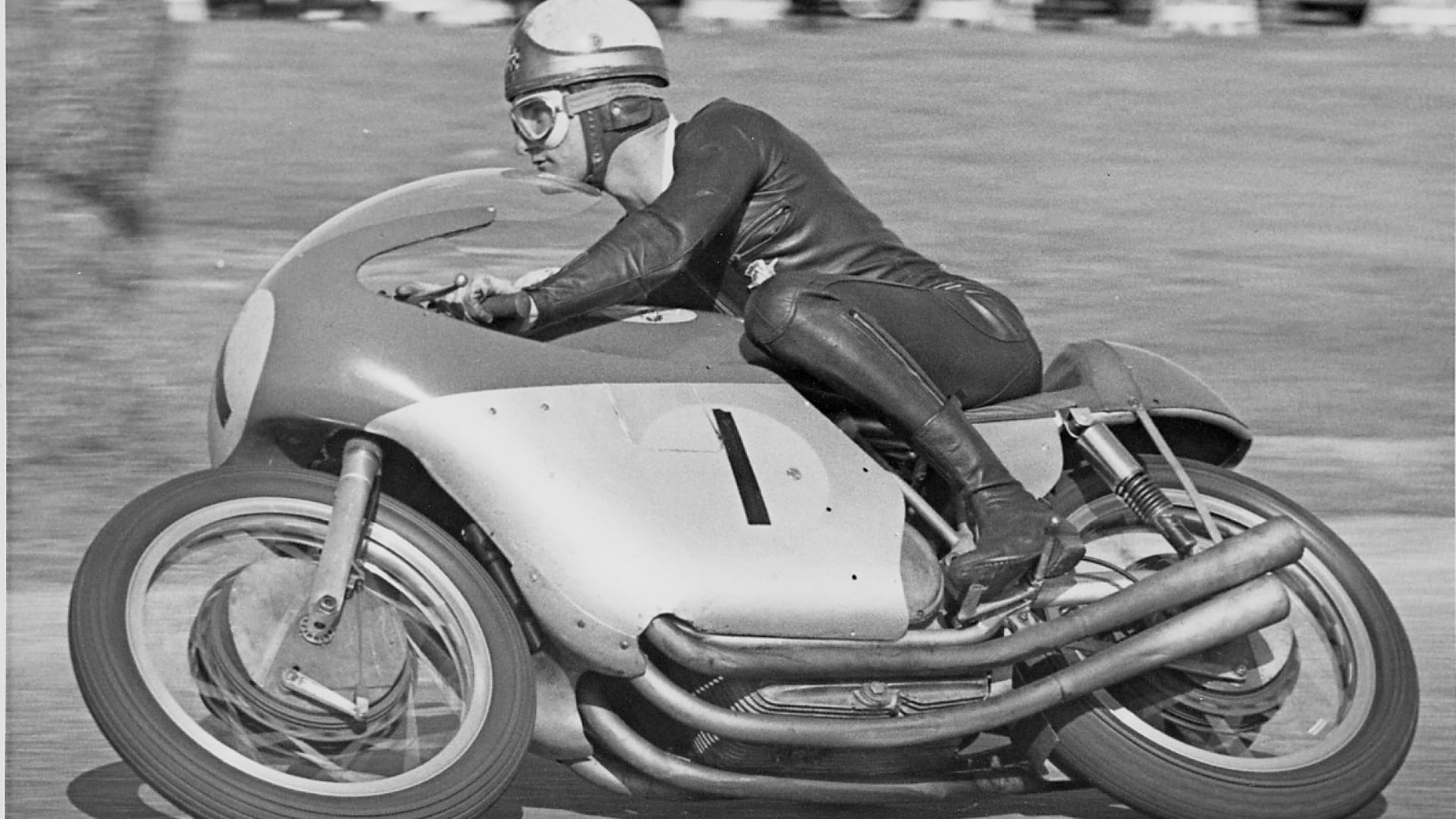 Image source: MV Agusta
In 1961, Gary Hocking won the 350cc and 500cc titles for MV. His name often passes quickly between Surtees and Mike Hailwood in condensed histories, yet he performed a real succession role. That year's 500cc championship kept MV at the top after its leading star had departed.
Hailwood then became the central figure, winning four consecutive 500cc world titles from 1962 to 1965. His ability was not confined to big bikes: he had already won the 250cc world championship on a Honda in 1961. At MV, he combined experience across classes with the factory's machinery to extend the marque's championship streak.
Racing across classes required one rider to adapt to different braking points, power delivery and shifting rhythms. Actions mastered in one class could not necessarily be transferred unchanged to another motorcycle. Hailwood's success with different capacities and manufacturers showed that MV had recruited a champion who could quickly understand new machinery, rather than simply someone accustomed to one bike.
Nor did MV rely only on Italian riders to build an Italian marque's reputation. Sandford, Surtees, Hocking, Hailwood and later Phil Read formed an international chain of personnel. The factory was in Italy, but from an early stage its racing operation depended on riders' experience from elsewhere and the test of European circuits.
In 1965, the young Agostini joined MV alongside Hailwood. The factory gave the newcomer opportunities in 350cc and 500cc, with a reigning champion beside him. They worked together in the garage and measured their speed on track. That year's learning would soon feed into a direct contest after Hailwood left.
How a three-cylinder racer became the image of an era
Agostini and the MV inline-three racer became one of the marque's most recognizable historical images. In 1965, he took his first Grand Prix victory at the Nürburgring on the new 350cc triple. At the same time, Hailwood was still winning on MV's four-cylinder 500cc. Beneath the red-and-silver paint, the factory was developing different engine concepts in parallel.
Cylinder count affects more than sound. At similar total capacity, layout can change cylinder dimensions, usable engine speeds, the number of parts and the engine's shape. The engine must also be packaged with the frame, intake and exhaust, transmission and rider position. Engineers were not trying to maximize one parameter, but to make the whole motorcycle more effective on track.
The three-cylinder concept deserves to be remembered because it became a key tool in MV's middle period of competition, accompanying Agostini to many victories. It also shows that a winning manufacturer continued to change its machinery. A long championship sequence may look smooth, but it cannot have come from leaving the same components untouched for more than a decade.
Whether a racer worked well was ultimately tested by its rider at a particular circuit. Straights demanded power, corner entry demanded stability, and exits tested the relationship between throttle and grip. In 1965 Agostini had already won rounds in both 350cc and 500cc and finished runner-up in both championships, giving the factory's new partnership a foundation for further title challenges.
The triple and Agostini then entered their most successful period together. An engine layout became memorable through repeated victories, while a rider became closely associated with a marque through years aboard its machines. By the time he left MV, changing motorcycles almost meant changing the public's entire image of him.
1967: the title was not decided in the most famous race
Hailwood returned to Honda in 1966, leaving Agostini at the centre of MV's effort. Team-mates quickly became rivals. Their battle in the 1967 Isle of Man Senior TT became one of the event's most celebrated chapters: a champion who knew MV well was challenging his successor on another manufacturer's machine.
Late in the race, Agostini had led by twelve seconds. On lap five, the MV's chain broke near Windy Corner, taking away his chance of victory. Hailwood won and set a lap record of 108.77 mph that stood until 1975. Rider performance and mechanical reliability had jointly decided the race.
The championship contest lasted until the Canadian finale. Hailwood won again, leaving the pair tied on counted points and five victories apiece. The next comparison was second places: Agostini took the title by three to two. A failure on the Isle of Man had cost him a win, but the points brought home elsewhere ultimately protected his championship.
The season therefore had two equally vivid endings. Hailwood won the most famous duel and held the Isle of Man lap record for eight years; Agostini won the championship and preserved MV's title streak. Speed in a single race and finishing results across a season each left their own mark.
The duel also provides a reference point for later discussions about the strength of opposition. Agostini had already won two 500cc titles before Honda withdrew; direct contests with Hailwood were part of his record. The subsequent change in the field is equally essential to understanding the championship streak that followed.
Five years of double titles: factory strength met superb execution
Honda withdrew from Grand Prix racing after 1967, changing the factory competition in the premier class. From 1968 to 1972, Agostini swept both the 350cc and 500cc riders' world titles for five consecutive years. He and MV entered their most dominant phase, binding the marque's name firmly to sustained victory.
MV concentrated its main results in both classes on one rider. Agostini switched between 350cc and 500cc, while mechanics prepared two sets of racers. For five seasons, riders, technical staff and race arrangements revolved around this two-class task, ultimately yielding ten riders' world titles.
Engines had to last the race, the rider had to avoid mistakes, and the team had to get two sets of machinery to different circuits. Even with greater speed, a missed start, mechanical failure or crash could erase a victory. The broken chain at the 1967 TT had taught MV a vivid lesson: lasting success still had to be completed one race at a time.
At the same time, such superiority could obscure how quickly competition was developing elsewhere. Japanese manufacturers kept working on two-stroke engines and customer racers, gradually making high performance available to more entrants. MV's results still looked impressive, but the coming challenge was already about more than another rider fitting better tyres.
By 1973 the threat had moved from development workshops to Grand Prix grids. Yamaha was no longer competing with European marques only in the smaller classes. Its new 500cc two-stroke would enter the very territory MV had occupied for so long.
After the Count's death, Read secured the last two premier-class titles
Domenico Agusta died in 1971, and the racing programme lost its long-standing leader. The family business then faced new management arrangements while the factory team kept competing. The rider and technical structures built during the Count's life still supported MV's titles, but the people deciding on long-term investment had changed.
In 1973, Phil Read won the 500cc world championship for MV while Agostini retained the 350cc crown. MV still held both riders' titles, but the trophies no longer belonged to one man. Agostini's seven-year 500cc reign ended, while the marque's premier-class streak continued for the time being.
Read was no novice called in at short notice. He already held world titles in 125cc and 250cc and had extensive experience with different machinery. After Agostini moved to Yamaha in 1974, Read won the 500cc title again, completing his own consecutive pair with MV. His name belongs fully in the factory's final chapter of premier-class glory.
The two championship tables from 1974 offer a snapshot of that technical transition: Read kept the 500cc riders' title for MV, while Yamaha won the manufacturers' championship. Agostini's new project already had speed, and MV's established champion partnership could still win over a full season.
The riders' championship measures an individual's points; the manufacturers' title measures a marque's results under its applicable rules. That the latter had changed hands while the former remained with MV shows that competitive advantage did not transfer neatly in one instant. Such a transition is closer to the real development of racing than declaring an era suddenly over on a particular day.
The two-stroke challenge changed the questions facing the whole motorcycle
Yamaha entered 500cc as a factory team in 1973. Jarno Saarinen won the opening French Grand Prix on the YZR500 and then won in Austria. He was later killed in the Italian round's 250cc race, and Yamaha stopped its remaining factory races that season. The new technology had nevertheless already shown that it could challenge MV directly.
The operating cycle of a two-stroke differs from that of a four-stroke, with a different frequency of power strokes and different intake and exhaust arrangements at the same engine speed. This offers performance potential but also creates problems of power delivery, combustion, exhaust and reliability. A theoretical advantage does not automatically make a motorcycle faster at every circuit.
Yamaha's subsequent 0W23 showed that the new competition involved more than engine type. The factory reorganized the engine and frame to make the motorcycle lighter and more compact, and adopted a cassette gearbox that was easier to change. Setup therefore concerned garage efficiency and adapting the bike quickly to different circuits, rather than merely pursuing a peak-power curve.
Agostini won the 500cc world championship on a Yamaha in 1975, creating the new winning partnership after MV's long streak. Four wins and two second places gave him the counted points to beat Read. The man who had most embodied MV personally demonstrated that another manufacturer's motorcycle could carry him through a championship campaign.
MV's difficulty was not that its earlier machines had suddenly become worthless, but that continuously improving opponents were expanding the advantages they could use. A mature technical system could still win some races without being able to defend a full-season title through the same investment and methods. Competitiveness in particular races and the long-term direction of the programme began to diverge.
Victory at the Nürburgring did not turn back time
In 1976 Agostini raced an MV again, winning the 350cc Dutch round and the 500cc German round. The 500cc victory at the Nürburgring became his final Grand Prix win and MV's last at the top level. A familiar rider and marque met again on a changing racing landscape.
The season's main story belonged to Suzuki, however, as Barry Sheene won the 500cc world championship. MV could still win at the Nürburgring, but the centre of the season-long competition had shifted towards Japanese manufacturers. The old champion's last victory and the rise of a new champion occurred in the same year.
Four-strokes then disappeared from the premier-class winners' list for many years, returning to the leading role only with the new MotoGP rules in 2002. By then capacity limits, materials, tyres and electronics had changed: a new generation of racers was returning. MV's 1976 victory became the full stop to the previous four-stroke era.
MV's traditional factory racing operation stopped in the 1977 season. The Agusta Museum places that decision in the context of an expanding helicopter business and a struggling motorcycle industry. Corporate resources and direction were shifting. In 1982 the original motorcycle production operation also ceased, making the racing withdrawal part of a wider change.
The red-and-silver racer's final first-place finish preserved the most moving element of that ending: even as it departed, it could still win a particular race. Continuing into another season, however, was a decision involving people, development and corporate direction, one that a final trophy alone could not replace.
The riders and classes behind seventy-five titles
In its 2025 eightieth-anniversary announcement, MV used the figure “seventy-five world championships”: thirty-eight riders' titles and thirty-seven manufacturers' titles. They span several capacity classes and include different awards won in the same season. This is an aggregate of the marque's Grand Prix honours, not seventy-five separate seasons.
For 500cc premier-class riders' championships alone, the figure is eighteen: four for Surtees, one for Hocking, four for Hailwood, seven for Agostini and two for Read. The years 1958 to 1974 form the seventeen-title streak, with 1956 as a separate season. Breaking it down makes the length of the dominance easier to understand.
Agostini won thirteen world titles at MV: seven in 500cc and six in 350cc. He later added one in each class at Yamaha to reach his personal total of fifteen. Agostini contributed the most to MV's tally, while other riders extended the marque's success into earlier years and different capacity classes.
Ubbiali's 125cc and 250cc machines, Hailwood's 500cc racer, and the motorcycles Agostini used across two classes together form MV's championship garage. Each category needed factory development and a suitable rider. Beyond the eighteen premier-class crowns, an entire field of small-capacity racing supported the marque's reputation.
From Sandford in 1952 to Read in 1974, these honours span more than two decades. Champions moved to rivals and leading riders left motorcycle racing, yet their successors kept winning. MV's rarest achievement was to connect several riders' individual peaks into one long period of success.
From a racing programme to an enduring, recognizable memory
In 1992, Cagiva under Claudio Castiglioni acquired the MV marque. Road models such as the F4 later brought the name back to prominence. The red-and-silver colours, sound and champions left by the factory racers entered the design and promotion of a new generation of road products. A reputation built on racing victories remained attractive years after racing had stopped.
The eightieth-anniversary models of 2025 continued to honour early MV history through historic emblems. The announcement recalled racing titles alongside road products, bringing the two histories together again. What began as a small motorcycle for post-war transport had become a machine people bought specifically for speed, appearance and craftsmanship.
Perhaps MV's most important legacy is that it lets us see the factory and the rider together. Without the machine, a star cannot display all his ability; without someone who understands it and finishes races, even the finest mechanism will not win titles by itself. Sandford, Ubbiali, Surtees, Hocking, Hailwood, Agostini and Read each carried a different part of the work. The knowledge engineers and mechanics retained through rider changes spared the next generation a complete restart, while newcomers' different feedback kept that knowledge from becoming only an answer to the past.
Its ending did not erase the earlier success. When competition changes, old champions must decide anew how to invest. Some manufacturers change direction and keep chasing; others leave. MV's final win at the Nürburgring shows both the heights it had reached and the fact that height alone cannot guarantee a future.
Looking back at the red-and-silver machines, there is more to remember than the exhaust note. The fuller picture is of people repeatedly building, riding, repairing and improving racers over more than twenty years, creating a championship sequence extraordinarily hard to reproduce. The legend comes from that work actually done, not from explaining every later change as destiny.
Timeline
| Year | Milestone |
|---|---|
| 1945 | MV's motorcycle business began with the MV 98 |
| 1952 | Sandford won the 125cc world title |
| 1956 | Surtees won MV's first 500cc riders' title; Ubbiali took a small-capacity double |
| 1958—1960 | Surtees won both 350cc and 500cc titles for three consecutive years |
| 1961 | Hocking won the 350cc and 500cc titles |
| 1962—1965 | Hailwood won four consecutive 500cc titles |
| 1966—1972 | Agostini won seven consecutive 500cc titles |
| 1968—1972 | Agostini won both 350cc and 500cc titles for five consecutive years |
| 1973、1974 | Read won two 500cc riders' titles for MV |
| 1975 | Agostini won on a Yamaha, ending MV's premier-class riders' title streak |
| 1976 | Agostini took MV's final 500cc victory at the Nürburgring |
| 1977、1992 | The traditional factory racing operation stopped; Cagiva later acquired the marque |
Honours record
| Category | Record and scope |
|---|---|
| 500cc Riders' World Championships | 18: 1956 and 1958–1974 |
| Consecutive premier-class riders' titles | 17: 1958–1974 |
| 500cc champion riders | Surtees 4, Hocking 1, Hailwood 4, Agostini 7, Read 2 |
| Riders' world titles across all classes | 38, as counted in MV's eightieth-anniversary announcement |
| Manufacturers' world titles across all classes | 37; combined with 38 riders' titles to give 75 |
| Agostini's world titles with MV | 13: seven in 500cc and six in 350cc |
| Statistics cutoff | End of the 2025 season; historic Grand Prix results exclude demonstration events, other competitions and modern road products |
Sources and Further Reading
- Isle of Man TT: the 1967 Agostini–Hailwood duel
- MotoGP: Agostini rider profile
- FIM: Phil Read tribute
- FIM 2023 Yearbook: world champions
- MotoGP: Hailwood rider profile
- Laureus: Agostini profile
- MV Agusta: official eightieth-anniversary announcement
- MV Agusta: brand history
- Agusta Museum: MV motorcycle history
- Isle of Man TT: official event history
- Motor Sport: retrospective interview with Sandford
- MotoGP: Surtees rider profile
- MotoGP: Ubbiali rider profile
- Yamaha: company racing history in the 1970s
- Yamaha: museum entry for the 1975 YZR500 (0W23)
 Image source: MV Agusta
Giacomo Agostini: beyond fifteen titles, how he stepped outside his championship era
Beyond fifteen titles and 122 wins: his battles with Hailwood, his choice over the Isle of Man, and learning anew after joining Yamaha.
Continue reading · About 19 minutes →