
Expand the Chapter List
- Before becoming “Ago”, he was a hillclimb racer
- Hailwood was both a team-mate and the standard he had to surpass
- His first 500cc title did not end their rivalry
- A chain on the Isle of Man and a second place in Canada
- Ten titles in five years: even a huge advantage required finishing races
- After ten TT victories, he decided not to return to race
- Read's title made the seemingly permanent number one a challenger again
- His first Daytona win came outside world Grand Prix racing
- The 350cc title came first; 500cc had to wait another year
- In 1975, he learned to turn second place into a championship
- Back on an MV, his last Grand Prix win came at the Nürburgring again
- Fifteen titles, and a man who stayed in the garage
- Timeline
- Career Record
At the 1975 Czechoslovak Grand Prix, Phil Read led on an MV Agusta, but Agostini had no need to catch him. The Yamaha rider finished second, scoring enough points to take his eighth 500cc world championship and his fifteenth across all classes.
This time he was not riding the MV that had made him an Italian hero, but a Japanese two-stroke. Leaving a factory that had given him thirteen world titles required more than courage: he had to learn a new motorcycle, accept defeats and trust that a new partnership could deliver. The title was secured at the finish, but the decision had been made more than a year earlier.
Agostini's most striking figures are fifteen titles and 122 Grand Prix victories. His career's depth, however, lies in the turns between those numbers. He learned alongside Hailwood, then fought him for titles; dominated two classes, then refused to keep contesting a dangerous race; and finally crossed a technological divide to become another manufacturer's first premier-class riders' world champion.
Before becoming “Ago”, he was a hillclimb racer
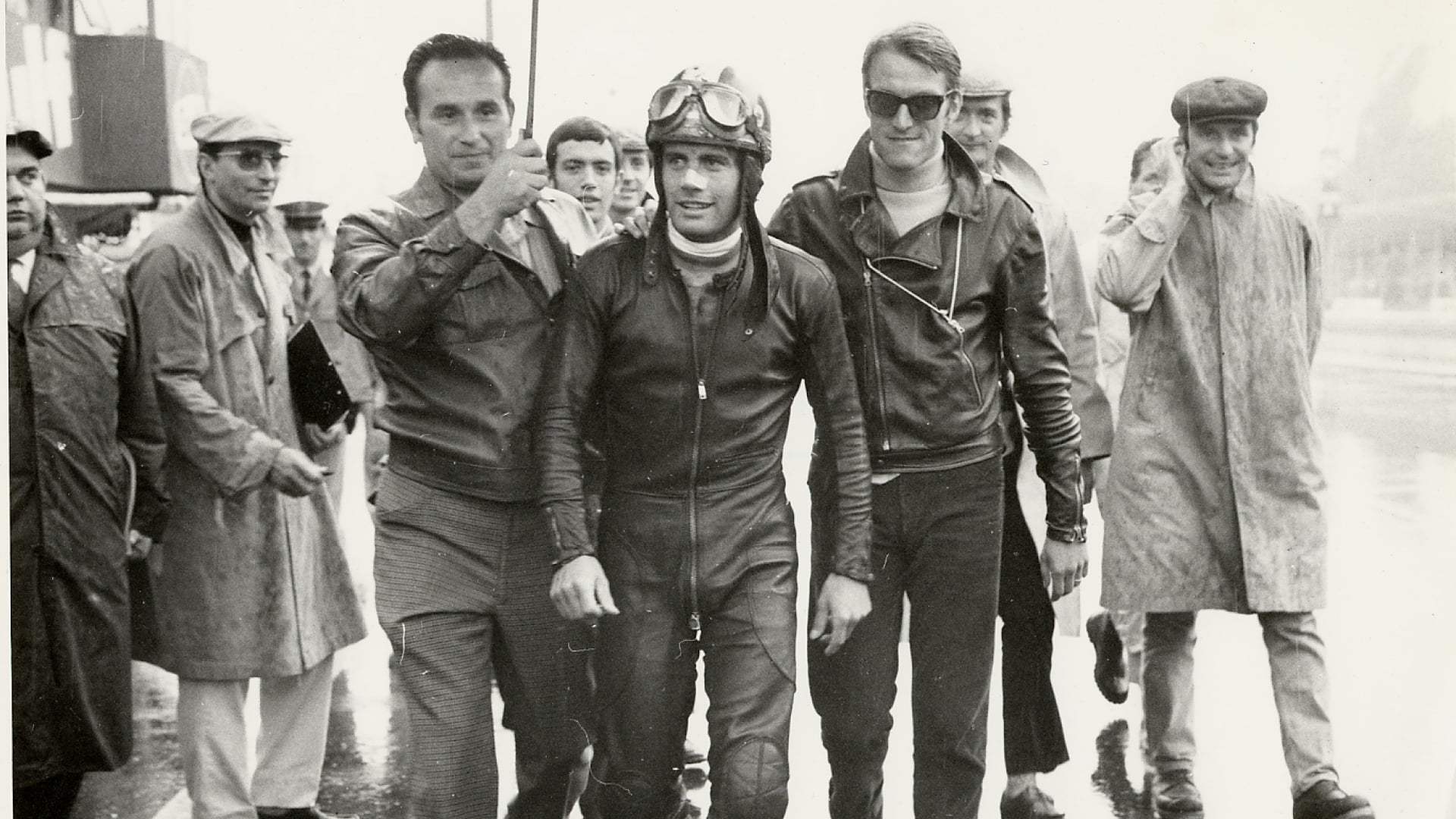
Giacomo Agostini was born in Brescia, Italy, on 16 June 1942. Fans later came to call him “Ago”, a name short enough for grandstand banners and shouts across a garage. Before reaching the world championship, though, he went through the familiar process of a young rider searching for chances to race.
European road hillclimbs were his early stage. Riders raced against the clock on closed mountain roads, accelerating along routes of constantly changing direction and gradient. Learning the course, judging bends beyond the visible road and understanding the surface in limited practice were fundamental skills. Agostini attracted attention in that environment before receiving his chance in international Grands Prix.
In 1964 he contested the 250cc world championship for Morini. His appearances were limited, but they brought him into view internationally. MV Agusta recruited him for the 1965 season in 350cc and 500cc, placing him alongside Mike Hailwood, already a serial premier-class champion.
Moving from limited 250cc opportunities to factory seats in two larger classes meant more than faster motorcycles. The schedule, mechanics, setup methods and public expectations all stepped up. Work once handled through a youngster's own judgement had to become a process he could carry out with a factory and repeat at different circuits.
When Agostini arrived at MV, Hailwood had won three successive 500cc titles, with a fourth to come that year. The newcomer gained factory machinery but also a direct comparison with the most successful rider of the day. He would quickly learn exactly where his own speed stood.
Hailwood was both a team-mate and the standard he had to surpass
Hailwood's success across classes and manufacturers made him an exceptionally useful benchmark. Sharing a team let Agostini observe how he raced, but also exposed him to direct comparison. The same badge did not guarantee the same speed, and experience did not transfer automatically when riders wore matching leathers.
In 1965, Agostini won races in both 350cc and 500cc and finished runner-up in both championships. His first Grand Prix victory came in the Nürburgring 350cc race. The new three-cylinder MV brought its potential into competition, and he showed that he could do more than learn: he could deliver wins for the factory.
Runner-up finishes in both classes made his first full season excellent and set out the next target. The power, weight and demands of 350cc and 500cc differed. He had to fight for victory on one bike and adapt promptly to the other. Winning rounds in both showed that this switching was already working.
Hailwood returned to Honda in 1966, and Agostini became MV's leading rider. There was one fewer formidable team-mate in the garage, but one more direct rival on track. His inherited seat came with outstanding machinery and people, as well as responsibility for maintaining the factory's title streak. His development entered a more difficult phase.
A legendary rider's early years are often told as talent swiftly overcoming experience. Agostini's story is closer to another pattern: first he proved he deserved a factory opportunity, then turned speed into titles through sustained opposition. Knowing Hailwood made their later rivalry more than two names chasing the same medal.
His first 500cc title did not end their rivalry
In 1966, Agostini won his first 500cc world title, decided only in the final race. Hailwood took the 350cc championship, with Agostini runner-up again. In the very year he became premier-class champion, he was still chasing his former team-mate in another class.
Each man took a world title that season. MV continued its 500cc success, while Hailwood delivered the 350cc crown to Honda. As Agostini first reached the premier-class summit, his old team-mate remained ahead on another front. Their contest was far from over.
In 1967 they continued their 500cc fight. MV and Honda followed different engineering paths, and each rider had to bring his machine's strengths to varied circuits. Braking, steering, corner-exit acceleration and reliability over a full race could all alter the outcome. The race approaching on the Isle of Man would bring those demands together.
Riders also faced the scheduling demands of several classes. Today's premier-class MotoGP weekends usually centre on one racing motorcycle; leading riders of that era could enter different capacity races at the same meeting. Physical effort and concentration had to be redistributed. Behind two sets of results lay a real increase in workload.
Two assignments in one weekend also forced riders and mechanics to organize limited time. After finishing one class, attention moved to another machine. The familiar course remained, but braking points, gears and throttle use had to change with the motorcycle. This was work he kept repeating during his later run of championship doubles.
A chain on the Isle of Man and a second place in Canada
The 1967 Senior TT was the most vivid scene in Agostini's rivalry with Hailwood. The Isle of Man Mountain Course was long and complex, with their performances compared at timing points along the route. Unlike a modern short circuit, the order was not always revealed by each side-by-side corner entry in front of the spectators.
Agostini built a twelve-second lead in the later stages, only for his chain to break on lap five. Windy Corner became the place where victory slipped away. The TT's official retrospective records the mechanical failure: he could only coast back, while Hailwood won and set a lap record that would remain unbroken for years.
Losing that victory did not immediately hand the championship to his rival. The 500cc fight continued to the Canadian finale, where Hailwood won. They finished tied on counted points with five victories each. Second places decided it: Agostini prevailed by three to two.
The official TT history records Hailwood's fastest lap that year at an average 108.77 mph, a record that lasted until 1975. The duel thus left two distinct memories: Hailwood's speed on the Mountain Course, and the championship Agostini preserved over a full season.
Second place rarely supplies a legend's most striking scene, yet it decided this title. A race without victory, but with the motorcycle brought home intact, can gain new value months later. A championship rewards not only dazzling afternoons but also the days when available points were not thrown away.
Five wins put Agostini level with Hailwood in the title fight; three second places settled the eventual tie-break. Results that had looked like settling for less at the finish became the year's decisive difference.
Ten titles in five years: even a huge advantage required finishing races
Honda withdrew after the 1967 season, leaving MV in a changed competitive environment. From 1968 to 1972, Agostini won both the 350cc and 500cc titles for five consecutive years. With his two earlier 500cc crowns, his name was already at the forefront of the record books.
Honda's departure removed MV's most direct factory rival. The remaining entrants varied greatly in machinery and resources, giving Agostini and MV a substantial advantage. The 1967 contest between two champions and two manufacturers, lasting to the finale, gradually gave way to a series of far more uneven races.
An advantage did not remove the rider's job. An engine problem, lost tyre grip or a single misjudgement could end a race. Sustained success in two classes required fitness and concentration as well as riding, and mechanics had to prepare different motorcycles so that the advantage still existed at the next round.
His two 500cc titles in 1966 and 1967 came from direct contests with Hailwood. The ten titles across two classes from 1968 came in another competitive setting. The first phase taught him to protect points in close competition; the second demanded that he turn a factory advantage into season-long results year after year.
By the end of 1972, he had twelve world titles: seven successive 500cc crowns and five in 350cc. What looked like a secure partnership would soon face both internal rivalry and new technology. Near the end of that dominance he also made another decision, unrelated to trophies.
After ten TT victories, he decided not to return to race
Agostini won ten Isle of Man TT races. His first Junior victory in 1966 and subsequent Senior–Junior doubles form an important part of his career. Having once lost a crucial victory there, he had since proved through results that he could master this demanding course.
In 1972, Gilberto Parlotti was killed in the Isle of Man 125cc race. Deeply shaken, Agostini completed and won that year's Senior race, then announced that he would no longer race on the island. His friend's death made him unwilling to keep accepting the same risk as a necessary condition of fighting for a world title.
He was still an Isle of Man winner when he made the decision. The Mountain Course had given him victories, glory and international standing, but his friend's death made the cost of continuing unacceptable. He was prepared to end that part of his career even while still capable of winning there.
The TT was still a world championship round. Refusing to enter could mean forfeiting points and prize money, as well as challenging a prestigious tradition. Other leading riders adopted similar positions. The Isle of Man held its last world championship event in 1976 and ceased to count towards the championship from 1977.
His ten TT wins remained on his record, with 1972 his final year of participation. His relationship with the island moved from competition to memory: he had pursued speed there as a young man, then used his standing to oppose publicly the continued treatment of that same risk as a condition of a championship challenge.
Read's title made the seemingly permanent number one a challenger again
In 1973, Phil Read ended Agostini's run of seven 500cc titles. Both rode for MV, so the marque still won, but Agostini's personal position changed. He retained the 350cc title, his thirteenth world championship for MV and the last world-title trophy of their partnership.
To outsiders, a rider with so many titles might seem to have nothing left to prove. Yet a rider must face the next race and next year's machine. Past achievements do not slow today's opponents or automatically secure the best place in a new technological contest.
That year, Jarno Saarinen brought Yamaha's two-stroke YZR500 into the premier class, winning on its debut and again at the next round. Saarinen was killed in the Italian round's 250cc race, and Yamaha temporarily halted its factory effort. The project had shown great promise, but also suffered a real and devastating interruption.
Agostini ultimately chose Yamaha, with the move announced in December 1973. Leaving MV meant leaving a familiar engineering environment and public image. He had to believe that his racing ability could exist apart from the machinery that had helped him win thirteen titles, and be rebuilt around different technology and teamwork.
The outcome was not so smooth that it could be written in advance. In 1974, Read would still win the 500cc title for MV. At Yamaha, Agostini would first succeed in one class and suffer setbacks in the other. His move towards new technology involved a full year of adjustment and waiting.
His first Daytona win came outside world Grand Prix racing
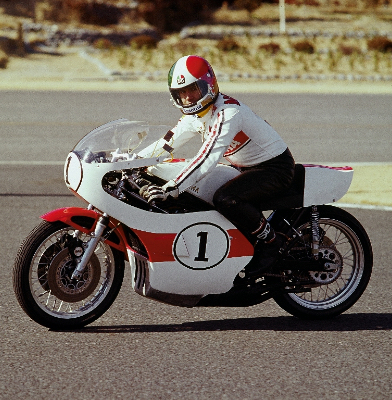 Image source: Yamaha Motor
In March 1974, Agostini won the Daytona 200 on a TZ750 in his first appearance for Yamaha. On an American stage and in a format unfamiliar to him, the victory gave the partnership a powerful start. Changing manufacturers had not made his experience obsolete.
The Daytona 200 was an American event outside world Grand Prix racing. Strong opponents including Kenny Roberts competed, yet Agostini won his first outing for Yamaha. For both sides of the new partnership, the TZ750's trophy showed that rider and unfamiliar motorcycle could work together quickly.
The two-stroke differed from his familiar four-stroke in power response and engine operation. He had to relearn when to shift, how to handle power at corner exit and how to describe problems to engineers. His riding experience provided a basis for judgement, but the specific actions still had to fit the new racer.
After Daytona he returned to Europe for the Grands Prix. Early success could build confidence but could not solve every circuit and capacity class in advance. The real season continued, and the factory needed to find out which gains were repeatable and which advantages existed only in particular race conditions.
This part of his move is easily overlooked: adaptation is not a single act that remains permanently valid. A thirteen-time world champion still had to keep learning after the first win. What he brought to Yamaha was not just fame but the ability to turn unfamiliar machinery gradually into a racing tool.
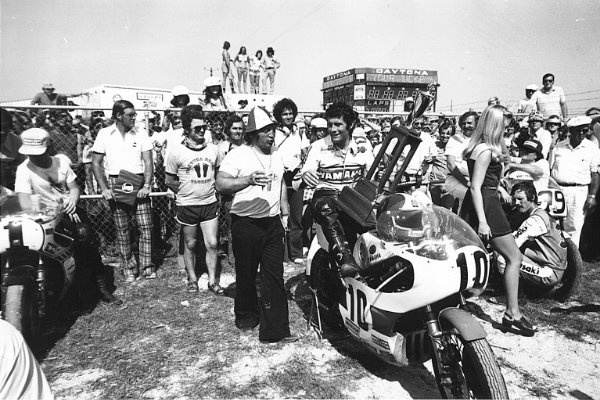 Image source: Yamaha Motor
The 350cc title came first; 500cc had to wait another year
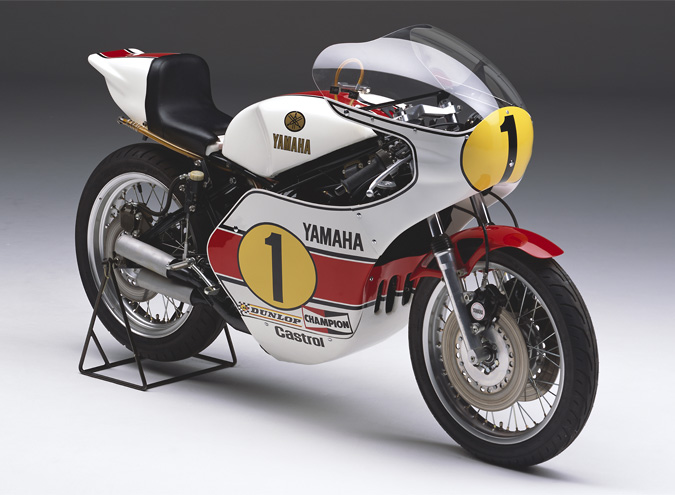 Image source: Yamaha Motor
In 1974, Agostini won the 350cc world championship for Yamaha with five victories in the class. It was his fourteenth world title and seventh consecutive 350cc crown. The change of manufacturer had not broken the sequence, although the motorcycle was now a Yamaha rather than an MV.
In 500cc, the outcome was different. Two wins and one second place left him fourth in the standings. Read retained the riders' title, while Yamaha won the manufacturers' championship. For the recently transferred rider, this proved the project's competitiveness while also showing the remaining gap to his personal goal.
Injuries and mechanical problems affected his 500cc challenge, while the 350cc title was already secured. The two results gave Yamaha different tasks: preserve its established advantage and keep improving the premier-class motorcycle. Agostini's fourteenth title was on his record, but an eighth in 500cc would have to wait another season.
Yamaha's 0W23 made its debut at the 1974 Belgian Grand Prix. It used a 494cc liquid-cooled inline-four two-stroke engine, with a smaller, lighter engine and frame, and a cassette gearbox. A single rear shock arrangement also entered this generation's development as the factory prepared the new machine for the following year's title contest.
The cassette gearbox particularly shows that competitiveness exists beyond the circuit. More efficient gear-ratio changes and adjustments helped mechanics prepare for different circuit speed profiles. It could not overtake for the rider, but it offered more workable options in preparation, allowing engineering and riding to support each other.
In 1975, he learned to turn second place into a championship
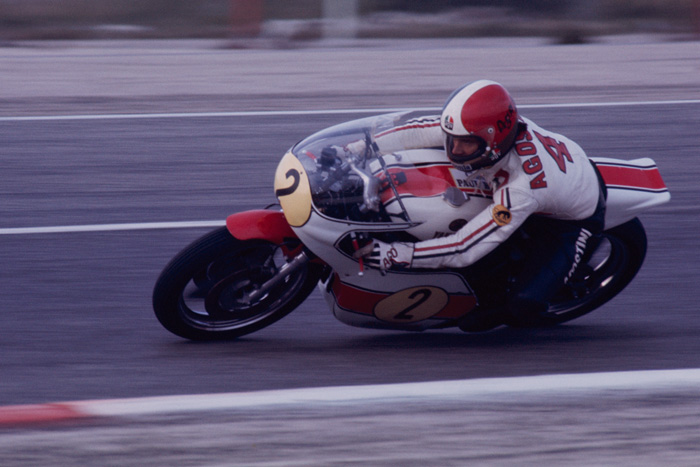 Image source: Yamaha Motor
In 1975, four 500cc wins and two second places finally gave Agostini Yamaha's first premier-class riders' world title. He was not the season's only contributor: team-mate Hideo Kanaya won in Austria, then returned to Japan to work on development and support further progress.
Yamaha's own retrospective emphasizes Kanaya's role in improving the YZR500. Race riding and testing were not always rigidly separated. A Grand Prix winner could also help another rider's title challenge by taking experience back to the factory. Behind the champion was work that did not appear on the first line of the final standings.
In the Netherlands, Agostini fought Barry Sheene to the finish. Sheene took his first 500cc Grand Prix win, with Agostini second. As Read closed in during the latter part of the season, the title went to the Czechoslovak finale. Agostini arrived with an advantage, but still needed to finish.
Under the points situation, a top-seven finish would secure his title even if Read won. He chose not to keep taking risks for the race victory and finished second. The season's objective and the best possible result that day were no longer identical; he chose a finish sufficient to achieve the larger goal.
The final counted championship points were 84 for Agostini and 76 for Read. Only a prescribed number of best results counted under the rules; Read's total of 96 fell to 76 after some results were dropped. Second place in the finale helped Agostini end the contest with an eight-point margin.
From winning the 1967 tie-break on second places to sealing the 1975 title with second, the two seasons reveal a specific skill: understanding what the position in front of him meant for the whole season. Agostini became famous for speed, but his final title also contained the judgement to know when he no longer needed to chase first place.
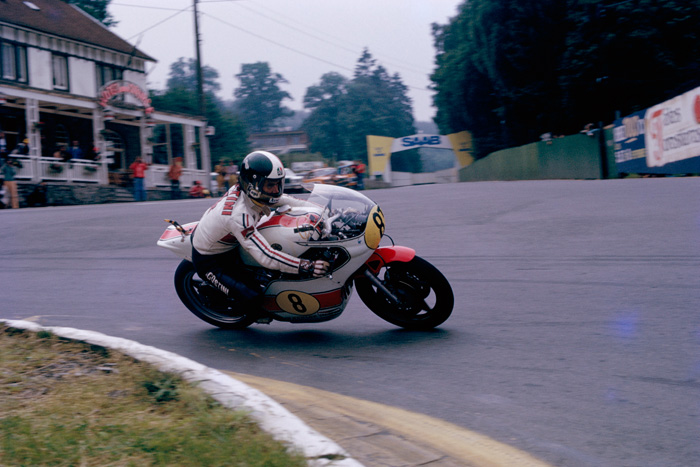 Image source: Yamaha Motor
Back on an MV, his last Grand Prix win came at the Nürburgring again
In 1976 Yamaha stopped directly running factory teams outside Japan, while continuing to supply factory-specification machines to leading riders through European importers. Yamaha motorcycles still raced, but the form of support had changed. Newly crowned Agostini was again seeking racing arrangements in the closing stage of his career.
In 1976 Agostini also rode MV Agusta again, winning the 350cc Dutch round and the 500cc German round. He did not interpret changing manufacturers as requiring him to reject the old motorcycle forever. Late in his career, he continued to look for opportunities across different machines and arrangements.
The Nürburgring thus provided a distinctive pair of bookends. In 1965 his 350cc win there began his Grand Prix victory career; eleven years later, a 500cc win there supplied the last of 122. The class had changed, but the rider and red-and-silver MV appeared at the same finish once more.
That victory also closed an era of four-stroke premier-class racing. MV never won another 500cc Grand Prix, while Agostini had already proved on a Yamaha that he could win a world title on a two-stroke. He was both the old era's defining champion and an active participant in the new technology's rise to the top.
1977 was his final Grand Prix season. Back on a Yamaha, he took two second places in 500cc and finished sixth in the championship. His career did not stop at his last world title: he continued for two more seasons as winning became harder. For someone long at the top, accepting a changed position was part of leaving.
He then tried car racing before moving into team management. Waiting in the garage for other riders' results was a new position compared with crossing the line himself. The factory support he had once received now informed his understanding of team work: preparing machines, organizing people and enabling a rider to complete a season.
Fifteen titles, and a man who stayed in the garage
From 1982, Agostini helped manage Yamaha's factory team, working with riders including Graeme Crosby, Kenny Roberts and Eddie Lawson. Lawson won the 500cc world titles for Yamaha in 1984, 1986 and 1988, with Agostini now contributing from a different role.
Lawson's first 500cc title in 1984 showed that a new generation now occupied the garage's central role. The pressure Agostini knew was carried on track by someone else. Three titles in the five seasons from 1984 to 1988 also gave his management career a clear record: the former rider had become another champion's team leader.
A team manager deals with the whole garage. People, motorcycles and schedules must work together, and different riders have different needs. Agostini had benefited from MV's accumulated experience, then learned anew at Yamaha. In management, those experiences began serving the next generation of riders.
His personal record comprises fifteen world titles, eight in 500cc and seven in 350cc. Of his 122 Grand Prix wins, 68 came in the premier class and 54 in 350cc. He did not race in the four-stroke era named MotoGP from 2002, but he belongs to the full history of the premier class.
By the end of the 2025 season, those records had stood unchanged for many years. Thirteen titles came with MV and two with Yamaha. His first 350cc victory and final 500cc victory both came at the Nürburgring. The record preserves the length of his dominance as well as the turns involved in changing manufacturers and adapting again.
Agostini deserves to be remembered for more than fifteen titles few can approach. After thirteen crowns at his most familiar factory, he dared to learn again. While still able to win on the Isle of Man, he chose not to bear the same risks. After riding, he put his experience into another kind of partnership. His legend retains human choices, not merely a count of trophies.
Timeline
| Year | Milestone |
|---|---|
| 1942 | Born in Brescia on 16 June |
| 1964 | Contested the 250cc world championship for Morini |
| 1965 | Joined MV; first 350cc win at the Nürburgring; runner-up in both 350cc and 500cc |
| 1966、1967 | First and second 500cc world titles |
| 1968—1972 | Won both 350cc and 500cc riders' titles for five consecutive years |
| 1972 | Completed his final TT appearance and did not race there again |
| 1973 | Won his final world title with MV; announced his Yamaha move at year-end |
| 1974 | Won the Daytona 200 and the 350cc world title for Yamaha |
| 1975 | 500cc world champion with Yamaha, his fifteenth career title |
| 1976 | His final two Grand Prix victories on MV machinery, the last in 500cc at the Nürburgring |
| 1977 | His final Grand Prix season |
| From 1982 | Involved in Yamaha team management |
Career Record
| Category | Record and scope |
|---|---|
| Riders' world titles across all classes | 15 |
| 500cc premier-class world titles | 8: 1966–1972 and 1975 |
| 350cc world titles | 7: 1968–1974 |
| World titles with MV | 13: seven in 500cc and six in 350cc |
| World titles with Yamaha | 2: 350cc in 1974 and 500cc in 1975 |
| World championship Grand Prix victories | 122: 68 in 500cc and 54 in 350cc |
| TT victories | 10; not to be simply added to the 122 world championship Grand Prix wins |
| 1974 Daytona 200 | Winner; not a round of the 500cc world championship |
| Statistics cutoff | End of the 2025 season; domestic races, demonstration events and sprints are not included in historic Grand Prix win totals |
Sources and Further Reading
- Isle of Man TT: the 1967 Agostini–Hailwood duel
- IOMTT historical database: 1972 retrospective
- MotoGP: Agostini rider profile
- MotoGP: all-time rider records
- Yamaha: Agostini career profile
- FIM 2023 Yearbook: world champions
- Laureus: Agostini profile
- MV Agusta: official eightieth-anniversary announcement
- Isle of Man TT: official event history
- Yamaha: company racing history in the 1970s
- Yamaha: 1975 season archive
- Yamaha: 1984 season archive
- Yamaha: 1986 season archive
- Yamaha: 1988 season archive
- Yamaha: museum entry for the 1975 YZR500 (0W23)
 Image source: MV Agusta
MV Agusta: eighteen premier-class titles and the road to the four-stroke era's final victory
Eighteen 500cc riders' titles, a factory operation spanning multiple classes, and its last period of competition as the two-stroke era arrived.
Continue reading · About 19 minutes →