
Expand the Chapter List
- Finnish Roads Provide Only a Starting Point
- A Factory Opportunity Opens, Then Suddenly Closes
- 1994: Ford Gives Him a Car That Can Win
- Before the Title, Make the Front Wheels Understand the Driver
- 1996: First, Finish an Unfamiliar Long-Distance Rally
- 1997: One Point Harder to Find Than Four Wins
- 1998: A Title Decided After the Driver Has Stopped
- The Fourth Title Begins on Winter Asphalt
- Five Consecutive Home Wins: Why Only Four Counted for the WRC
- 2001: The Most Familiar Car Is Still Winning
- A Fourth Monte Carlo Victory, This Time in Blue
- How to Make a Team Faster Without Holding the Steering Wheel
- Sweden's Final Day: How a 3.8-Second Lead Became Victory
- Champion Again, but the Trophies Belong to Different People
- Timeline
- Career and Team Record
Shortly after the 1998 Rally Great Britain began, Tommi Mäkinen's title defence ran into the unexpected. Oil on the Millbrook stage cost his Mitsubishi grip and damaged the rear suspension. The car could no longer continue the fight. Whether he retained the world championship now depended on Carlos Sainz, who was still competing.
From then on, Mäkinen could no longer change the result through his driving. On the final stage, however, Sainz's Toyota failed near the finish. The third drivers' world title ultimately went to the Finn who had already retired. Such an ending can easily obscure everything he had done before: recovering a difficult start through second-half speed, and staying champion for three consecutive years after once struggling to obtain a full factory opportunity.
Mäkinen later won a fourth title, drove winning cars for Mitsubishi, Ford and Subaru, and became Toyota's team principal. His story did not end when he left the cockpit. Linking the two careers was the same question: how do you identify what is wrong with a rally car, and enable a group of people to put it right?
Finnish Roads Provide Only a Starting Point
Born in 1964 in Puuppola, near Jyväskylä, Finland, Mäkinen grew up on a farm. Machinery and driving entered his life early, but country roads did not automatically lay a path to a world championship for a Finnish youngster. Local events required a car, tyres, repairs and entry fees. Even a fast driver still had to find a way to enter the next rally.
He began rallying in 1985, gradually moving from domestic events to international competition. The Finnish Group N title in 1988 was an important result in that phase. Group N retained a relatively close production-car basis, allowing a driver to learn routes, teamwork and car management. But a class title could not by itself prove competitiveness at the world's highest level. Moving up required a better car and more people willing to believe in him.
In interviews years later, Mäkinen identified 1990 as the stage when the programme became more serious. Juha Kankkunen and manager Timo Jouhki provided support. The team began raising a larger budget for selected world championship rounds and assigning people specifically to administrative work. Behind a fast driver, an organisation capable of supporting international competition was beginning to emerge.
This experience helps explain his later preference for small teams. Early on, every additional person and budget item directly affected whether he could enter a rally or repair the car. Speed and business did not exist separately. For a driver without a secure contract, learning to turn a plan into the next actual start was as urgent as finding time on a stage.
A Factory Opportunity Opens, Then Suddenly Closes
In 1991, Mäkinen had a chance to drive a factory Mazda, showing his ability in Finland and Britain. Help from Hannu Mikkola brought him closer to the professional world. But Mazda then withdrew from the WRC, closing a door that had only just opened. Personal improvement did not guarantee the survival of the programme supplying his car.
He then worked with Nissan, still facing uncertainty as entry plans changed. Looking back, Mäkinen did not portray every choice as the correct and inevitable step. He admitted taking wrong turns when judging opportunities. That candour makes the pre-championship years concrete: not every step moved in the same direction, and not every factory connection became a lasting seat.
Intermittent entries also carry a technical cost. Each new car requires adaptation to steering response, braking, transmission and tyres. Without continuous testing and competition, feedback from one outing may never become an improvement at the next. A career that seems merely short of contracts is also missing the conditions for steady accumulation of experience.
Mäkinen did not disappear amid those changes. He kept looking for events that could prove his ability, especially the familiar fast gravel of Finland. Home experience could help him read crests and rhythm, but would not land the car after every jump or guarantee a whole rally's pace against elite opposition. Preparation had to continue before the opportunity arrived.
1994: Ford Gives Him a Car That Can Win
At the 1994 1000 Lakes Rally, Mäkinen drove a Ford Escort RS Cosworth to his first WRC victory, with Seppo Harjanne as co-driver. For a man still pursuing a secure factory seat, this was proof of a different order. He was no longer simply fast on some stages; he could carry a world championship rally from its start to a winning finish.
Finland's speed does not mean courage alone is enough. Successive crests hide the road beyond, while undulations and corners connect with one another. Positioning the car in one place affects whether it can turn cleanly several seconds later. The co-driver's information must align precisely with the driving rhythm, and any late correction can remove the margin needed for the next section.
After that first win, Mäkinen had to choose his next step. He later said he liked the Ford's driving feel, but Mitsubishi offered a more complete factory development opportunity. This was not a choice between two attractive photographs. It meant weighing a car he already knew against professional conditions that allowed sustained testing, competition and improvement.
He chose Mitsubishi. Four later titles make the decision look inevitable, but at the time the Evo had not won a WRC round, much less a world championship. Mäkinen was choosing a programme still taking shape. His greatest advance was finally being able to place his own future and the long-term development of one car within the same plan.
Before the Title, Make the Front Wheels Understand the Driver
Mäkinen did not immediately find his ideal feeling with Mitsubishi's set-up. In his recollections, the initial steering characteristics made it difficult to enter corners as he preferred. A more neutral set-up used by test driver Lasse Lampi eventually gave him front-end responses that restored confidence. The change happened not in publicity slogans, but in how the nose actually responded after he moved the steering wheel.
Why did that difference matter? A driver must anticipate how much margin remains on corner entry. If the front resists turning, he may add steering lock or use stronger braking and body movement to rotate the car. If grip then returns suddenly, the earlier input may be excessive. A more suitable balance reduces corrective work and frees attention for the next change in the road.
In Sweden in 1995, Kenneth Eriksson won and Mäkinen finished second, giving the Mitsubishi Evo its first WRC victory. The driver who later became Mitsubishi's most famous was not the one who delivered the model's first win. More importantly, both cars demonstrated that development was beginning to work. Their speed could now support strong results, while Mäkinen could continue developing within a factory partnership.
The year did not immediately bring him a title. Accidents, mechanical problems and the accumulation of experience made his first full factory season uneven. The Evo III's arrival required him to understand new power response and changes to the car. Unlike a few years earlier, however, he could now take problems back to the same team and return with a modified machine. The value of continuity was becoming clear.
1996: First, Finish an Unfamiliar Long-Distance Rally
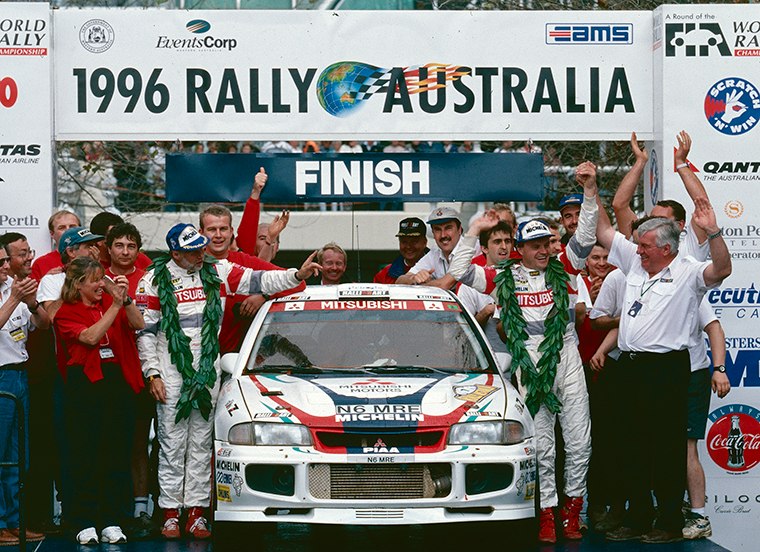 Photo: mitsubishi-motors.com
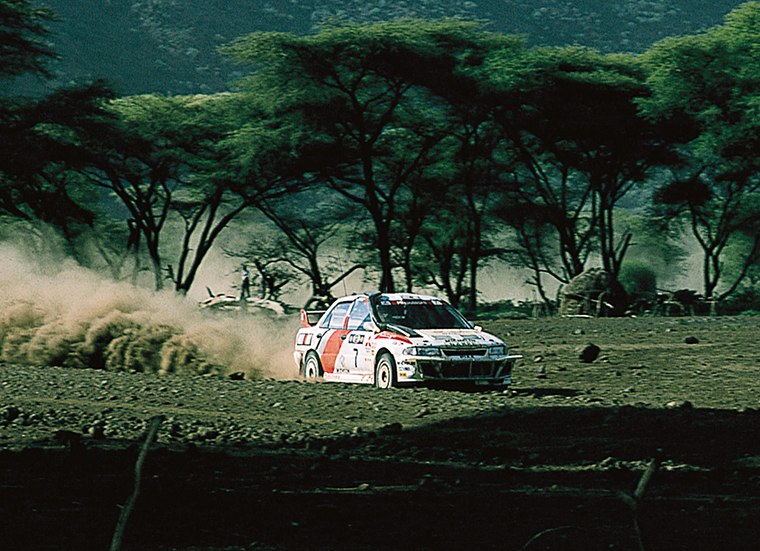
After winning in Sweden in 1996, Mäkinen headed to the Safari Rally. The demands of East African roads differed from Finland's familiar fast gravel. With a total distance of about 2400 kilometres and nearly 1500 kilometres of timed sections, the car had to absorb prolonged punishment. Supplies, servicing and the life of key components also had to become part of the team's competitive rhythm.
Mitsubishi prepared through measures such as preventive parts replacement, trying to address failure risks before the driver needed to slow down to protect the car. Mäkinen's attack therefore did not happen in isolation: speed inside the car depended on planned work outside it. In a long-distance rally, additional preparation in service could become a more confident burst of acceleration on a stage.
He won the Safari, then Argentina, Finland and Australia, taking five victories from the year's nine rounds. Swedish snow and ice, East African endurance and gravel in South America and Oceania showed that he had moved beyond the image of a home-event specialist. His first world title came from competitiveness across different conditions, not a limited advantage on one surface.
Harjanne completed the season alongside him. Co-driving involves more than calling the next corner: it includes pace notes, time controls and the event's whole procedure. A championship rally crew consists of two people. Even if the public knows the driver better, the sustained accuracy from the right-hand seat belongs in the history too. Mäkinen's first title was the result of that partnership reaching maturity.
1997: One Point Harder to Find Than Four Wins
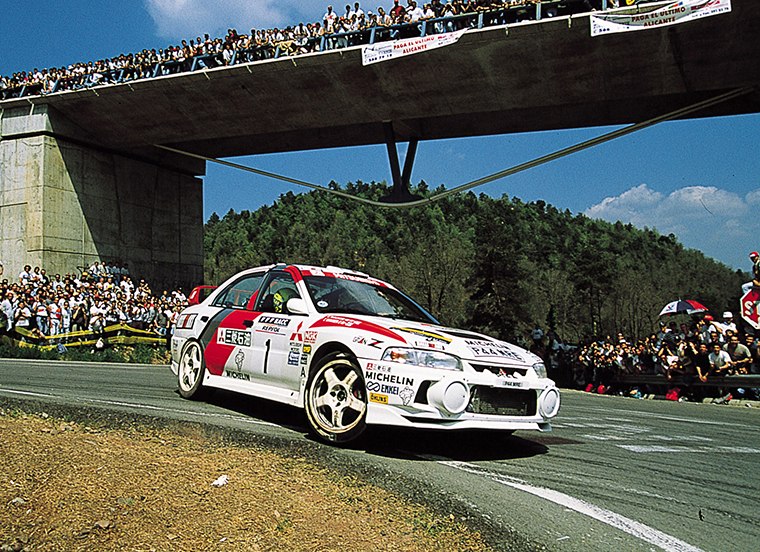 Photo: mitsubishi-motors.com
The title defence did not use an unchanged championship car. The Evo IV brought a new mechanical layout and driving feel, while the WRC introduced World Rally Car rules and rivals began changing technical direction. Mitsubishi stayed with Group A. Mäkinen had to carry the confidence built the previous year into a new car and find a repeatable rhythm again.
He won in Portugal, Catalunya, Argentina and Finland. The asphalt win in Catalunya added a different kind of proof to his career: a champion could not simply wait for gravel events and rely on his strengths to recover every loss. Tyre response, precision on entry and understanding of road information had to work under another set of conditions.
At the British finale, Colin McRae could still threaten the championship. Mäkinen finished sixth, bringing home the points needed for his defence and winning the title by just one point. It was neither his fastest nor his most elegant result of the season, but it was the final gate through which the year's work had to pass. The earlier wins needed this limited result added to them to become a second title.
That ending changes the way he is understood. Four consecutive titles suggest sustained domination, yet his second required accepting a place far from the podium. Maturity did not mean losing speed, but recognising the real task when the car and conditions did not support a win. Sixth place that year carried more weight than many rally wins with no effect on a championship.
1998: A Title Decided After the Driver Has Stopped
The third championship season did not begin smoothly. Risto Mannisenmäki replaced Harjanne as co-driver, requiring a new rhythm of communication, while Mitsubishi developed from Evo IV to Evo V. Beneath the familiar red-and-white livery, both car and crew were changing. A defending champion still had practical problems to solve; last year's status bought no discount on a single second.
Mäkinen won in Sweden and Argentina, then Finland, Sanremo and Australia, carrying a title chance into Britain. The consecutive wins in the second half were particularly important, making it possible for the final round's outcome to favour him. Without the points recovered rally by rally beforehand, no failure suffered by Sainz at the finale could have changed the champion.
Oil on the Millbrook stage sent Mäkinen's Mitsubishi sliding off the road, damaging the rear suspension and forcing retirement. Recalling it years later, he still spoke of the helplessness: a year's title effort had left his control through an incident he could not remedy. After his retirement, Sainz needed only to finish fourth or better to take the championship.
Sainz's Toyota failed on the final stage, and Mäkinen retained the title. Team-mate Richard Burns won the British round, helping Mitsubishi take the manufacturers' championship. The two outcomes arrived on the same day for different reasons. Mäkinen preserved his individual season points position; Burns's continued run contributed to the manufacturers' contest. Luck changed the ending, but the full season created the foundation on which luck could matter.
The Fourth Title Begins on Winter Asphalt
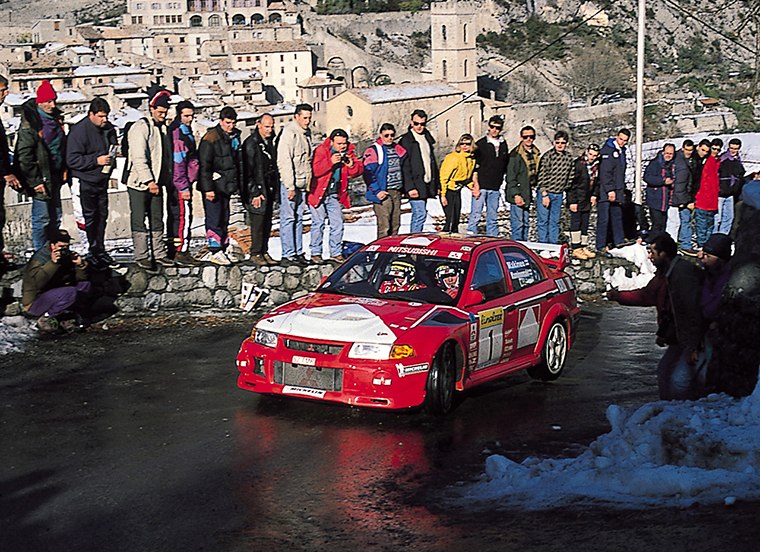 Photo: mitsubishi-motors.com
At Monte Carlo in 1999, Mäkinen began another winning sequence. He won in the Evo VI and then won again in Sweden. Both were winter events, but their requirements could not simply be merged. Monte Carlo could switch between dry asphalt, shaded ice and snow; Sweden centred more on snow and studded tyres. The crew had to assess them separately.
Tyre choice makes speed at Monte Carlo a problem of allocation. A tyre ideal for one section may lose time on another, and an immediate change is not always possible between stages. The driver's job is to take the available set through a whole group of roads, knowing where to exploit its strengths and where to accept being slower for a while.
New Zealand brought a third win, and Sanremo a fourth. On the Italian asphalt event's final stage, Mäkinen moved into the lead, adding a crucial result to the title fight. Mitsubishi was still improving systems such as the differentials, and the driver had to turn new responses into real stage speed. Four consecutive titles could never be achieved simply by repeating the previous year's settings.
From 1996 to 1999, he won four consecutive WRC drivers' world championships. Harjanne shared the first two and Mannisenmäki the next two, while the main cars progressed from Evo III to IV, V and VI. The seemingly fixed partnership of one driver and one team contained repeated model changes, a new co-driver and an evolving competitive environment. The unbroken sequence of titles conceals work that never stood still.
Five Consecutive Home Wins: Why Only Four Counted for the WRC
Mäkinen won the 1000 Lakes/Rally Finland five times in succession from 1994 to 1998. The first was in a Ford and the next four in Mitsubishis. Many people knew the local roads; very few could hold off world-class rivals year after year. That sustained performance reveals more about his mastery of fast gravel than one isolated home victory.
There is a calendar change that title totals can easily obscure: the 1995 event did not count towards that year's top-level WRC drivers' world championship. The Finnish victory was real and belongs in the event's consecutive-win record, but cannot be added to his 24 WRC wins. The event name stayed the same; its championship status did not remain identical every year.
Five straight wins in Finland become especially interesting alongside four straight wins at Monte Carlo. One involves gravel that demands anticipation of crests, compressions and successive fast corners; the other is winter asphalt changing with altitude, temperature and shade. Together they show that Mäkinen's strongest ability was not only increasing speed in familiar situations, but quickly adjusting his expectations of car and road.
Both events demand a match between information from the right-hand seat and actions from the left. Pace notes do not drive the car, and the driver cannot wait for every danger to appear fully before deciding. Speech speed, pauses and rhythm developed through long cooperation help the crew bring unseen roads into their judgement in advance. This unobtrusive understanding is one condition of repeated victory.
2001: The Most Familiar Car Is Still Winning
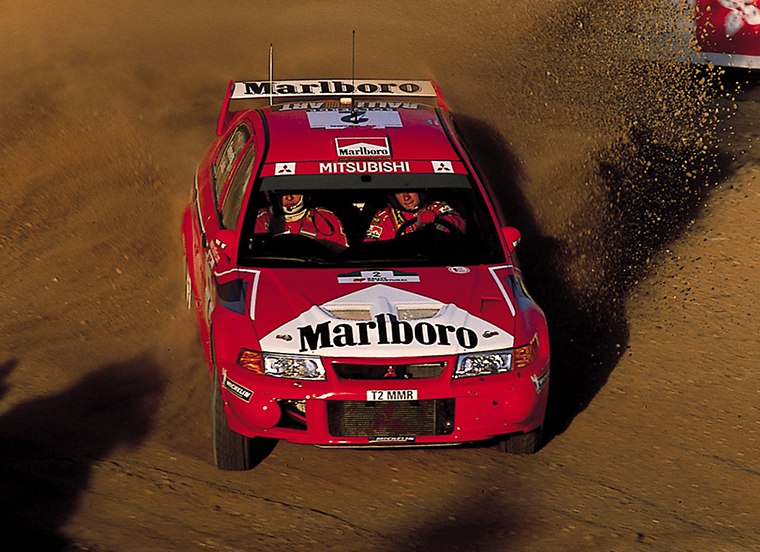 Photo: mitsubishi-motors.com
Competition kept changing after the four titles. In 2000, Mäkinen won only at Monte Carlo, and the championship went to Peugeot's Marcus Grönholm. Mitsubishi's established system still had strengths, but the new generation of World Rally Cars continued to mature, narrowing the room for Group A machinery. For the first time, the long-standing champion had to face an advantage no longer broad enough to cover the season.
In 2001, the improved Evo competition model won three times: Monte Carlo, Portugal and the Safari. Often called the Evo 6.5, it still enabled Mäkinen to fight for the championship. A mature car's advantages are tangible to a driver: knowing where to attack, how it reacts on different surfaces and how to communicate feedback to familiar engineers.
The new Lancer Evolution WRC debuted at Sanremo, but did not immediately improve results. Mitsubishi later acknowledged insufficient development time: the freedom offered by the new rules had not been fully converted into mature performance. Mäkinen finished only one of the last four rounds and ended the season third. For a driver still capable of winning before the switch, the new car brought not an abstract future benefit but a succession of immediate problems.
This period brought his Mitsubishi partnership to a turning point. Past success does not make a combination permanently right for the next phase. Models, development methods and career choices can all change. In 2002, Mäkinen moved to Subaru, ending his long association with the red-and-white Evo. Even four titles already won could not predict what the new environment would bring.
A Fourth Monte Carlo Victory, This Time in Blue
At Monte Carlo in 2002, Mäkinen and Kaj Lindström competed in a Subaru Impreza WRC. He ultimately became the winner, extending his consecutive victories there to four. This time, however, the penalty process must be made clear. Sébastien Loeb finished with the lower aggregate stage time, but Citroën received a two-minute penalty for changing tyres in a prohibited area.
Citroën initially appealed, leaving the result provisional. It later withdrew the appeal, the penalty stood, and Mäkinen became the official winner. The provisional order in early post-event reports differed from the final winners' list. The victory belongs in his career record, but includes a dispute over procedure and penalties; it cannot be rewritten as simply beating Loeb outright on the stages.
It was his 24th and final WRC victory. The breakdown is clear: one with Ford, 22 with Mitsubishi and one with Subaru. Of his four consecutive Monte Carlo wins, the first three were with Mitsubishi and the last with Subaru. A driver's record crosses manufacturers; each manufacturer's results remain its own. They connect, but cannot replace one another.
Two years with Subaru did not bring a fifth world title. In 2003, Mäkinen ended his full-time WRC driving career. He had not lost interest in cars or left Finnish rallying behind. Instead, he devoted more attention to car preparation, development and related business. Experience once used to win events began to enter another form of work.
How to Make a Team Faster Without Holding the Steering Wheel
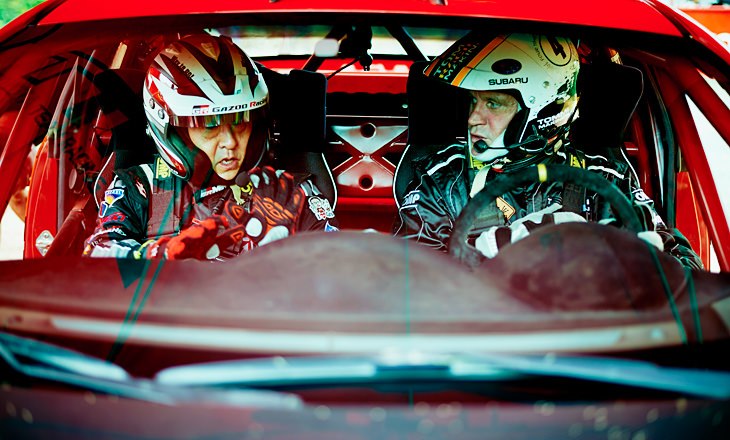 Photo: toyotagazooracing.com
In July 2015, Toyota announced Mäkinen as team principal for its WRC return, targeting entry in 2017. Akio Toyoda became team chairman. The appointment gave a champion best known for his Mitsubishi years responsibility for building another manufacturer's world rally team. The task changed from driving the car he was given well to bringing both car and team into being.
Mäkinen's company and specialists participated in developing the Yaris WRC and organising its competition programme. A base and testing environment close to Finland's rally industry could draw on familiar roads, engineering experience and talent, while coordinating with Toyota's resources in Japan and Europe. Direct communication in a small team and technical backing from a large manufacturer had to fit within the same practical processes.
In interviews, he emphasised the value of long, concentrated testing. Keeping engineers close to a continuously running car could shorten the interval between finding a problem, altering a design and checking it again. A comment from his driving days now extended into decisions about staffing, parts manufacture and testing time. Feel developed behind the wheel had to be translated into tasks many people could carry out.
World-champion status does not automatically confer every management skill. Engine, chassis, aerodynamics, service and logistics require specialists, and the principal must help their work connect. Drivers' reports may conflict, and test conditions may not be directly comparable. Choosing the first problem to solve requires subjective feedback to be considered alongside measurements, with clear priorities for engineers. Mäkinen's strength was knowing how a rally car needed to be understood. Success also depended on allowing other people's knowledge into the decisions.
Sweden's Final Day: How a 3.8-Second Lead Became Victory
Toyota returned to the WRC in 2017, and a winning opportunity appeared at the second round in Sweden. In the previous day's super special stage, leader Thierry Neuville damaged his steering, handing the lead to Jari-Matti Latvala. That opportunity did not prove Toyota was already superior in every respect. It showed that the new car and crew had put themselves in a position to take advantage.
At the start of the final day, Latvala and co-driver Miikka Anttila led by only 3.8 seconds, with Ott Tänak behind. Three stages remained, and any mistake could change the result. For a new team in only its second rally, conservative waiting could not guarantee victory. Genuine stage speed was still required.
Latvala won all three stages that day, including the Power Stage, and finished 29.2 seconds clear. Toyota took its first WRC win since China in 1999. Afterwards, Mäkinen acknowledged the opportunity created by a rival's retirement while crediting the crew and the cooperation of staff in different countries. It was the full perspective required of a team principal assessing a rally.
He was no longer the driver of the car on the television screen. A successful finish once belonged to him and his own co-driver; now his task was to provide other crews with the conditions for success. That change gives the second career its own value. He did not repackage earlier championships as management results. He helped create a new team capable of winning.
Champion Again, but the Trophies Belong to Different People
In 2018, Toyota won the WRC manufacturers' championship in the second season of its return. In 2019, Tänak and Martin Järveoja won the drivers' and co-drivers' world titles. Mäkinen was an important leader of the programme, but not the champion driver in those years. His four driving titles and the team's honours during his leadership belong on adjacent, separate lines of the record.
In 2020, Toyota announced the next arrangement: from 2021, WRC operations would be managed directly within Toyota, while Mäkinen became a motorsport advisor. Existing people and some facilities in Finland and Estonia continued to contribute. The project was not emptied and restarted because its leader changed roles; capabilities built in the early years entered a longer-term organisation.
It is a meaningful echo of the factory withdrawals he faced when young. Early opportunities could vanish with a project's closure. In the second half of his career, the team he helped build had a chance to continue, preserving people, knowledge and car development. The conditions for sustained work remained one of the most important resources in his career.
Returning to the champion waiting for news in 1998, Mäkinen once had no choice but to accept an ending he could not change. Later, he used his professional experience to change more things: how to prepare a car, organise a test and give another driver a chance to win. Four consecutive titles placed his name in history; a second venture allowed that history to keep producing new races.
Timeline
| Year | Key Milestone |
|---|---|
| 1964 | Born in Puuppola, Finland |
| 1985、1988 | Began rallying; won the Finnish Group N title |
| 1991—1992 | Gained opportunities with Mazda and Nissan, while experiencing programme withdrawals and changes |
| 1994 | Won the 1000 Lakes Rally in a Ford Escort, his first WRC victory |
| 1995 | Joined Mitsubishi's full factory programme; second in Sweden |
| 1996—1999 | Won four consecutive WRC drivers' world championships |
| 1999—2002 | Four consecutive Monte Carlo Rally wins, the last in a Subaru |
| 2002—2003 | Raced for Subaru; ended full-time WRC driving in 2003 |
| 2015、2017 | Appointed Toyota team principal; led the new programme back to the WRC |
| 2018、2019 | Toyota won the manufacturers' title; Tänak/Järveoja won the drivers'/co-drivers' titles |
| 2021 | Became Toyota motorsport advisor as the WRC programme moved to direct Toyota management |
Career and Team Record
| Category | Record and Definition |
|---|---|
| WRC Drivers' World Championships | 4: 1996, 1997, 1998 and 1999, all with Mitsubishi |
| WRC Rally Wins | 24: Ford 1, Mitsubishi 22, Subaru 1 |
| Championship Co-driver Partners | Seppo Harjanne: 1996, 1997; Risto Mannisenmäki: 1998, 1999 |
| Consecutive Wins in Finland | 5 straight wins from 1994 to 1998; 1995 is excluded from the 24 WRC wins |
| Consecutive Monte Carlo Wins | 4 straight wins from 1999 to 2002, the first three with Mitsubishi and the last with Subaru |
| First / Last WRC Win | 1994 Finland / 2002 Monte Carlo |
| Toyota Team-Principal Period | 2017 WRC return; 2018 manufacturers' title; 2019 drivers' and co-drivers' titles |
| Statistical Scope | Individual drivers' titles, co-drivers' titles and team honours during his leadership are listed separately; through the end of the 2025 season |
Sources and Further Reading
- Lunch with Tommi Makinen January 2020 - Motor Sport Magazine
- Mitsubishi Official Rally History: 1996
- Mitsubishi Official Rally History: 1997
- Mitsubishi Official Rally History: 1998
- Mitsubishi Official Rally History: 1999
- Mitsubishi Official Rally History: 2000
- Mitsubishi Official Rally History: 2001
- Monte Carlo Rally revised placings/standings | IOL
- Tommi Mäkinen — Four World Championships | Okautoralli.fi
- Tommi Mäkinen Leads Toyota GAZOO Racing’s WRC Return in 2017 | News | TOYOTA GAZOO Racing
- Latvala Wins Rally Sweden and Leads Championship | Toyota Motor Corporation Official Global Website
- WRC - Latvala & Anttila win for Toyota! | Fédération Internationale de l'Automobile
- Toyota Motor Corporation Announces Appointment of Tommi Mäkinen as a Motorsport Advisor | Toyota Gazoo Racing
 Photo: mitsubishi-motors.com
Mitsubishi: Four Evo Generations, Four Consecutive Titles — Why Did the New Rules Bring a Sudden Slowdown?
Colt, Galant and four generations of Evo link production-car development, European operations, four consecutive titles and the transition to World Rally Cars.
Continue Reading · About 20 Minutes →