
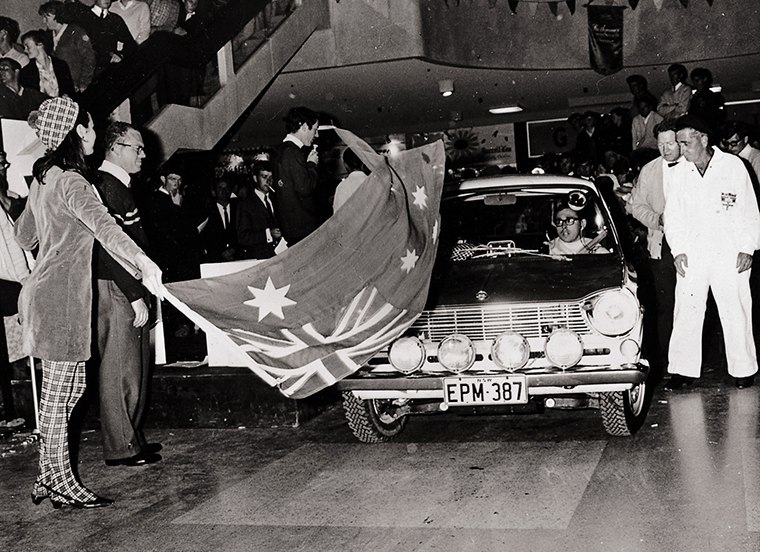
Expand the Chapter List
- The Original Reason to Race: Selling a Car Overseas
- From Cowan's Southern Cross Win to Singh's First Safari Victory
- From Long-Distance Endurance to a Fuller World Championship Season
- Galant VR-4: Bringing Victory Back to Europe
- The First Evo Win Was Not Mäkinen's
- Safari 1996: Endurance Tradition as a Tool for Attack
- The Rules Opened Up. Why Did Mitsubishi Stay with Group A?
- 1998: The Second Car Changes What “Champion” Means
- Evo VI and the Fourth Title: A Shrinking Advantage, Continuing Development
- 2001: The Old Car Still Won, but the New One Had to Appear
- Organisational Speed Starts to Matter More Than Established Experience
- The 2005 Podiums Could Not Secure Another Season
- What Mitsubishi Truly Left to Rallying
- Timeline
- Championship and Model Record
At the 1998 Rally Great Britain, Mitsubishi faced an unusual situation in its service area. Tommi Mäkinen's car had retired, leaving his drivers' world championship fate out of his hands. Team-mate Richard Burns was still on the road fighting for victory, with the manufacturers' title also within reach. The season's two main storylines were heading in different directions at the final round.
Then Carlos Sainz's Toyota failed near the finish of the final stage. Mäkinen retained the drivers' title, Burns won the rally and Mitsubishi took its first WRC manufacturers' world championship. It was the marque's greatest year, and the clearest illustration of how its history must be read: Mäkinen's four consecutive titles do not mean Mitsubishi won four consecutive manufacturers' championships.
Before the Evo became an icon in posters and games, Mitsubishi had travelled a long road through Australia, East Africa and Europe. It later succeeded through engineering closely tied to production cars, then lost pace as the nature of competition changed. The reasons a championship-winning car succeeds can often also explain the difficulties it encounters later.
The Original Reason to Race: Selling a Car Overseas
Mitsubishi's international rallying can be traced to its exploration of the Australian market in the 1960s. The company arranged local testing to assess the reliability and durability of export models. Doug Stewart, who helped coordinate the work, suggested entering the Southern Cross Rally, testing the cars in genuine competition while bringing them to a wider audience.
In 1967, two Colt 1000Fs entered the event. Facing larger-engined rivals, Mitsubishi sought results through lightness, reliability and endurance. Colin Bond finished fourth overall and won the small-capacity class. It was not a WRC world championship round in the later sense, but it was an important beginning on the marque's path into international rallying.
That beginning established a lasting idea: racing and production cars were not entirely separate businesses. Mechanical problems exposed in competition could feed back into product development, while finishing an event in harsh conditions could support a car's image in the real market. That relationship became especially advantageous in the Group A era.
Early experience, however, first came through practical tasks. The team had to secure suitable tyres, spare parts and service arrangements in distant regions. Drivers had to protect the cars on unfamiliar roads and work with local people. Technology could leave Japan, but racing capability had to be built gradually around the world.
From Cowan's Southern Cross Win to Singh's First Safari Victory
In 1972, Andrew Cowan won the Southern Cross Rally in a Galant. The Scottish driver would later play a major role in the Ralliart Europe organisation. For Mitsubishi, he could deliver more than results: he helped connect markets, events and engineering staff.
In 1973, Lancer 1600GSRs swept the top four at the Southern Cross Rally. The contrast between compact saloons and punishing roads can make “durability” the only word people remember. Yet strong results for several cars required drivers, preparation, maintenance and the basic model to work together. Reliability was not a static property, but a capability tested and refined over long competition distances.
The 1974 Safari Rally had a more unusual story. The oil crisis affected Mitsubishi's planned entry, but Kenyan driver Joginder Singh remained determined to compete. He bought a Lancer 1600GSR himself, Mitsubishi supplied competition spare parts, and he went on to win the marque's first WRC round.
The result brought together personal determination, local experience and manufacturer technology. Singh understood the demands of East African events, while the Lancer provided a suitable basis for long, arduous competition. Mitsubishi swept the top three at the Safari in 1976. African roads proved its ability, but a world title would demand repeated tests on European snow, asphalt and gravel as well.
From Long-Distance Endurance to a Fuller World Championship Season
The early Safari differed markedly from many European rallies. Long routes, rough roads, maintenance and navigation all had a huge influence on results. As world rallying developed, event organisation, timed stages and car regulations changed. A manufacturer could no longer build its reputation solely on a few events that suited it.
Through the 1980s, Mitsubishi explored different models and technical directions. Turbocharging and four-wheel drive became essential foundations for top-level rally cars. After Group B ended, Group A put the production-car basis back at the centre. For a company long accustomed to connecting competition needs with road-car development, this offered a new opportunity.
Launched in 1987, the Galant VR-4 combined a turbocharged engine with four-wheel drive and became central to rebuilding Mitsubishi's WRC competitiveness. In 1988, the European factory programme and the Japan-supported Asia-Pacific programme progressed together, with Ralliart Europe and TASK Engineering gathering experience in different events. The marque's racing activities were not all concentrated in one garage.
The regional structure had clear advantages: experience on different surfaces could serve a common technical base, while regional championships developed drivers and staff. But it also demanded coordination. The World Championship, Asia-Pacific Championship and other classes did not have identical tasks, so resources and objectives had to be clearly distinguished.
Before the Galant, Mitsubishi had seriously pursued another route. The rear-wheel-drive Lancer EX2000 Turbo returned to international competition in 1981. It finished third at Finland's 1000 Lakes Rally the next year, but remained clearly behind the two four-wheel-drive Audis ahead. Mitsubishi's historical account treats that rally as an important realisation: further development of a two-wheel-drive car could no longer readily answer the new questions posed by the four-wheel-drive era.
The engineering department then developed a four-wheel-drive Starion prototype aimed at Group B. It entered trial events, developed its suspension and drivetrain, and also retired through overheating. The prototype was already running, but homologation, production preparation and further testing remained. When Group B's cancellation was decided in 1986, the WRC programme prepared for those rules never materialised as intended.
The Starion did not disappear without a trace. It later entered the Hong Kong–Beijing Rally, which allowed prototypes, and finished second in 1986. Its longer-term value was the continued accumulation of turbocharged four-wheel-drive expertise. When the Galant VR-4 arrived, the team was not confronting the problem of delivering power to all four wheels for the first time. A model that never became a WRC winner could still form the technical prehistory of a later champion.
Galant VR-4: Bringing Victory Back to Europe
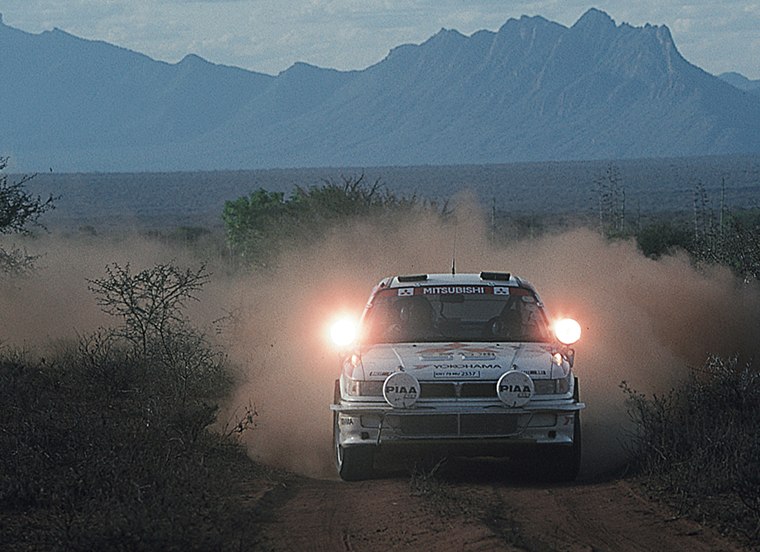 Photo: mitsubishi-motors.com
In 1989, Mikael Ericsson won Finland's 1000 Lakes Rally in a Galant VR-4, and Pentti Airikkala won Britain's RAC Rally. Winning two highly representative European events in one season meant Mitsubishi's competitiveness was no longer associated only with East African endurance rallies.
Finland's fast gravel roads demand a precise understanding of the relationship between crests, jumps and corners. Britain's forest roads can present very different challenges of grip judgement and rhythm. The Galant's wins showed that its turbocharged four-wheel-drive package could adapt to a wider range of conditions, rather than work on just one type of road.
Kenjiro Shinozuka later took important victories in Côte d'Ivoire, bringing the Galant VR-4's WRC total to six wins. Meanwhile, its relatively large body prompted the team to ask whether the existing engine and drivetrain knowledge could be placed in a more compact model. The next step did not reject the Galant; it repackaged the technical foundation the car had helped establish.
The Lancer Evolution entered the main story in this way, making its WRC debut in 1993. To those who later knew the Evo mainly through games and enthusiast culture, the name can seem to have meant “champion” from the start. The actual results preserve several years of development. The first generation had to build experience and the second continued to improve; victory did not arrive automatically on the day the name was chosen.
The First Evo Win Was Not Mäkinen's
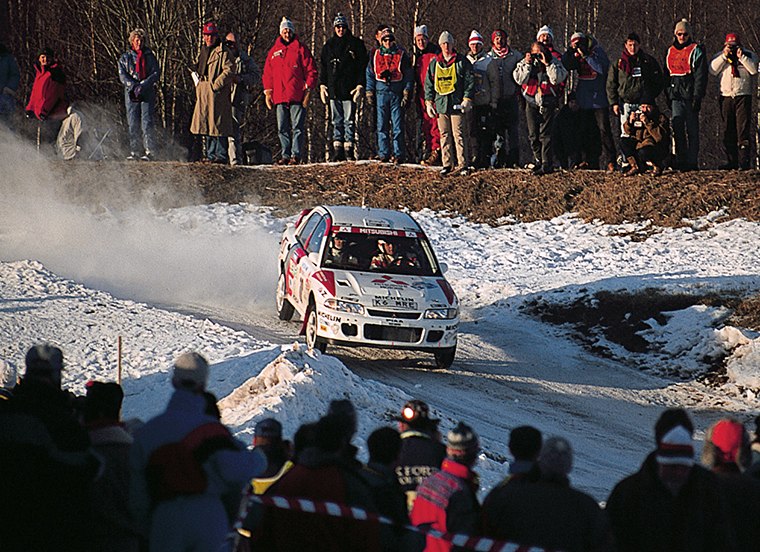 Photo: mitsubishi-motors.com
At the 1995 Swedish Rally, Kenneth Eriksson won and Mäkinen finished second, giving the Lancer Evolution II its first WRC victory in a one-two finish. The result helps open Mitsubishi's history beyond one man's biography. Mäkinen later became its central figure, but before his four consecutive titles, other drivers also helped the model mature.
That year, Mitsubishi began entering asphalt events more actively. Drivers took on tasks according to their surface strengths, while Mäkinen became an important part of the long-term plan. The team needed not just to preserve its gravel advantage, but to make the car score across the entire calendar. The road towards a title began by widening the range in which it worked.
The Evo III followed, with a larger intercooler, revised intake and aerodynamics, and measures to improve turbo response forming another development step. How quickly the turbo system regained effective response after the driver lifted and reapplied the throttle directly affected corner exit. Increased performance meant not just peak horsepower, but usable torque when the driver needed it.
Eriksson won again in Australia, and Mitsubishi finished runner-up in the manufacturers' championship. It showed that the team was close to the summit, but also that its work was unfinished. Mäkinen's first full factory season had not been smooth, yet the team now had an increasingly mature technical foundation and was preparing to focus more closely on a season-long title.
The Evo's turbo response also concerned the seconds after the driver lifted off. Releasing the throttle before a corner changes exhaust energy and can reduce turbo speed; when the throttle is pressed again, the driver wants power back quickly. Anti-lag works around this transition, helping connect the repeated braking, turning and acceleration of competition.
The performance was not free. Maintaining turbo response increased the thermal load on some components, so maintenance had to account for their condition and lifespan. The production car supplied the foundation, while competition modifications pushed it to greater intensity. The Evo's sustained competitiveness depended on performance and maintenance maturing together, not on one impressive-sounding technology name.
Safari 1996: Endurance Tradition as a Tool for Attack
In 1996, Mitsubishi built a full WRC title campaign around Mäkinen. After the opening win in Sweden, the team went to the Safari. Its total distance was then about 2400 kilometres, including nearly 1500 kilometres of timed sections, far longer than many European events of the period. That intensity required different preparation from the European operating team.
Mitsubishi adopted active preventive maintenance, replacing key parts at service opportunities and addressing potential risks before failures occurred. The aim was not to have the driver conserve the car slowly all the way, but to let him attack at a stronger pace. Service planning and driving strategy supported each other, putting endurance knowledge to work in pursuit of greater speed.
Mäkinen won the Safari, then added Argentina, Finland and Australia. With five wins from the year's nine rounds, he secured his first world title before the season ended. The Evo III became a key model in the marque's history. Driver, co-driver, car and service crew finally linked years of accumulated work into a complete line of results.
In the same period, Burns handled Asia-Pacific duties, while the Lancer Evolution also won the WRC Group N Cup. These results belong to Mitsubishi's wider rally map, but cannot all be counted as WRC manufacturers' championships. The principal top-level honour of 1996 was Mäkinen's drivers' title. Mitsubishi still had one step to take towards a manufacturers' world crown.
The Rules Opened Up. Why Did Mitsubishi Stay with Group A?
In 1997, World Rally Car regulations entered the WRC. Within the rules, manufacturers could turn road cars that were not originally turbocharged and four-wheel drive into top-level rally machines, gaining more development freedom than under traditional Group A. Subaru, Ford and other rivals adopted the new formula, while Mitsubishi continued with a Group A Lancer Evolution.
This was not simply a refusal to progress. The road-going Evo already had a turbocharged four-wheel-drive foundation. Mitsubishi could also incorporate certain competition-driven structural changes into production-car development, then bring them to the rally car through homologation. At the time, the close link between road and competition cars remained an effective resource.
Nor was the Evo IV merely an Evo III with a new body. Engine and drivetrain positioning changed substantially, while suspension and transmission continued to develop. The new generation needed fresh testing and set-up, and Mäkinen later recalled the different driving feel of successive Evos. Remaining in the same regulatory category did not mean stopping technical renewal.
In 1997, Mäkinen won in Portugal, Catalunya, Argentina and Finland, retaining his title by one point over Colin McRae. The asphalt victory in Catalunya was particularly important, turning Mitsubishi's ability on different surfaces into a concrete result. Group A could still win, but each year's advantage had to be earned anew.
1998: The Second Car Changes What “Champion” Means
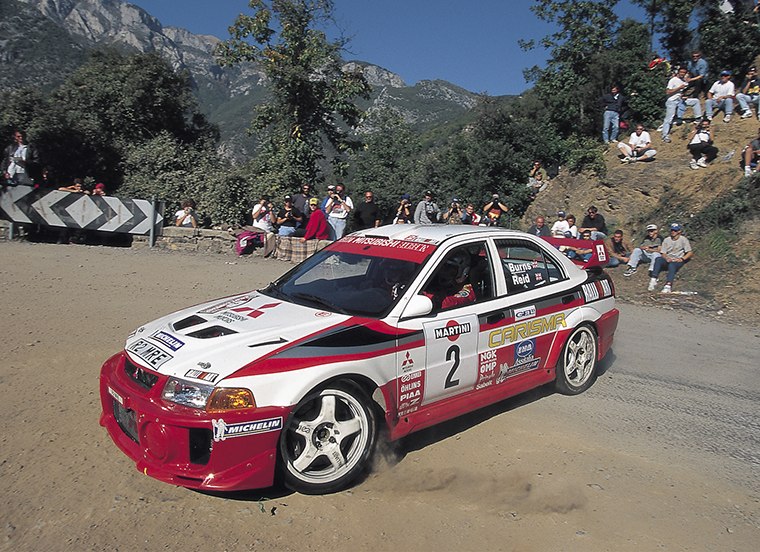 Photo: mitsubishi-motors.com
In 1998, Mitsubishi entered Mäkinen and Burns in a more complete two-car campaign. A single outstanding driver may sustain a drivers' title challenge. For the manufacturers' championship, however, the second car's ability to contribute across different rallies can transform the situation. A team's strength cannot be judged only by the position of its leading driver.
Burns took his first WRC victory at the Safari. Mäkinen kept scoring through an uneven campaign and won repeatedly in the second half. The Evo V brought a wider body and further-developed chassis and drivetrain. It won not because of the name of its regulatory class, but because continuing development expanded its usable performance.
At the British finale, Mäkinen slid off on oil on the stage, damaged the rear suspension and eventually retired. Mitsubishi could no longer directly control the drivers' title, but Burns remained in the rally. The value of a two-car manufacturer programme became clear: one person's retirement did not erase all the team's objectives at once.
Sainz's final-stage failure preserved Mäkinen's individual title, while Burns's victory helped Mitsubishi win the manufacturers' championship. The team took seven wins that season: five for Mäkinen and two for Burns. The 1998 double was not two descriptions of the same honour. Two distinct tasks had finally reached their goals in the same year.
Evo VI and the Fourth Title: A Shrinking Advantage, Continuing Development
The Evo VI arrived in 1999, and Mäkinen won first in Monte Carlo and then Sweden. The two contrasting winter events demonstrated the adaptability of driver and car. Monte Carlo was a particular test of tyres, road information and risk assessment: snow, ice and dry asphalt could alternate within one rally, making a pursuit of outright speed alone insufficient.
Through the season, World Rally Car designs continued to mature, with new models such as the Ford Focus and Peugeot 206 intensifying competition. Mitsubishi kept refining its Group A drivetrain and chassis, with active differential development becoming a major task. How a differential distributes and limits differences in wheel speed affects traction as well as the car's response in corners.
At Sanremo, Mäkinen moved ahead on the final stage, adding a key victory to his fourth title season. New technology has to be understood within a specific event; the entire result cannot be credited to one differential. Driver, tyres, set-up and stage conditions all contributed. Yet continuing to improve the car was certainly one reason Mitsubishi was not immediately left behind by the new rules.
Mäkinen completed four consecutive titles from 1996 to 1999, associated respectively with the Evo III, IV, V and VI. The manufacturers' title, however, went to Toyota in 1999. Again, individual dominance and overall team results did not necessarily move together, while Mitsubishi's technical route was leaving it an increasingly narrow margin.
The Evo VI's rear wing made the relationship between road and rally cars particularly visible. Mitsubishi adopted a two-level wing on the production model to serve competition needs, but the FIA judged its shape incompatible with the relevant technical requirements, forcing the rally car to close the lower opening. Even a component already fitted to the road car was not necessarily usable unchanged under competition rules.
Engineers and regulatory staff had to keep managing such boundaries. Group A's permitted modifications, the structures listed in homologation documents and event scrutineering together determined the final form of the car. Mitsubishi's 1999 drivers' title showed that development room remained within the restrictions. Managing those restrictions, however, also consumed time and resources.
2001: The Old Car Still Won, but the New One Had to Appear
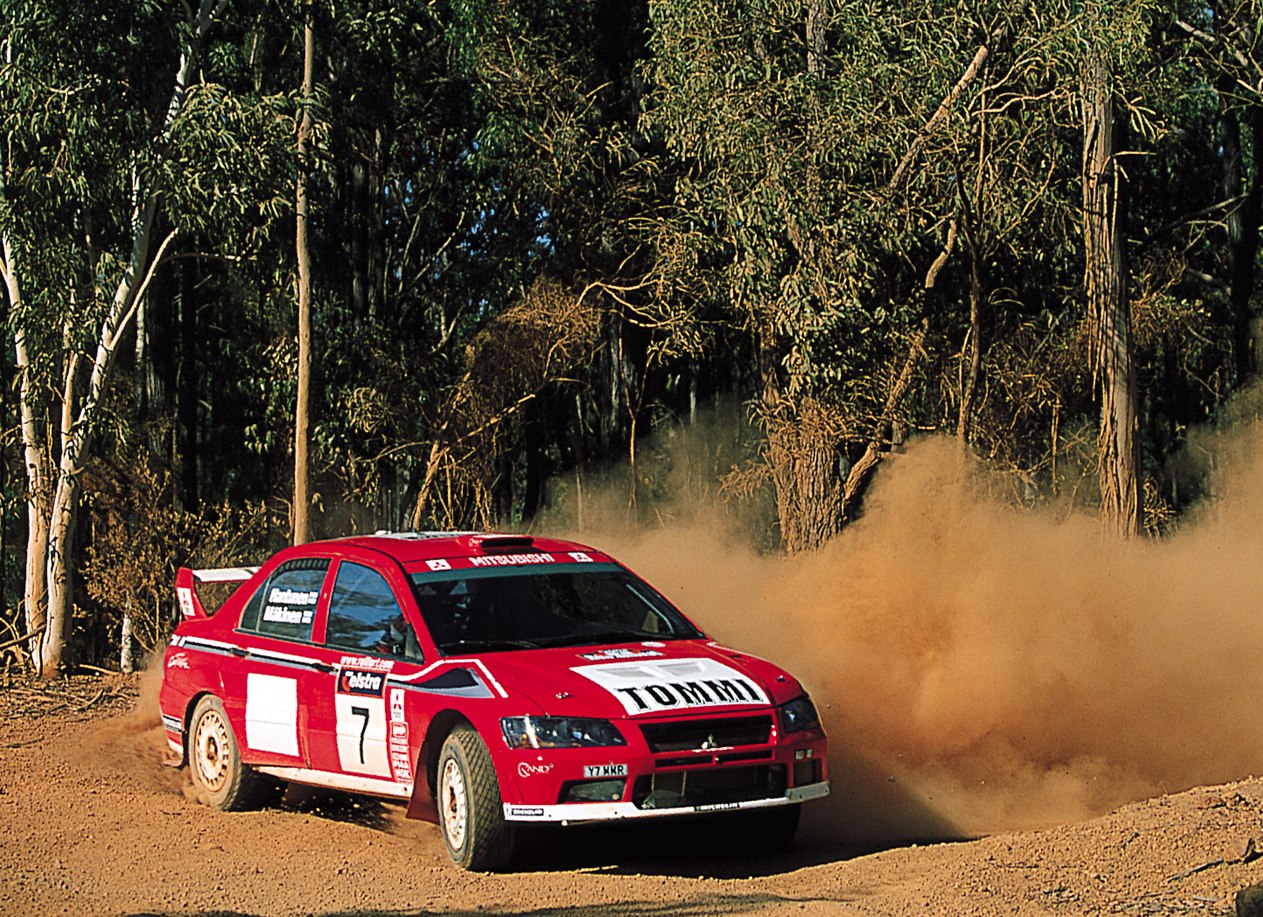 Photo: mitsubishi-motors.com
By 2001, Mitsubishi had decided to develop its own World Rally Car, with a planned Sanremo debut. The existing Evo continued racing in the meantime. It received permitted improvements including changes around suspension mounting space and the engine flywheel, becoming the competition version later often called the “Evo 6.5”.
Still developed from the existing platform, this car gave Mäkinen three wins in Monte Carlo, Portugal and the Safari. The old concept had not suddenly become useless; he even led the title contest for a time. Its continued ability to win made the transition more complicated. Developing the familiar car could deliver immediate results, while committing to a new platform concerned the ability to keep pace with rivals in the future.
The new Lancer Evolution WRC appeared at Sanremo as planned, but did not immediately deliver the expected improvement. Mitsubishi's own history acknowledges insufficient development time and the team's failure to fully rebuild all key areas around the new rules. The car struggled over the final four rounds. Mäkinen finished only one of them and ended the season third.
The change cannot be reduced to “the new rules did not suit Mitsubishi”. Regulations offer room; using it depends on development time, organisation and testing. A previously successful system facing a new task may need not merely more of the same work, but a different structure for the work itself.
Organisational Speed Starts to Matter More Than Established Experience
Mitsubishi's earlier advantage lay in close cooperation between competition development and production-car research in Okazaki, Japan. Road models could consider rallying requirements from the design stage, while the competition department made improvements with relatively concentrated resources. Within Group A, this relationship had worked extremely well and gave the Evo its distinctive road-and-rally connection.
World Rally Car competition demanded faster and more specialised development responses. In 2002, Mitsubishi redistributed responsibilities, bringing the European side into the design of more areas from the planning stage to shorten development cycles. Engine and drivetrain work remained connected with Japan, and cooperation across regions had to adapt to a new tempo.
Results did not recover immediately. A changed driver line-up, continuing improvements and progress on individual stages failed to produce a strong season. In 2003, Mitsubishi paused factory participation to make time for restructuring and a new car. The brand associated with four consecutive titles now had to prove it could become competitive again.
The revealing point of this low period is that the old strengths had not simply vanished. Engineers still had experience, the manufacturer still understood four-wheel drive and turbocharging, and the drivers remained capable. But those abilities had to be organised for the new environment. Experience that cannot be converted promptly into faster new development can become a familiar process that grows harder to update.
Moving more development responsibility to Europe was not simply a change of office address. Body, suspension, engine and drivetrain had to serve the same performance target. Design changes affected parts manufacture, testing and transport to the next rally. If a problem required repeated confirmation across several departments, improvements to the whole car could lag behind the calendar even when each department was highly skilled.
That gives the 2003 pause a concrete meaning: the team needed rebuilding time not consumed by continuous competition. A break offered an opportunity to adjust, but also removed the steady flow of competitive data from real events. On returning, ideas on paper still had to be validated on different surfaces. The 2004 comeback could not automatically restore the position held in 1999.
The 2005 Podiums Could Not Secure Another Season
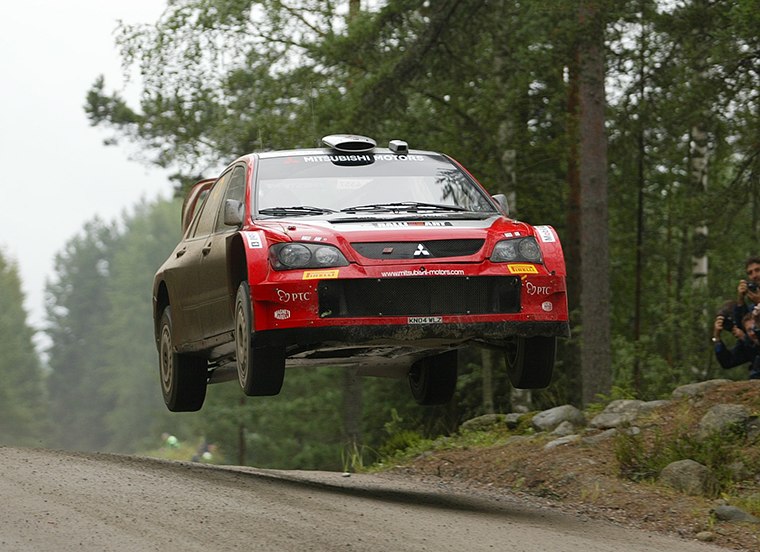 Photo: mitsubishi-motors.com
Mitsubishi returned with a new car in 2004. The 2005 Lancer WRC05 continued to develop, widening with the regulation change and receiving revisions to suspension, engine control and gearshift systems. The team began to regain more convincing results.
Gilles Panizzi finished third in Monte Carlo, and Harri Rovanperä took second at the Australian finale. For a team that had endured prolonged difficulty, these were not positions to dismiss. They showed the new system finally carrying progress to the finish. They did not yet amount to a title challenge, but demonstrated recovering competitiveness.
Yet in December 2005, Mitsubishi announced that its WRC factory programme would pause from 2006, concentrating resources on other priorities, including its Dakar programme at the time. Improvement on the stages and investment decisions at company level ultimately pointed in different directions. The team had made progress, but was not given a full season in which to build on it.
The factory withdrawal did not take every Evo out of rallying at once. Production-based classes, local events and customer drivers continued using the cars, with maintenance, parts and set-up knowledge surviving for years. Later public memories of the Evo came partly from four drivers' titles, and partly from its continued use, repair and trust on stages far from the world championship contest.
The two 2005 podiums came in very different events. Third in Monte Carlo reflected the Panizzi brothers' handling of asphalt and changing road conditions; second in Australia belonged to the crew of Rovanperä and Risto Pietiläinen. The new car was beginning to deliver significant results in different circumstances, more convincing than an isolated burst of speed on one particularly suitable road.
They were still milestones within a rebuilding process. A drivers' title requires performance across an entire season, and a manufacturers' title needs contributions from multiple cars. Mitsubishi's late results deserve recognition precisely because they show real progress after difficulty. Exaggerating two podiums into a completed revival hides how much work the team still had ahead.
What Mitsubishi Truly Left to Rallying
From Colt to Galant to Lancer Evolution, Mitsubishi's story consistently concerns turning the foundations of real production models into competition capability. At its most successful, production development, rally operations and driver feedback supported one another. When technical rules and the scale of competition changed, those relationships needed to be reorganised.
Four consecutive titles proved that a Group A Evo could keep beating rivals after the new rules appeared. They did not prove that the old system could continue indefinitely. The three wins of 2001 and the new car's subsequent struggles demonstrate the difficulty particularly clearly. The most mature tool in the present is not necessarily the one with the greatest future potential, and both timing and preparation affect the cost of switching.
The 1998 manufacturers' title also brings people beyond Mäkinen into view. Burns, co-drivers, testers, mechanics, Japanese engineers and the European operating team together determined whether two cars' results could become one trophy. A legendary driver stands at the centre of the story, but is not the whole of the work.
Today, the Evo's red-and-white livery still evokes very specific sounds and images. What deserves preservation is not merely an impression of past invincibility, but how the machine matured step by step, persisted through change and finally met questions it could not immediately answer. Championships made Mitsubishi memorable; transition makes its history worth continuing to read.
Timeline
| Year | Key Milestone |
|---|---|
| 1967 | Colt 1000F entered Australia's Southern Cross Rally |
| 1972—1976 | Cowan won the Southern Cross; Singh took Mitsubishi's first WRC victory in 1974; a top-three sweep at the 1976 Safari |
| 1988—1989 | Galant VR-4 entered the WRC, winning in Finland and Britain in 1989 |
| 1993 | Lancer Evolution's WRC debut |
| 1995 | Eriksson won in Sweden, giving the Evo its first WRC victory |
| 1996—1999 | Mäkinen won four consecutive WRC drivers' titles |
| 1998 | Mitsubishi's first WRC manufacturers' title; seven wins in the season |
| 2001 | The new World Rally Car debuted at Sanremo; difficulties in the transition |
| 2003—2004 | Returned after pausing factory participation |
| 2005 | Returned to the podium; announced a pause in the WRC factory programme at year end |
Championship and Model Record
| Category | Record and Definition |
|---|---|
| WRC Manufacturers' World Championships | 1, in 1998 |
| WRC Drivers' World Championships | 4, Mäkinen from 1996 to 1999 |
| Champion Co-drivers in Those Seasons | Seppo Harjanne: 1996, 1997; Risto Mannisenmäki: 1998, 1999 |
| Rally Wins in 1998 | Mäkinen 5, Burns 2, for a total of 7 |
| Main Models of the Four-Title Run | Evo III, IV, V and VI, all within the Group A development line |
| The Marque's First WRC Win | 1974 Safari, Joginder Singh / Lancer 1600GSR |
| The Evo's First WRC Win | 1995 Sweden, Kenneth Eriksson / Evo II |
| Statistical Scope | WRC top-level competition, APRC, production-based classes and Dakar are counted separately; through the end of the 2025 season |
Sources and Further Reading
- Mitsubishi Official Rally History: 1967-1977
- Mitsubishi Official Rally History: 1981-1987
- Mitsubishi Official Rally History: 1988-1992
- Mitsubishi Official Rally History: 1993
- Mitsubishi Official Rally History: 1995
- Mitsubishi Official Rally History: 1996
- Mitsubishi Official Rally History: 1997
- Mitsubishi Official Rally History: 1998
- Mitsubishi Official Rally History: 1999
- Mitsubishi Official Rally History: 2001
- Mitsubishi Official Rally History: 2002
- Mitsubishi Official Rally History: 2004
- Mitsubishi Official Rally History: 2005
 Photo: mitsubishi-motors.com
Tommi Mäkinen: After Four Consecutive Titles, Building Another Championship Team
From seeking a full factory opportunity to four consecutive titles and then building Toyota's new team: how a driver's experience became organisational capability.
Continue Reading · About 20 Minutes →