
Expand chapter list · 18 sections
- Key milestones
- 1. Why Honda insisted on four-strokes when it returned
- 2. Oval pistons: Finding more space within four cylinders
- 3. After the first failure, the real problems began to emerge
- 4. The NS500's answer was one fewer cylinder
- 5. From three cylinders to four: Another radical approach
- 6. As power grew, a rider's job was more than opening the throttle
- 7. What did the "big bang" change?
- 8. 2002: Four-strokes finally returned under different rules
- 9. Even after winning, the engine still needed fixing
- 10. After Rossi left, horsepower did not bring back the title
- 11. Hayden's 2006: A different kind of championship
- 12. The 800cc era: Honda misjudged again
- 13. Stoner turned accumulated work into a title
- 14. The Márquez era: A formidable rider–machine combination
- 15. What separates an occasional win from a renewed title challenge?
- 16. The tradition worth keeping is the freedom to change the answer
- Honda's premier-class models and championship record
Key milestones
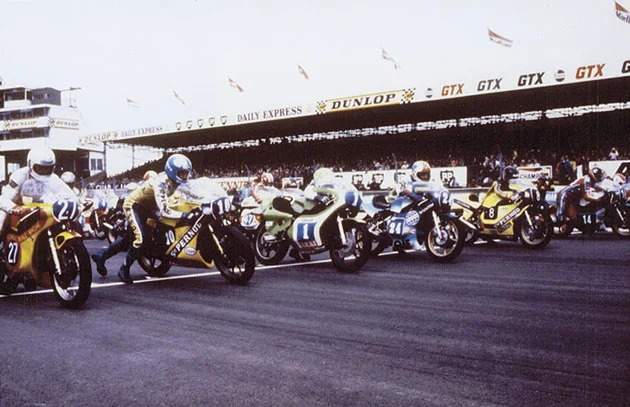
At the 1979 British Grand Prix, Honda brought a bike to Silverstone quite unlike its rivals. It had a four-stroke engine, unusually shaped pistons and a manufacturer's ambition to return to the premier class. Once the race began, however, ambition did not become speed.
Mick Grant crashed out at the first corner, and Takazumi Katayama's bike stopped with a fault a few laps later. The NR500's debut did not deliver the imagined technical triumph. At the following French round, neither bike even qualified for the race.
Years later, Honda's name would evoke Spencer, Doohan, Rossi, Stoner and Márquez, and rows of world titles. But understanding its place in premier-class motorcycle racing cannot begin with trophies. The most dramatic part is how engineers repeatedly discovered that the technology they believed in might not win—and that continuing to win required a willingness to understand the motorcycle anew.
1. Why Honda insisted on four-strokes when it returned
Honda entered the Isle of Man TT in 1959 and rapidly became a major force in World Grand Prix motorcycle racing. In 1966 it won the manufacturers' titles in all five capacity classes then contested. Small-capacity multicylinder engines, high revs and precision machinery formed its most distinctive racing image.
After the 1967 season, Honda temporarily withdrew from World Grands Prix and redirected resources elsewhere. By the late 1970s, when it prepared to return, the 500cc environment had changed. Two-strokes were dominant, with important advantages in high-output racing applications at the same displacement.
A four-stroke completes intake, compression, combustion and expansion, and exhaust for each power stroke; a two-stroke completes the corresponding processes with fewer piston strokes. Actual output also depends on gas exchange, combustion efficiency and revs. Under the rules and technology of the time, however, challenging equal-capacity two-strokes directly with a four-stroke posed very specific difficulties for Honda.
Honda did not simply copy its opponents. The NR500 pursued power through higher revs and greater breathing capacity. That choice extended the technical convictions established in the 1960s, while sending the development team into territory far more complex than conventional round pistons. Before winning, it had to build an engine for which no ready-made answer existed.
2. Oval pistons: Finding more space within four cylinders
The rules limited cylinder count, preventing Honda from simply adding cylinders to obtain the design freedom it wanted for high revs. Engineers therefore changed the shape of piston and cylinder. Each elongated piston used two connecting rods and eight valves per cylinder, increasing breathing capacity.
The arrangement commonly called "oval pistons" was not intended merely to look unusual. More room for valves could help the engine breathe at high revs, a crucial condition for this route to greater power. The drawing-board logic was clear; manufacturing and reliability problems multiplied with it.
Piston rings had to maintain a seal around the special shape; thermal changes in components had to be controlled; two rods had to coordinate with the piston's motion. A racing engine also had to be light, compact and serviceable. Structure or material added to solve one problem could make another worse.
The NR500 thus magnified a central engineering tension: an inventive proposal remains far from a race-ready product. It was not enough to make it run in one experiment; a rider had to accelerate, brake, lean and shift repeatedly on a real circuit. Racing judges the finished whole, not each clever idea with a separate prize.
3. After the first failure, the real problems began to emerge
Honda kept improving the NR500 after Silverstone. Weight, output and reliability all changed, and it achieved results outside World Grands Prix. It was not a machine that never progressed. Those gains nevertheless failed to make it a contender for the 500cc world championship.
Honda's official project history lists practical difficulties: excessive engine braking disturbed the rear wheel, a complex chassis made maintenance and adjustment slow, and durability improvements added weight. Features that initially looked beneficial could impose new costs when incorporated into the whole motorcycle.
Engine braking, for example, helps deceleration but is not better simply for being stronger. On corner entry the rear wheel is already affected by braking and load transfer. Extra engine drag can disturb it further and reduce stability. Back-torque-limiting technology developed to address such issues later reached production bikes: a real technical gain from a failed project.
Technical gains could not replace results. With the NR500 unable to achieve its World Grand Prix winning ambition, Honda had to choose between persisting with the original route and recovering competitiveness quickly. A company can learn much from failure; riders and teams still need a bike that can win.
4. The NS500's answer was one fewer cylinder
Honda began developing the two-stroke NS500 in 1981. Rather than copy the four-cylinder configuration common among rivals, it chose a V3. The aim was practical: less weight and bulk, with chassis and handling advantages compensating for lower peak power.
A smaller engine helped packaging, a narrower frontal area could reduce drag, and a light bike offered opportunities under braking and in changes of direction. The approach split the question of the fastest lap into several parts, instead of organising everything around maximum engine output.
Honda brought experience from its two-stroke motocross machinery into the project and entered World Grands Prix in 1982. Freddie Spencer won in Belgium, ending Honda's long wait for a premier-class Grand Prix victory. In 1983 he rode the NS500 to the 500cc riders' world title.
The NS500 did not prove innovation useless; it made distinctive technical choices itself. The real change was Honda's willingness to test its objectives against race results. Technology had to serve the competitiveness of the whole motorcycle, and even a heavily funded approach could change when the evidence did not support it. That willingness finally brought the return programme close to its original purpose.
5. From three cylinders to four: Another radical approach
The NSR500 arrived in 1984. Its two-stroke V4 became the core of Honda's premier-class machinery for years to come. Alongside greater power potential, the new bike adopted a distinctive layout: the fuel tank beneath the engine, with exhaust expansion chambers above it.
Placing fuel mass low appeared helpful in lowering the centre of gravity. Yet a motorcycle must lean and change direction quickly, and handling cannot be explained by one centre-of-gravity figure. Burning fuel alters mass distribution; exhaust placement also affects heat, maintenance, cooling and suspension space.
Honda's technical review of the early NSR500 shows the layout's multiple difficulties. The lower tank consumed space, while elaborate upper exhausts added structural and maintenance burdens. Whether the bike handled well had to be answered by its dynamic behaviour, not a static layout drawing.
Honda's preserved technical data makes the problem precise. The first NSR500's underslung tank held thirty-two litres, with a full fuel load weighing about twenty-four kilograms. With both bikes carrying twenty litres, its centre of gravity was nearly thirty millimetres lower than the NS500's. As that low-mounted fuel was consumed, however, the whole bike's centre of gravity rose by more than thirty millimetres.
In other words, the bike Spencer rode at the start and the one approaching the finish could respond quite differently. Engineers added baffles and foam to reduce fuel movement, yet he could still feel it shifting under heavy braking. He had to adapt not just to the circuit but continually to mass distribution changing inside the motorcycle.
The upper exhaust created another problem: hot pipes occupied the area normally gripped around the fuel tank. Honda made a double-layer heat shield, introduced air and added outlets for heat. A decision about lowering the centre of gravity ultimately changed fuelling, heat management, rider-contact areas and maintenance together. Those connections reveal the complexity of whole-bike engineering.
The radical layout still won races. Honda's model history records three wins in the five Grands Prix Spencer contested on the first NSR500. That made the question harder: the bike had speed and a gifted rider could win on it, but the structure was not necessarily worth retaining. Engineers ultimately had to compare development scope with the cost of each improvement, rather than design the next generation solely around whether the bike had won.
The 1985 NSR500 returned to a more conventional layout. Spencer won the 500cc title and also the 250cc crown on a different bike, the RS250RW. Contesting two classes meant alternating between two machines each weekend, then entering the 500cc race after only a short rest following the 250cc event.
Another 1985 change appears less often in championship photographs. Honda sent young chassis-design engineers to races for technical support, letting them see how the components they had drawn actually worked. Engineers Miyajima and Yamamoto covered the earlier and later parts of the season respectively, carrying riders' and mechanics' concerns back to development.
Improvement did not always mean more output. That year the team increased crankshaft rotational inertia to slow the rise in engine speed and make usable rear-wheel traction easier to find. A component less willing to accelerate rapidly could let the whole bike accelerate out of a corner faster. This apparently counterintuitive choice anticipated the NSR500's enduring theme: power must arrive in a form the rider and tyre can accept.
6. As power grew, a rider's job was more than opening the throttle
The NSR500 subsequently took Wayne Gardner, Eddie Lawson and Mick Doohan to 500cc titles. An unchanged name did not mean an unchanged motorcycle. Engine, chassis, suspension and tyres kept evolving, while riders continually demanded clearer feedback.
The difficulty of two-stroke 500cc bikes is often compressed into words such as "dangerous" and "violent". More specifically, the rear tyre must accept acceleration loads while the motorcycle is still leaning. If output changes too abruptly, the tyre can slide; if it then regains grip suddenly, it can throw the rider out of the saddle.
For engineers, raising peak power was only part of the problem. How early and delicately a rider could use it determined corner-exit speed. If he had to wait too long for the bike to stand upright, greater power on paper might find too few chances to work. Delivery became as important as the amount of power.
In a later Motor Sport interview, Doohan attributed handling improvements to the combined evolution of chassis, suspension, tyres and engine. He did not portray himself as a lone hero taming machinery. That fits the NSR500's history: a champion bike matured through many specific problems being solved one by one.
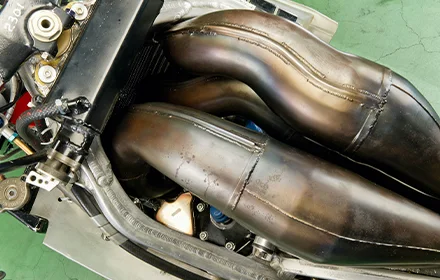 Photo: global.honda
7. What did the "big bang" change?
In 1992 Honda adopted the famous "big bang" firing concept. The name describes the timing of the cylinders' power strokes, not an actual explosive failure. By changing the intervals between power pulses, engineers tried to make the loads at the rear wheel more controllable.
Describing it as "suddenly much more power" is inaccurate. Its greater value was usability. Doohan remembered a more predictable, friendlier bike, but the rear wheel still slid; the rider still had to manage the throttle.
In 1992 Doohan built a strong championship lead before serious injury at Assen interrupted his challenge. He returned for the last two rounds and lost to Rainey by four points. From 1994 he won five consecutive 500cc world titles. Honda's advantage came both from development and from sustained cooperation among rider, engineers and race team.
Honda won all fifteen 500cc races in 1997, twelve through Doohan. The NSR500 could take different riders to victory, while Doohan won twelve times against rivals on the same marque. Those results showed the strength of rider and machine together.
8. 2002: Four-strokes finally returned under different rules
The premier class entered the MotoGP era in 2002, with rules allowing 990cc four-strokes to race alongside existing 500cc two-strokes. Honda introduced the V5-powered RC211V. The four-stroke route that had caused the NR500 such difficulty more than twenty years earlier returned to centre stage under new rules.
This was not simply a belated direct victory for the NR500. Capacity limits, tyres, electronics, manufacturing capability and the racing environment had all changed. In 1979 the challenge was to catch two-strokes at equal displacement; in 2002 it was to design an entirely new motorcycle around different regulations.
Rossi won the title on the RC211V, and Hondas took fourteen of sixteen races. Such results can suggest a motorcycle mature from birth. The official engineering retrospective presents a far more tense picture than the points table.
Engine testing around the start of the season exposed durability problems. Wear and failures in pistons and valve gear forced continuous improvement, with a substantial gap between intended life and reality. Spectators watched repeated wins while engineers worked to keep the next race from ending with the same failures.
9. Even after winning, the engine still needed fixing
Honda originally targeted 2,000 kilometres of piston life, but initially had to replace them every 300 kilometres. The bike could already win, yet component life remained far below target. Converting one race's speed into a season's results required constant repair of these weaknesses between events.
Honda's engineering history records the continual parts updates made in 2002. Connecting-rod small ends, valve gear and other areas needed attention. A high public win rate did not make the work behind it easy.
This contrast is valuable for understanding racing. A result tells us who won, but not automatically how much margin lay behind the victory. A rider may appear to have a perfect machine, while engineers know a particular component still needs a new version before the next start.
The RC211V remained hugely successful in 2003, with Rossi taking another title. He then chose to leave for Yamaha. The newly dominant bike remained; the rider who had won its championships stood on the other side. The debate over rider versus machine finally faced a direct test, and one easily oversimplified.
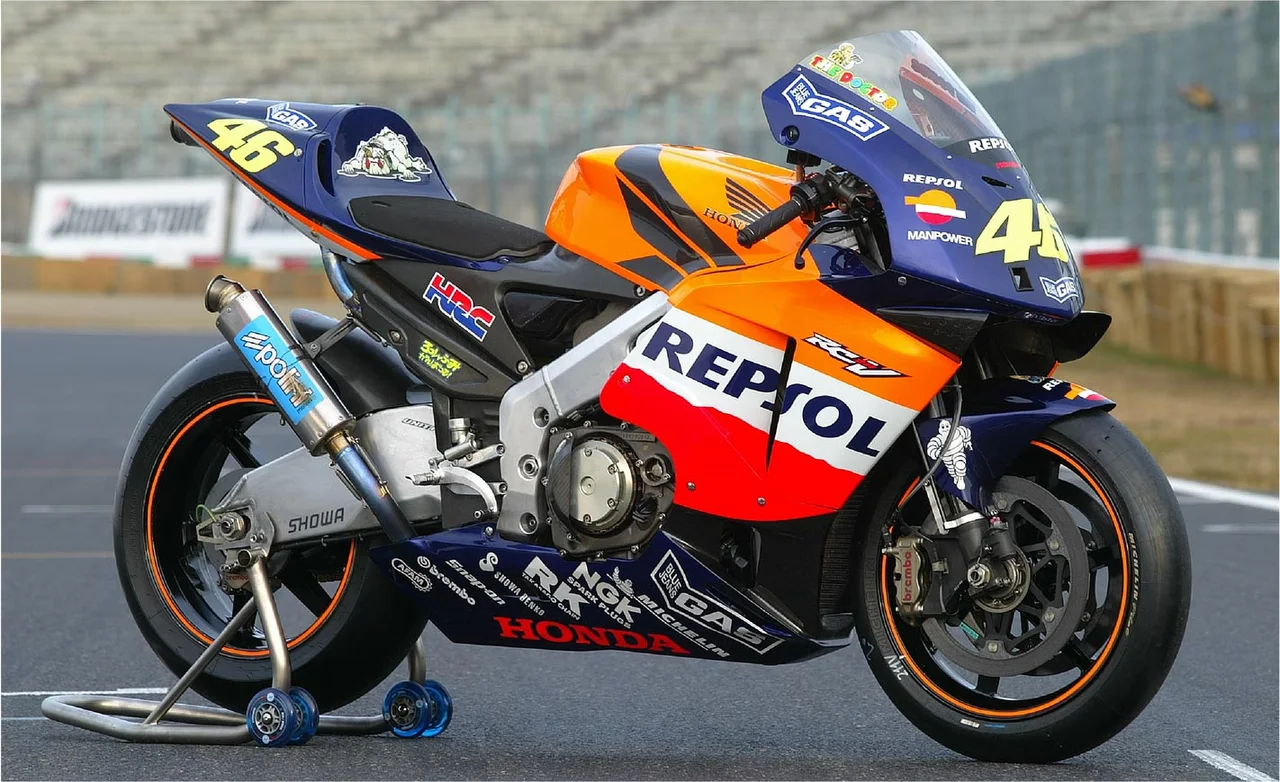 Photo: global.honda
10. After Rossi left, horsepower did not bring back the title
Rossi won the 2004 riders' world title for Yamaha. Honda retained the manufacturers' crown but could not stop its former rider taking the individual title. Rossi won again in 2005 as Honda continued to seek a breakthrough.
A manufacturers' championship differs from a riders' championship. The first reflects a marque's accumulated results across rounds; the second belongs to one rider's whole season. Honda still had several excellent riders and strong bikes, allowing manufacturer-level success without guaranteeing that any one rider could beat Rossi.
Honda was not idle. Official engineering accounts show continual changes to engine characteristics and chassis, seeking better entry stability, turning and exits. Riders' feedback concerned the whole cornering sequence from braking to acceleration, not merely top speed at the end of a straight.
This period shows how identifying where a bike is fast can be harder than improving an attractive specification. More horsepower may load the tyre more heavily or make the ideal line harder to hold. Unless all phases connect, an isolated gain will not appear fully in the time at the finish.
11. Hayden's 2006: A different kind of championship
Nicky Hayden brought Honda the riders' world title in 2006. He won twice, building his challenge on consistent points across many weekends. The title did not look like Rossi's win-heavy campaigns, but equally required rider and machine to complete a long season.
At the penultimate round in Portugal, Pedrosa crashed and brought Hayden down. Hayden arrived in Valencia eight points behind Rossi, unable to decide the championship through his own finish alone. Rossi fell at Turn 2 in the finale and took only three points; Hayden's third place earned sixteen, turning an eight-point deficit into a five-point advantage. Between the rounds, the task changed from protecting a lead to exploiting a rival's mistake.
The RC211V also changed significantly. Honda provided Hayden with a new version that further reduced engine size and overall packaging, aiming to improve balance throughout a corner. Consistent riding and engineering direction together restored a result after the setbacks of 2004 and 2005.
Hayden's title is a reminder that motorcycle racing has no single championship pattern. Some champions build a lead through many wins; others must accumulate thirds, fourths and finishes while rivals win more often. Building a bike that supports the latter route is an important engineering achievement too.
12. The 800cc era: Honda misjudged again
MotoGP's capacity ceiling fell to 800cc in 2007, and Honda introduced the RC212V. A smaller engine and body were expected to produce an agile, compact machine. The new season quickly showed that results would not follow that intuition.
Stoner won ten races and the title for Ducati, leaving Honda chasing. Official technical accounts acknowledge that the early RC212V was too compact, making setup sensitive and stability inadequate. Engine performance, tyres and their integration with the whole bike also needed work.
On a motorcycle, smaller does not automatically mean faster. A rider needs room to move, engineers need suitable fore-and-aft load distribution, and tyres need the right conditions for braking and drive. If compactness makes those needs harder to reconcile, saved dimensions do not directly become shorter laps.
Honda continued developing the engine, valve control and transmission. Pneumatic valves helped meet high-rev demands, while gearboxes reducing interruptions in power during shifts became increasingly important. Other racing programmes could inspire ideas, but they still had to be redesigned for a motorcycle's space, mass and handling.
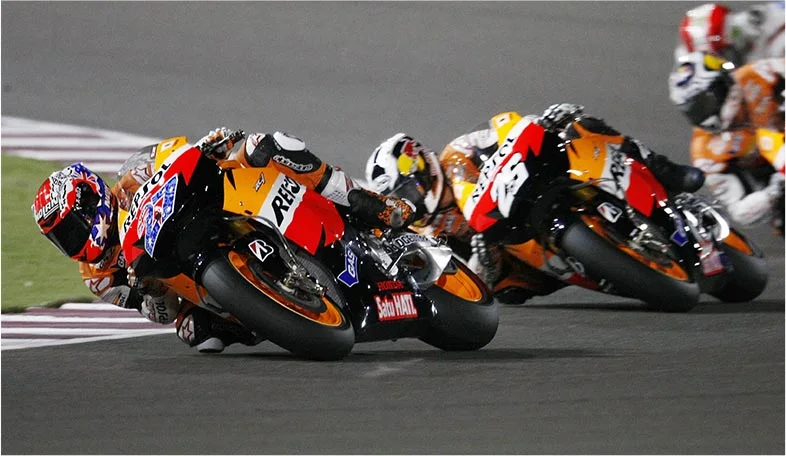 Photo: global.honda
13. Stoner turned accumulated work into a title
Stoner joined Honda in 2011 and won ten races and the world title on the RC212V. Honda bikes took thirteen victories that year, finally producing a dominant result in the last season of the 800cc rules.
It is easy to tell this turn as "sign a champion and the problems disappear". Yet the RC212V already had years of development behind it, with engine performance, transmission and overall balance changing. Stoner's riding met those improvements and produced a concentrated burst of results.
A top rider can reveal potential faster and guide the team through clear feedback, but still needs a bike able to meet those demands. Conversely, no amount of development resources automatically creates a champion without effective riding and race execution.
The limit rose to 1000cc in 2012 and the RC213V arrived. Honda remained highly competitive in individual races, but Yamaha's Lorenzo won the riders' title. Again, a manufacturer's speed across many events and one rider's final points total were not quite the same question.
14. The Márquez era: A formidable rider–machine combination
Márquez entered MotoGP in 2013 and won the world title at his first attempt. He defended it in 2014, then won four in succession from 2016 to 2019, creating a dominant era of development alongside the RC213V.
Those six titles took different forms. In 2013 Márquez had six wins and sixteen podiums, beating eight-race winner Lorenzo by 334 points to 330. In 2014 he won ten straight from the opener and thirteen overall. In 2019 he won twelve of nineteen races and finished second six times; his only non-podium was a retirement, and he amassed 420 points. Wins, consistency and rivals' performances jointly shaped the outcomes. Six titles did not mean the same advantage repeated six times.
As rules, tyres and rivals evolved, MotoGP placed greater emphasis on electronic control, aerodynamics and managing the whole bike's attitude. The engine remained important, but performance was distributed across more interacting parts. A change in one could require others to be matched again.
Honda could not maintain its riders' title run after 2019. Márquez's injury, lengthy recovery and departure after 2023 made the difficulties more visible. With the strongest old combination broken up, Honda again faced the familiar question: how could more riders consistently turn the bike's speed into results?
15. What separates an occasional win from a renewed title challenge?
In 2025 Johann Zarco won the MotoGP Grand Prix race at Le Mans for Honda, then reached the podium at Silverstone. Joan Mir also took two podiums. Honda finished fourth in the manufacturers' standings, showing signs of recovering competitiveness.
These results matter, but remain some distance from renewed dominance. A weekend that suits the bike may bring a win; a season title demands performance across more surfaces, temperatures, grip levels and layouts. Riders also need confidence that the same motorcycle will not become unpredictable from one weekend to another.
This is a recurring Honda theme. For the NR500, the question was whether an advanced concept could become competitiveness; for the NSR500, whether great power could be used; for the RC211V, how performance could coexist with durability. Later the question expanded to the whole motorcycle as electronics, tyres and aerodynamics worked together.
Recovery will require more than finding the next Doohan or Márquez. Excellent riders matter, but the engineering system must also admit varied feedback and make speed repeatable. One win can lift a team; sustained work is what can turn that encouragement into the conditions for another championship.
16. The tradition worth keeping is the freedom to change the answer
List Honda's models and the sequence is NR500, NS500, NSR500, RC211V, RC212V and RC213V. It looks like continuous technical progress, but the real process includes abandonment, reworking and corrections to earlier judgements.
Oval pistons did not bring Grand Prix victory; a three-cylinder two-stroke completed the task. The underslung tank did not become the NSR500's lasting layout, and wins continued after a conventional design returned. Pursuing compactness alone did not guarantee success at 800cc; the team had to find balance again.
Those experiences give Honda's legend more depth than the phrase "technical leadership". Sometimes it led, sometimes it misjudged, sometimes a rider carried a difficult bike far beyond expectations, and sometimes years of quiet improvement created new opportunities. Titles record success; failures explain why success was difficult.
The two NR500s at Silverstone in 1979 did not do what was expected of them. Yet people willing to admit that and propose new solutions later built machines that changed premier-class motorcycle racing. Honda faces the same test today: making the next change work on track, not merely look correct within its own history.
Honda's premier-class models and championship record
Through the end of the 2025 season, Honda has won 21 riders' and 25 manufacturers' titles in the 500cc/MotoGP premier class. They cannot be combined as one type of championship. The table lists first entry years; old and new models sometimes competed together, rather than being completely replaced year by year.
| Model | Premier-class debut | Technical approach | Related championship milestones |
|---|---|---|---|
| RC181 | 1966 | 500cc four-stroke inline-four | 1966 500cc manufacturers' title |
| NR500 | 1979 | 500cc four-stroke V4 with oval pistons | No premier-class title |
| NS500 | 1982 | 500cc two-stroke V3 | Spencer's 1983 riders' title |
| NSR500 | 1984 | 500cc two-stroke V4 | Doohan's five titles, 1994–1998 |
| RC211V | 2002 | 990cc four-stroke V5 | Riders' titles: Rossi in 2002 and 2003; Hayden in 2006 |
| RC212V | 2007 | 800cc four-stroke V4 | Stoner's 2011 riders' title |
| RC213V | 2012 | 1000cc four-stroke V4 | Márquez's riders' titles in 2013, 2014 and 2016–2019 |
Sources
- Honda Global | Returning to the World Motorcycle Grand Prix / 1979
- Behind the Birth of the NS500 | RACERS All About Honda Motorcycle Racing Machines | Honda Global
- 1984 NSR500 Technical Specifications | RACERS All About Honda Motorcycle Racing Machines | Honda Global
- 1984 NSR500 Technical Specifications | RACERS All About Honda Motorcycle Racing Machines | Honda Global
- 1985 NSR500 in Racing | RACERS All About Honda Motorcycle Racing Machines | Honda Global
- How I rode: Mick Doohan | Motor Sport Magazine
- Honda 1998 Motorsports Plans for Motorcycles | Honda Global Corporate Website
- Chapter V: Initiatives to Expand Joy Section 1: Motor Sports Part 1: Road Racing World Championship | 75 Years of Honda History | Honda's History | Honda Global Corporate Website
- Chapter V: Initiatives to Expand Joy Section 1: Motor Sports Part 1: Road Racing World Championship | 75 Years of Honda History | Honda's History | Honda Global Corporate Website
- Honda HRC move to C Concessions after year of improvements in 2025 | Honda HRC Castrol
- Honda: Premier-class championship chronology
- MotoGP: Valencia's title deciders through the years
- MotoGP: 2013 riders' standings
- MotoGP: Marc Márquez's season records
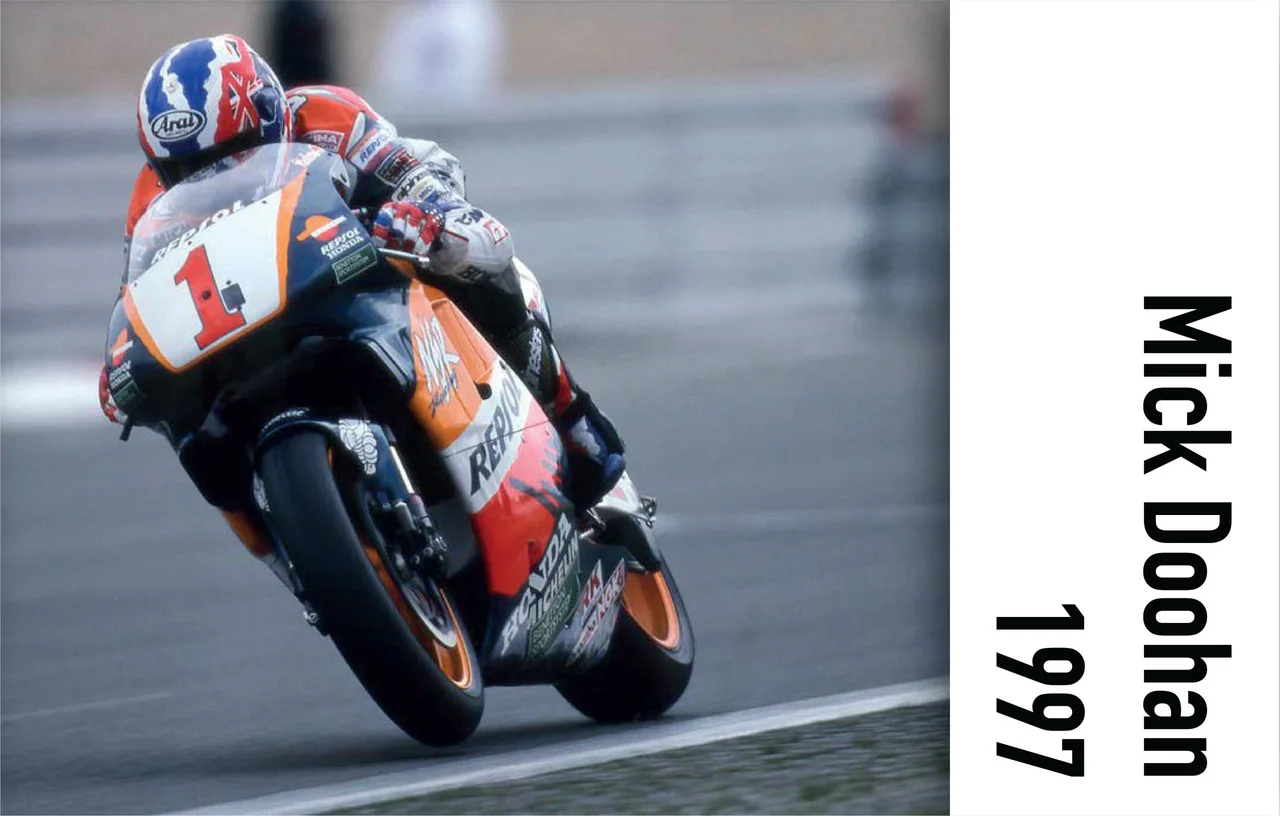 Photo: honda.co.uk
Mick Doohan: He could not recover the 1992 title, but went on to rule for five years
Continue with how Doohan and his Honda crew rebuilt his riding after injury.
Continue reading · Approx. 19.8 min →