
Expand chapter list · 17 sections
- Key milestones
- 1. Arriving in 500cc, he first met a bike he could not control
- 2. Before a first win, he had to trust the front tyre
- 3. The first seven rounds of 1992: The title seemed to be approaching
- 4. Time in hospital and time in the points table
- 5. Two races: Why the final gap was four points
- 6. 1993: The miracle did not come immediately
- 7. A left thumb takes over the right foot's job
- 8. A Mugello victory worth more than twenty-five points
- 9. 1994: Fourteen podiums build a first title
- 10. Defending a title is quieter than returning, but just as difficult
- 11. 1997: Choosing a more familiar power delivery again
- 12. Beyond twelve wins, one final retirement
- 13. Biaggi arrives: A fifth title still has to be earned
- 14. After Jerez, the career did not wait for a planned farewell
- 15. Five consecutive titles came from repeated, practical rebuilding
- Mick Doohan's career record
Key milestones
At the 1992 Brazilian Grand Prix, Mick Doohan returned to the grid. Around two months had passed since the severe Assen accident. His right leg was still far from normal, yet he already had to control a 500cc two-stroke race bike again.
He finished twelfth, a position worth no points under that year's rules. Wayne Rainey won, cutting Doohan's remaining lead to two points. At the South African finale, Doohan fought to sixth and Rainey took third. The world championship ultimately slipped away by four points.
Doohan was back, but the title was not. His leg had been saved, but his former control had not immediately returned. He later won five consecutive 500cc world titles. The real turning point was not one pain-defying ride, but rebuilding championship-level riding after his body had changed.
1. Arriving in 500cc, he first met a bike he could not control
Doohan was born in Australia in 1965. He emerged through domestic racing and superbikes in the late 1980s, already winning in World Superbike in 1988. In 1989 he joined Honda and entered the 500cc premier class of World Grands Prix.
The transition from superbikes to a 500cc Grand Prix machine is more than swapping for a faster motorcycle. One is based on a production model; the other is developed specifically for regulations and racing. Weight, power delivery, chassis feedback and tyre characteristics all demand a fresh understanding.
In a later Motor Sport interview, Doohan recalled struggling to obtain clear tyre feedback from the early Honda. Throttle response was direct, the rear wheel slid easily, and the front did not always enter corners as expected. For a young rider already proven elsewhere, such a gap would quickly show in lap times and crashes.
He also faced rivals such as Lawson, Rainey and Schwantz. "Still adapting" could not explain forever why he could not catch them. He had to identify specific improvements: settings, feeling the tyres, and connecting occasional good laps into an entire race.
2. Before a first win, he had to trust the front tyre
Doohan took his first Grand Prix podium in 1989, then his first 500cc victory in Hungary in 1990, finishing third in the standings. He advanced to second in 1991, already close to the championship.
That ascent did not mean a dangerous bike had suddenly become tame. Doohan and his engineers continually sought chassis and geometry settings better suited to him. Clearly feeling what the front tyre was doing was essential to further speed.
Why does front-tyre feedback matter so much? During entry, braking load gradually gives way to lateral cornering load as the bike leans. A rider must judge how much braking can remain and how far to lean. If that transition is hard to sense, the limit becomes a suddenly appearing boundary instead of a range approached progressively.
Understanding the front gave Doohan a better basis for managing rear-wheel slide and power. The forceful riding spectators later saw rested on increasingly precise recognition of mechanical responses. Championship pace need not mean greater willingness to risk every lap; it can also mean recognising the risk earlier.
3. The first seven rounds of 1992: The title seemed to be approaching
In 1992 Honda's big-bang NSR500 improved power control. Doohan won the first four rounds, finished second twice and won again in Germany. Before Assen he had five victories from seven races.
Motor Sport's retrospective records a fifty-three-point lead over second-placed Kevin Schwantz. Under the scoring system of the time it was enormous. Yet a lead was only a record of results to that point; it could not prevent an accident in the next practice session.
Assen demands much of a rider, and a weekend includes more than the race. Practice requires finding settings; qualifying requires securing a position. Those phases also carry risk. In June 1992 Doohan crashed at Assen and badly injured his right leg. A championship route that had seemed clear was abruptly broken.
He lost more than a few races. Complications during treatment put his right leg at risk of amputation. At that point, discussing points at the next round no longer described the situation. Bodily function had to be saved before returning to his old profession could even be considered.
4. Time in hospital and time in the points table
Doohan underwent repeated treatment, with Grand Prix doctor Claudio Costa playing an important part in care and transfer between hospitals. Complex treatment saved his right leg, but recovery was far from complete.
Accounts often centre on extreme pain and determination. His later career was also shaped by specific restrictions: limited movement in the right foot and ankle meant that supporting his body, shifting weight and operating the rear brake were no longer thoughtless actions.
The championship continued. While Doohan could not race, Rainey closed in. For a rider with five commanding wins, enforced absence and physical recovery did not run to the same rhythm. A lead could shrink the following Sunday; bones, muscles and nerves would not heal to the calendar simply because a title required it.
That was the cruel contradiction in returning. He wanted to preserve an opportunity already built, but his body could not return to its pre-accident state. Five later titles cannot retrospectively prove every early-return step cost nothing. The difficulties of 1992 and 1993 show precisely how long the road was.
5. Two races: Why the final gap was four points
Before Brazil, Doohan still led Rainey by twenty-two points. Twelfth on return brought none; Rainey's win brought twenty. Only two remained between them. That explains why an apparently heroic finish was still insufficient to protect the championship.
At Kyalami in South Africa, Doohan finished sixth and Rainey third. Under that year's rules, sixth earned six points and third twelve. Rainey gained six at the round, overcame his two-point deficit and won the title by four.
The calculation turns a vague "so close" into a precise result. Doohan did not suddenly lose the whole advantage in one finale; absence, return and two different finishes allowed a rival to catch him incrementally. Rainey did not automatically inherit a title because another rider was injured: he still had to complete his own racing tasks.
Doohan had returned and completed two races, but the points were not enough. He preserved the possibility of continuing to compete, without recovering that year's title. A new goal could only begin beyond that result.
6. 1993: The miracle did not come immediately
Winter did not fully restore his leg. Physical restrictions and difficulty controlling the bike continued in 1993. He finished fourth overall with one win, far short of the dominance shown before his 1992 injury.
A rider's legs operate controls and help manage forces between body and machine. They support the body under braking, reposition it through successive bends and transmit accurate movements during fast changes of direction. A limited right leg makes other parts work harder and can unbalance familiar actions.
That is why sitting on the bike and recovering former speed are far apart. He might complete practice but not handle every corner in a full race the same way. Improvement at one circuit could be followed by another layout magnifying the problem.
The 1993 Laguna Seca crash exposed this sharply. Doohan later told Motor Sport that at the Corkscrew his right leg still lacked strength, so he relied more on his upper body to change direction quickly. The left-to-right movement became too large, the bike's response escaped control, and he crashed from the lead.
He also asked Alpinestars to change his boot heel so it could hook onto the footrest better, helping his lower body brace under braking. His arms would not then carry the entire deceleration load. Less famous than the thumb brake, these details mattered just as much: solving right-foot braking did not restore every other interaction between body and bike.
He needed not to keep proving how much pain he could bear, but to find working methods of control again. The crew had to understand the restrictions and equipment had to adapt to the rider. There was no clear finishing moment like a title celebration, yet it laid crucial foundations for the recovery of results.
7. A left thumb takes over the right foot's job
Brembo developed a thumb-operated rear brake for Doohan in 1993. The rear braking previously controlled by the right foot moved to a device on the left handlebar. It directly addressed his restriction: if his right foot could not apply braking force precisely, the task could move to a body part that still worked consistently.
The rear brake does more than stop a bike in racing. Riders use it to help control speed, attitude and cornering. Doohan had used it frequently before injury; losing that ability removed a familiar, important tool.
The thumb device added no power and removed none of the other leg problems. It restored a usable control channel, allowing fine adjustment of rear braking again. The technology was modest in scale but answered a question decisive to competitiveness.
More riders later adopted the solution, and products developed for other race bikes and track riding. For Doohan in 1993, it first concerned his own career: how a motorcycle designed for a normally functioning body could continue to accommodate a rider changed by injury.
8. A Mugello victory worth more than twenty-five points
Earlier, in July 1993, Doohan had won again at the San Marino Grand Prix held at Mugello. Despite its name, the race took place at Italy's Mugello circuit. It was his first return to the top step of a Grand Prix podium after the Assen injury.
It did not make 1993 a title-winning season, but established an important fact: under changed physical conditions and methods of control, he could still win in the premier class. For rider and crew, that was more concrete than any encouragement.
One win still could not prove everything solved. Doohan continued to suffer accidents and recovery difficulties, requiring further treatment. Physical recovery is not one-way progress, and race results do not rise steadily forever after one breakthrough.
Mugello nevertheless changed the assessment of his future. The question had been whether he could win again. Now it could become how to sustain that level, make the new riding approach work at more circuits and reduce errors caused by physical restrictions. The objective gradually moved from one return to a complete season.
9. 1994: Fourteen podiums build a first title
Doohan finally won the 500cc world title in 1994. He won nine of fourteen races and stood on the podium at every round, accumulating 317 points. The figures place speed and consistency on the same table.
Nine wins demonstrate overwhelming winning ability; a podium at every round shows he still brought valuable points home when he could not win. After two years of recovery and adaptation, that completeness explains the change better than one astonishing victory.
The crew led by Jeremy Burgess developed a lasting, effective working relationship with Doohan. He had to express sensations as problems that could be addressed; engineers had to translate setup changes into responses he could understand. Neither side could work merely from a request to "go faster".
The title was secured at Brno. Two years earlier he had watched his points lead shrink from a hospital bed; now he no longer needed to wait for the final round. He did not recover the 1992 crown, but won a new one belonging to 1994 and proved that his post-injury self could achieve what he had not achieved before.
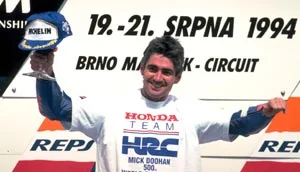 Photo: honda.co.jp
10. Defending a title is quieter than returning, but just as difficult
Doohan won again in 1995 and 1996. Spectators grew used to Honda's No. 1 at the front, but repeated wins did not mean each weekend merely enacted a result written in advance.
Rivals studied his speed, tyres and bikes changed, and team-mates drew closer. Development that helped him win could also give other Honda riders better tools. A successful manufacturer spreads technology across more bikes, requiring its leader to keep finding a difference on similar equipment.
Àlex Crivillé became a major challenger. At Brno in 1996, the two Hondas fought to the final lap, changing the lead repeatedly. Doohan exited the last corner ahead, but Crivillé passed before the line. The official margin was just 0.002 seconds, almost impossible to distinguish by eye.
The Independent's report recorded a small wobble as Doohan left the final corner, which Crivillé exploited. The defending champion had not collapsed at the start or midway; he lost at the very end of a nearly completed race. Crivillé had beaten him in Austria two weeks earlier. Another win by the same team-mate made the threat sustained and concrete.
Such a rival makes setup and riding decisions more sensitive. On the same Honda marque, Doohan could not rely entirely on a brand advantage. Sharing a garage also sharpened both riders' knowledge of each other's capability. A champion had to find an advantage on comparable machinery that lasted to the final metre.
Doohan's advantage was no longer simply about recovering from injury. That stage had been proven; the task was now to remain at the top. Every test, setup choice and race execution could be compared by rivals. A previous winner still had to provide new reasons why he should lead next time.
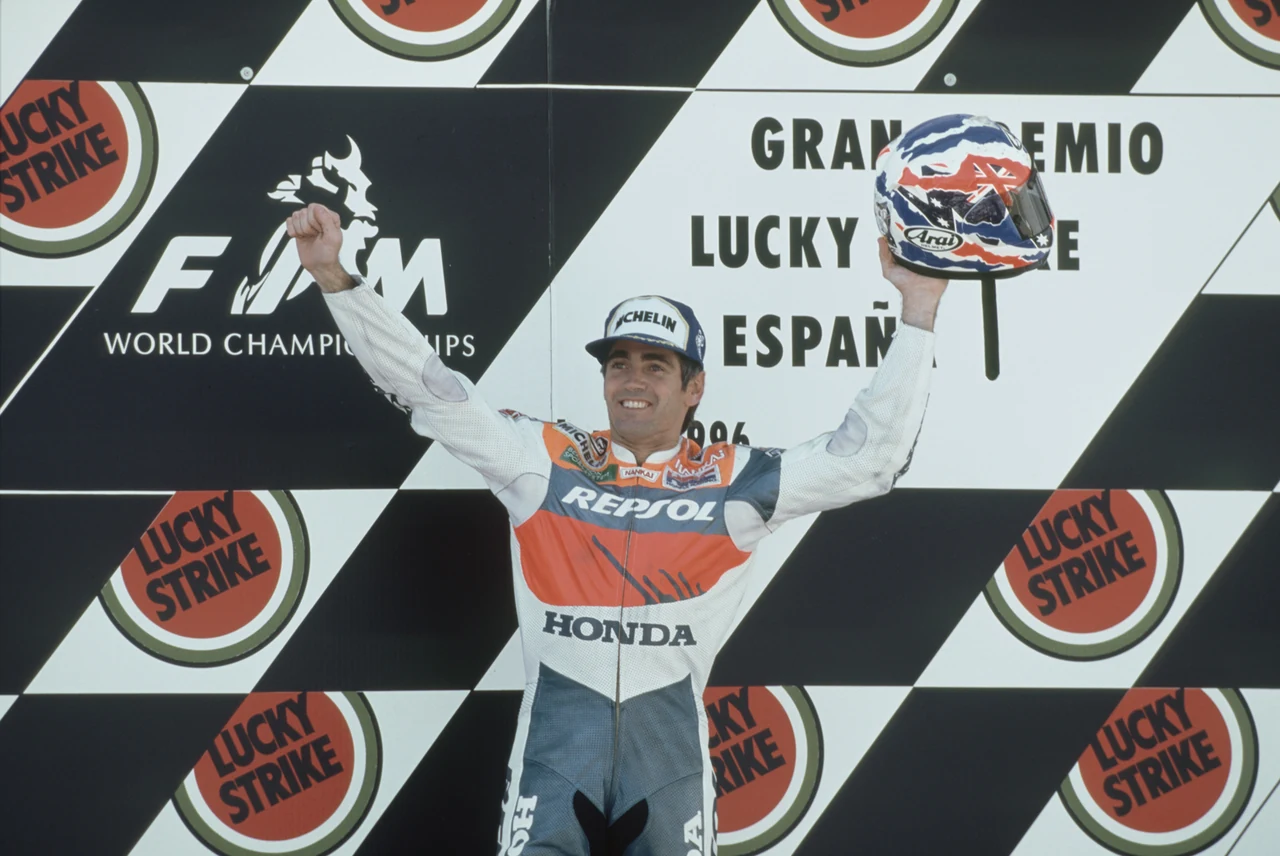 Photo:Box Repsol · CC BY 2.0
11. 1997: Choosing a more familiar power delivery again
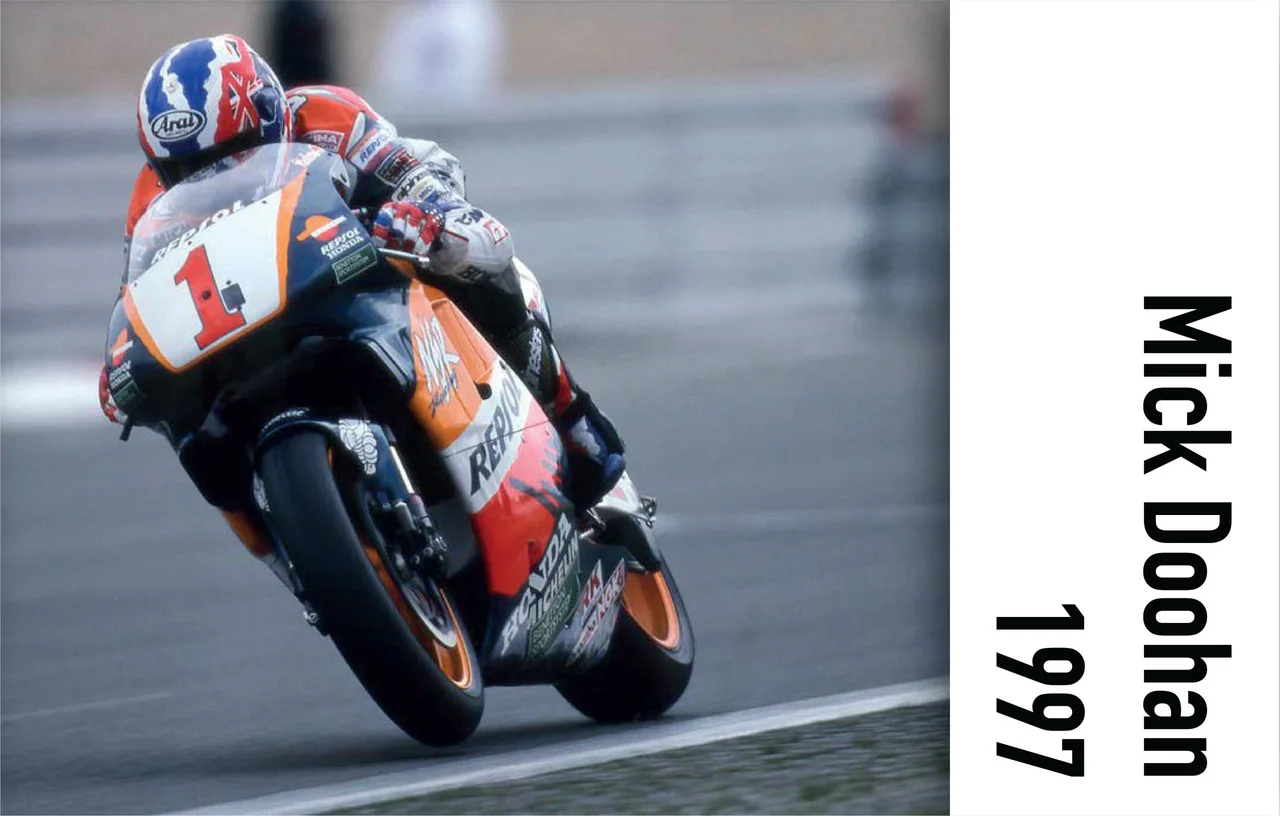
In 1997 Doohan chose the firing configuration usually called a "screamer", contrasting with the more manageable big-bang route. It is often portrayed as deliberately choosing the hardest bike to prove that nobody could approach him.
His later explanation to Motor Sport was more nuanced. By 1997 the engine, controls and whole bike had developed for years; that screamer was not the brutal early machine. He still wanted a power response suited to his own method of control.
He also acknowledged a psychological motive. In his account, both configurations performed equally, but rivals accustomed to the big bang had to relearn finer throttle control. Familiarity with that approach might give him a mental edge. This was his retrospective explanation, not proof that firing order alone won races.
The choice coincided with his most successful season, but all twelve wins cannot be attributed to engine configuration. Riding, tyres, chassis, crew and rivals all shaped results. The important point is that after consecutive titles he still made a deliberate technical choice around his needs, rather than mechanically retaining every answer from the previous year.
That control included left-hand actions difficult for spectators to see. In the Motor Sport riding interview, he described using the clutch to manage rear-wheel spin. When rear-wheel drive needed an immediate reduction, the clutch could act more directly than waiting for the engine to respond to a closed throttle. He did not always cut drive completely; he made fine adjustments as needed.
His example came from Le Mans in 1994. On the last lap he slid the rear, realised he had gone too far and quickly pulled the clutch to avoid being thrown off. He treated it as a warning against overconfidence. Leading did not permit careless experiments with the tyre. Riding that looked forceful from outside required extremely fine judgement and correction.
12. Beyond twelve wins, one final retirement
Of fifteen races in 1997, Doohan won twelve, finished second twice and crashed out of the Australian finale. Twelve divided by fifteen means he won eighty per cent of the year's rounds.
Such a season can be remembered only by its win total. Restoring the two seconds and final retirement makes the portrait more complete. He was not unbeatable every weekend, nor exempt from mistakes or risk because he had built a vast advantage.
Honda won all fifteen 500cc rounds that year. Doohan's twelve therefore need another comparison: many rivals rode the same marque. Manufacturer advantage explains the competitive setting, but not fully why he won more than those riders.
A stable crew relationship, understanding the bike's responses and carrying speed to the finish on most weekends formed a repeatable advantage. To spectators it might seem less thrilling than a final-corner pass each race. For opponents it was harder, requiring opportunities throughout the weekend rather than waiting for an occasional mistake.
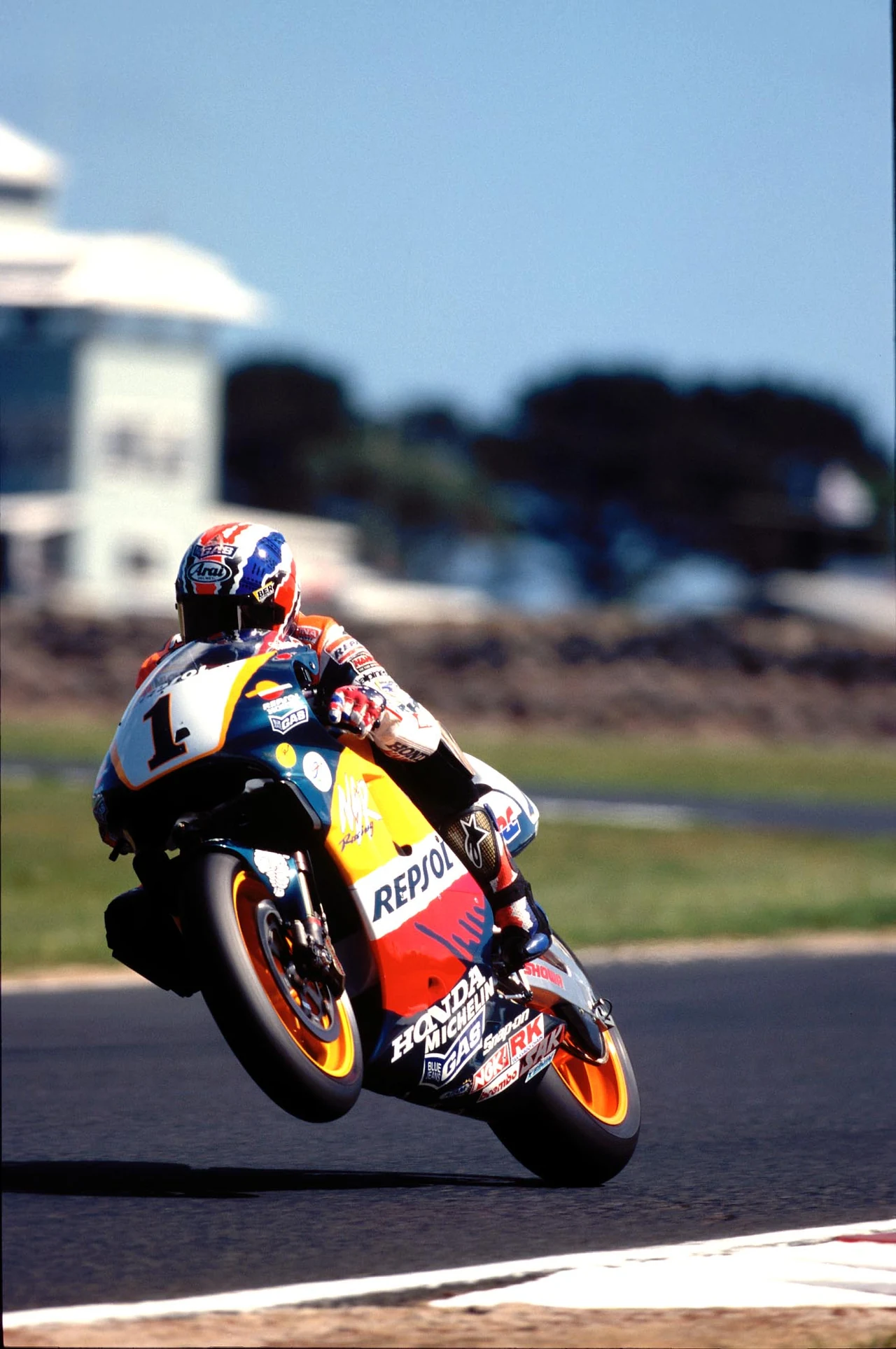 Photo:Box Repsol · CC BY 2.0
13. Biaggi arrives: A fifth title still has to be earned
Max Biaggi moved up to 500cc in 1998, won on his premier-class debut and finished runner-up overall. Already hugely successful in 250cc, he made the new generation's arrival unmistakable.
Fuel regulations also changed in 1998. Doohan recalled that unleaded fuel softened the power response, allowing higher mid-corner speed. He had preferred turning the bike first, then standing it up to accelerate along a sharper V-shaped line. The new characteristics demanded a revised cornering rhythm.
This was his personal experience and adaptation, not an identical answer for every rider. It makes the difficulty of the fifth title concrete, though: not only had a new opponent arrived, but the NSR500 he had ridden for years was asking him to learn another way of using it.
Doohan did not settle the contest by pointing to four past titles. He kept winning and secured his fifth consecutive 500cc world championship. New rivals, pressures and a different season trajectory required another complete title-winning effort.
He stayed competitive through habits and partnerships that kept working. He knew what a title required but still had to deliver it in new races. The 1998 crown was not an appendix commemorating the recovery of 1994; it belonged to another independent, complete season.
14. After Jerez, the career did not wait for a planned farewell
Doohan suffered a serious accident in qualifying for the 1999 Spanish Grand Prix at Jerez. The injuries ultimately ended his Grand Prix career. Like many racers, he did not say farewell in a final race on a weekend planned in advance.
His premier-class record stopped at five world titles and fifty-four wins. All five championships belonged to the 500cc era, all with Honda. The numbers place him among motorcycling's most important names, but do not remove the abruptness of the ending.
Injury had forced him to change his controls; ultimately it forced him to stop. Both outcomes exist together. Portraying him only as a man always able to defeat bodily limits would make the final chapter untrue and the earlier recovery seem too easy.
After retirement his experience remained in racing. Crew knowledge, control methods and ways of working with engineers became resources for those who followed. A champion's influence does not end immediately when he no longer appears on the grid.
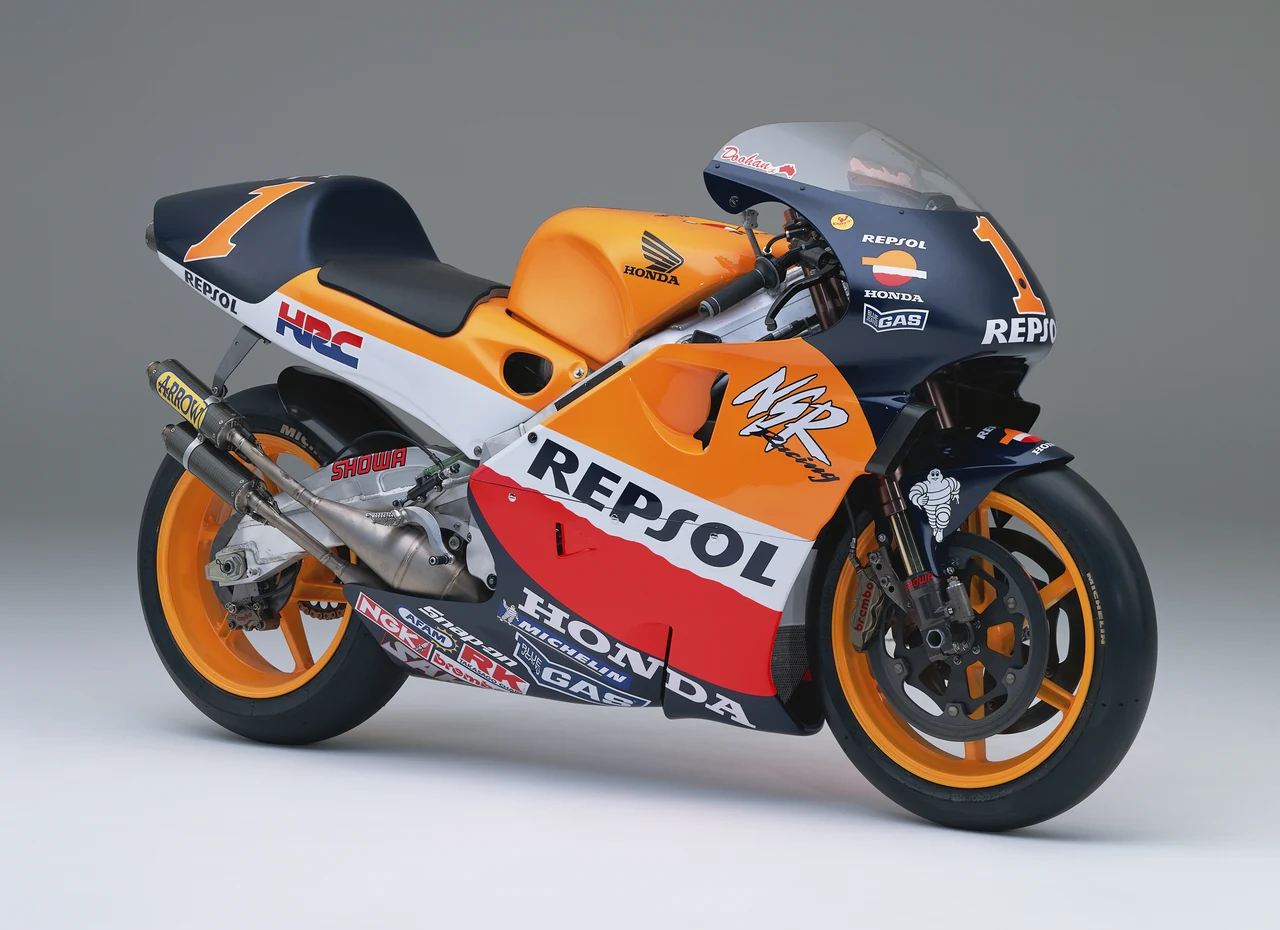 Photo:Box Repsol · CC BY 2.0
15. Five consecutive titles came from repeated, practical rebuilding
His story is easily reduced to toughness and willpower. Twelfth place in Brazil in 1992 reminds us that returning to a bike did not restore championship-level control. He never recovered that year's title; the four-point margin remains in the record.
The changes that followed were practical. Treatment continued; his left thumb took over rear braking that his right foot could not manage. Body position, boots and settings were matched again. The engineers helped him use abilities still available after injury, rather than asking the body to pretend it had never been hurt.
The consistency of 1994, the tiny Brno margin in 1996 and twelve wins in 1997 were results of that partnership under different competitive conditions. Five later titles did not erase 1992, but revealed what happened between a return and sustained winning contention.
Doohan could not recover the 1992 title. Later, he won five years of his own.
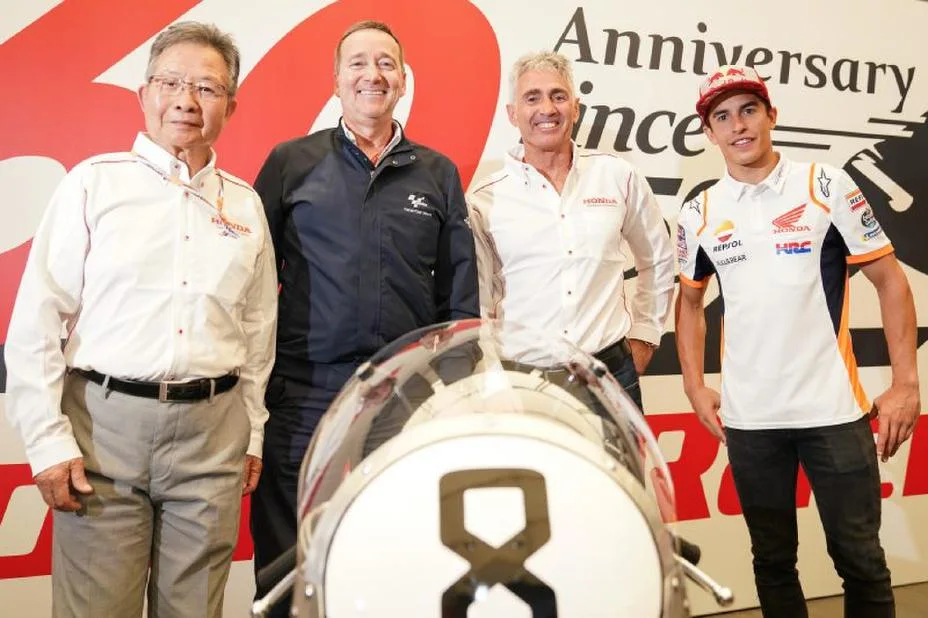 Photo: hondanews.com
Mick Doohan's career record
As of the end of 2025. Five consecutive titles and 54 wins are rider records; manufacturer win totals are counted separately.
| Category | Record | Scope |
|---|---|---|
| 500cc world titles | 5 titles | 1994、1995、1996、1997、1998 |
| Premier-class Grand Prix wins | 54 wins | All achieved in 500cc |
| Championship-winning bike | Honda NSR500 | Used in all five championship seasons |
| 1992 World Championship | Runner-up, 4 points behind | Rainey 140 points, Doohan 136 |
| 1994 first-title season | 9 wins, 14 podiums | Based on that season's rider results |
| 1997 season | 12 individual wins | Honda's 15 wins from 15 races are a manufacturer result, not 15 Doohan wins |
Sources
- Mick Doohan - Sport Australia Hall of Fame
- TWO DAYS OR 2184 - They are all heroes
- Mick Doohan - Wikipedia
- Mick Doohan and MotoGP’s greatest comeback - Motor Sport Magazine
- Thumb Master Cylinder, the Story of an Innovation | Brembo EN
- How I rode: Mick Doohan | Motor Sport Magazine
- Flashback Friday | Doohan wins his first 500cc Title | MCNews
- Doohan denied by late burst | The Independent | The Independent
- Honda 1998 Motorsports Plans for Motorcycles | Honda Global Corporate Website
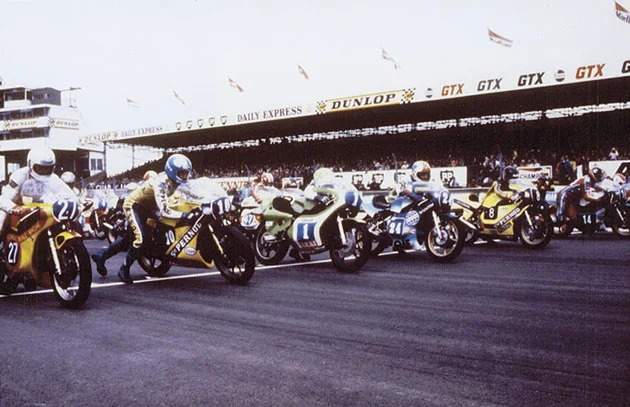 Photo: global.honda
Honda: From the failure of oval pistons to machines that changed premier-class motorcycle racing
From a rider's methods of control, continue into the technical evolution of Honda's premier-class bikes.
Continue reading · Approx. 21.4 min →