
Expand chapter list · 18 sections
- Key milestones
- 1. Why a Japanese manufacturer based its rally team in Europe
- 2. Two "first wins", both starring a small Corolla
- 3. Four-wheel drive swept Europe, but Toyota won in Africa
- 4. From Group B to Group A: Old strengths were no longer enough
- 5. 1990: Sainz expanded Toyota's map
- 6. 1993 and 1994: The championship finally belonged to the whole team
- 7. 1995: Engineering ability was put to the wrong use
- 8. A year of suspension did not make every car disappear
- 9. Why the Corolla suited this fresh start better than the Celica
- 10. 1998: How a failure before the finish swallowed a season
- 11. 1999: Becoming the best manufacturer without a mass of wins
- 12. The return was entrusted to a man who had once beaten Toyota
- 13. Tänak and Ogier: A changing championship seat
- 14. Rovanperä made the new rules his own era
- 15. 2024: This time the final stage brought the title
- 16. Nine trophies, answers from different eras
- Toyota's WRC championship record
Key milestones
At the 1998 British rally, Toyota stood one final stage away from the drivers' world title. Main rival Tommi Mäkinen had retired long before. Carlos Sainz and co-driver Luis Moya only had to complete the task ahead to bring the crown home.
Then the Corolla stopped.
The engine failed only a few hundred metres from the finish. Moya got out and eventually hurled his helmet at the rear window. Television preserved the stranded Toyota and one of racing's hardest distances to explain: an entire season had been travelled, yet its last few hundred metres could no longer be crossed.
Toyota's championship record today makes that humiliation hard to imagine. By the end of 2025 it had won nine WRC manufacturers' titles. The route included technical infringement and suspension, voluntary departure after a championship, and building a team again more than a decade later. Its legend lies not only in famous cars but in repeatedly changing how it went racing.
1. Why a Japanese manufacturer based its rally team in Europe
Toyota's international rallying reaches back to Australia in 1957. The team that later sustained a world championship campaign, however, began in early-1970s Europe. Swedish driver Ove Andersson started working with Toyota in 1972, gradually organising cars, personnel and spares.
Japan had not simply shipped an established team overseas. Andersson's early operation was small and constantly sought funds; the 1973 oil crisis increased pressure on manufacturers' motorsport involvement. Rally-history site Juwra records that support from Toyota importers in different countries was essential to keeping it running.
A European base had practical value. The team competed across Europe, needed drivers familiar with local roads and had to service cars between events. Working closer to the stages shortened the distance between parts problems, setup feedback and the next rally. Japanese manufacturing resources began connecting with European competition experience.
From that partnership emerged Toyota Team Europe, or TTE. It moved to Brussels, Belgium, in 1975 and Cologne, Germany, in 1979. Before titles could arrive, a more basic problem had to be solved: keeping people in different countries working continuously on the same car.
2. Two "first wins", both starring a small Corolla
A Toyota's first WRC victory came at the 1973 Press-on-Regardless Rally in the United States. Walter Boyce won in a privately entered Corolla. It belongs to the marque's record, distinct from later wins run directly by the works team.
Only when Hannu Mikkola won Finland's 1000 Lakes Rally in a Corolla in 1975 did Andersson's official team take its first WRC win. Toyota often uses that year as the start of its works victory history. The two firsts reveal early rallying's reality: a car's competitiveness could be proved by the factory, or first by a private driver on another continent.
The 1000 Lakes was especially persuasive. Fast gravel roads and repeated crests demanded intimate route knowledge and a car that settled quickly after jumps. Winning there showed Toyota need not seek chances only away from the centre of competition.
Product priorities and team preferences did not always align. Toyota wanted to promote the sportier Celica, while the team had favoured the smaller Corolla. The Celica then became central for years. That choice led towards a different success: before broad dominance on Europe's fast stages, African endurance tests gave the team its place.
3. Four-wheel drive swept Europe, but Toyota won in Africa
Group B brought rapid performance growth in the 1980s. Audi and others developed four-wheel drive, while some rivals built highly specialised competition models. Toyota's Celica Twin Cam Turbo remained rear-wheel drive; on low-grip European short stages, power alone struggled to close the traction gap.
Africa posed different questions. The Safari and Ivory Coast rallies covered immense distances, with punishing roads testing suspension, cooling, transmission and service organisation. Repeated impacts and the crews' ability to fix problems promptly mattered as much as a few seconds on one stretch of road.
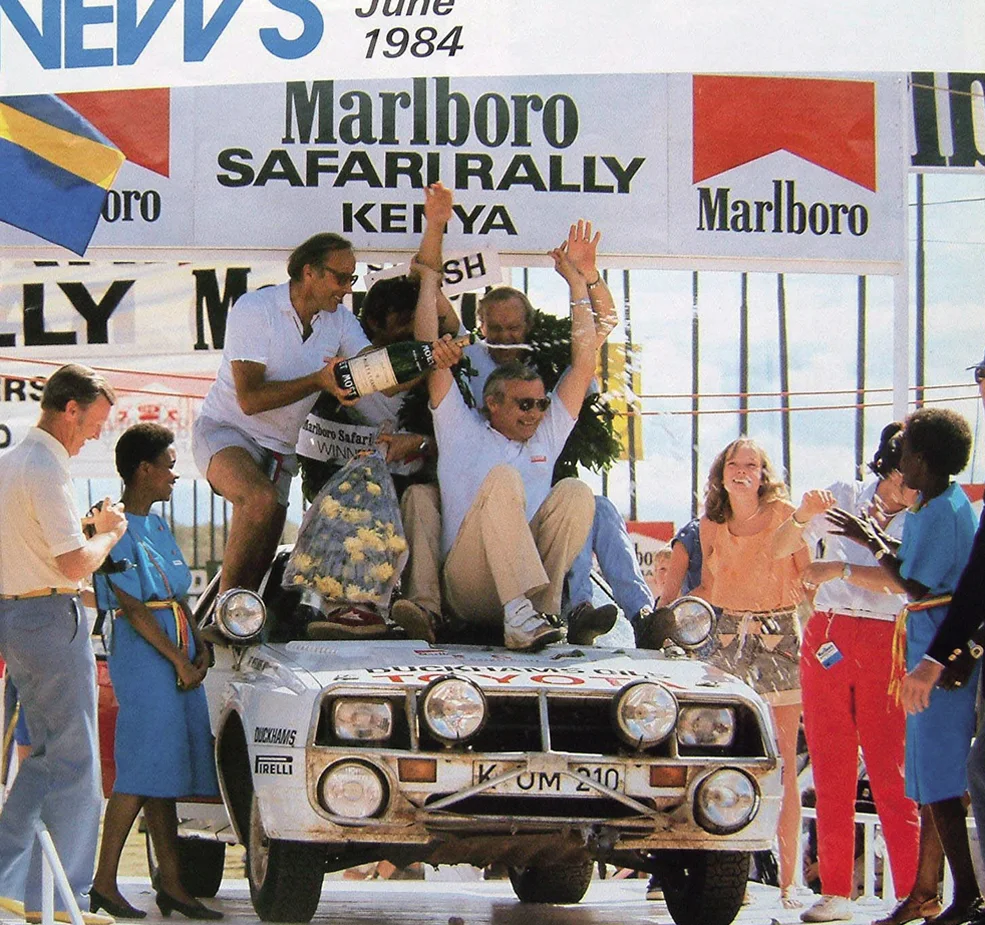
The Celica found its strength there. Björn Waldegård won the Ivory Coast round in 1983. Toyota then won three consecutive Safaris from 1984 to 1986 through Waldegård and Juha Kankkunen, while also winning in Ivory Coast in 1985 and 1986.
Those wins did not suddenly make rear-wheel drive best everywhere. They showed that when an event's principal difficulty changes, the most valuable car attributes change too. Europe's emphasis on acceleration and cornering traction had to be tested alongside durability in Africa. Toyota had not yet built the most complete car, but had built one hard to beat in some of the toughest events.
4. From Group B to Group A: Old strengths were no longer enough
After serious accidents, Group B left the WRC's top level at the end of 1986 and Group A became central. Toyota used the Supra as a bridge before placing its hopes on the four-wheel-drive Celica GT-Four. The ST165 entered the WRC in 1988, giving the team a foundation better suited to the new competition.
Group A had tighter homologation links to production cars. A manufacturer had to consider not just what the service park needed, but whether its road model could supply suitable engine, drivetrain and structural foundations. The racing department's wishes had to enter product decisions earlier.
Four-wheel drive did not bring instant wins either. It improved the chance of putting power down, but added weight, drivetrain losses, cooling demands and complexity. The ST165 struggled initially; Kankkunen delivered its first WRC rally victory only in Australia in 1989.
Toyota now faced a powerful Lancia, experienced at scoring across surfaces with established drivers and operations. Becoming world champion rather than an African specialist required a driver who could win on different roads. Sainz, the Spaniard who joined in 1989, shared that ambition.
5. 1990: Sainz expanded Toyota's map
Sainz and Moya won in Greece, New Zealand, Finland and Britain in 1990, taking the drivers' and co-drivers' world titles. Those four places alone convey the breakthrough: Toyota was winning in varied gravel environments and entirely different stage rhythms.
In Finland, Sainz became the 1000 Lakes' first non-Nordic winner. Toyota had found someone to take the Celica into the traditional powers' territory; the driver had found a car and team that could help him escape the "asphalt specialist" label. Their ambitions amplified each other's ability rather than creating a one-sided achievement.
The 1990 drivers' crown did not also become Toyota's manufacturers' title. That championship tests the whole line-up, not one driver's brilliant result every few rounds. Sainz proved the top-end speed existed; more cars still had to turn performance into season-long points.
Sainz won a second drivers' title in the new ST185 in 1992, supported by wins at the Safari, New Zealand, Catalunya and Britain. Toyota could now win two world championships for one man; the next breakthrough was to put the whole team first overall.
6. 1993 and 1994: The championship finally belonged to the whole team
In 1993 Kankkunen won the drivers' crown for Toyota, which took its first manufacturers' title. It was a landmark WRC manufacturers' championship for a Japanese carmaker. For TTE, years of work finally appeared at the top of both tables together.
Didier Auriol became drivers' champion in 1994 and Toyota defended the manufacturers' title. Different drivers winning in successive years demonstrated broader competitiveness than simply repeating one victory. The ST185 suited more than one style and met different events' demands.
Toyota made the Cologne company wholly owned in 1993, deepening the team–manufacturer relationship. The transformation from Andersson's small group seeking support everywhere to a factory able to concentrate on development went far beyond livery.
New rivals were growing too. Subaru and Mitsubishi strengthened, and more compact cars pressured the Celica. The ST205 did not automatically inherit its predecessor's advantage. More resources did not make the problems easier. In 1995 the team crossed the rules' boundary.
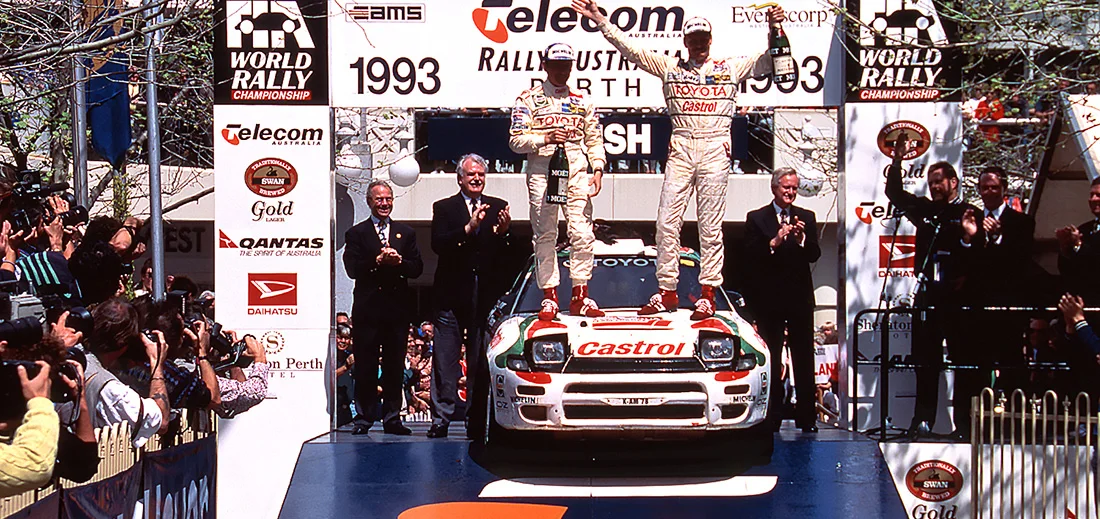 Photo: toyotagazooracing.com
7. 1995: Engineering ability was put to the wrong use
An illegal restrictor mechanism in Toyota's turbo system was discovered at Catalunya in 1995. Intake restrictors regulate airflow, and all competitors must develop within the same restriction. Bypassing it alters the foundation on which competition takes place.
The device's ingenuity did not change the infringement. Severe penalties followed, including TTE's ban from the next year's WRC. The recently dominant works team vanished from the official entry list. Engineering cleverness became the centre of its history in a deeply embarrassing way.
The suspension affected people directly. Driver contracts, sponsors, test plans and staff's event work all had to change. Sainz, who had planned to return for 1996, went to Ford instead. The team had to explain what future remained.
This history defeats a brand narrative in which Toyota never fails. It had earned trust through endurance, then damaged it through a technical breach. Later titles could prove its strength after returning, but could not turn the punishment into a boastworthy tale of ingenuity.
8. A year of suspension did not make every car disappear
Celicas remained visible in the 1996 WRC without contradicting the ban. It applied to TTE's official entries; private teams and importers could still compete with the cars under their own identities. The manufacturers' campaign had stopped, not the whole Toyota competition network.
DirtFish later documented the transition through interviews with sporting director George Donaldson and co-driver Nicky Grist, among others. Importer programmes in Sweden, Australia and Finland continued, while some personnel moved into the European championship and other events. Armin Schwarz won the European Rally Championship that year.
These activities preserved competitive experience but could not replace a full WRC works season. Limited racing and test resources had to be reorganised for each programme. Drivers and staff kept working, but the next works challenge for a world title needed a new car.
Meanwhile, the 1997 World Rally Car rules were approaching. They reduced dependence on certain production-model drivetrain configurations, widening manufacturers' model choices. Toyota could finally look again at the Corolla. The compact hatchback was now a means of re-entering the top contest, not just a supporting figure in its early win history.
9. Why the Corolla suited this fresh start better than the Celica
The Corolla WRC began its world championship campaign in Finland in 1997. Its ordinary name concealed years of TTE experience. Proven technology was retained while body, driving position and mechanical layout were rearranged.
Toyota UK's technical material stresses the dimensions: the Corolla was shorter than the Celica, with shorter front and rear overhangs. Overhang means the distance from axle centreline to the body's end. Less body projecting beyond the wheels gave engineers more freedom with ground clearance over crests or near obstacles, and helped handling on narrow roads.
It retained the two-litre turbo engine's technical foundation with a six-speed sequential transmission. Compactness did not excuse high-speed instability: wind-tunnel and track tests still had to resolve aero balance, suspension and centre of gravity. A smaller shell offered a chance to redistribute the whole car's conditions, not automatic victory.
Auriol took the Corolla's first WRC podium in Australia in 1997. Returning to Toyota, Sainz gave it a first win at the 1998 Monte Carlo opener. After suspension, Toyota was back not just on the entry list but in the championship fight.
10. 1998: How a failure before the finish swallowed a season
Sainz won Monte Carlo and New Zealand in 1998 and finished second repeatedly. The Corolla was not always fastest, but kept a place in title contention. By the British finale, Toyota could carry its rebuild directly into a drivers' championship.
Mäkinen's retirement shifted the odds strongly towards Sainz. His task changed to protecting the required place rather than pursuing the rally win. Every corner still had to be completed and every component had to work. Celebrations imagined in advance could not shorten the distance.
On the final stretch the engine stopped. The finish was only a few hundred metres away, but the car would not restart. Moya's helmet against the rear window made the failure many people's first image of rallying.
The lost title exposed a blind spot in viewing motorsport. Overtakes and crashes are visible; a component's full responsibility before it breaks is not. The Corolla had completed nearly all its tasks, but engine, transmission and countless small parts still had to finish the remaining road together. One link stopping meant the points calculation stopped too.
Across the year, the Corolla took second in Sweden, Portugal, Argentina, Greece, New Zealand, Finland and Australia. It challenged near the front on snow, asphalt and gravel, giving Toyota's title hopes a substantial season-long foundation. So much had gone right that Britain's stoppage was harder to accept: the team did not need to redesign the entire season, only get this car through one last stretch.
11. 1999: Becoming the best manufacturer without a mass of wins
Toyota finally won its comeback manufacturers' world title in 1999. Compared with the previous near-miss in the drivers' contest, it was a quieter success. Its only rally win of the year came through Auriol in China.
The title rested on results spread through the season. Sainz and Auriol kept scoring heavily in Sweden, the Safari, Portugal, Greece, Finland and Australia. In China, Auriol won and Sainz finished third. Both cars on the podium showed clearly how a manufacturers' championship accumulates.
Counting victory photographs alone cannot explain it. A drivers' title centres on one person's season; manufacturers need designated cars to combine. A win and a retirement may be less useful than two front-running finishes. Repeated seconds and thirds can form the strongest overall campaign.
After the title, Toyota announced the end of that WRC works programme to focus on F1. Its third manufacturers' trophy closed the chapter. Private drivers still used Corollas and TTE's engineering knowledge remained, but many years would pass before a full Toyota works line-up returned to world rallying.
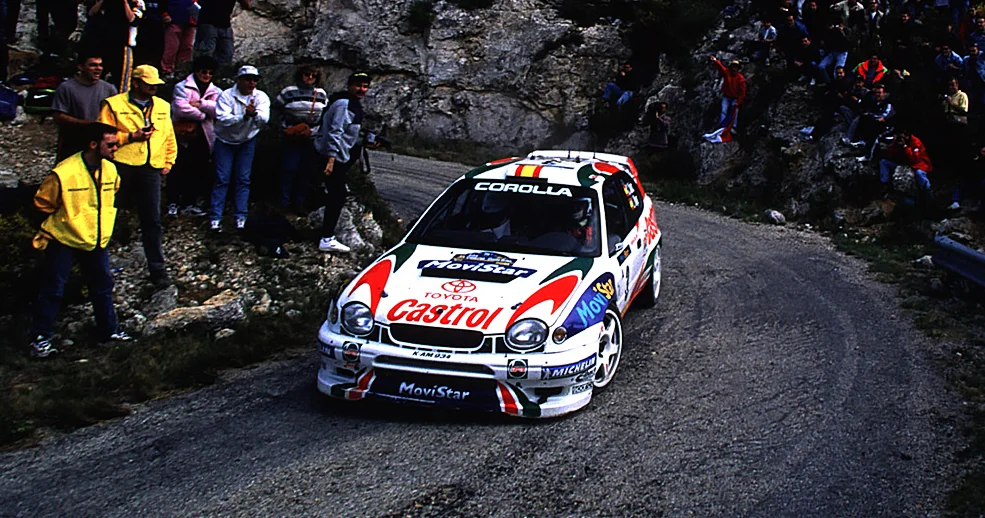 Photo: toyotagazooracing.com
12. The return was entrusted to a man who had once beaten Toyota
Toyota announced its WRC return in 2015, targeting 2017. Tommi Mäkinen, appointed to lead it, was the rival who had taken the title after the 1998 British finale. Old disappointment and the new programme met in the same name.
The main competition base was established around Jyväskylä, Finland, drawing on local drivers, roads and rally talent. Cologne still supported engineering, but this was not TTE reopened unchanged. People, organisation, model and rules had changed. A team suited to contemporary competition had to be built.
The Yaris WRC faced a new technical world. The 2017 cars had more power, wider bodies and more pronounced aerodynamic packages. Those capabilities had to work on gravel, asphalt and snow. Strong performance on Finland's fast roads could answer only part of the problem.
Jari-Matti Latvala finished second on the 2017 Monte Carlo debut, then won in Sweden. Esapekka Lappi added a second team win in Finland. Toyota did not dominate immediately, but rapidly proved genuine rally-winning competitiveness.
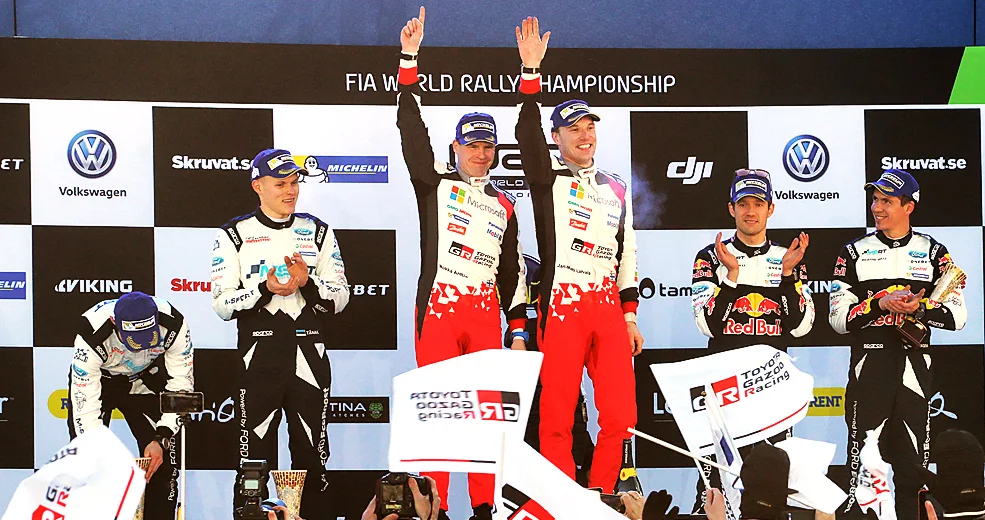 Photo: toyotagazooracing.com
13. Tänak and Ogier: A changing championship seat
Ott Tänak joined in 2018. Four wins put him in drivers' title contention, while Latvala's win at the Australian finale helped secure the first manufacturers' title of the return. Only two seasons had passed since the Yaris's WRC debut.
Tänak and co-driver Martin Järveoja won the drivers' and co-drivers' titles in 2019, with six wins demonstrating formidable pace. Hyundai took the manufacturers' crown, again separating the tasks: the most successful crew did not mean the whole team did best in every points calculation.
Tänak then left and Sébastien Ogier arrived. Toyota kept the drivers' title run intact: Ogier and Julien Ingrassia won in 2020 and 2021. Elfyn Evans also challenged, making internal title rivalry part of daily life.
Latvala became team principal in 2021 and Toyota regained the manufacturers' title. A driver's understanding can inform management, but must still be implemented through engineering, service work and resource allocation. The team built under Mäkinen began proving it could keep winning through changes of leader and leading driver.
14. Rovanperä made the new rules his own era
The 2022 Rally1 rules introduced a new generation including hybrid systems. The GR Yaris Rally1 differed structurally and operationally from the Yaris WRC. Familiarity with the old car was not enough: deployment, reliability and mass all needed fresh attention.
Kalle Rovanperä and co-driver Jonne Halttunen won the world titles that year and defended them in 2023. The young driver did more than inherit good results: he established his own speed advantage during a rule change. Toyota also took consecutive manufacturers' crowns.
The line-up's value appeared in differing roles. Ogier reduced his schedule but still contributed wins; Evans sustained full-season challenges; Rovanperä pursued titles; Takamoto Katsuta kept gaining top-class experience. The brand no longer depended solely on whether one car's rally went smoothly.
More personnel did not guarantee retaining every victory. Rovanperä also went part-time in 2024, while Hyundai became a strong opponent. Toyota still trailed in manufacturers' points at the Japanese finale. After years of success, the contest again reached the last day.
15. 2024: This time the final stage brought the title
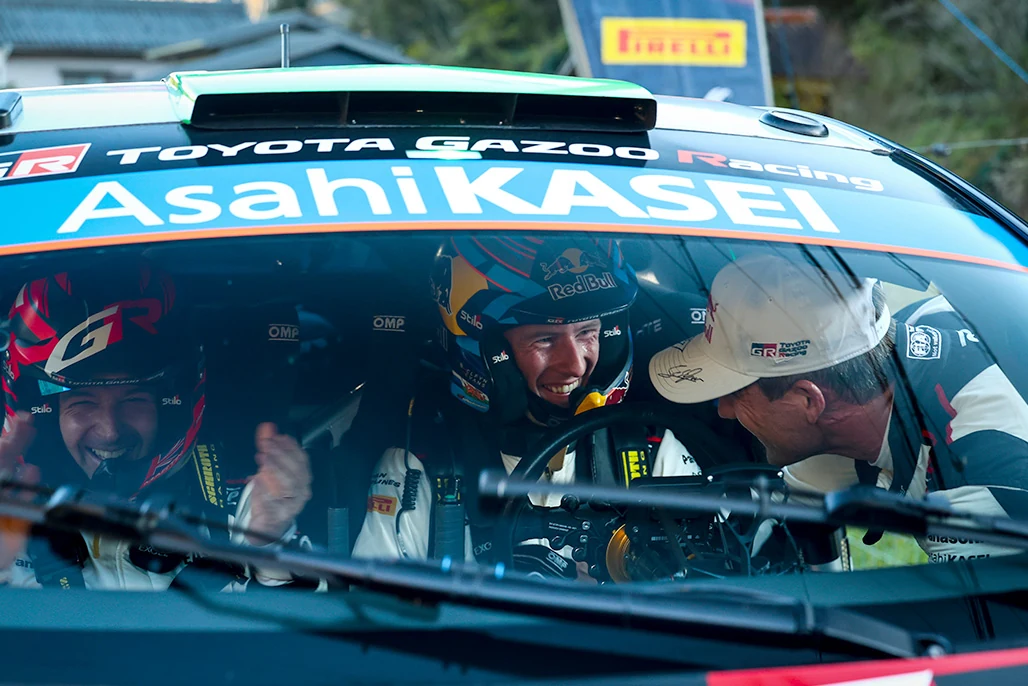 Photo: toyotagazooracing.com
Toyota began Japan fifteen points behind Hyundai. At Saturday's end the provisional calculation under that year's split scoring still left eleven. Tänak, leading the rally, went off on Sunday's opening stage. Evans and Ogier moved to first and second overall, abruptly changing the title contest.
In 2024 the base points used Saturday's overall order, but crews had to finish the whole rally and be classified to receive them. Sunday's stages had a separate ranking, and the final Power Stage offered bonuses. This designated bonus-points stage gives the quickest drivers extra points. Teams therefore had to follow several positions at once; an overall one-two did not settle the title.
Before the final stage, the manufacturers were level in the then-current points calculation. Ogier was fastest, Evans third and Katsuta fourth. Toyota took the title by three points, while Evans and Scott Martin won Rally Japan.
This time the last kilometres delivered the result to Toyota. Compared with the stopped engine of 1998, it was not abstract compensation by luck. Several cars remained, drivers could still chase points, and the machinery finished its last task. Twenty-six years did not erase regret, but let another finale's opportunity be seized.
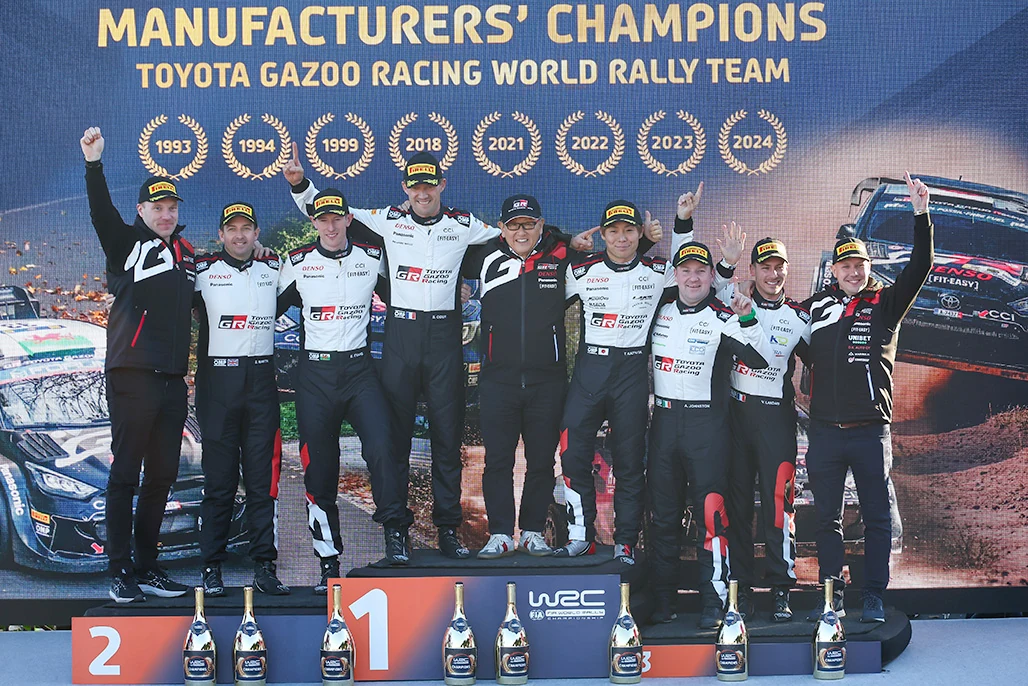 Photo: toyotagazooracing.com
16. Nine trophies, answers from different eras
At the 2025 Central European Rally, Toyota clinched a fifth consecutive manufacturers' title with two rounds remaining, taking its total to nine. Its cars won twelve of fourteen rounds. Ogier claimed his ninth drivers' crown at the Saudi finale, while Vincent Landais won his first co-drivers' world title.
Saudi Arabia placed two Toyota drivers before the same difficult task. Evans arrived three points ahead, but tyre trouble cost both him and Ogier time. On the final day's penultimate stage, Ogier beat Evans by 7.9 seconds; others' problems also lifted him to third overall. Evans won the final bonus stage but could not reverse the title result.
Ogier contested only eleven rounds but took six wins and ten podiums. Evans entered all fourteen and finished every event in the top six. Different schedules and scoring patterns kept the title alive to the end. Toyota's ability to support both gave its strength a fuller meaning: multiple crews had the means to pursue the highest goal, rather than waiting for the same hero to rescue every situation.
The nine manufacturers' years are 1993, 1994, 1999, 2018 and 2021–2025. They did not belong to one unchanged organisation: Cologne-era TTE's Celica and Corolla differ from the Yaris and GR Yaris developed by the Finnish team. Suspension, withdrawal and prolonged rebuilding separate the histories.
The connecting thread is answering the road. African endurance requires strength and servicing; Finland needs high-speed stability and confidence; asphalt demands precision. A world title requires those abilities to converge in one year. Toyota once excelled at only some, then repeatedly broadened its reach.
The Corolla stranded before the 1998 finish cannot be deleted from the legend. A name, budget and titles cannot keep a failed car moving. Toyota's later nine-crown status came from the next engineers, crew and car making those specific roads passable again.
Toyota's WRC championship record
Statistics through the end of 2025. Manufacturers', drivers' and co-drivers' titles are different awards; the drivers' crowns of 1990, 1992, 2019 and 2020 are not included in the nine manufacturers' titles.
| Category | Total | Year |
|---|---|---|
| Manufacturers' world title | 9 titles | 1993、1994、1999、2018、2021、2022、2023、2024、2025 |
| Drivers' world titles won in Toyota cars | 10 titles | 1990、1992、1993、1994、2019、2020、2021、2022、2023、2025 |
| Sainz's two drivers' titles | 2 titles (included above) | 1990, 1992; co-driver Moya won the co-drivers' title in the same years |
| The 2025 championship crew | One drivers' and one co-drivers' title | Ogier / Vincent Landais; Landais's first individual title |
Sources
- juwra.com | Teams - About Toyota Team Europe (TTE)
- THE HISTORY OF WRC -Toyota has challenged to a great many roads in the world- | 2018 | SPECIAL | WRC | GAZOO Racing
- Biography | Carlos Sainz
- Toyota's European R&D Base Changes its Name | Corporate | Global Newsroom | Toyota Motor Corporation Official Global Website
- Inside Toyota's banned 1996 season – DirtFish
- Toyota Corolla WRC - Toyota Media Site
- Corolla and Motor Sports | Toyota Motor Corporation Official Global Website
- History - Toyota GAZOO Racing
- WRC 2024 Rd.13 Day 4 | 2024 | PRESS RELEASE | WRC | GAZOO Racing
- WRC 2025 Rd.12 Day 4 | 2025 | PRESS RELEASE | WRC | GAZOO Racing
- WRC 2025 Rd.14 Preview | 2025 | PRESS RELEASE | WRC | GAZOO Racing
- WRC 2025 Rd.14 Day 4 | 2025 | PRESS RELEASE | WRC | GAZOO Racing
- FIA: 2024 World Rally Championship points rules
 Photo: audi.com
Carlos Sainz: Refusing to remain an asphalt specialist, or let a lost title define his life
Continue with how Sainz and his co-drivers contributed to Toyota's championships.
Continue reading · Approx. 19.8 min →