
Expand chapter contents · 13 chapters
- The roots of his speed lay at the kart track
- Spa 1992: Running wide revealed a route to victory
- Benetton: From catching the eye to becoming world champion
- Spa 1995: Starting sixteenth did not remove the cost of his choices
- Why leave a place where you are already winning?
- Greatness does not erase boundaries
- One race that explains Schumacher: Hungary 1998
- That Sunday at Suzuka, the wait finally ended
- Seven championships must be more than a single total
- 2003: One final point secured his sixth title
- Brazil 2006: Still chasing as he said farewell to Ferrari
- After leaving the red cars, he still wanted to race
- What should you watch when revisiting his races?
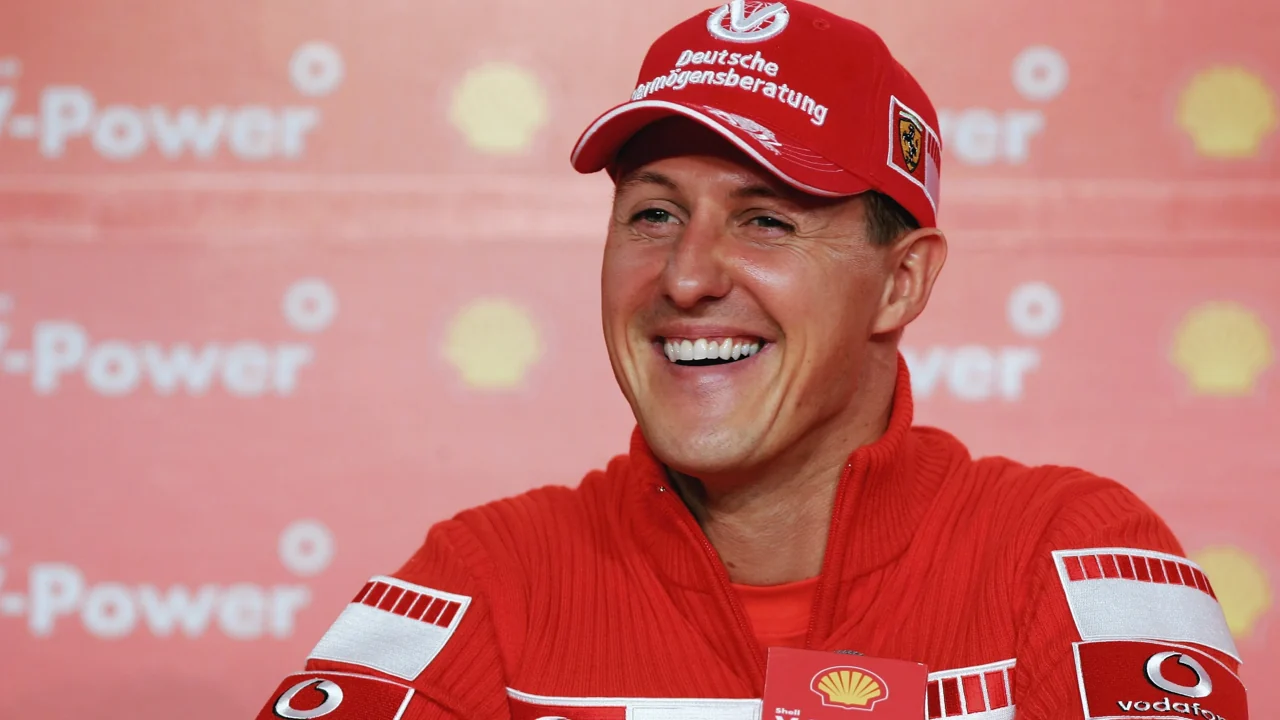
In 1996, having just won two consecutive world championships, Schumacher left Benetton and put on Ferrari's red overalls. Looking back today, it seems an inevitable step on the road to legend. At the time, though, it meant leaving a team that already knew how to win for one that had gone years without a drivers' title. The five consecutive crowns to come were not yet written anywhere.
His career is worth approaching through this question: why would someone already at the summit choose a harder road? The answer lies not only in talent, but in testing, garages, unsuccessful seasons and a handful of contests that changed the way races were won. At the same time, success does not make the controversies disappear.
The roots of his speed lay at the kart track
Michael Schumacher was born in Germany on 1969-1-3, and his upbringing was closely tied to the kart track at Kerpen. A kart is not a miniature F1 toy. It demands an immediate understanding of grip, weight transfer and an opponent's position: a small difference in steering or braking can affect the next corner.
In 1987, Schumacher became German and European karting champion. In 1990, he won the German F3 title and joined Mercedes' sports-prototype programme. From short-distance kart racing to single-seaters and then sports prototypes, he had experienced different cars and racing environments before reaching F1. Jordan gave him his F1 debut at the 1991 Belgian Grand Prix, making Spa the circuit that changed his career.
The opportunity at Jordan came suddenly. Schumacher had never raced an F1 car at Spa. His background included both German F3 and Mercedes' powerful sports prototypes, so he was not a newcomer who had never faced a high-speed machine. Equally, he was far from a veteran familiar with every Grand Prix procedure. Seventh in qualifying delighted Jordan, but a clutch failure meant the race gave him no opportunity to demonstrate how long he could sustain that speed.
That experience also shows how immediate a young driver's opportunity can be. It does not necessarily begin with several guaranteed years in which to adapt. A single weekend may require learning, communicating with engineers and delivering lap times. His debut result recorded only a retirement, yet his standing in the driver market had already changed. Moving next to Benetton finally allowed him to turn one appearance into a continuous process of learning.
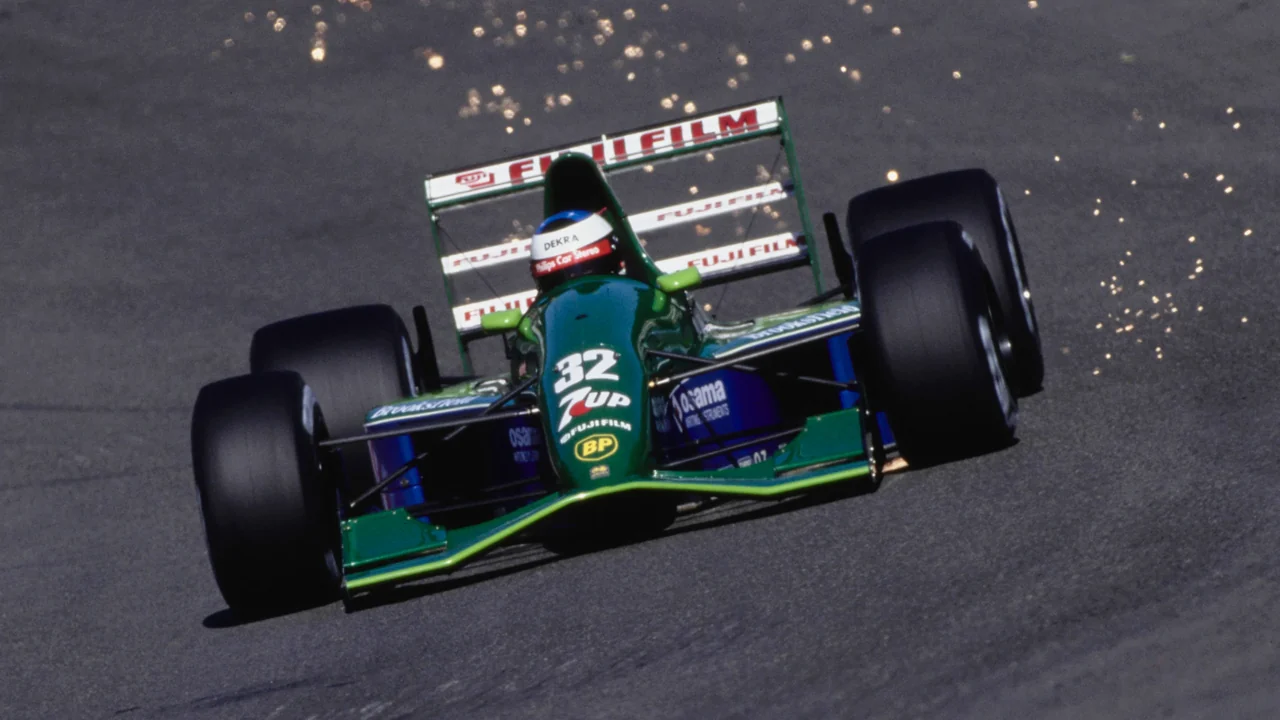 Photo: F1.com
Spa 1992: Running wide revealed a route to victory
Schumacher's first win came at the 1992 Belgian Grand Prix. As the circuit dried, he ran wide and was passed by team-mate Martin Brundle. Dropping behind usually means a loss; this time it let him see that the wet tyres on the car ahead were blistering, prompting him to switch to dry tyres. The decision was not as simple as pitting when the rain stopped. It was about identifying when a tyre began to lose its original advantage on a changing surface.
He made the change earlier than his main rivals in the leading group. When Mansell emerged after his later tyre stop, he was already behind. Exhaust trouble then affected the Williams, preventing the pursuit from becoming a pass for the lead. Schumacher won, with Mansell and Patrese second and third. This memorable first victory involved both the driver's sharp observation and the mechanical limitations encountered by his opponents.
There was a clear connection with his debut a year earlier. In 1991, a mechanical failure ended his race just after it began. In 1992, he was beginning to turn a changing situation into an opportunity of his own. Spa thus linked two important identities—newcomer and Grand Prix winner—at the same circuit.
Benetton: From catching the eye to becoming world champion
At Benetton, Schumacher grew from a newcomer who attracted attention at a single appearance into a driver capable of sustained championship challenges. He won consecutive drivers' world titles in 1994 and 1995, while establishing working foundations and relationships that he later took to Ferrari.
The importance of the Benetton period is easily overshadowed by the red years that followed. It made Schumacher take on a leading role while still young, and taught him to connect his own driving with the performance of the whole team. A championship season is not a matter of repeating a fastest lap dozens of times. It requires constant choices between weather, the risk of failures, rivals' pace and the different demands of every round.
The 1994 title must still be told alongside the collision in Adelaide. Schumacher and Damon Hill were fighting for the championship; both retired after contact at the final round, leaving Schumacher champion by one point. The controversy continues, but the destination of the title did not change. He won the championship that year, and the collision is also part of understanding his public image.
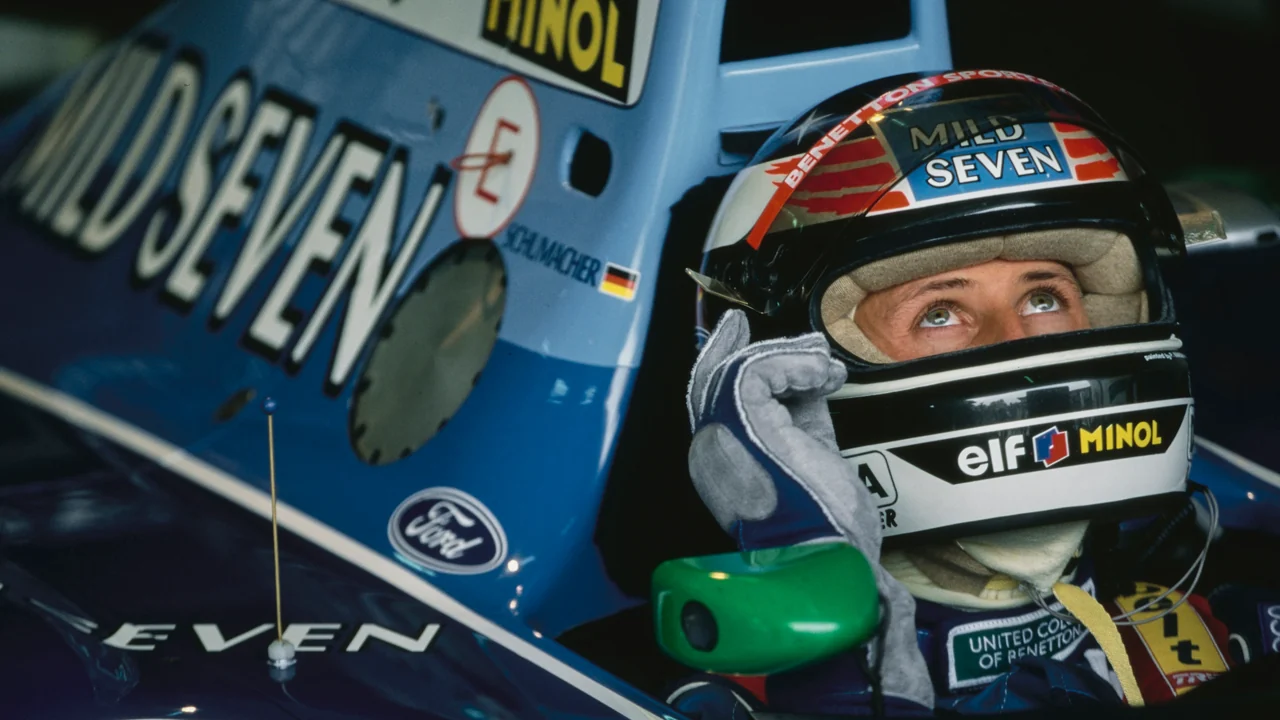 Photo: F1.com
Spa 1995: Starting sixteenth did not remove the cost of his choices
At the 1995 Belgian Grand Prix, Schumacher started sixteenth but went on to win. During the early part of the race, he and Hill gradually moved to the front. When rain returned, they made different choices: Hill fitted wet tyres, while Schumacher stayed on dry tyres. The advantage of either tyre depended on the intensity of the rain and the track surface. Hill, clearly faster for a time, did not immediately turn that speed into a secure lead.
This phase displayed both Schumacher's car control and the controversy over his defence. Dry tyres were harder to make work on the wet surface, yet he remained in contention. His blocking of Hill, however, brought a suspended one-race ban. Later rain and Hill's pit-lane speeding penalty also affected the final outcome. This was not a story in which bravery alone guaranteed success on the wrong tyres. It resulted from repeated trade-offs, changing weather and his rival's circumstances combining.
The race helps explain why the championships of 1994 and 1995 were not exactly alike. The first came with an intensely tense final-round ending; the second further demonstrated his ability to keep winning in different circuit conditions. Yet a carefully written career account must still separate outcome from method. Victory says that he achieved the race objective; the penalty says that some conduct along the way crossed a boundary.
Why leave a place where you are already winning?
When Schumacher joined Ferrari in 1996, the team's most recent drivers' title still dated to 1979. Changing overalls meant changing working environment, technical resources and expectations. He could bring his accumulated racing experience, but he could not pack all of Benetton's advantages into his luggage.
The move ultimately succeeded, but the title prospects were still unclear in 1996. Ferrari first had to address deficiencies in speed, reliability and organizational coordination. Schumacher's value was that he was not only the driver on race Sundays, but an important participant in a long-term programme of improvement. Whether driver feedback could become engineering action determined whether the team was working in the same direction.
The wet race at Barcelona in 1996 delivered the first powerful reward. Driving the F310, he took his first victory for Ferrari and demonstrated a striking advantage in very poor conditions. It revealed what was possible, but did not eliminate the long wait that followed. For a champion driver, admitting 'we are not good enough yet' can sometimes be harder than proving 'I can be fast'.
Nor did that first win immediately make Ferrari the championship benchmark. He won three races in 1996, but Williams' Hill still took the title. An exceptional performance in one wet race and the ability to challenge consistently at most circuits are two different stages. The initial value of the red years was to bring a project with clear weaknesses to a position where investment and correction could continue.
Todt ran the team; Brawn and Byrne joined the rebuilding of its technical and racing operations in turn; Schumacher supplied driving and testing feedback. Naming these people together prevents years of work from being mistaken for a transformation accomplished by one driver alone. The driver can describe problems and test a direction, but cannot personally replace every stage of design, manufacture and pit-lane work.
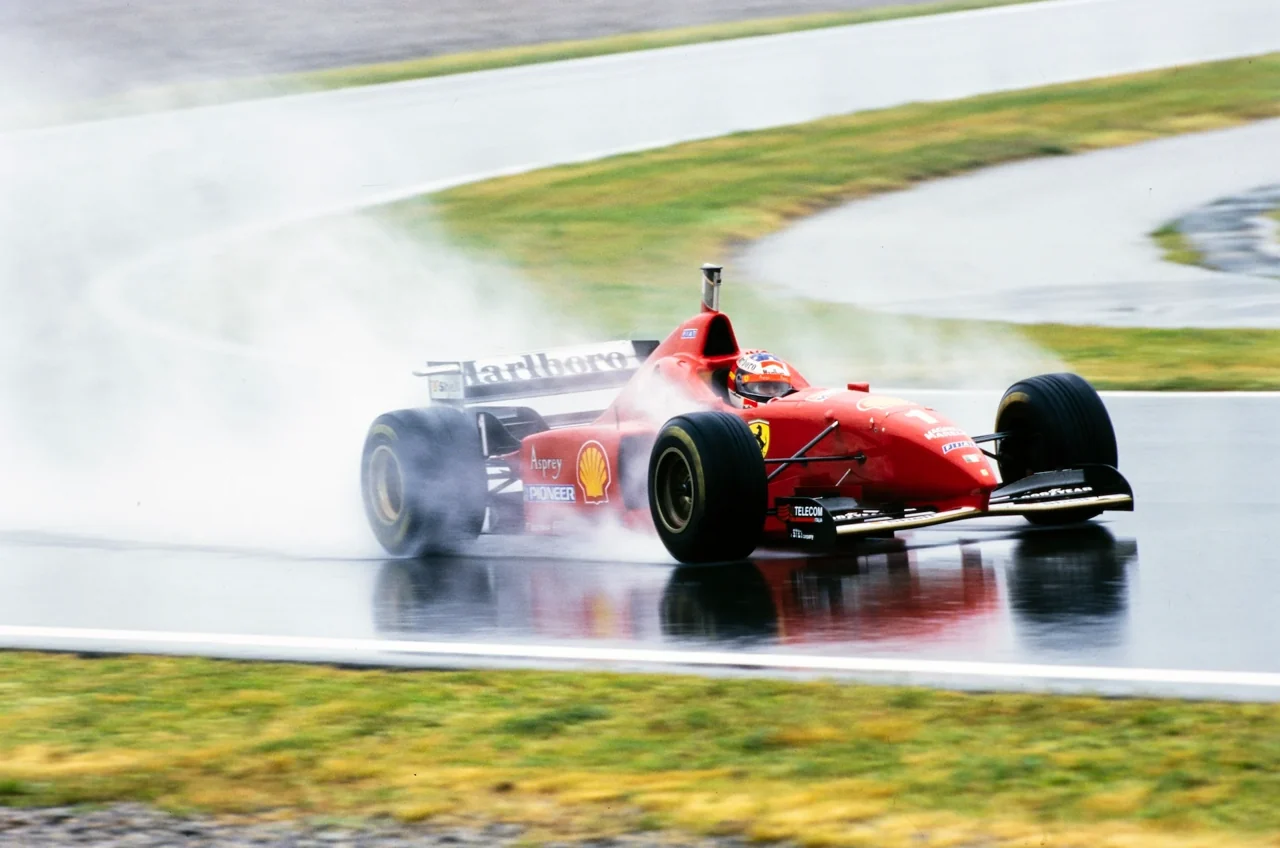 Photo: F1.com
Greatness does not erase boundaries
At the 1997 European Grand Prix, Schumacher and Jacques Villeneuve collided at Jerez. The subsequent penalty had a precise meaning: Schumacher was excluded from that year's drivers' championship standings. This differed from the outcome of the 1994 finale. The two events should not be blurred into the same official result under the vague label of 'controversial collisions'.
Two things can be acknowledged at once when discussing this history. Schumacher possessed exceptional speed, technical understanding and working ability; some of his conduct on track also crossed acceptable boundaries. Removing the controversies turns a biography into a brochure. Reducing all his achievements to one controversy, however, cannot explain why he remained competitive for so long.
Motorsport's dependence on rules becomes clearest precisely when the championship contest is at its fiercest. A reader can admire a driver and still disagree with a particular action.
One race that explains Schumacher: Hungary 1998
If only one race could be chosen to explain the partnership between Schumacher and Ross Brawn, the 1998 Hungarian Grand Prix belongs on the list. Facing the two McLarens, Ferrari decided during the race to switch Schumacher to a three-stop strategy. An extra stop normally means losing another pit stop's worth of time. How could it become the winning plan?
The key was that refuelling during a race was allowed at the time. A shorter stint meant carrying less fuel and therefore a lighter car. If the driver could sustain sufficiently fast laps on a relatively clear track, there was a chance to recover the time lost to the additional stop. Brawn proposed the plan; Schumacher had to deliver it at the wheel. The gap calculated on paper could ultimately be built only through lap after lap of driving.
The victory also depended on the opposition's condition and the circumstances of the race. McLaren's car problems, tyre performance and the relative positions of its two drivers all influenced the contest. Schumacher ultimately won in Hungary. What impressed was his ability to sustain performance under a precise, demanding pace requirement. It was a driver's achievement, but also a collaboration dependent on accurate judgement and team execution.
How can one extra stop be faster?
This illustrates a strategy under the 1998 rules allowing in-race refuelling. It cannot be transferred directly to today's F1 regulations.
That Sunday at Suzuka, the wait finally ended
The title challenge fell short in 1998. In 1999, an injury at the British Grand Prix interrupted Schumacher's season. Only in 2000 did he and Ferrari cross the final threshold together. At the Japanese Grand Prix, he fought Häkkinen in a race shaped by pit-stop timing and lap times at crucial stages. He won the race and clinched the championship.
The weight of that trophy was not solely that it was his third personal title. Between their first season together in 1996 and the breakthrough in 2000, Ferrari had endured failed championship bids, adjustments during the rebuilding process and the impact of injury. Schumacher did not erase those failures from history; he made them the background to the success that followed. Without those years of waiting, Suzuka would have been just another win.
New fans revisiting this period can watch the reactions of team members in the post-race footage. F1 usually places the driver in the most prominent position on the podium, but the long-held expectations truly belong to many people. Those working in design offices, at tests and in the pits were also waiting for their work to be vindicated. Here, Schumacher's career became tightly bound to the history of the entire team.
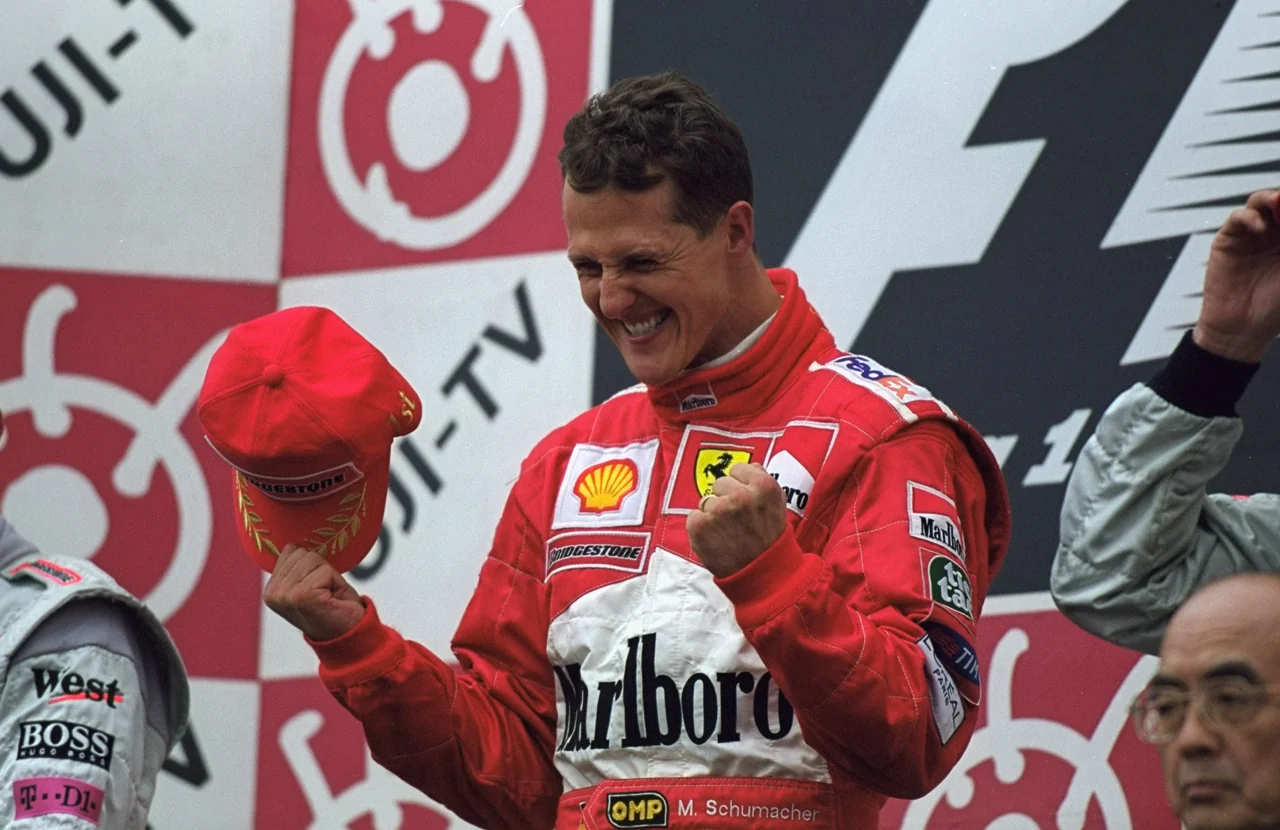 Photo: F1.com
Seven championships must be more than a single total
From 2000 to 2004, Schumacher won five consecutive drivers' championships, the most important statistical marker of his Ferrari era. Yet those five seasons unfolded differently. In some, his advantage was clear; in others, the fight went to the end. In 2003 in particular, the contest continued to the final round. The domination of the surrounding seasons should not turn the whole period into a story without suspense.
The F2002 and F2004 are often seen as representative of the era. In 2004, Schumacher took 13 race wins, converting the team's advantage into results with exceptional consistency. Driver, car, reliability and teamwork formed a powerful combination in these years. For many people afterward, the very mention of Ferrari naturally brought to mind the man beneath the red helmet.
That achievement needs to be judged within its period. Calendar lengths, car regulations and rivals' circumstances all differ. Seven titles do not compress different eras into a simple ranking of ability. They are more like a map, marking a driver's repeated capacity to complete a season-long contest across different technical environments and stages of collaboration.
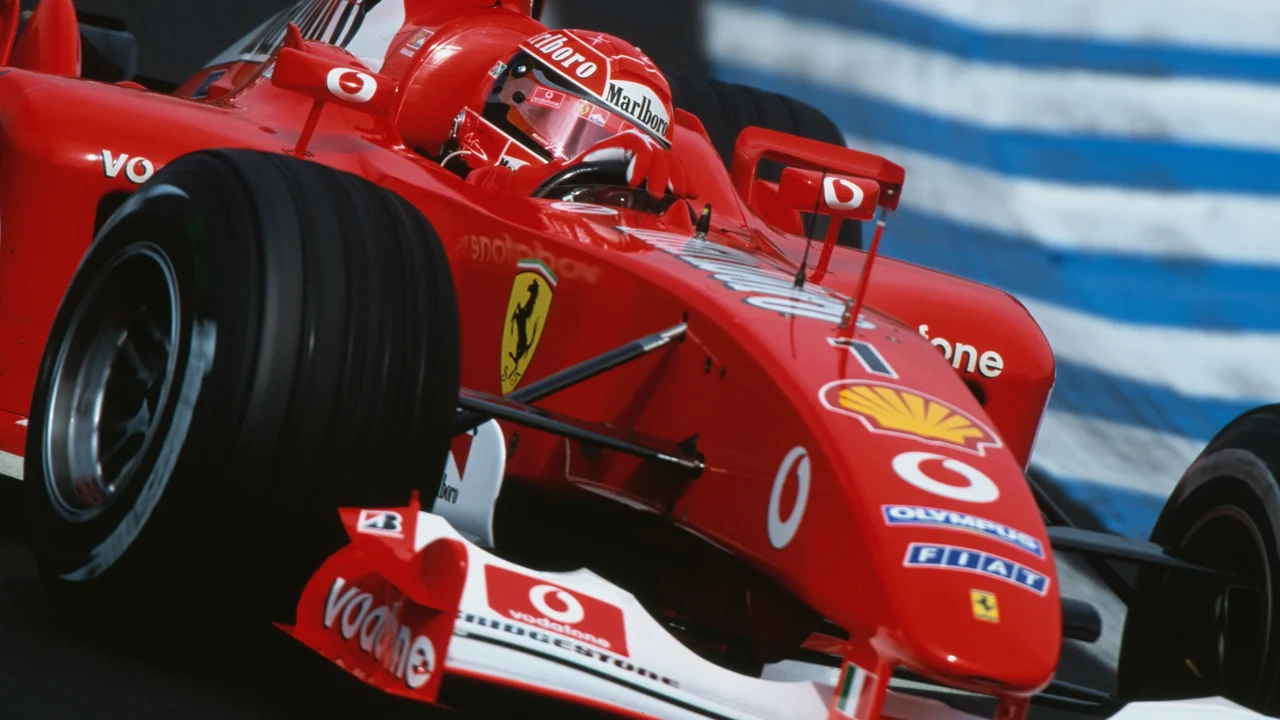 Photo: F1.com
| Championship years | Team | Place in his career |
|---|---|---|
| 1994、1995 | Benetton | From rising star to consecutive world champion |
| 2000 | Ferrari | The first drivers' title after rebuilding |
| 2001、2002 | Ferrari | Turning the breakthrough into a sustained advantage |
| 2003 | Ferrari | The contest lasted to the end of the season |
| 2004 | Ferrari | Fifth consecutive title and 13 wins in the season |
2003: One final point secured his sixth title
At the 2003 Japanese finale, Schumacher needed to secure the result required for the title, while Räikkönen had to win and hope his rival dropped points. They were not the only protagonists. Barrichello won in the other Ferrari; Räikkönen finished second; Schumacher took one point for eighth and preserved his championship lead. It was the day he broke Fangio's record of five titles, yet his finishing position was hardly dazzling.
That ending deserves to be read in the middle of the five-title sequence. Schumacher reached the podium at every round in 2002, then won thirteen races in 2004. In between, the 2003 season required counting points all the way to the final finish. Even the same driver and team had to achieve the objective differently as rules, tyres and rivals' form changed.
The value of eighth place had been established by the entire season before it. It did not demonstrate that he was the fastest driver that day, but supplied the last piece needed for the championship. For anyone accustomed to podium highlights, it is a useful additional image. Sometimes a title comes from overwhelming speed; sometimes it comes from taking the result still available to the finish on a difficult weekend.
Brazil 2006: Still chasing as he said farewell to Ferrari
On his final Grand Prix weekend driving for Ferrari, Schumacher first suffered a fuel-pressure problem in qualifying, then a puncture early in the race. His title hopes became even more remote, but the race did not end there. After changing tyres and returning to the track, he began chasing again and eventually finished fourth, while Alonso retained the championship.
That fourth place had a different character from the win at Suzuka in 2000. It did not turn years of waiting into a trophy, but clearly showed how he approached the remaining race after his objective had been damaged. The car's speed, the timing of passes and the commitment over successive laps were all still there. For spectators watching Schumacher in red for the last time, the appeal was precisely that he refused to treat the day as merely a farewell procession.
From eighth in 2003 to fourth in 2006, we can see why a results sheet needs context. The first completed his sixth title; the second could not rescue that year's championship. Neither was a victory, but each explains an important stage of his career. Keeping them alongside the ninety-one wins prevents the person from shrinking into a single gesture on the podium.
After leaving the red cars, he still wanted to race
The 2006 Chinese Grand Prix was Schumacher's 91st career victory and his 72nd for Ferrari. At the end of that season, he left the F1 driving grid for the first time. For many spectators, the story seemed ready to end there: seven titles, 91 wins and an era-defining partnership.
Instead, he returned to F1 with Mercedes in 2010 and did not finally end his racing career in the championship until 2012. The comeback did not recreate the old dynasty, nor can all of Mercedes' later successes simply be counted retrospectively as his achievements. It adds another perspective on the person: someone with more than enough honours was still willing to face young team-mates, different cars and an unfamiliar competitive position again.
The podium at the 2012 European Grand Prix is an important scene from that period. Compared with the successive championships of his earlier years, it was small in statistical terms, but not in emotion. Sporting value sometimes comes from absolute dominance, and sometimes from meeting a challenge anew at a different stage of life.
What should you watch when revisiting his races?
Watching highlights alone can make Schumacher seem like a collection of wet-weather drives, overtakes and celebrations. Watch more complete stretches of races and another ability emerges: how he maintained his pace over a sustained run, worked with strategy to turn a brief opening into an advantage, and kept producing results before the team itself reached the summit.
The controversies should remain in the picture too. His career deserves a long account because it connects questions of speed, working methods, relationships within a team and sporting boundaries. Seven titles are the entrance to this story, not its entirety. Understanding him also makes it easier to understand why F1 has never been a sport accomplished by one person alone.
View sources · 18 entries
- Official F1: Michael Schumacher
- F1: Schumacher's debut and first victory
- F1: The story of Schumacher's 1991 Jordan debut
- F1: The tyre call at Spa and the first victory in 1992
- F1: Official results of the 1992 Belgian Grand Prix
- F1: The title deciders of 1994 and 1997
- F1: Classic comeback drives, including Spa 1995
- F1: Ten defining Schumacher races
- Ferrari official historical timeline
- F1: Ferrari's iconic victories
- F1: Reviewing the strategy of the 1998 Hungarian Grand Prix
- F1: Official results of the 1998 Hungarian Grand Prix
- Ferrari: The double championship of 2000
- Ferrari: Winning the title at Suzuka in 2000
- Ferrari: Dominance in 2004
- F1: Official results of the 2003 Japanese Grand Prix
- Ferrari: The Michael 50 exhibition
- F1: Official results of the 2012 European Grand Prix
 Photo: F1.com
Ferrari: How did a racing team become a faith?
Continue reading · 21 minutes →