
Expand chapter contents · 16 chapters
- The team came before Ferrari cars
- 1951: Beating the name it once raced for
- Titles arrived, but history never runs entirely smoothly
- The Lauda era: Rebuilding starts with engineering
- 1976: Back from the flames, then choosing to leave the title decider
- 1979–1999: A twenty-one-year wait, with achievements too often overlooked
- Monza 1988: A victory that changed the mood, though not the balance of power
- When Schumacher arrived, the title-winning machine was not yet built
- Hungary 1998: How could an extra stop be the way to win?
- Suzuka 2000: A twenty-one-year wait came down to a few laps
- 2000–2004: When winning became a habit
- 2007 and 2008: The same Brazilian finish line, two different one-point margins
- After Schumacher: A title can be so close, yet so far
- Five cars to help you understand Ferrari
- Putting fifteen drivers' titles back into nine drivers' lives
- Why keep reading this history?
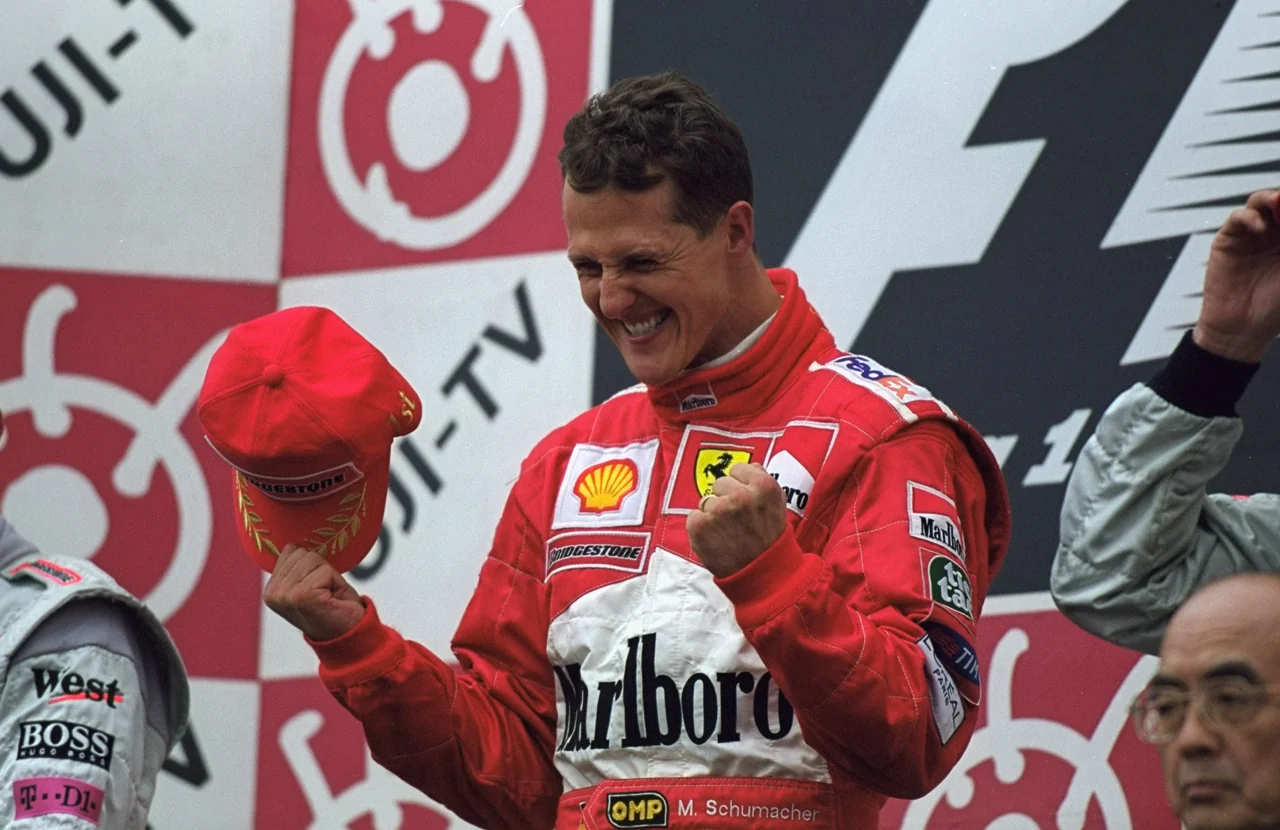
On 2000-10-8, Schumacher crossed the finish line at Suzuka. For the German driver, it was his third world championship; for Ferrari, it was an answer 21 years in the making. The last driver to win the annual drivers' crown in red overalls had been Jody Scheckter in 1979. Viewers who later grew accustomed to Schumacher winning can easily forget just how desperately this team once wanted a title.
Understanding Ferrari cannot begin and end with counting trophies. It has built the best cars, and endured seasons that failed to meet expectations; it can turn great drivers into idols, while placing an immense burden on them. By tracing a series of decisive turning points, we can see how this red team became F1's most recognizable presence, and why it repeatedly has to prove itself all over again.
The team came before Ferrari cars
Ferrari's story has three distinct beginnings. In 1929, Enzo Ferrari founded Scuderia Ferrari in Modena; in 1947, the 125 S bearing the Ferrari name left the factory; in 1950, Ferrari entered the F1 World Championship for the first time. Compressing those three events into the phrase 'Ferrari was founded in 1947' leaves out the period when the racing team existed before the car marque.
The early Scuderia organized its racing activities mainly around Alfa Romeo cars. Enzo's business began by bringing together drivers, mechanics, cars and the resources needed to compete, then leading his team against other teams. Later, Ferrari became a manufacturer that built its own cars and engines and raced them itself. Those overlapping identities have always kept track results closely tied to the marque's image.
Those three beginnings also explain something distinctive about Ferrari: the team was not a publicity project added after a car production line had been established. The racing organization came first. Initially, the problem was how to get through a race; only later did it become how to take cars of its own manufacture into competition. By the F1 era, a mistaken engineering choice affected more than a single Sunday: it could strike directly at the brand's sense of itself.
1951: Beating the name it once raced for
Ferrari did not enter the opening round of the 1950 World Championship at Silverstone. Its official debut came at the second round, Monaco. One of its strongest opponents was Alfa Romeo, the very name so closely connected with Enzo's early career. Ferrari needed to show that, outside the old structure, it too could build a car good enough to compete.
The breakthrough came at the 1951 British Grand Prix. José Froilán González won in the 375 F1, taking Ferrari's first F1 World Championship race victory. Beyond the driver's speed, this contest involved a decidedly unromantic but crucial factor: fuel. Ferrari's relatively economical consumption helped it when it came to refuelling stops.
That is part of what makes early F1 so interesting. The winning car was not simply the loudest on the straight or the one with the largest engine; it had to combine speed, fuel consumption, reliability and pit-stop planning. The Silverstone victory later became part of the marque's mythology. As a race, though, it was first of all a victory achieved jointly by driving and engineering.
The opposition at Silverstone was no stranger. For Enzo, who had once raced Alfa Romeos, beating Alfa also meant confronting part of his own past. Yet the 1951 win was still only a breakthrough, not something to be prematurely described as season-long domination. Between winning a race and winning a championship lay different circuits, mechanical failures and the points accumulated across an entire season.
Placed before the long history that followed, this race shows that Ferrari's first success did not depend on an already established status as a great team. It was the challenger, changing the comparison through a 375 F1 and González's driving. Today, the red cars are regarded as a team that ought to fight for titles. In the beginning, however, Ferrari too had to learn from more established opponents, then find the specific areas where it could win.
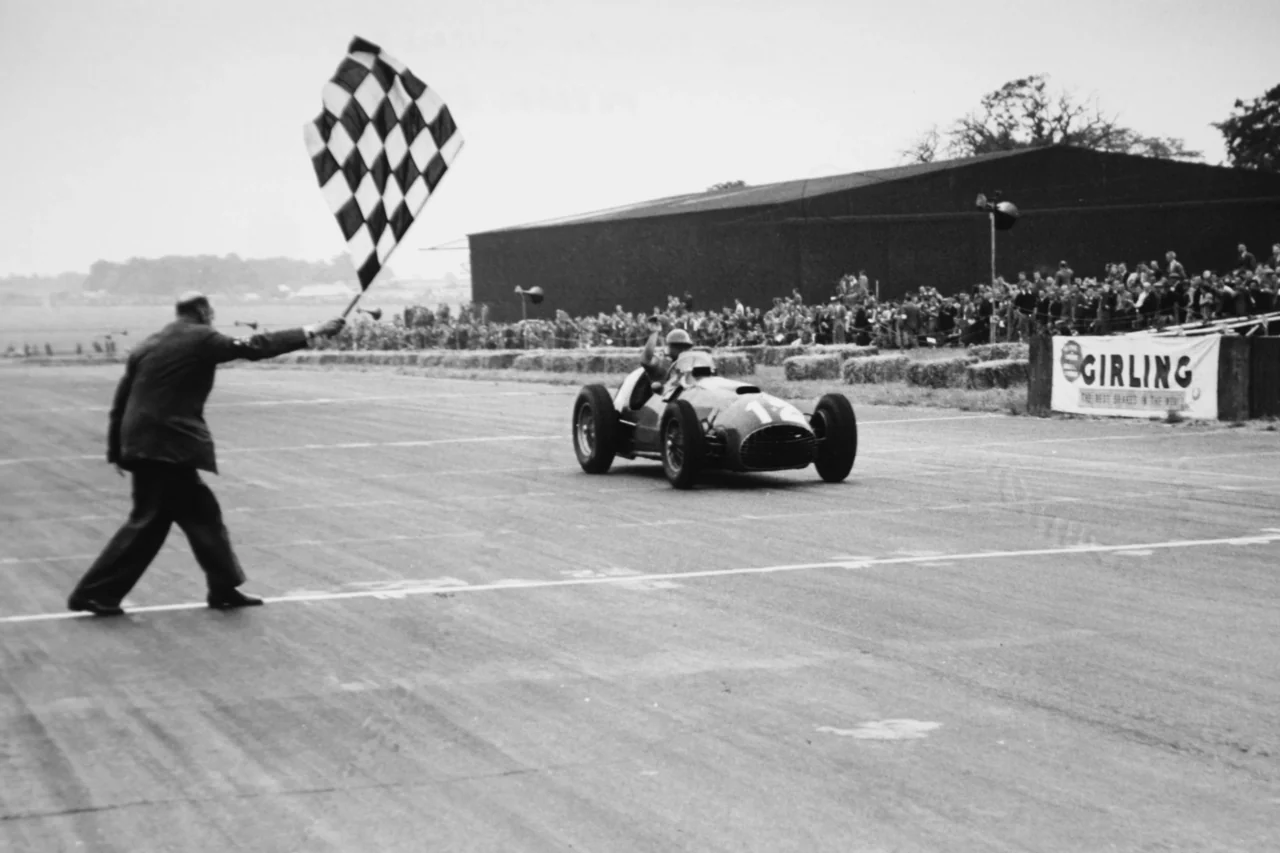 Photo: F1.com
Titles arrived, but history never runs entirely smoothly
Alberto Ascari won consecutive drivers' titles in 1952 and 1953, and Ferrari began to become synonymous with championship success. Fangio, Hawthorn, Phil Hill and John Surtees subsequently also won annual drivers' crowns for the team. Surtees was particularly unusual: he brought championship experience from top-level motorcycle racing into F1, and became world champion on four wheels in 1964.
Nor can those early titles be understood merely by stringing drivers' names together. Hawthorn won in 1958, but Vanwall took the inaugural constructors' championship. Ferrari did not win its first constructors' crown until 1961, when Phil Hill drove the 156. Surtees's success in 1964 united motorcycle and car world championship experience in one person. Although all involved red cars, these three moments answer different questions: how drivers score points, how two cars contribute to a team's result, and how experience from one form of racing adapts to another.
There is another common trap when reading Ferrari's history: Ascari's early drivers' titles cannot simply be counted as constructors' titles from the same years. The F1 constructors' championship was introduced only in 1958. The two annual trophies familiar today did not exist as a pair from 1950 onward. That is why we list drivers' and constructors' honours separately.
New viewers are especially likely to interpret 'winning the championship' as being fastest at every round. In reality, a title is the outcome of a whole season under a particular points system. Sometimes the speed advantage is overwhelming; sometimes consistent finishes, rivals' retirements and decisive placings combine to settle it. Ferrari's early honours should be read alongside the rules of their time, without imposing today's calendar length and points totals on the past.
The distinction would recur repeatedly. A drivers' title gives the public a face to remember; a constructors' title more directly reflects the combined performance of two cars over a season. A star becoming champion does not mean the other driver had an equally smooth year. A team reaching the summit does not mean it also had the leader of the drivers' standings. This is the starting point for understanding Ferrari's later seasons in which it had clearly won, yet was still waiting.
The Lauda era: Rebuilding starts with engineering
Ferrari's revival in the mid-1970s came from changes in driving, engineering and management together. Niki Lauda, Clay Regazzoni, engineer Mauro Forghieri and the team's management all formed part of the rebuilding effort. Lauda took his first win in Spain in 1974, and the team regained a clear direction for progress. In 1975, he won the drivers' championship in the 312T, while Ferrari also took the constructors' title.
The T in 312T referred to its transverse gearbox. Ferrari placed the gearbox ahead of the rear axle line to concentrate the mass and make the car change direction more readily. This was not just a matter of replacing one component: the wings, suspension and weight distribution had to work together. For the driver, the benefit ultimately had to mean greater confidence on corner entry, smoother transitions through sequences of corners, and the ability to maintain pace late in a race.
Ferrari's official retrospective contains a detail easily hidden by the glorious outcome: the 312T was not ready for the start of the season. The team began with the old 312B3, but the new tyres did not suit it, and results in the two South American rounds were disappointing. Ferrari therefore accelerated the new car's preparation and introduced it in South Africa. Championship-winning engineering does not mean finding the right answer on day one. It means acknowledging problems while racing is already under way and bringing a more suitable solution to the track as quickly as possible.
Lauda won in Monaco, Belgium, Sweden, France and the United States that year. Regazzoni won at Monza, where Lauda clinched the drivers' title. Including the team-mate in the picture reveals that the double championship of 1975 belonged to more than one face in a cockpit: design direction, driver feedback and results from both cars were finally supporting one another.
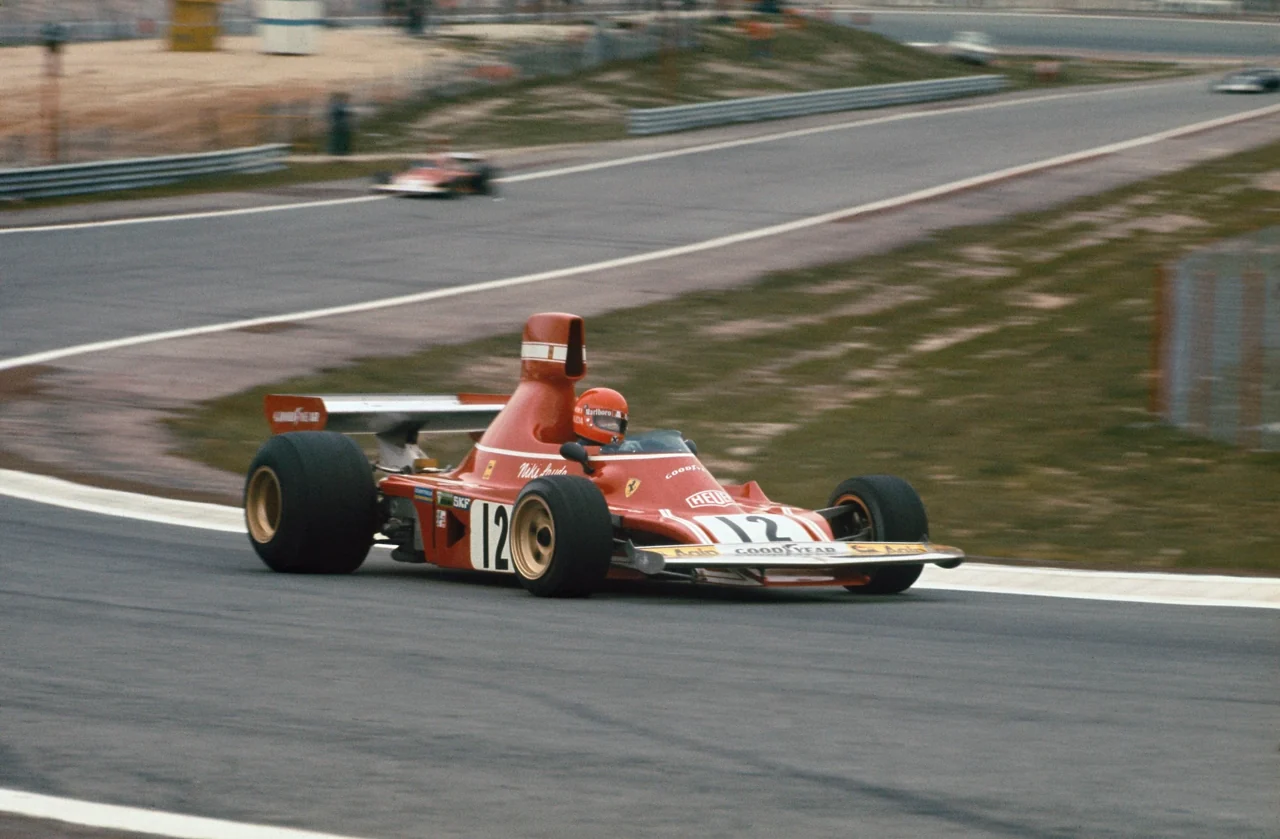 Photo: F1.com
1976: Back from the flames, then choosing to leave the title decider
The following year's test went far beyond whether a car was good to drive. Lauda was severely injured at the Nürburgring, then returned to racing. His comeback is often reduced to 'bravery'. But reading the whole story simply as racing through pain can obscure the most important decision of the final round: in the heavy rain at Fuji, he judged the conditions unacceptable and chose to withdraw.
James Hunt ultimately won the drivers' championship by one point. That ending sits uneasily in a conventional heroic narrative: the same man first overcame enormous difficulties to return to the circuit, then stopped racing with the annual title within reach. Yet the decisions were not contradictory. His comeback was a choice about whether to continue his career; Fuji concerned his assessment of risk at that particular moment. We should not rewrite those two choices on his behalf as if courage could point in only one direction.
Lauda won again in 1977, proving that the ending of 1976 had not ended his competitive ability. In Ferrari's history, the episode left two distinct layers of memory. One is of the red cars winning championships again; the other is that a champion driver need not submit solely to the demands of a trophy. The team's history is therefore about more than machinery and points. It also includes relationships between people and organizations that cannot always be easily reconciled.
1979–1999: A twenty-one-year wait, with achievements too often overlooked
In 1979, Scheckter took the drivers' championship. From the end of that season, it would have been hard to foresee that Ferrari's next such trophy would not arrive until 2000. In the years that followed, spectators remembered Gilles Villeneuve's unforgettable races, the team's fluctuations in the 1980s, and repeated title bids that seemed close but never quite reached their goal.
But '21 years without a drivers' title' does not mean '21 years with nothing to show for them'. Ferrari won constructors' titles in 1982 and 1983, and again in 1999. Here, the difference between the two awards becomes tangible: the results accumulated by two cars could put the team on top, while the drivers' standings were still led by the spearhead of another team.
The 1999 season illustrates the point especially well. After Schumacher was injured at the British Grand Prix and missed several rounds, the focus of the title challenge shifted to Eddie Irvine. Mika Häkkinen ultimately won the drivers' crown, while Ferrari brought home the constructors' championship. The outcome was disappointing in one respect, but also sent a signal: the rebuilding was bearing fruit. All that remained before both trophies could return to Maranello was one final, complete season.
In 1990, Prost had taken Ferrari into the drivers' title decider. After the start at Suzuka, he and Senna collided at the first corner; both retired, ending the championship contest. The scene makes a telling contrast with Monza in 1988. Both involved contact during a race, but the earlier incident handed Ferrari an unforgettable victory, while the later one extinguished a season's title hopes. To understand what history's 'almost' really means, we often need to return to one particular race and one particular corner.
| Year | Ferrari's achievement | A point easily confused |
|---|---|---|
| 1979 | Drivers' and constructors' double | The next drivers' title would not come until 2000 |
| 1982, 1983 | Constructors' title | Not the drivers' title in those years |
| 1999 | Constructors' title | Häkkinen won the drivers' championship |
| 2000 | Drivers' and constructors' double | The long rebuilding effort delivered its full reward |
Monza 1988: A victory that changed the mood, though not the balance of power
In 1988, McLaren swept almost everything before it. When Ferrari arrived at Monza, Enzo Ferrari had just died, giving the home race an unusually heavy emotional weight. But a race does not automatically grant victory to a team simply because it deserves consolation. The red-and-white McLarens had won every previous round and remained the strongest benchmark.
The first change came with Prost's engine failure. Senna was still leading, but near the end of the race he made contact with Schlesser while lapping him and came to a halt off the corner. Berger and Alboreto moved into the top two positions, and Ferrari completed a one-two. There is no need to invent a more romantic explanation based on car performance: the rival's trouble and the late incident really were the decisive factors in the race's reversal.
The victory did not displace McLaren as the strongest team of 1988, but it gave a marque that had just lost its founder an extraordinarily vivid farewell scene. Sporting value and emotional value do not always coincide. A race that cannot change the destination of the annual title may still become the memory that generations of fans most want to retell.
When Schumacher arrived, the title-winning machine was not yet built
When Schumacher joined in 1996, he was already a two-time world champion. What he brought first was speed and experience of fighting for titles, but Ferrari needed more than a faster pair of hands at the wheel. Aligning design, testing, race strategy and driver feedback around the same goal was harder than signing a superstar. The work of Jean Todt, Ross Brawn, Rory Byrne and others, together with Schumacher's driving, became essential components of the success that followed.
The 1996 Spanish Grand Prix gave the new partnership a special opportunity. Williams had already demonstrated more rounded competitiveness that year; Ferrari's F310 was not the fastest car across the season. Before the wet race, Schumacher chose a setup tailored to the conditions. Persistent heavy rain made tyre grip, throttle control and confidence at the wheel particularly important. He took his first victory for Ferrari, giving a team still rebuilding a result they could all believe in.
From the team's perspective, the most valuable lesson is not to copy a hero, but to understand how an organization gradually becomes dependable. The driver can consistently explain the car's problems; engineers can turn that feedback into objectives for the next test; the race team can execute a shared plan at the critical moment. Victories that later seemed inevitable were built gradually through these less conspicuous processes.
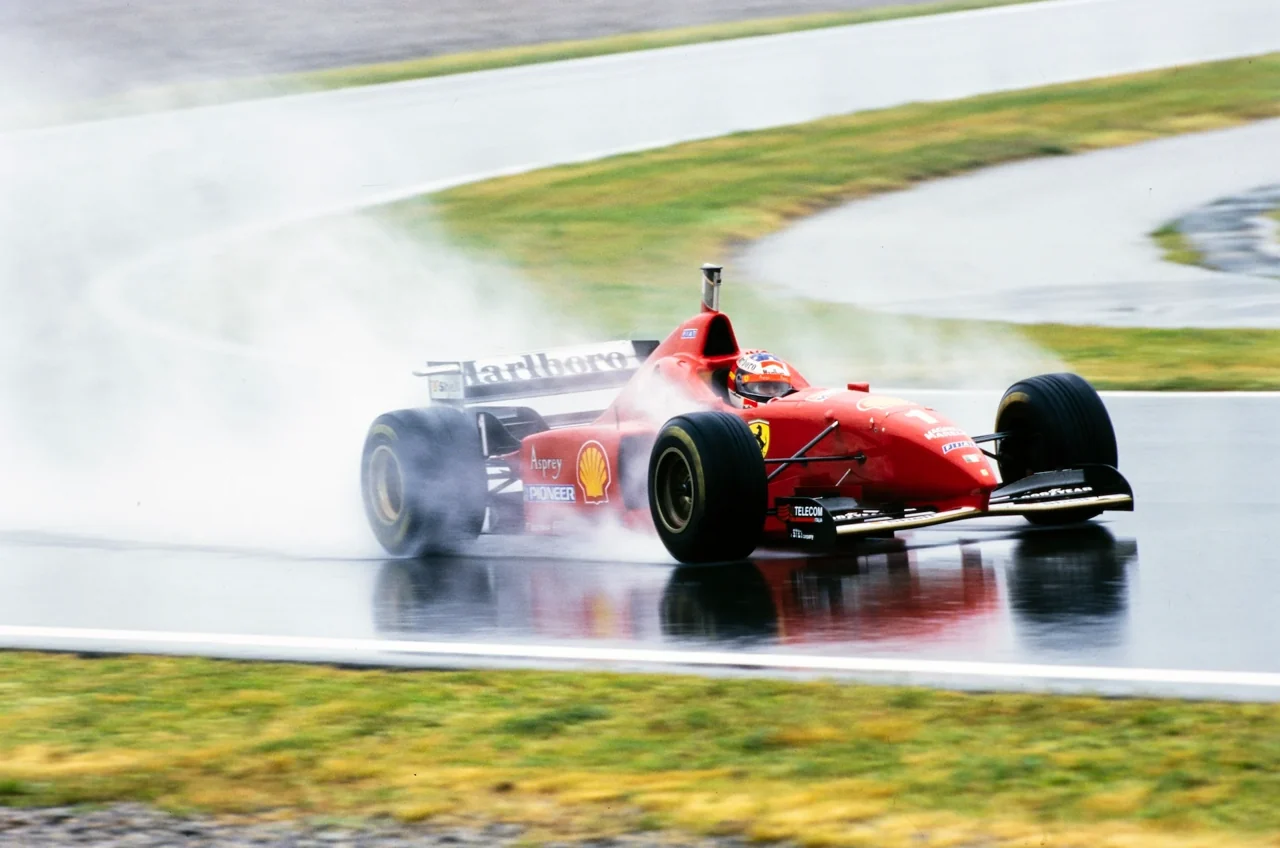 Photo: F1.com
Hungary 1998: How could an extra stop be the way to win?
In Hungary, Schumacher was stuck behind the two McLarens. Overtaking was difficult, and continuing to follow them was likely to leave the race finishing in the same order. Brawn chose three stops, turning a two-stop contest into a different calculation: pay for an extra trip through the pits in exchange for a faster stint on a lighter fuel load.
The cost of that plan was equally clear. Before the additional stop, Schumacher had to build a gap large enough to offset the time he would lose. A temporary lead on the timing screen was not a true lead, because one stop was still owed. Watching races from the refuelling era requires attention both to track position and to stops remaining; looking only at who is currently first misreads the risk of the strategy.
Nor can the victory be explained simply as 'a succession of qualifying laps'. Häkkinen's car developed handling problems, Coulthard was held up by his team-mate, and tyre performance and fuel weight also affected both sides' pace. Schumacher's execution was outstanding, but it combined with the problems his rivals encountered to produce the result. Ferrari's strength lay in recognizing and exploiting that opportunity, not in possessing a magic instruction that worked every time.
Suzuka 2000: A twenty-one-year wait came down to a few laps
By the 2000 Japanese Grand Prix, the contest between Schumacher and Häkkinen no longer needed to be explained by saying that Ferrari was rebuilding. Ferrari's task was to take the final step in a direct confrontation. Häkkinen took the lead at the start, with Schumacher following; the championship had not already been decided by qualifying.
The decisive change came around the second round of stops. Häkkinen pitted first; Schumacher stayed out. What mattered then was not who appeared in the lead on that lap, but the order in which they would meet again after both had stopped. Schumacher remained ahead after his own stop and eventually won by less than two seconds.
For an ordinary spectator, this was less immediately obvious than a wheel-to-wheel pass. The decisive move was not made side by side at a single corner; instead, the race changed through a few laps of pace combined with the pit stops. Every portion of time had to be added together. Had the driver, pit wall or mechanics been slower at any stage, the outcome might have been different.
That is also why the emotions in the Suzuka photographs are so intense. Schumacher won his third personal title; Ferrari ended a wait for a drivers' crown stretching back to 1979. Put those two timescales together and the celebration is no longer simply 'another race won'. It is the moment when many people, after years of persistence, finally see the same shared project deliver.
2000–2004: When winning became a habit
At Suzuka in 2000, Schumacher beat Häkkinen in their direct contest, winning the race and clinching the championship. Ferrari finally turned years of 'if only' into a result. Thereafter, the question was no longer simply whether it could fight for titles, but how its rivals could break its advantage. Schumacher won five consecutive drivers' crowns from 2000 to 2004, while Ferrari took six consecutive constructors' titles from 1999 to 2004.
The F2002 and F2004 are the era's most celebrated representatives, but attributing the victories to one miraculous design feature does little to explain why the dominance lasted. Car performance, reliability, the tyre partnership, testing and race execution formed a mutually supporting system. Having other elements able to compensate when one detail went wrong was more formidable than possessing only an exceptional peak lap time.
In 2004, Schumacher won 13 Grands Prix. That number demonstrates the advantage, but also reminds readers that judging different eras requires more than comparing raw victory totals. Calendar lengths, points systems and technical rules change from year to year. The most enduring historical mark of Ferrari's dynasty was its ability to contend and deliver repeatedly, rather than any single record that might later be broken.
The 2002 season is especially useful for understanding that consistency. Schumacher finished on the podium in all seventeen races and won eleven of them. Even on a weekend when he did not win, he brought home substantial points, leaving rivals little prospect of waiting for a run of scoreless finishes. Compared with one exceptionally fast qualifying lap, an entire season without dropping outside the top three shows more directly how car, driver and race execution protected one another.
The thirteen wins of 2004 came in an eighteen-round calendar. Restoring that denominator lets readers feel the concentration of success: almost every time the championship reached a new circuit, rivals had to search again for a way to beat the same combination. Ferrari's dynasty was not one car reused for five years. Each season required the development of the next car, while sustaining the working relationships already established.
2007 and 2008: The same Brazilian finish line, two different one-point margins
Schumacher retired for the first time after 2006, and Räikkönen took over a major seat at Ferrari. Before the 2007 finale, Hamilton had 107 points, Alonso 103 and Räikkönen 100. A win was then worth only 10 points. A deficit of 7 meant that even victory would not be enough for Räikkönen without the right finishing positions for his rivals.
The Brazilian Grand Prix produced that unlikely combination: Räikkönen won, Massa finished second, Alonso third and Hamilton seventh. The final points totals were 110, 109 and 109. Räikkönen's drivers' championship proved that Ferrari could still complete a title challenge after Schumacher's departure. Yet the one-point margin also showed that the ending of a championship season does not always involve one car overpowering every rival from start to finish.
A year later, Massa won at the same circuit, but did not win the drivers' championship. Hamilton ultimately finished fifth and took the title by 98 points to 97. When Massa crossed the line first, his own race was over, but his championship rival's was not. Few F1 moments have shown so plainly the distance between 'I have done everything I can' and 'the season's result belongs to me'.
Ferrari won the constructors' championship in 2008, so the day was not one on which the entire team came away empty-handed. The two cars' points over the year brought home a trophy, while Massa's personal bid fell short by one point. Keeping both emotions in view comes closer to the complexity of the team's real experience than describing the season as either pure triumph or pure failure.
After Schumacher: A title can be so close, yet so far
Alonso joined in 2010, won on his debut in Bahrain, and arrived at the Abu Dhabi finale leading the championship. He finished only seventh, however, while Vettel won the race and the title by 256 points to 252. In 2012, Alonso again took the contest to the final round, only to finish behind Vettel once more, by 278 points to 281. Those two runner-up finishes, separated from the title by just four and three points, gave Ferrari's ongoing wait a particularly precise form of regret.
Vettel replaced Alonso in 2015 and gave the team three wins that year. In the first half of 2017, Ferrari again had the strength to fight Mercedes for the championship, but technical problems and mistakes affected its second half. Vettel won five more races in 2018, yet still could not convert the car's speed into the annual crown. Those two seasons showed that speed is needed to approach a title, while winning it also demands reliability, development and race execution throughout the season.
In 2024, Leclerc and Sainz contributed five Grand Prix victories between them, and Ferrari fought McLaren for the constructors' title until the final round before finishing second. After Hamilton joined in 2025, the SF-25 failed to sustain that upward trend, and the team slipped to fourth overall. Such fluctuations give every present-day victory for a red car two layers of expectation: celebrating the race just won, while waiting to return to the summit over a complete season.
Five cars to help you understand Ferrari
There is no need to memorize dozens of model names at the outset. Choose a few cars that represent turning points, then restore the drivers, rules and eras around them, and the history becomes easier to remember. The 375 F1 represents Ferrari first proving itself; the 312T, a technical rebuilding; the F1-2000, the end of the wait; the F2004, the height of a dynasty. The F2007 of 2007 shows that a team must learn to keep winning after a central figure leaves.
Putting these models back in their own periods reveals how car development changed the way teams pursued victory: from early compromises among engines, fuel consumption and reliability, through the 312T's overall weight layout, to the fine demands of coordinating aerodynamics, tyres and chassis in modern cars. The model names belong to different technical contexts. The table below identifies their most memorable places in the team's history.
| Car | What to remember | Associated drivers |
|---|---|---|
| 375 F1 · 1951 | First World Championship race victory | González |
| 312T · 1975 | Transverse gearbox and a double-title revival | Lauda, Regazzoni |
| F1-2000 · 2000 | Ending a 21-year wait for a drivers' title | Schumacher, Barrichello |
| F2004 · 2004 | Schumacher's 13-win season | Schumacher, Barrichello |
| F2007 · 2007 | A final-round comeback to win the title | Räikkönen, Massa |
Putting fifteen drivers' titles back into nine drivers' lives
Ferrari's drivers' titles were won by nine different drivers. Ascari delivered the first two in 1952 and 1953; Fangio won in 1956; Hawthorn, Phil Hill and Surtees each subsequently added a title year. In the eras of Lauda, Scheckter and Schumacher, the same red name entered new technical contexts. The last driver to win the drivers' crown for Ferrari before this statistical cutoff at the end of 2025 was Räikkönen, in 2007.
There are two ways to read the table. Vertically, it shows the championship passing from one era to another; horizontally, it reveals that the same driver may also have won titles away from Ferrari. Fangio and Lauda both became champions with other teams, and Schumacher's first two titles belonged to Benetton. 'How many championships did this driver win in his career?' and 'How many did he win for Ferrari?' therefore require separate answers.
The nine names also suggest routes for further reading. For early racing, start with Ascari and Fangio. To see how technical feedback can help revive a team, continue with Lauda. To understand how teamwork, testing and strategy combine, turn to Schumacher. Opened up in this way, the wall of honours becomes more than a wall covered only in numbers.
| Driver | Championship years with Ferrari | Total |
|---|---|---|
| Alberto Ascari | 1952, 1953 | 2 |
| Juan Manuel Fangio | 1956 | 1 |
| Mike Hawthorn | 1958 | 1 |
| Phil Hill | 1961 | 1 |
| John Surtees | 1964 | 1 |
| Niki Lauda | 1975, 1977 | 2 |
| Jody Scheckter | 1979 | 1 |
| Michael Schumacher | 2000—2004 | 5 |
| Kimi Räikkönen | 2007 | 1 |
Why keep reading this history?
Ferrari is most fascinating because its history cannot fit inside one image. It is both manufacturer and racing organization, a place of highly rational engineering and intense emotional projection. Engineers must persuade the stopwatch with data, while spectators often explain a red car through their memories. Those two ways of seeing have long met here, and often come into conflict.
After reading this team history, Schumacher's career comes into a different focus. He is not only a seven-time champion, but also a central figure in a long rebuilding effort. Today's races look different too: a pit stop, a reliability problem or a new season's design direction no longer appears as an isolated news item. Each belongs to a longer question: how does a team accustomed to being expected to win turn that expectation into real competitiveness?
View sources · 24 entries
- Ferrari official historical timeline
- Ferrari: Historical material for the team's ninetieth anniversary
- Ferrari: The 1951 British Grand Prix
- F1: Ferrari's iconic victories
- F1: Ferrari's year-by-year history
- F1: Results of the inaugural constructors' championship in 1958
- Ferrari: Lauda and the 1975 championship
- Ferrari: The engineering of the 312T and the 1975 season
- F1: Niki Lauda's career profile
- F1: Historic Japanese Grand Prix moments, 1990 and 2000
- F1: Historic Monza moments and Ferrari's 1988 one-two
- Official F1: Michael Schumacher
- F1: Montezemolo and Ferrari's rebuilding
- Ferrari: The double championship of 2000
- F1: The background to Spain 1996 and the wet-weather setup
- F1: Reviewing the strategy of the 1998 Hungarian Grand Prix
- F1: Official results of the 2000 Japanese Grand Prix
- Ferrari: Dominance in 2004
- F1: Championship deciders in Brazil
- F1: The 2007 drivers' standings
- F1: The 2008 drivers' standings
- Official F1: The 2010 drivers' standings
- Official F1: The 2012 drivers' standings
- Official F1: The 2010 Abu Dhabi Grand Prix results
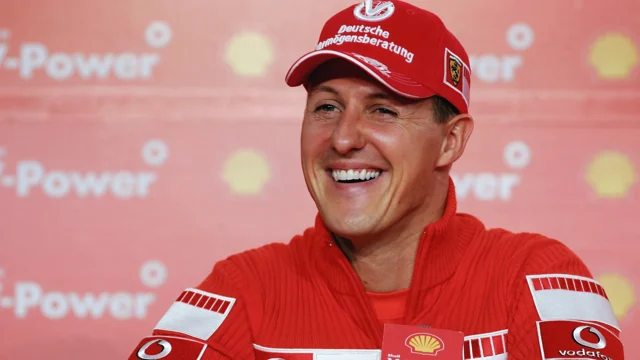 Photo: F1.com
Schumacher: Who was the driver behind the seven titles?
Continue reading · 15 minutes →