
Expand chapter list · 10 chapters
- His father showed the way; he still had to earn his own results
- The Legacy years: Before a first win, learning to finish a world-level rally
- A dispute before the title: Catalunya 1995
- 1995: An entire season came down to the British stages
- Understanding his speed beyond simply "going for it"
- The move to Ford: Leaving the familiar blue behind
- Britain 2001: A second title had been so close
- Citroën and Škoda: His later career was no straight line of decline
- From a name in rallying to a game cover: Bringing the sport to more people
- After 2007: How do we remember a person with care?
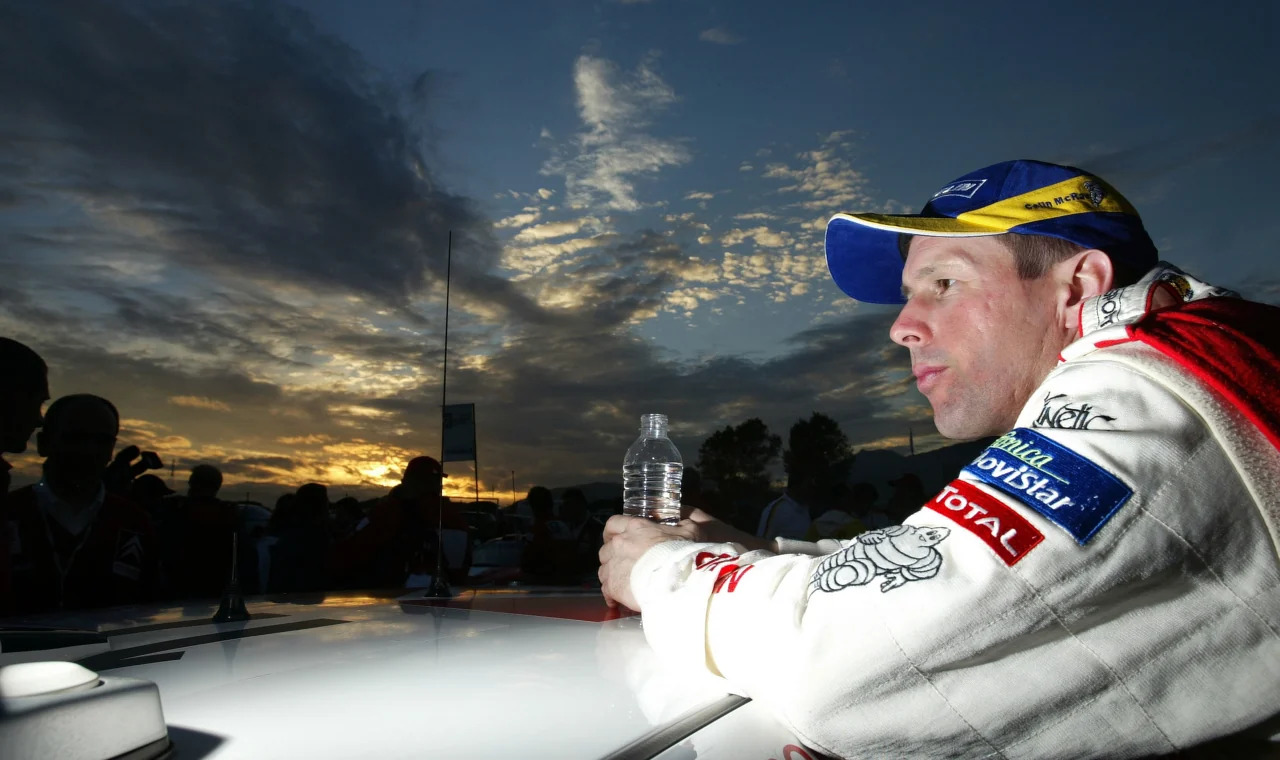
Championship totals provide a clear starting point, but they do not measure the whole of someone's influence. Colin McRae won just one WRC drivers' world title, yet his name reached beyond rallying itself. Some people first knew the blue Impreza; others remembered him through racing games. Others were drawn to this charged kind of speed the first time they saw a car slide sideways through a gravel corner.
Calling him merely "fearless" flattens his career. A world championship demands speed sustained to the end of a season, with co-driver, car and team working together. His career also contained transfers, defeats, injuries and unfulfilled opportunities. To read McRae's story, it helps to set aside the familiar slogans and begin with how a young Scot reached the world stage.
His father showed the way; he still had to earn his own results
McRae was born in Scotland in 1968. His father, Jimmy McRae, was a five-time British Rally Championship winner. Racing was therefore not an unfamiliar world discovered by chance on television: garages, repairs and journeys to events were tied to family life. Having a successful father also meant facing comparisons from an early age.
McRae first competed on motorcycles. At sixteen he began driving a Mini in autotests, before moving into rallying. His father's experience made racing familiar, but he still had to earn the results that would take him into professional competition. Consecutive British titles in 1991 and 1992 were crucial steps from family background towards an opportunity with a world-class team.
Local competition offered more than trophies for a résumé. Rally crews must learn to read road surfaces, cooperate with a co-driver and keep a car running with limited resources. The world stage magnifies those problems without making them disappear. McRae's later speed was grounded in a long accumulation of experience.
This route differs from the impression given by a list of WRC champions alone. The title was not the first moment he was noticed. Local rallies, the British championship and early world-level appearances had gradually shown teams his speed and the support that speed required. Ringer's long partnership in the co-driver's seat is an essential part of that development.
The Legacy years: Before a first win, learning to finish a world-level rally
In the early 1990s McRae joined Subaru's World Rally programme. The works car was still the Legacy, not the Impreza that later became so familiar. For driver and manufacturer alike, this was a process of turning potential into consistent competitiveness: the car needed improvement, and the young driver needed to convert speed over individual stages into results over a whole rally.
At Rally New Zealand in 1993, he and Derek Ringer took their first WRC victory. It was also Subaru's first WRC rally win. The breakthrough thus had a double meaning: the driver proved that he could win, and the manufacturer proved that its programme could support a world-level victory.
Subaru began using the Impreza that same year. Looking back at photographs of McRae, the transition from Legacy to Impreza should not be passed over. The former carried the first win, the latter the championship. What joined them was experience gradually accumulated by the same group of people, rather than a colour suddenly creating a legend.
A first rally win also means a crew has connected several days of work successfully. A fastest stage time can come from one outstanding performance; a rally victory requires the advantage to survive everything from reconnaissance and tyre choice to servicing and the final timed stage. It established that McRae could win an entire world-class event.
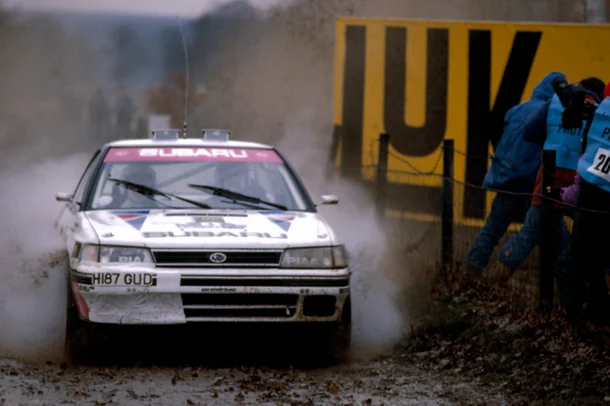 Photo: STI (official)
A dispute before the title: Catalunya 1995
Before the British showdown, Subaru faced an internal dispute at Catalunya. The team wanted Sainz to win at home, but McRae kept chasing and at one stage moved ahead. According to Sainz's later recollection to the FIA, McRae ultimately accepted a time penalty and gave the position back, leaving the championship to be settled in Britain.
This story cannot be reduced to "obedience" or "disobedience". The manufacturer wanted to control the team's collective risk, while the driver was pursuing a world-title opportunity that might arise only a few times in a lifetime. Wearing the same uniform does not mean two people have identical interests at every moment. Acknowledging that tension makes the British victory more than one extra line at the bottom of the season's results.
McRae then won in Britain and became world champion alongside Ringer. The result did not erase the earlier conflict, but it allowed him to deliver the decisive answer in competition. Reading the two rallies together brings us closer to the real pressure of a title-challenging season than looking only at the final celebrations.
1995: An entire season came down to the British stages
One of McRae's main title rivals in 1995 was Subaru team-mate Carlos Sainz. The two-time world champion had extensive experience, and competing within the same team made it difficult for McRae to attribute any gap simply to machinery. To become world champion, he had to measure himself against such a rival across an entire season.
McRae and Ringer won the British finale and became the world-championship-winning crew. At 27, McRae became the first British WRC drivers' world champion. It was a clear milestone for Scottish and British rallying, and for Subaru it coincided with the manufacturer's own first title.
The champion driver's name is often better known than the co-driver's, but Ringer's role was not to sit passively in the passenger seat. Pacenote information had to be accurate and delivered before the driver needed to act. A rally car appears to be steered by one person, but the event is completed through close coordination between two. Ringer's name should remain beside McRae's in any account of this title.
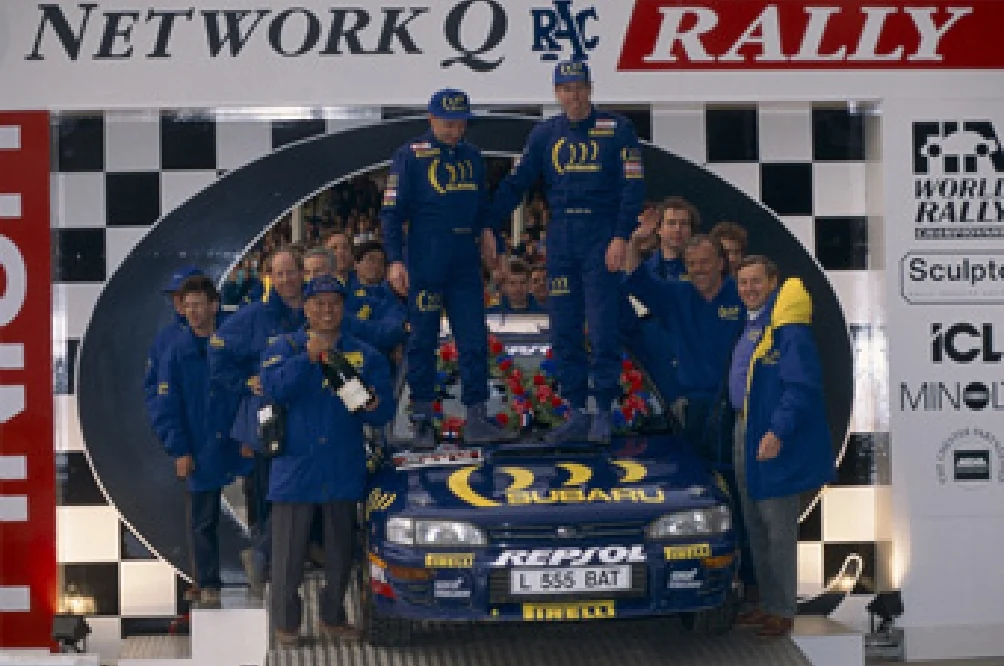 Photo: STI (official)
How a rally crew works together for speed
These elements require a long-developed partnership. Co-drivers also have world championship honours of their own.
Understanding his speed beyond simply "going for it"
McRae left countless dynamic racing images: a car sliding sideways, wheels scattering gravel, a machine recovering its direction at the edge of the road. They are compelling, but one photograph cannot explain the driving over an entire stage, nor prove that every conspicuous slide is faster.
In rallying, a driver must consider the road's direction, surface grip and the car's attitude together. Different corners, tyres and surfaces call for different actions. Assertive driving can save time, while also increasing the cost of a misjudgement. Understanding McRae means examining how he tried to extract the car's limits, without portraying every risk as heroic behaviour to imitate.
His onboard footage reveals two processes that extend beyond a single slide: how Ringer, or later Nicky Grist, delivers an uninterrupted stream of pacenotes, and how McRae links turn-in, the car's rotation and the next acceleration. Photographs readily preserve a leaning body and flying dust, but the clock also counts the time spent on every correction of direction.
His appeal was certainly tied to his willingness to attack, but his record also contains retirements and missed titles. Keeping both in the story explains why the same tension could excite spectators and worry a team. A complete legend comes not from deleting mistakes, but from preserving how a person confronted speed and its costs.
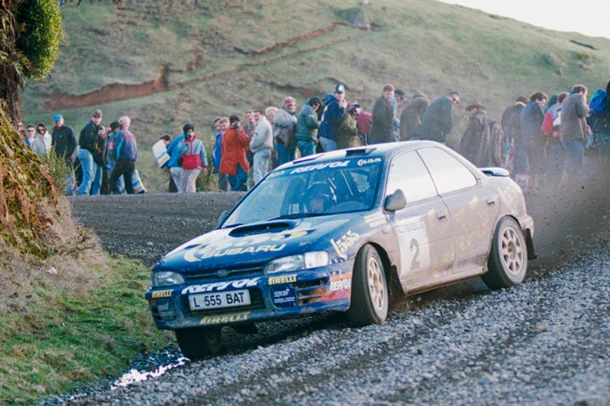 Photo: STI (official)
The move to Ford: Leaving the familiar blue behind
McRae joined Ford in 1999. Over the following four seasons he took nine WRC victories for the manufacturer. This period shows that his success belonged neither to one Impreza nor to a single marque. Yet within the new programme, winning individual rallies and winning another season-long title remained two different challenges.
A change of team requires a driver to relearn a car's reactions, build communication with engineers and manage the balance between testing and racing in a new organisation. Previous experience offers a basis for comparison, but cannot replace an understanding of the new car. Even for an established world champion, it is another round of learning.
He remained among the most closely watched figures in world rallying during his Ford years, but did not win another drivers' world title. Instead of treating these seasons as an empty wait for title number two, we should recognise the nine victories themselves. Continuing to win with a different car and organisation gives the career much of its depth.
Britain 2001: A second title had been so close
McRae arrived at the 2001 British finale in his Ford still fighting for the world championship. He led for a time, then crashed out. Burns finished third and won the title by 44 points to 42. The British rally that had brought his greatest joy six years earlier now left a different memory.
Those two points open up the story behind "only one title". They do not mean McRae ceased to compete at the highest level after 1995; they show that he came close to his goal again but could not complete it. Nine Ford-era rally wins proved that his competitiveness remained. Retirement in Britain showed how speed could lose its chance to become points at the most decisive moment of a title fight.
Burns's third place also reveals different ways of succeeding in rallying. One driver was trying to seize enough control to win the title; the other adjusted his task as rivals retired. Competition does not reserve potential points for somebody simply because his driving is more spectacular.
Citroën and Škoda: His later career was no straight line of decline
In 2003 McRae moved to Citroën, bringing two drivers' histories together. An established British world champion joined the French works team while the next dominant force, Loeb, was developing in the same line-up. McRae did not win a rally that season, which became his final full WRC campaign.
By joining Sainz and Loeb at Citroën in 2003, his career connected two different team eras. Fourth place in Britain helped Citroën secure its first manufacturers' title. For a former drivers' champion, it was not his greatest individual day, but it was a definite contribution to the team.
Opportunities to return still followed. In 2005 McRae drove a Škoda Fabia in the British and Australian WRC rounds. He finished seventh in Britain; in Australia he came close to a podium, only to retire after a problem changing the clutch in service. Škoda's official retrospective still includes the partnership as part of its motorsport story.
This episode explains why a driver should not be read through annual standings alone. Some performances that never became trophies still revealed new possibilities for a car, a team or a group of spectators. Possibility, however, is not an achieved result: the impressive run in Australia must not be written as a victory that never happened.
From a name in rallying to a game cover: Bringing the sport to more people
McRae's name also spread through the racing games that bore it. The FIA's account of his influence includes the games' appeal to new audiences. For people unable to visit forest stages, a screen offered another entrance: first the sound of pacenotes and different surfaces, then a search for the drivers and cars of real competition.
Games cannot reproduce the risks of real driving or replace a full understanding of rallying. Their value lies in making the first encounter easier. Someone might first learn to recognise a blue Impreza, then discover McRae and Ringer, Subaru and Prodrive, and the era of the 1995 title. Sporting culture often spreads from just such an incomplete first impression.
This influence helps explain why equal title counts do not produce equal public memories. Results are reliable historical reference points, while the means of communication shape how more people encounter that history. McRae had a real world championship and 25 wins, as well as a cultural legacy that first made many people interested in rallying.
After 2007: How do we remember a person with care?
McRae died in a helicopter accident in 2007, aged just 39. That ending abruptly stopped both his professional and personal story, but a retrospective need not remain confined to grief or myth. A more concrete respect for an athlete means remembering accurately what he achieved, without turning a future that never happened into championships supposedly destined to be won.
In 2007 McRae had also driven the familiar blue Impreza at the Goodwood Festival of Speed. Historic-car demonstrations brought audiences of different ages back into contact with that era. In 2025, Goodwood again looked back at his career around the thirtieth anniversary of his 1995 title.
How long a story can one world title tell? For McRae, the answer includes his development in British rallying, the title achieved with Ringer, three principal manufacturer chapters, later guest appearances and the continuing echoes in games and historic-car events. Together, they reveal more than a man reduced to a slogan: a champion who truly changed how many people saw rallying.
| Period | Main models / manufacturers | Key milestones |
|---|---|---|
| The Subaru years in the 1990s | Legacy, Impreza | First win in 1993; world title in 1995 |
| 1999—2002 | Ford | Nine WRC wins over four seasons |
| 2003 | Citroën | Final full WRC season |
| 2005 | Škoda | Guest appearances in Britain and Australia |
View sources · 9 items
- Scottish Sports Hall of Fame: McRae
- FIA: The McRae legend
- STI: Company and motorsport chronology
- Goodwood Media Centre: McRae's 30th anniversary tribute and cars
- Prodrive: Motorsport history
- FIA AUTO, issue 8: Sainz recalls Subaru's team arrangements at Catalunya in 1995
- Pirelli: On-event report from Rally Great Britain 2001 and Burns's title victory
- Škoda: McRae's 2005 WRC appearances
- Pirelli: On-event report from Rally Great Britain 2003 and Solberg's title victory
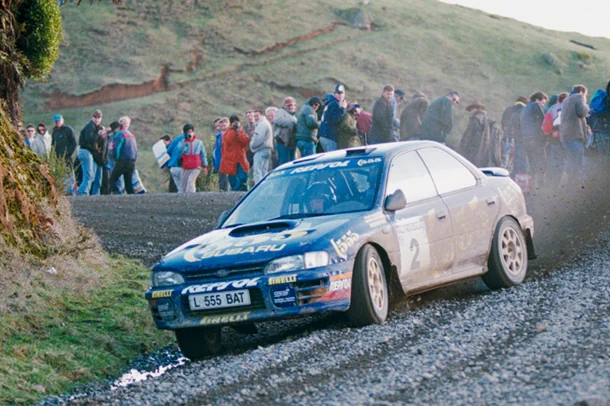 Photo: STI (official)
Subaru: How did the blue Impreza become part of rallying's shared memory?
Continue reading · 13 min →