
Expand chapter contents · 13 chapters
- Before entering MotoGP, he had already won two world titles
- 2013: The rookie did not wait for his era to arrive
- Late 2013: A black flag almost changed the rookie title story
- 2014 and 2015: Ten straight wins, then a year without retaining the title
- Germany 2016: From struggling on wet tyres to finding the bike-change window
- Why rivals matter: Revisiting the duels with Dovizioso
- 420 points in 2019: Every finish was in the top two
- In 2020, the story abruptly changed direction
- Leaving Honda meant returning to the unknown
- Aragón 2024: A Sprint win, then the end of a 1043-day Grand Prix wait
- Japan 2025: Second place can mark the most important day
- Seven titles or nine? Check what a number includes
- Why is the second half of his career more powerful than the numbers?
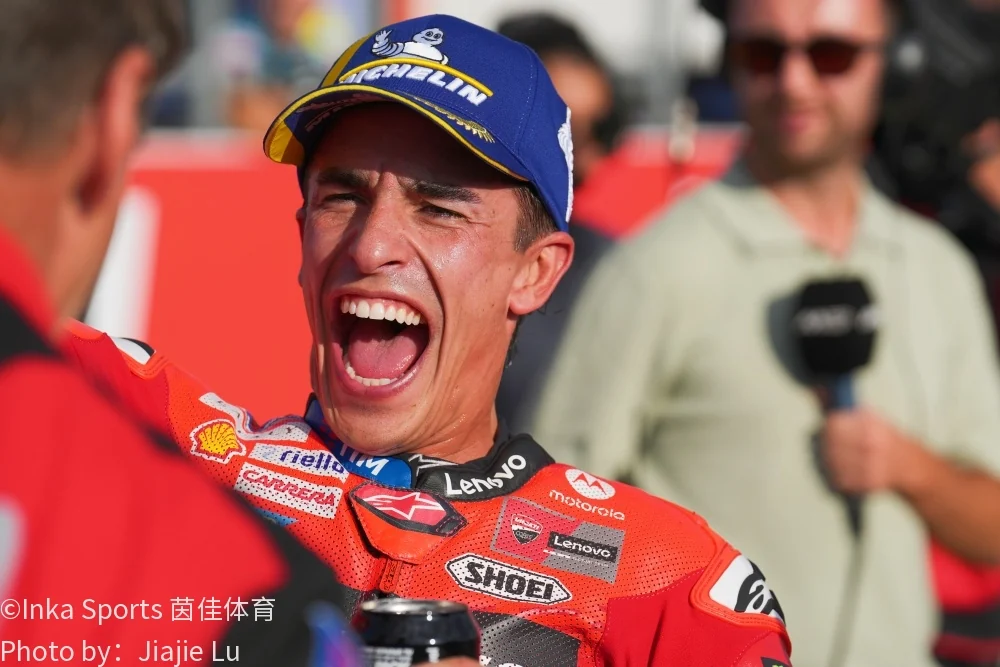
At the 2025 Japanese Grand Prix, Marc Márquez finished second but became the weekend's centre of attention. He did not need to win the race to secure the championship. For a rider who had once made winning routine, the expression on his face this time carried unusual weight.
The line connecting his 2019 title with the one in 2025 was anything but straight. Between them lay the serious injury at Jerez in 2020, repeated operations and comebacks, the decision to leave Honda, and the process of rediscovering in an independent team whether he could still win. Understanding number 93 means putting the first half, when a prodigy burst onto the scene, alongside the second, when starting again was painfully difficult.
Before entering MotoGP, he had already won two world titles
Márquez comes from Cervera in Spain and was born in 1993, the year echoed in his number 93. He entered the 125cc Grand Prix World Championship in 2008 and won that class's world title in 2010. After moving to Moto2, he became champion again in 2012. When premier-class audiences first saw him, he had already passed the test of two season-long title campaigns.
The 125cc title of 2010 and Moto2 title of 2012 show that his development did not consist of repeating each year in the same class. Two promotions changed the machine's weight, power and braking feel, and actions that had worked before needed testing again. The truly useful part of a rider's experience is not performing the same movement more aggressively, but discovering what a new bike allows and what it does not.
2013: The rookie did not wait for his era to arrive
In 2013, Márquez joined Honda's factory team and won the world championship in his rookie MotoGP season. Against established riders such as Jorge Lorenzo, Dani Pedrosa and Valentino Rossi, he did not treat the first year merely as an apprenticeship. He quickly moved to the centre of the contest for wins and the title.
Winning as a rookie is difficult for more reasons than unfamiliar circuits or a more powerful engine. Premier-class racing places greater demands on braking, tyres and electronic controls, and every opponent knows how to find a weakness. Even a young rider capable of the fastest lap must keep mistakes within what a whole season can absorb. Márquez managed that season-long contest in his very first year.
Extreme lean angles, aggressive corner entries and spectacular saves later became his visual signatures. Watching them, it helps to move attention from the lean angle itself to race position: did braking near the limit complete a pass, and did he retain the advantage on the corner exit?
Late 2013: A black flag almost changed the rookie title story
At the 2013 Australian Grand Prix, Phillip Island's resurfaced track placed exceptional demands on the tyres. Race officials required a compulsory bike change at the end of the ninth or tenth lap, onto another bike fitted with fresh tyres. This change was not a response to weather turning from dry to wet, but to limits on tyre use.
Márquez changed bikes too late and was disqualified, while Lorenzo won. For the rookie fighting for the championship, the loss came not from a lack of single-lap speed, but from an error in following the race procedure. A title that might have been settled early was pushed back into the following races.
He still led Lorenzo by 13 points before the Valencia finale. Lorenzo won, Pedrosa finished second and Márquez third, leaving number 93 with the championship. That third place mattered as much as the first victory with which he had burst onto the scene early in the season. A rookie must prove not only that he can win, but that he knows when to bring home the position that fulfils the season's goal.
2014 and 2015: Ten straight wins, then a year without retaining the title
Márquez opened 2014 with ten consecutive wins, eventually winning 13 Grands Prix and retaining his title. That consistency changes his opponents' circumstances: rivals must find chances to win and also wait for the leader to drop points. Márquez often denied them that opportunity.
There were disruptions along the way, however. He did not retain the title in 2015; Lorenzo became champion, and the late-season conflict with Rossi continued to shape fan debate for years. The season interrupted Márquez's run of titles and extended the confrontation on track into an enduring argument among supporters.
| Championship period | Bike | What to focus on |
|---|---|---|
| 2013、2014 | Honda | A rookie title and ten straight wins to start a season |
| 2016—2019 | Honda | Four consecutive years of season-long competitiveness |
| 2025 | Ducati | A return after injury, a transfer and rebuilding |
Germany 2016: From struggling on wet tyres to finding the bike-change window
The Sachsenring race started on a wet track, and Márquez did not immediately look dominant. He struggled to match the pace ahead, ran wide at turn eight and only just kept the bike upright. As the surface dried, staying out and pitting to change bikes became two choices that would both cost time, but between which he had to decide.
On the seventeenth lap, he pitted for the bike fitted with slicks. His lap times soon became markedly better than those of the leaders still on wets. With six laps remaining he took first place and went on to win. The decisive act was not one late-braking manoeuvre, but connecting the changing surface, tyre choice and timing of the bike change. Waiting until the current tyres had completely lost their speed might have meant missing the opportunity.
The win also added depth to the image of number 93. His riding is often described as risk-taking, but taking a risk is not the same as acting without judgement. The German decision had clear conditions, and still required him to make the slicks work on a track with wet patches. The 2016 championship was reclaimed through races like this and a sustained accumulation of points.
Why rivals matter: Revisiting the duels with Dovizioso
Márquez's championship story is not a solo performance. When Dovizioso challenged him on a Ducati, he repeatedly took races to the last lap or even the final few corners. Those battles help new readers understand that MotoGP is about more than who dares to brake later. It also tests who can anticipate the other's line, and who still has enough tyre performance and a usable position at the end.
Dovizioso won their direct duel at the 2017 Austrian Grand Prix. From Márquez's side, a defeat is also worth studying. An unsuccessful attack does not necessarily mean a bad weekend; a season-long title fight requires wins, podiums and the lesser results that must sometimes be accepted to fit within the same calculation.
When revisiting such races, set aside the argument about who is best and watch how each attack and defence affects the next corner. A rider giving up the apex is not necessarily retreating passively; he may be preparing a better exit. Understanding those details gets closer to the pleasure of elite motorcycle racing than merely remembering the finishing order.
At the 2017 Valencia finale, he had another scare. After passing Zarco, he ran wide at turn one, saved the bike but dropped to fifth. Dovizioso later retired, Pedrosa won, and Márquez finished third to take the championship. The endlessly replayed save belongs to the title story, but the full sequence also includes positions lost through the mistake and the rival's failure to finish.
That is an image more worth remembering than 'he can always save it'. World champions also make imperfect judgements. Control at the limit can undo the consequences only sometimes; it does not guarantee a second chance every time. Márquez's strength was to place even such weekends within the season's objective, rather than demanding victory in the most aggressive way at every race.
An overtake happens across more than one corner
A viewing guide; choices vary with the circuit, bike and tyre conditions.
420 points in 2019: Every finish was in the top two
Breaking down the points from 2019 makes Márquez's consistency easier to see. Twelve first places and six seconds, worth 25 and 20 points respectively under the race scoring system of the time, added up to exactly 420. The only race in which he did not reach the podium was Austin, where he crashed while leading. His other eighteen races all ended in the top two.
His pursuers therefore could not simply wait for him to lack speed at a race or two. Even when someone beat him directly, Márquez often brought home 20 points for second, so the championship gap might barely shrink. His annual lead was built not through one particularly astonishing win, but by maintaining an exceptionally high position in almost every race he could finish.
The duel with Quartararo in Thailand encapsulated the year. They fought to the final lap, with Márquez winning the race and clinching the title. Rookie Quartararo had already shown he could challenge, but the world champion could still turn the crucial opportunity into a result. That makes the abrupt interruption in 2020 all the more stark: before the injury, he was in exceptionally strong competitive form.
In 2020, the story abruptly changed direction
At the 2020 Spanish Grand Prix, Márquez crashed at Jerez and fractured his right humerus. The rhythm of title contention sustained over many years was broken. The operations, rehabilitation and comeback arrangements that followed the injury became an unavoidable central story of the next several seasons.
Being able to sit on a racing bike again does not mean a rider's body is ready to fight for a championship over a full season. Riding a premier-class motorcycle imposes sustained loads under extreme braking, direction changes and acceleration. Familiar movements may no longer be easy when physical conditions have changed. Readers need to distinguish between returning to racing and regaining competitiveness.
He was winning races again in 2021, but setbacks continued. In 2022, he chose to undergo a fourth operation on his right arm. The account of his career should remain measured: this was not a difficulty that willpower alone could skip over. Recovery needed time, and a fresh assessment of what was possible.
The photograph from the 2022 Australian Grand Prix records a podium during the rebuilding process, not the end of the journey back to a world title. It was his 100th MotoGP Grand Prix podium, a striking number in a Honda career already containing six titles. For Márquez at the time, its more immediate meaning was that he could again compete with the leading riders for an entire race.
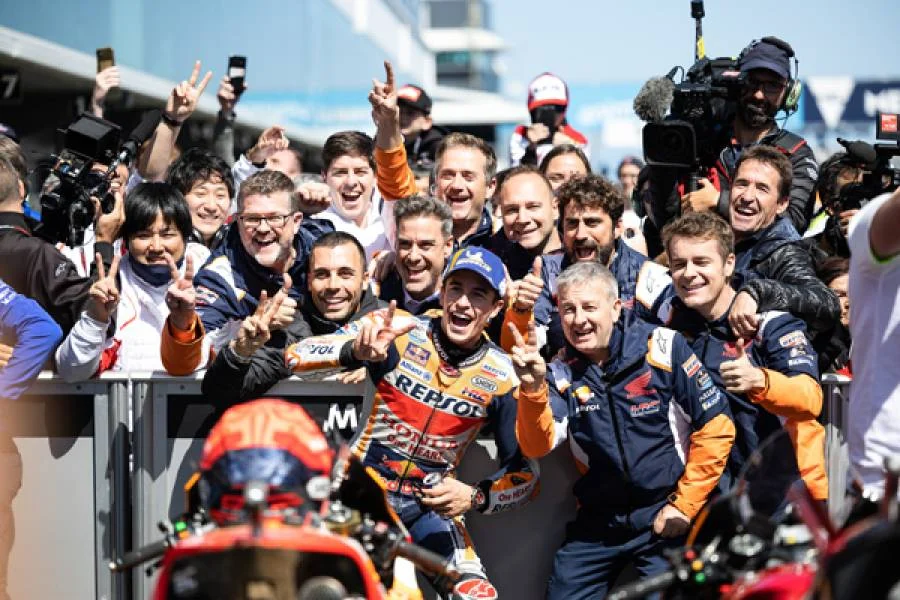 Photo: Honda Racing
Leaving Honda meant returning to the unknown
In 2023, Márquez and Honda agreed to end their long partnership. He had raced within that structure since entering MotoGP in 2013, and all six of his premier-class championships had come with Honda. Leaving meant setting aside a familiar garage, working relationships and technical environment to learn another bike afresh.
In 2024, he joined Gresini and rode a Ducati. To outsiders, a rider with so many titles moving to an independent team might look like a step down. Competitively, however, it offered an answer to a specific question: could he recover his competitiveness in a different environment? Status on a career record and the most suitable working conditions in the present are not always the same thing.
Aragón 2024: A Sprint win, then the end of a 1043-day Grand Prix wait
On Saturday at Aragón, Márquez first took his maiden MotoGP Sprint victory. On Sunday, he built an advantage from the start and finished the Grand Prix 4.789 seconds ahead of Martín, ending a 1043-day wait for a Grand Prix race win stretching back to 2021. The two victories came in the same weekend, but belong to different statistical categories.
This breakthrough differed in many ways from his early Honda wins. His partner was Gresini, the bike came from Ducati, and the rider himself had experienced injury and readaptation. It did not make the difficulties of the preceding years vanish, but gave an answer that no longer depended on memory: number 93 could still sustain the ability to fight for victory from start to finish in a current race.
Three wins and third in the championship that year became an important stop on his route to Ducati's factory team. Judging it directly against the thirteen victories of 2014 misses the real task of the period: learning a new bike, restoring his competitive position, and turning the question of whether it was still possible into an accomplished result. Only then did a further title campaign have a foundation.
Japan 2025: Second place can mark the most important day
Márquez joined the Ducati factory team in 2025. Team-mate Bagnaia won the Japanese Grand Prix, while Márquez finished second and secured the world championship there. For those at the circuit, the race winner and the central figure in the season's story appeared together: a scene familiar late in a season, yet always capable of moving an audience.
He had now won premier-class titles on bikes from both Honda and Ducati. The success built at Honda was not copied unchanged at Ducati. Physical recovery, a change of environment and adaptation in his riding had all come between, before converging again in this result.
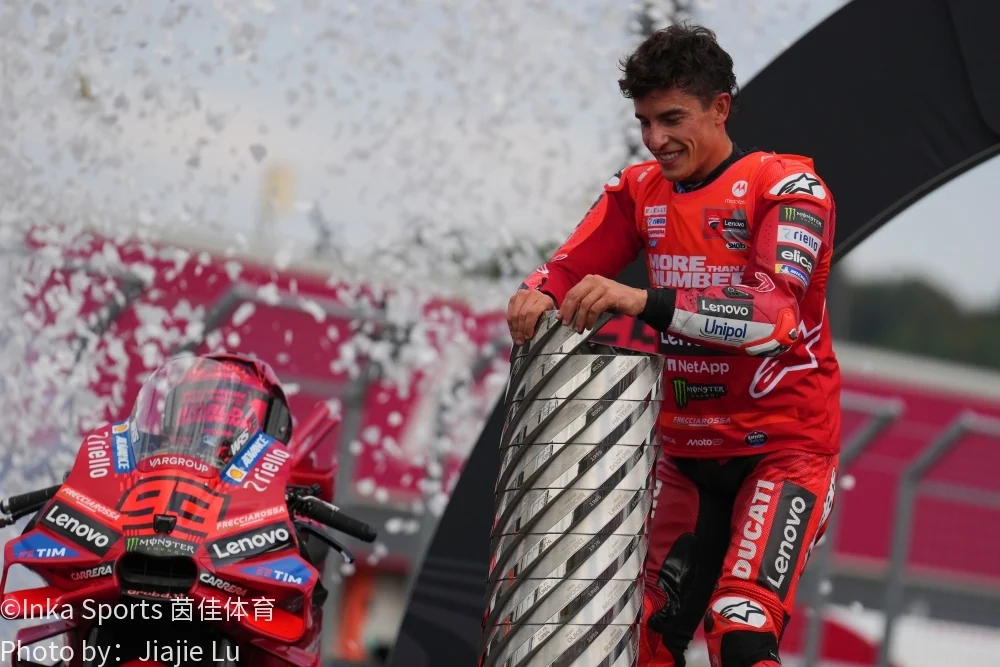
The Japanese Grand Prix photographs taken by this site bring the story back from statistics to the person. The trophy, number 93 bike and expressions of celebration belong to one scene, and to a long process of return. A race's outcome is settled at the finish, but the full weight of a rider's low points often becomes visible only in celebrations such as these.
From third at Valencia in 2013 to second in Japan in 2025, two of his most important championship moments ended without a race win. As a young rider he had to protect an existing lead; after his comeback he had to turn years of rebuilding into a season-long result. The numbers look similar, but the experiences behind them had completely changed. That is why the same rider remains worth writing about over time.
Seven titles or nine? Check what a number includes
Before entering MotoGP, Márquez had already won world championships in 125cc and Moto2. Nine annual trophies record his growth across three classes; seven came in the premier class. When comparing his championship record with other riders', first check which classes the numbers include to understand the stages at which each achievement was made.
Márquez's titles by class · Through 2025
The titles in 2010 and 2012 came in the smaller classes; the seven titles from 2013 onward came in MotoGP.
Why is the second half of his career more powerful than the numbers?
The early Márquez astonished because he won so quickly. The later Márquez keeps people watching because they know how hard winning again was. The same racing number came to represent different things at different stages: a new king with almost no experience of defeat became a veteran who had to answer patiently whether he could still do it.
His career also reminds us that a sporting story need not be reduced to 'never give up'. Sometimes persistence means continuing to attack. At other times it means stopping, receiving treatment, leaving a familiar environment and admitting that old methods need to change. The photographs from Japan in 2025 deserve a closer look because this success includes those less dazzling decisions.
View sources · 17 entries
- MotoGP: Márquez's season-by-season results
- MotoGP: Marc Márquez's career
- Honda Racing: The joint decision to end the partnership after 2023
- MotoGP: Mid-race bike changes and Australia 2013
- MotoGP: Valencia championship deciders through the years
- MotoGP: Winning through a bike change in Germany in 2016
- Honda: Márquez's season history
- Ducati: Historical results in Austria
- Honda: The 2017 Valencia save and world championship
- Honda: The official retrospective at the end of the partnership in 2023
- MotoGP: Announcement of the fourth right-arm operation in 2022
- MotoGP: The 2022 comeback and Australian podium
- Honda: The 100th MotoGP podium at the 2022 Australian Grand Prix
- MotoGP: Márquez wins the 2024 Aragón Grand Prix
- Gresini: The first Sprint victory at Aragón in 2024
- MotoGP: The 2025 Japanese Grand Prix and the championship
- MotoGP: Márquez wins titles with two manufacturers
 Photo: Ducati.com
Ducati: From a bike only a few could ride fast to the bike everyone wanted
Continue reading · 15 minutes →