
Expand chapter list
- Finding possibilities others missed within limited resources
- Two different beginnings for a first victory
- Lotus 25: the driver no longer sat among a web of tubes
- Across the Atlantic, proving a small car could win a big race
- Lotus 49: the engine becomes part of the car's structure
- 1968: first, the team had to learn to carry on
- Lotus 72: one car, six seasons
- Ground effect: the unseen parts determine speed
- Rivals copied yesterday; Lotus searched for tomorrow
- Victory by one twentieth of a second
- After the founder, there was still Senna
- A team can end without its name disappearing
- Timeline
- Honors and technical record
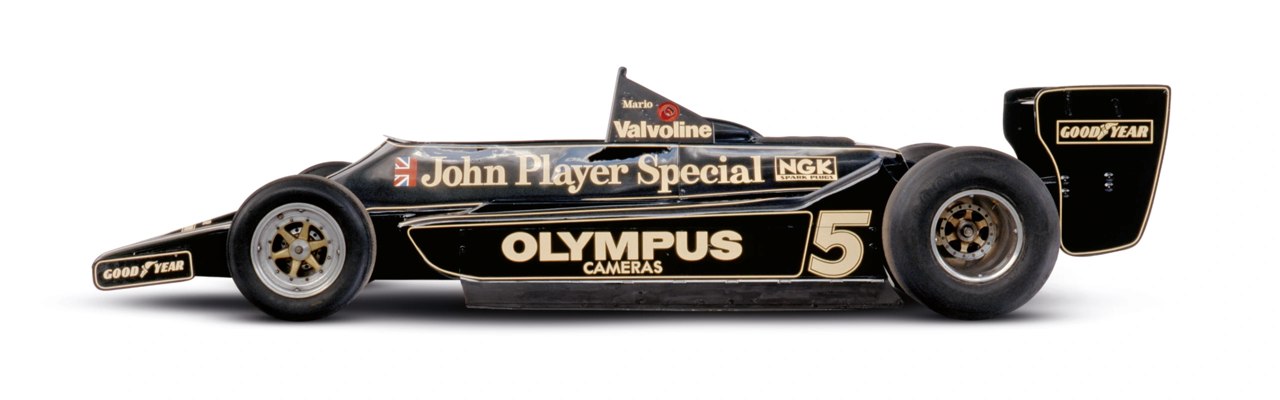
The 1978 Lotus 79 looked as though it had arrived from the future. Gold lines on its black body traced a remarkably slim outline, and its sidepods sat low against the road. As it swept past, its greatest secret lay beneath, hidden from spectators. Mario Andretti was driving toward his first F1 world title; teammate Ronnie Peterson was reaching podium after podium with the same technology. Their rivals faced a problem that went well beyond finding a few extra horsepower.
Lotus had changed the relationship between a racing car and the ground. Air was no longer merely resistance to be pushed aside; it became a means of pressing the car down and helping it corner faster. The British team had already changed chassis construction, changed how engines were mounted and moved radiators away from the nose. Every few years, it seemed to make the paddock ask again: what should an F1 car actually look like?
Inventing the next era, however, did not mean being able to dominate it indefinitely. After seven constructors' world titles, Lotus never won another; by the end of 1994, the original Team Lotus had left F1. Understanding that rise and fall means looking inside its beautiful cars, and beyond the drawing board.
Finding possibilities others missed within limited resources
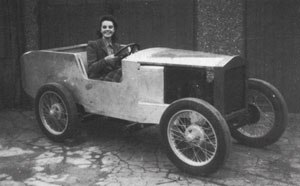 Photo: classicteamlotus.co.uk
Lotus did not begin as a large, well-funded factory. Colin Chapman first modified an Austin Seven for competition, then gradually built his own racing and sports-car business. That approach left a clear mark: if he could not outspend everyone in every area, he had to ask whether one component could solve several problems, and whether better structure could produce a smaller, lighter car.
Lightness was not simply a matter of shaving metal thinner. The demands of brakes, suspension, bodywork and engine were interdependent: reducing mass changed the inertia the car had to overcome in acceleration, braking and turning; a more compact structure could reduce its frontal area. Valuable designs often emerged from rearranging those relationships. The same thinking can be found in several of Lotus's most successful F1 cars.
Yet this was never a shortcut without costs. New structures required new manufacturing methods, compact packaging could make maintenance harder, and poorly understood loads could expose weaknesses. Chapman's team did not always choose the right direction. It produced cars ahead of their time and experiments soon abandoned; innovation sometimes left rivals behind, while the search for another breakthrough sometimes cost an advantage already won.
Lotus entered F1 in the late 1950s. Britain's racing industry was challenging the established powers, and mid-engined cars were beginning to show their advantages. Lotus did not cling to the past simply because it too had used front engines. What it consistently pursued was a more effective answer; yesterday's proud solution could be discarded when necessary.
Two different beginnings for a first victory
At the 1960 Monaco Grand Prix, Stirling Moss won in a Lotus 18. The narrow streets put agility and driver judgment at the forefront, and Moss's compact car delivered Lotus's first victory in the F1 World Championship. But it was entered by Rob Walker's private team, not by the Lotus works team.
The distinction matters. Lotus both raced and sold cars to other teams, so its engineering could succeed first in a customer's hands. Constructor, entrant and driver were not always parts of one organization; any “first” therefore needs a clear owner. The Lotus works team's first win came at the 1961 United States Grand Prix, with Innes Ireland driving a Lotus 21.
Together, those two beginnings show the vitality of early Lotus. The name did not emerge suddenly through one driver and one car; it accumulated experience across venues, customers and categories. Selling cars exposed its designs to wider practical use, while customer victories helped the young marque establish its reputation.
But the driver who would truly take Lotus to world titles was already in the team. Jim Clark might not have had the most flamboyant public presence, but he could find remarkable speed in a car that was still imperfect. His partnership with Chapman gave radical designs a route from experiment to championship-winning machine. The driver supplied sensations; engineers turned them into structure, setup and reliability improvements, and the cycle accelerated.
Lotus 25: the driver no longer sat among a web of tubes
The 1962 Lotus 25 took that partnership into a new phase. Conventional spaceframes used many slender tubes joined into a skeleton, with the outer bodywork primarily serving as covering and aerodynamic shape. The Lotus 25 instead used a load-bearing aluminum structure, giving the body structure itself a major structural role. Box sections beside the driver worked with bulkheads to form a more compact, more rigid chassis.
Its significance went beyond a lower silhouette. In a corner, suspension was intended to move the wheels according to designed geometry; excessive chassis twist could disrupt the tire attitude engineers wanted. Greater torsional stiffness made suspension behavior more predictable. Packaging driver, fuel and mechanical components more efficiently then delivered gains beyond any one statistic.
The Lotus 25 won the 1962 Belgian Grand Prix, but a new design did not automatically deliver the season title. Clark stayed in contention until the South African finale, where an oil leak drained away his championship chance. A small mechanical detail could cancel out the conceptual advantage of an entire car. That contrast runs through Lotus history: the idea could already be fast enough, but racing still required every component to work until the finish.
In 1963 the balance finally tipped toward Lotus. Clark won seven of ten World Championship races, delivering both drivers' and constructors' titles. The key was not that a genius had suddenly become braver, but that advanced chassis design, driving ability and season-long execution finally came together. Innovation had to produce repeatable results before a dazzling day could become a championship year.
The Lotus 25's box sections also helped answer where to put the fuel. Early F1 cars needed enough for long races while seeking the smallest possible body; driver, fuel and framework competed for limited space. Designing the load-bearing sections together with fuel placement could achieve more than simply seeking lighter materials. Its low side profile today reveals a compromise among several demands.
In preserving historic cars, Classic Team Lotus has compared the 25 alongside its spaceframe contemporary, the 24. Such physical comparisons are valuable: the two belonged to the same technical environment but organized their interiors differently. Similar green-and-yellow paintwork could conceal the real change underneath. The importance of the 25 is revealed by the structures beside the driver and behind the cockpit.
Across the Atlantic, proving a small car could win a big race
The Indianapolis 500 differed greatly from European grands prix. Oval speed, long race distance, pit strategy and traffic management all posed new questions. Dan Gurney saw the potential of Europe's mid-engined cars and encouraged Chapman to consider the event. Lotus took its thinking to America and confronted an established local racing tradition.
Clark finished second in 1963, then retired after taking pole in 1964. Both attempts showed that speed was present, but completing 500 miles was another hurdle. By 1965 the Lotus 38 combined its structure, Ford engine and oval-specific layout, while the team sought better people and methods for pit service. Success did not occur only in the cockpit.
That year Clark led 190 of 200 laps. Efficient pit service assisted by the Wood Brothers crew supported the victory alongside the car's pace. Lotus had not merely shipped a good European car across and expected to win; it reorganized the entire race operation for a new environment. That gave substance to the image of a small, clever team: it included an ability to learn from others.
Clark also won the F1 world title that year. The two achievements carried Lotus's reputation across disciplines, but technical success could not be preserved unchanged indefinitely. F1's engine rules changed in 1966, reshuffling established advantages, and Lotus endured difficulties too. Chapman needed a new overall concept, not a little more polish on an old answer.
Lotus 49: the engine becomes part of the car's structure
In 1967 the Lotus 49 arrived with the DFV, funded by Ford and developed by Cosworth. Their crucial relationship was structural: the engine supplied power while also acting as a major load-bearing connection at the rear of the chassis, linking the cockpit's rear to the gearbox and rear-suspension area. The chassis no longer needed a complete framework surrounding the engine.
This was a change at the level of the whole system. Engine strength, mounting points and car structure had to be considered together from the start, rather than designed separately and then fitted together. Removing unnecessary supports helped make the rear layout cleaner and more compact, while requiring the engine itself to assume responsibilities that had not fully belonged to it before.
On its debut at Zandvoort in the Netherlands, Graham Hill took pole but retired; Clark inherited the lead and won. Victory on the first outing made the new combination's potential almost self-evident. Yet Hill's retirement was equally part of the day's record. The Lotus 49 had shown the future without solving every problem.
The DFV went on to power many F1 teams, with an influence far beyond Lotus. It also contained a lasting challenge for its first user: once an excellent technology becomes a common foundation for rivals, the initial advantage shrinks. The pioneer must keep advancing while others can concentrate resources on a route already proven to work. The same dynamic would return in the ground-effect era.
1968: first, the team had to learn to carry on
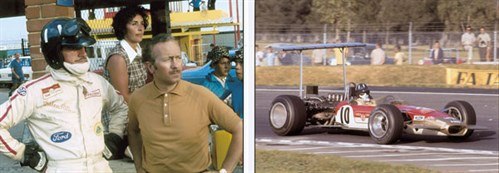 Photo: classicteamlotus.co.uk
In April 1968 Clark was killed in an F2 race at Hockenheim. Lotus lost far more than someone who could drive quickly. Years of trust, communication and shared experience were abruptly severed; the crucial link between designer and driver was gone. A technical history that simply moves from the Lotus 25 to the 49 and then the 72 misses that immense rupture.
Hill assumed an important responsibility in those circumstances. He helped the team keep racing and won that year's drivers' title, while Lotus also took the constructors' crown. Championships could not offset the tragedy, but they showed that the organization could still function: engineers kept improving, mechanics kept preparing, and another leading driver carried their work to the finish.
The team's appearance was changing too. Gold Leaf sponsorship replaced green and yellow with a more prominent commercial livery, making the car part of a sponsor's visual identity. Lotus was not the only organization in racing history to explore commercial sponsorship, but it was an important force in bringing it to the center of F1. Color, publicity, paddock image and funding increasingly became elements of one competitive activity.
Money could turn ideas into reality, but it could also create a new dependence. Lotus later moved from Gold Leaf to black-and-gold JPS, then yellow Camel, leaving powerful visual memories. Behind those colors was the question of how a team could keep securing resources for expensive innovation.
Lotus 72: one car, six seasons
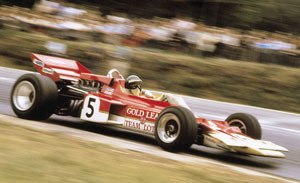 Photo: classicteamlotus.co.uk
The Lotus 72's wedge shape came from another structural rearrangement. Moving radiators to the sides freed the nose from its previous cooling role and allowed different body shapes. Brakes, suspension and aerodynamics were considered together. This was not a prettier version of an old car, but a redistribution of space and function.
The new car struggled initially and needed adjustments before its potential emerged. Jochen Rindt won repeatedly in 1970, but was killed during practice at Monza. That year's drivers' title ultimately went to him posthumously. Young Emerson Fittipaldi's victory in the United States put Rindt's points beyond Jacky Ickx's reach. Once again, Lotus's success stood beside an irreversible loss.
In 1972 Fittipaldi took his first world title in a black-and-gold Lotus 72. The team won the constructors' championship again in 1973, while Jackie Stewart took the drivers' crown. Fittipaldi and Peterson were both strong scorers and independent race-winning contenders; the team's overall result and an individual's result did not have to point in the same direction.
The Lotus 72 raced from 1970 through 1975, winning twenty World Championship grands prix and delivering two drivers' and three constructors' titles. Its longevity corrects an easy misconception: Lotus did more than endlessly introduce new concepts. A sufficiently good foundation also needed repeated development to build such a record.
Monza in 1972 completed the Lotus 72's journey from new concept to mature championship car. Fittipaldi won the race and secured the drivers' title, with the constructors' championship settled too. A car that had needed corrections at its 1970 debut could now sustain a young driver through a complete season. Launching a new car quickly was exciting, but years of revising parts and setups could also change history.
That is why the 72's six-season career remains worth studying. Different drivers gave different feedback, tires and rivals kept changing, and the same model designation covered a succession of developments. Treating it as a machine built in 1970 and unchanged for five years afterward would hide the sustained work of mechanics and designers. The name remained; the car was always being developed.
Ground effect: the unseen parts determine speed
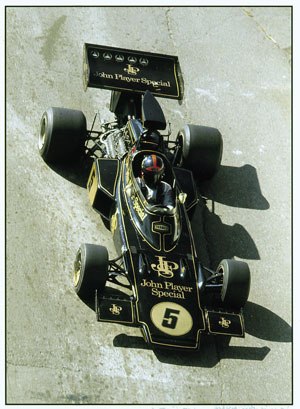 Photo: classicteamlotus.co.uk
A slump in the mid-1970s led Lotus to re-examine airflow beneath the car. Wings could already generate downforce, but there was a tradeoff with drag. If the passage between the floor and the road could reduce pressure more effectively, grip might be gained in another way. The Lotus 78 brought that direction into competition; the 79 refined it.
The space beneath the sidepods can be understood as a deliberately shaped air passage. Airflow changed speed and pressure as it passed through that shape; skirts restricted outside air from entering, allowing the low-pressure region to act more effectively on the car. This did not create a perfect vacuum, nor make the car immune to road changes. Ride height, sealing and underbody shape became more important, not less.
Andretti and Peterson took several one-two finishes in 1978, and Lotus won both titles. The 78 used early in the season also contributed, so all the year's victories cannot simply be credited to the 79 alone. The championship was the achievement of the entire program, combining the new car's power with the groundwork of its predecessor.
Yet 1978 did not end in an unbroken celebration. Peterson died from his injuries after the start-line accident at Monza. Andretti's title was settled at that round, but Lotus was again facing the loss of a teammate. The romance of the black-and-gold cars was inseparable from the era's immense risks. Looking at the photographs today, we cannot see only color and speed while overlooking those inside.
The 1978 Belgian Grand Prix showed the succession directly, with both generations racing together. Andretti won from pole in the 79, while Peterson finished second in the 78. The one-two did not come from two identical new cars. The old car provided a dependable competitive base as the new one began to release more of the research gains; that transition itself was part of a championship program.
The 79's advantage also made once-inconspicuous parts crucial. If the skirts failed to limit air entering from the sides, the underfloor pressure distribution changed; pitch and road undulations also affected the passage. Ground effect was therefore not a design finished by drawing one curve. Suspension, chassis stiffness and the ability to follow the road all had to make the aerodynamic idea work on track.
It moved competition another step toward integration of the whole car. Greater theoretical downforce became higher cornering speed only when the driver could predict how it would change. The Lotus 79 mattered historically both for redirecting rivals' research and for making the paddock understand more clearly that aerodynamics and mechanical design could no longer be treated as unrelated tasks.
Rivals copied yesterday; Lotus searched for tomorrow
Ground effect's success quickly redirected development throughout the paddock. Rivals no longer needed to prove the concept; they could go straight to better floors, skirts and suspension. Lotus wanted another leap forward. The ambition was understandable: it had beaten stronger opponents before by changing how a problem was solved.
Once the technical direction was clear, however, steady development could be faster than another leap. Lotus's subsequent experiments did not consistently reproduce the 79's advantage. “Others copied it better” is insufficient explanation: complexity, setup windows and resource allocation all affected the conversion of theoretical gains into real lap time. Even a great idea had to pass the test of how the whole car worked.
The 1981 Lotus 88 proposed a twin-chassis concept, using different load-bearing systems for aerodynamic loads and the movement of the driver-carrying section. It provoked a regulatory dispute and never raced in a grand prix. Whatever the designers' interpretation of the wording, a car needed acceptance from the sport's governing system to compete. Engineering ingenuity alone could not determine legality.
The setback also showed that innovation has several distinct endpoints: an idea making sense, a prototype running, regulations permitting it and competition proving it effective are not the same thing. Lotus sometimes crossed every threshold at once and sometimes stopped at one. Calling every failure “genius suppressed” is as simplistic as saying failure proves an idea had no value.
Victory by one twentieth of a second
Austria in 1982 did not initially seem a likely venue for a naturally aspirated Lotus victory. The old Österreichring's altitude favored turbo cars; only as the turbo runners ahead retired or were delayed did Elio de Angelis bring Lotus into the lead. Keke Rosberg's Williams was closing too, giving two Cosworth-powered cars an opportunity few had expected.
At the start of lap 53, the final lap, Rosberg was 1.6 seconds behind. He kept closing, and by the final corner the gap was small enough to leave the result in doubt. They charged toward the line, where de Angelis won by 0.050 seconds. That is one twentieth of a second; reading it as the more familiar half-second would lose almost the defining scale of the race.
Neither driver had won a grand prix before. Rosberg won the Swiss Grand Prix two weeks later and became that year's world champion; de Angelis left Lotus this moment in Austria. The team did not regain season-long dominance through it, but seized an opportunity rivals had lost and defended the available result to the final meter.
After the founder, there was still Senna
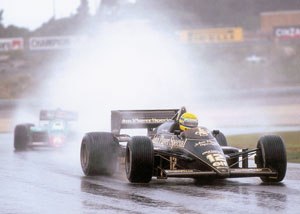 Photo: classicteamlotus.co.uk
At the 1982 Austrian Grand Prix, Elio de Angelis beat Keke Rosberg by the narrowest of margins to win for Lotus. It was the last F1 grand prix victory Chapman saw his team take. He died of a heart attack that December, leaving Lotus without the founder who had defined its working methods and appetite for risk.
The team carried on. Peter Warr and others organized the next phase, introducing Renault turbo engines, while Gérard Ducarouge worked on car design. De Angelis and Nigel Mansell formed a capable lineup before the young Ayrton Senna arrived. In heavy rain at Portugal in 1985, Senna took his first F1 victory and Lotus's first grand prix win since Chapman's death.
The wet-weather victory made it easy to believe that the classic combination of Lotus and a gifted driver had returned. But the era had changed. Engines, electronics, testing, sponsorship and organizational scale increasingly shaped competition; one extraordinary race could not guarantee a season of dominance. Senna's qualifying speed and wet-weather ability put the team in the spotlight, but could not solve all its resource problems.
In 1987 the yellow Lotus 99T, with Honda power and active suspension, won in Monaco and Detroit. Its suspension used control systems to help manage the car's attitude, again showing Lotus's instinct to explore. But it did not immediately become a reliable shortcut to titles. Senna then left, and the Honda partnership ended too, changing the conditions for victory once again.
A team can end without its name disappearing
In the 1990s Lotus could still discover talent: both Mika Häkkinen and Johnny Herbert showed their potential there. It could still design cars, organize race operations and seek results within limited means. The problem was that the money and facilities required to remain competitive in F1 kept growing. Historical prestige could not automatically pay the next year's development bills.
The original Team Lotus's F1 career ended at the close of 1994. Other teams later used the Lotus name, but names, brand licensing and continuity of the original organization must be understood separately. Those later histories cannot simply be appended to Chapman's team's record as though nothing had changed.
Another form of continuity is more tangible. Classic Team Lotus preserves, restores and runs historic cars. Original drawings, components, engineering experience and staff memories keep the machines available for study. A static display preserves shape; a running car helps explain why it was arranged that way, where care is needed and how past technology worked in reality.
Lotus's legacy is therefore more than seven constructors' titles. It redefined fundamental questions of racing-car design and exposed the limits of innovation: a good idea needs manufacturing, reliability, driver feedback, funding and organization to become reality. At the team's peak, those elements supported one another. As their coordination weakened, even the most beautiful next drawing could scarcely bring victory back on its own.
Timeline
| Year | Key milestones |
|---|---|
| 1950s | Lotus's racing and sports-car business grew, and it entered F1 |
| 1960 | Moss scored the marque's first F1 win in a privately entered Lotus 18 |
| 1961 | Ireland won in the United States, the Lotus works team's first victory |
| 1963、1965 | Clark and Lotus twice won both the drivers' and constructors' titles |
| 1965 | Clark and the Lotus 38 won the Indianapolis 500 |
| 1967 | The Lotus 49 and Cosworth DFV won on their debut in the Netherlands |
| 1968 | Clark was killed; Hill and the team won both F1 season titles |
| 1970—1975 | The Lotus 72 raced for six seasons and won twenty grands prix |
| 1978 | Andretti became champion; Lotus took its seventh constructors' title |
| 1982 | Chapman died |
| 1985、1987 | Senna won for Lotus as the team entered the turbo and active-suspension eras |
| 1994 | The original Team Lotus ended its F1 career |
Honors and technical record
| Category | Record and scope |
|---|---|
| F1 constructors' world titles | 7: 1963, 1965, 1968, 1970, 1972, 1973, 1978 |
| F1 drivers' world title | 6: Clark twice; Hill, Rindt, Fittipaldi and Andretti once each |
| Indianapolis 500 | 1965, Clark / Lotus 38; counted separately from F1 titles |
| Lotus 25 | A landmark car for monocoque construction and compact packaging |
| Lotus 49 | Combined with the Cosworth DFV in a stressed-engine layout |
| Lotus 72 | Side-mounted radiators and wedge bodywork; twenty F1 World Championship wins |
| Lotus 78 / 79 | Key cars in ground-effect development; not all 1978 results belong to the 79 |
| Scope of this article | The original Team Lotus and preservation of its history; statistics through the end of the 2025 season, excluding later teams with the same name |
Sources and further reading
- The Early Years: 1950's – Classic Team Lotus
- The Early Years: 1960's – Classic Team Lotus
- The Early Years: 1970's – Classic Team Lotus
- Lotus Type 72 — Lotus Heritage Race Cars
- Lotus Type 79 — Lotus Heritage Race Cars
- Moments in time — the Austrian Grand Prix | Formula 1
- The Early Years: 1980's – Classic Team Lotus
- The Foundation Years: 1990's and beyond – Classic Team Lotus
- Did you know? – Classic Team Lotus
 Photo: jimclarktrust.com
Jim Clark: after making up a whole lap, he left far more than twenty-five wins
A young farmer, touring-car champion and Indy 500 winner—and the Lotus driver who recovered a full lap at Monza yet still did not win.
Continue reading · About 19 min →