
Expand chapter contents · 11 chapters
- His driving career did not begin on a list of childhood champions
- First distinguish being fastest from officially winning
- Sweden 2004: Tearing off his own label
- Why the person in the other seat cannot be left out
- Nine straight titles did not mean copying one season nine times
- The Welsh forests in 2009: One point behind, he had to turn it around
- Leaving full-time WRC did not mean ceasing to be a racing driver
- Spain 2018: One set of tyres, a long-awaited win
- Monte Carlo 2022: A different car and a different partner
- How to read his records without misreading them
- Why watching Loeb means more than waiting for a dramatic moment
On the podium of the 2022 Monte Carlo Rally, Loeb lifted a trophy again. He was 47, driving a Ford Puma and partnered by co-driver Isabelle Galmiche. For viewers familiar with the red Citroën dynasty, the scene revealed change, and an ability to transcend it.
Nine consecutive world championships are certainly central to Loeb's record, but do not explain the whole story. How did this Frenchman, who practised gymnastics before turning to rallying, grow from a new face on asphalt into a competitor on every surface? Why could he return and win years after ending his full-time WRC career? The answers lie in stages, pace notes, choices and adaptation.
His driving career did not begin on a list of childhood champions
Loeb practised gymnastics for many years as a child, before turning more of his competitive interest toward motorsport. He did not follow a step-by-step route from childhood karting into single-seaters. The results he gradually accumulated in rallying were what truly brought him to the attention of professional teams.
What opened professional racing's door was performance, and delivering when opportunities arose. In 2001, he and Elena contested the Super 1600 world series in a Saxo, winning all five events they entered and taking the young drivers' championship. He also won the French asphalt rally championship that year. Those results provided clear evidence that he was ready for a higher level.
His early label was that he was fast on asphalt. It was praise, but carried a limitation: the World Rally Championship does not take place only on a driver's favourite roads. To become world champion, opponents must know that you can win not just near home or on familiar surfaces, but also keep scoring on snow, gravel and stages whose conditions continually change.
First distinguish being fastest from officially winning
At Monte Carlo in 2002, Loeb showed performance worthy of victory but lost the win through a penalty. His German Rally victory later that year is therefore his first WRC rally win in the official record. The detail may seem minor, but belongs at the start of a career account: results must follow the final confirmed classification, not merely the most emotional image at the finish.
In 2003, Loeb entered his first full WRC season at Citroën alongside champion team-mates Carlos Sainz and Colin McRae. He ultimately lost to Petter Solberg by just one point, while Citroën took the manufacturers' championship. For a new driver completing his first whole campaign, it was both a breakthrough and the regret of coming so close.
At the 2003 British finale, Solberg not only won the rally but also thirteen of its eighteen stages. Loeb finished second and McRae fourth, helping secure Citroën's manufacturers' title. Team success and personal disappointment fell on the same weekend for Loeb. He was close enough to the crown, yet could not find that final point.
The later nine-title sequence can make that defeat seem like inevitable groundwork. At the time, however, the season had only just ended. The next car, the next weather conditions and the next opponent would not yield because he had missed by one point. Loeb needed to carry the lessons of his first full campaign into 2004, rather than wait for a trophy supposedly destined to be his.
Sweden 2004: Tearing off his own label
In 2004, Loeb won Rally Sweden, becoming the first non-Nordic driver to win the snow-and-ice event. It meant more than one victory. It answered an established assumption: the man regarded as an asphalt specialist was extending his competitiveness to a radically different surface.
Snow-and-ice rallying looks very different from asphalt, but the important thing is not to make the car slide more dramatically. The driver still has to control speed and direction, understand the grip available from the tyres and use pace notes to prepare movements in advance. The most theatrical image is not necessarily the fastest. A seemingly calm line can also reflect extraordinarily precise control.
Loeb won his first drivers' world championship that year. The titles that followed make it easy to view 2004 as merely number one in a sequence. Sweden offers a more specific explanation: he was beginning to repeat high-level performances in different environments. A challenger with a clear speciality was becoming an all-round driver who threatened every opponent.
Why the person in the other seat cannot be left out
All nine of Loeb's consecutive drivers' titles were achieved with Daniel Elena. A co-driver is not someone sitting alongside watching the driving. He must deliver pace-note information in the right order, rhythm and clarity, so that the driver understands the shape and dangers of the road before it comes into view.
The difficulty of that partnership is especially clear on long stages. Information arriving too late leaves no time to prepare; an unsuitable rhythm may interrupt a continuous chain of judgements. Pace notes are not an ordinary map that anyone can pick up and read. They are closely linked to the crew's reconnaissance, ways of expressing information and trust. At speed, the unseen next corner first enters the driver's judgement through sound.
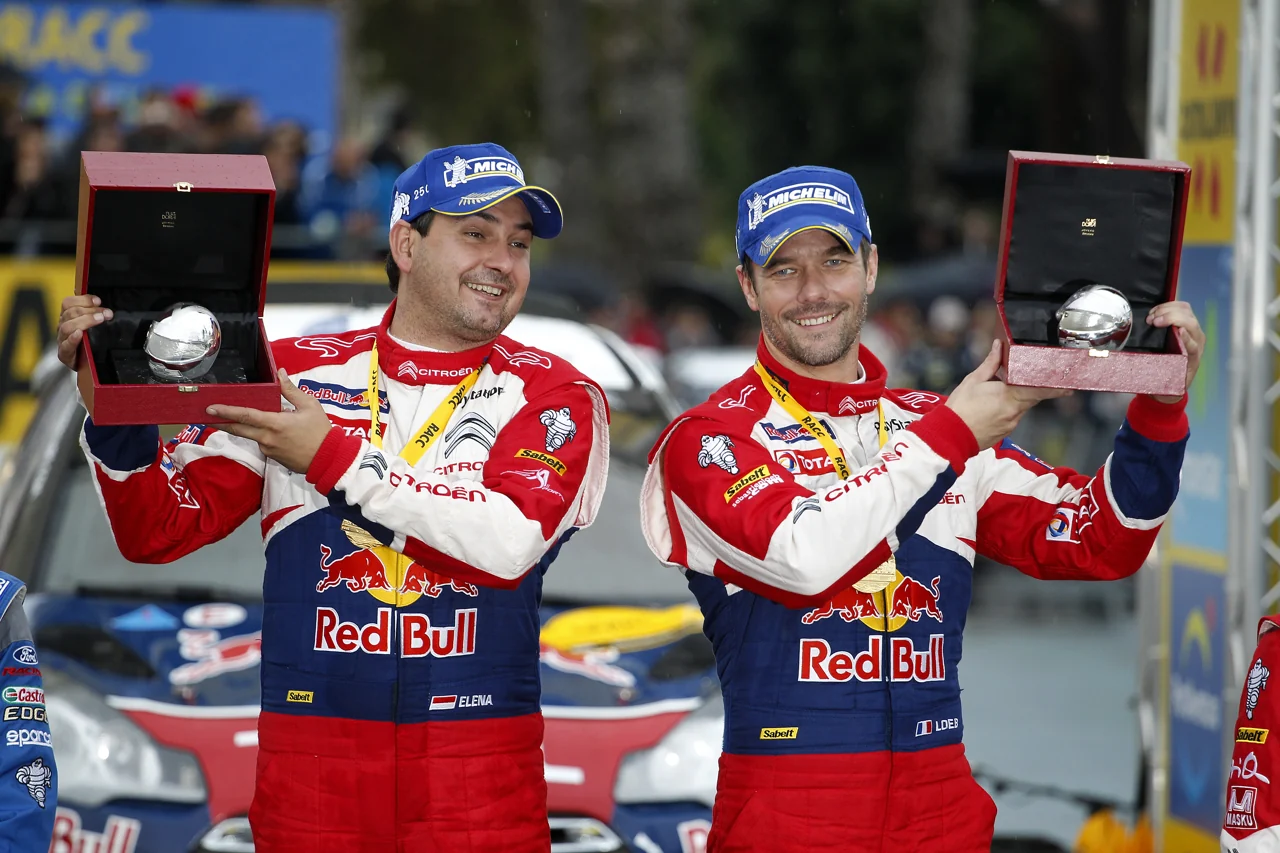
Seeing the pair together on the podium also reveals an easily overlooked fact. A drivers' championship is an individual award, but completing a rally depends on a crew. Elena won the corresponding nine co-drivers' world titles too. Both names belong in this history.
Rally communication has another constraint rarely shown in television highlights: unlike circuit racers, drivers cannot refine a movement over dozens of laps around the same short course. Pace notes must compress a long road into information usable in time. The co-driver has to keep up with the car's position while leaving reaction time for changes ahead.
When watching onboard footage, choose a short sequence of corners and notice the timing between calls and car movements. Not every instruction corresponds to an obvious slide. Much of the information simply helps the driver place the car correctly in advance. Loeb and Elena's partnership lived in this continuous work, which a single photograph cannot easily record.
From reconnaissance to the stage: How two people share the road ahead
A guide to watching rallying, not an instruction manual for competing or driving.
Nine straight titles did not mean copying one season nine times
The nine years from 2004 to 2012 line up neatly on a trophy wall, but their courses on the road differed. Loeb used the Xsara, C4 and DS3 in turn, encountering different regulations, surfaces and ever-changing opponents. The difficulty of repeated titles is that he still had to prove himself again the next year.
Some years brought a clear advantage; others went to the final rally. In 2006, injury kept him out of the last four rounds, yet the points already earned preserved his title. In 2009, he trailed Mikko Hirvonen by one point before the British finale and needed the rally result to reverse that position. The fact that every destination was a title does not mean every road there was equally easy.
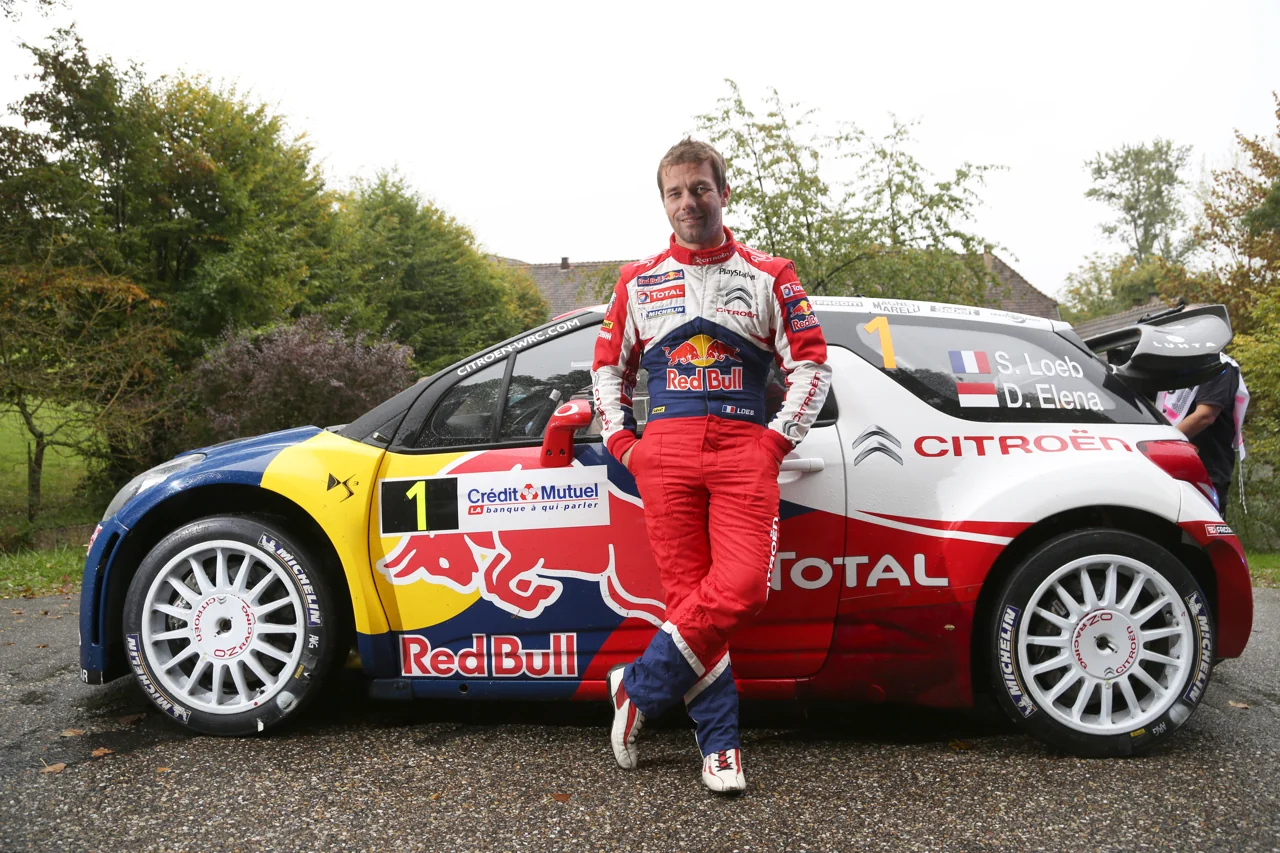 Photo: FIA.com
| Championship years | Car used | Crew |
|---|---|---|
| 2004、2005、2006 | Citroën Xsara WRC | Loeb / Elena |
| 2007、2008、2009、2010 | Citroën C4 WRC | Loeb / Elena |
| 2011、2012 | Citroën DS3 WRC | Loeb / Elena |
The Welsh forests in 2009: One point behind, he had to turn it around
Before the finale, Hirvonen led by one point. Loeb could not settle for following the Ford driver home; he needed to reverse their order in Britain. At the end of the first day, Loeb's lead was only 5.3 seconds, leaving a whole year's championship suspended on a tiny margin.
Saturday's rain made the roads more slippery, but Loeb extended his lead in two crucial stages to around 25 seconds. Consistency here meant something other than slowing down. When the title situation demanded opening a gap, the crew had to deliver speed in difficult conditions. On Sunday, Hirvonen also suffered a bonnet problem. Loeb ultimately won and took his sixth consecutive championship.
The rally left a tense cross-section of the nine-title sequence. A leader can adjust pace to the gap; the pursuer has to seek an opening. Every split time can change how the next stretch of road should be handled. The nine-year record includes titles settled early, and years like this when the final event still demanded an all-out effort.
Leaving full-time WRC did not mean ceasing to be a racing driver
After 2012, Loeb ended his life as a full-season WRC driver. He still won Monte Carlo and Argentina in a limited 2013 programme. That same year he turned to Pikes Peak, winning the hill climb in 8 minutes 13.878 seconds and setting a new record at the time. Moving from an aggregate over many stages to one timed run toward a summit added a new form of competition to his career.
In 2014, he entered the World Touring Car Championship in a Citroën C-Elysée and finished his first season third overall; he was third again in 2015. Rally followers saw him compete in another environment, with cars directly contesting the same lines and starts and wheel-to-wheel battles becoming important parts of every race.
His exploration also extended to longer rally raids. On his second Dakar appearance in 2017, Loeb and Elena finished second overall in the car category in a Peugeot 3008 DKR. In 2018, he also won the Belgian round of the World Rallycross Championship. Each result belongs to a different competition, but together they reveal the direction of his post-full-time-WRC career: continually finding another way to confront speed, rivals and unfamiliar conditions.
Spain 2018: One set of tyres, a long-awaited win
At Rally Spain in 2018, Loeb and Elena returned to the winners' position in a Citroën C3 WRC. It was their 79th overall WRC rally victory, many years after the previous one. The story was shaped not only by cornering speed, but by a judgement about changing conditions on the final day.
The team expected the roads to dry, and Loeb chose hard-compound slicks, converting that decision into a lead on key stages. He later had a minor incident, and his rivals kept closing in; the final margin was just 2.9 seconds. Watching only the finishing result misses the choices that gradually turned possibility into reality.
The event also showed that rally experience is more than remembering a road. It includes understanding change, deciding with incomplete information and taking the car to the finish after that choice. Loeb's driving still mattered, but the victory was also the combined product of weather assessment, tyre work and crew cooperation.
Hard slicks are not faster on every wet surface. The choice depended on the crew and team judging that the roads were moving toward conditions better suited to them, and on Loeb controlling the sections not yet fully dry. Tyre selection concerned the overall conditions of the next group of stages, not just the patch of ground underfoot in service.
The final 2.9-second margin kept all the suspense in the comeback. An advantage gained earlier through a choice is not automatically locked into the results; every later corner can spend it. For a driver years removed from full-time competition, reconnecting judgement, speed and control in the closing stages was more persuasive than merely proving he could still drive one section very quickly.
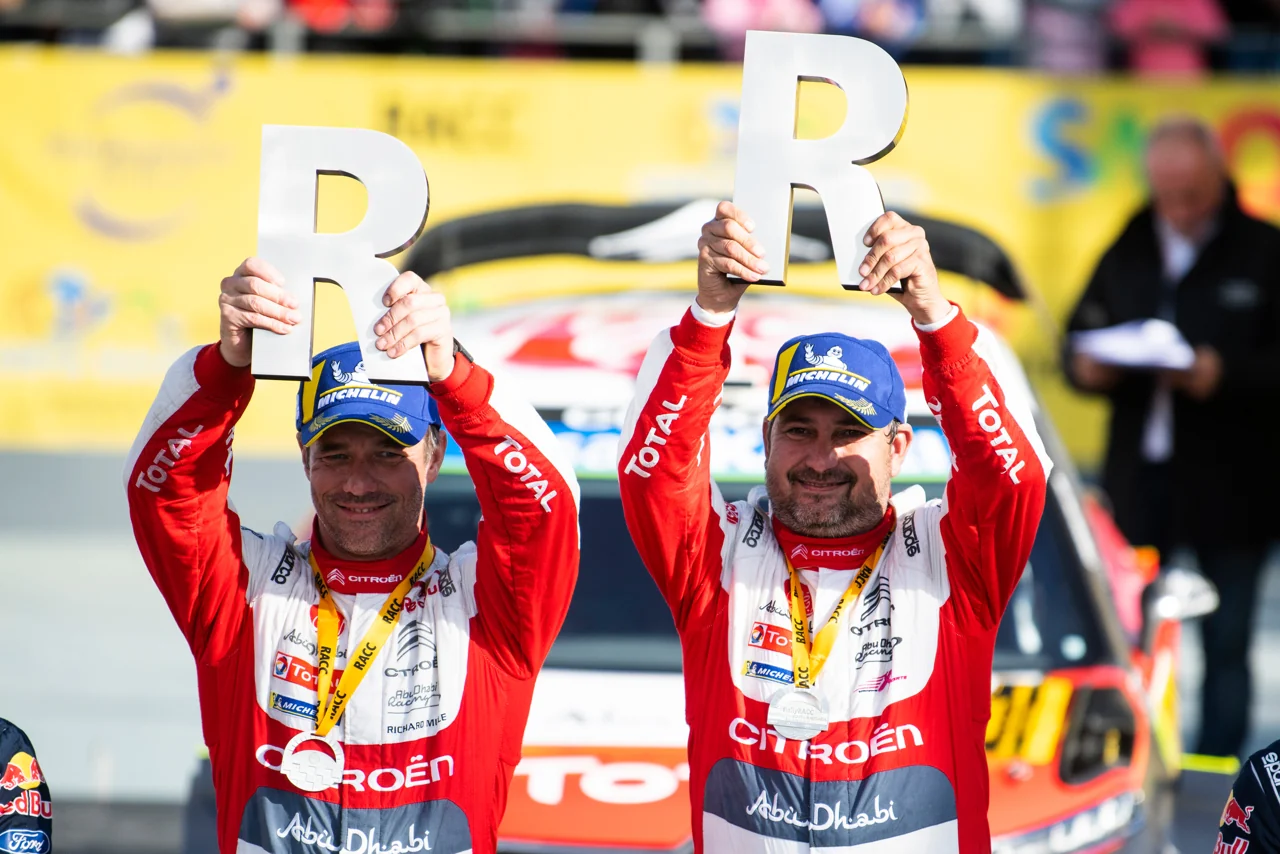 Photo: FIA.com
Monte Carlo 2022: A different car and a different partner
In 2022, Loeb contested Monte Carlo in M-Sport's Ford Puma alongside Isabelle Galmiche. Victory by a final margin of 10.5 seconds became his 80th overall WRC rally win.
At forty-seven, Loeb became the oldest winner of a WRC round at the time, while Galmiche reached the top step on her premier-class debut. The result carried different meanings in their individual careers, yet was achieved together in the same car.
Loeb did not lead throughout. Ogier first took the advantage; Loeb moved ahead after winning four consecutive stages on Friday, then fell behind him again on Saturday. Before the penultimate stage, they were still separated by nearly half a minute. Only when Ogier suffered a front-left puncture did the situation turn again.
Galmiche was also a mathematics teacher, but telling her victory solely as a contrast between professions overlooks the real job in the other seat. On her first top-level appearance, she had to work with Loeb through Monte Carlo's changing roads. Only after the final stage did the ten-and-a-half-second margin become an official victory shared by both.
The 2022 season was also the first for hybrid Rally1 cars at the top level of WRC. A forty-seven-year-old veteran, a new partner and a car built to new rules appeared together on the podium, giving the eightieth win a special sense of eras meeting. It did not copy the past nine titles; it was a competition completed anew under different conditions.
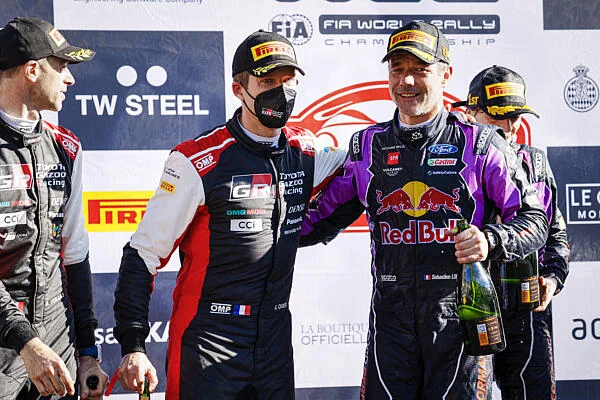 Photo: FIA.com
How to read his records without misreading them
By the end of the 2025 season, Loeb held nine WRC drivers' world championships, and Ogier had also reached nine in 2025. Their totals were equal, but the distribution of title years differed. Loeb's nine consecutive crowns from 2004 to 2012 remain a distinct, unmistakable marker of his career.
The 80 WRC victories also have a precise meaning: they count the final overall winner of each rally. Stage wins are another measure. Class victories, Dakar stages and results in other events are counted separately too. This prevents a report that he has 'won again' from being mistakenly added to his WRC career rally total.
Likewise, nine drivers' titles cannot automatically become nine manufacturers' titles for Citroën. An outstanding crew and an outstanding team help make each other successful, but have different records. Once those distinctions are clear, numbers help explain the story instead of adding confusion.
Why watching Loeb means more than waiting for a dramatic moment
Rally highlights often select jumps, slides and moments close to the roadside, but Loeb's value extends beyond those images. Judgements completed early, choices that preserve the entry position for the next corner, and the ability to avoid unnecessary losses over long events may have less visual impact, yet continually alter the stopwatch.
After reading his career, return to a rally with one question: why can this car sustain effective speed on roads whose conditions never stop changing? Once you begin watching pace notes, tyres, lines and crew cooperation, nine consecutive titles cease to be merely an unimaginable number. They become many specific, difficult tasks, done correctly again and again over many years.
View sources · 13 entries
- Loeb's official website: Career
- FIA: Loeb's farewell to a full-time WRC career
- Pirelli: The 2003 Rally GB report and Solberg's title
- Citroën: The C3 WRC and the team's history
- Citroën: The 2009 British title decider
- WRC: History of the World Rally Championship
- Loeb's official website: Career results across disciplines
- Citroën: Loeb's 2018 Spanish victory and tyre choice
- FIA: Loeb's 79th win in Spain in 2018
- FIA: Loeb wins Monte Carlo in 2022
- FIA: Loeb's 80th WRC victory
- FIA: Ogier's ninth world title in 2025
- Citroën: Ending the factory WRC programme in 2019
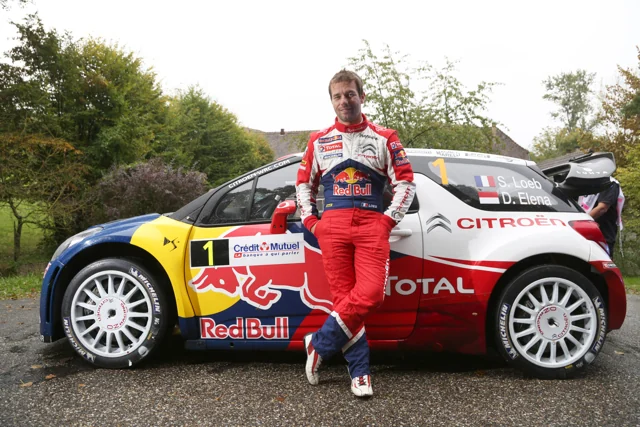 Photo: FIA.com
Citroën: How did a team that left the top level define an era?
Continue reading · 14 minutes →