
Expand chapter contents · 14 chapters
- Before becoming a WRC force, it learned to face long journeys
- How could a two-wheel-drive car beat four-wheel-drive rivals?
- 2003: From isolated breakthroughs to a season-long threat
- Britain 2003: Drivers' runner-up and manufacturers' champion at once
- Behind nine consecutive titles: Driver, co-driver and team
- The 2006 transition: The old car raced while the new one was prepared elsewhere
- From Xsara to DS3: How do you keep winning when the rules change?
- When Loeb stopped competing full-time, winning momentum could fade too
- C3 WRC: Starting again is harder than continuing to win
- The 100th win arrived, but the story did not follow expectations
- A factory withdrawal does not end every story
- Asphalt, gravel, ice and snow: Why strong teams must keep rethinking
- Eight manufacturers' titles are clearer in two periods
- Citroën left more than a long row of trophies
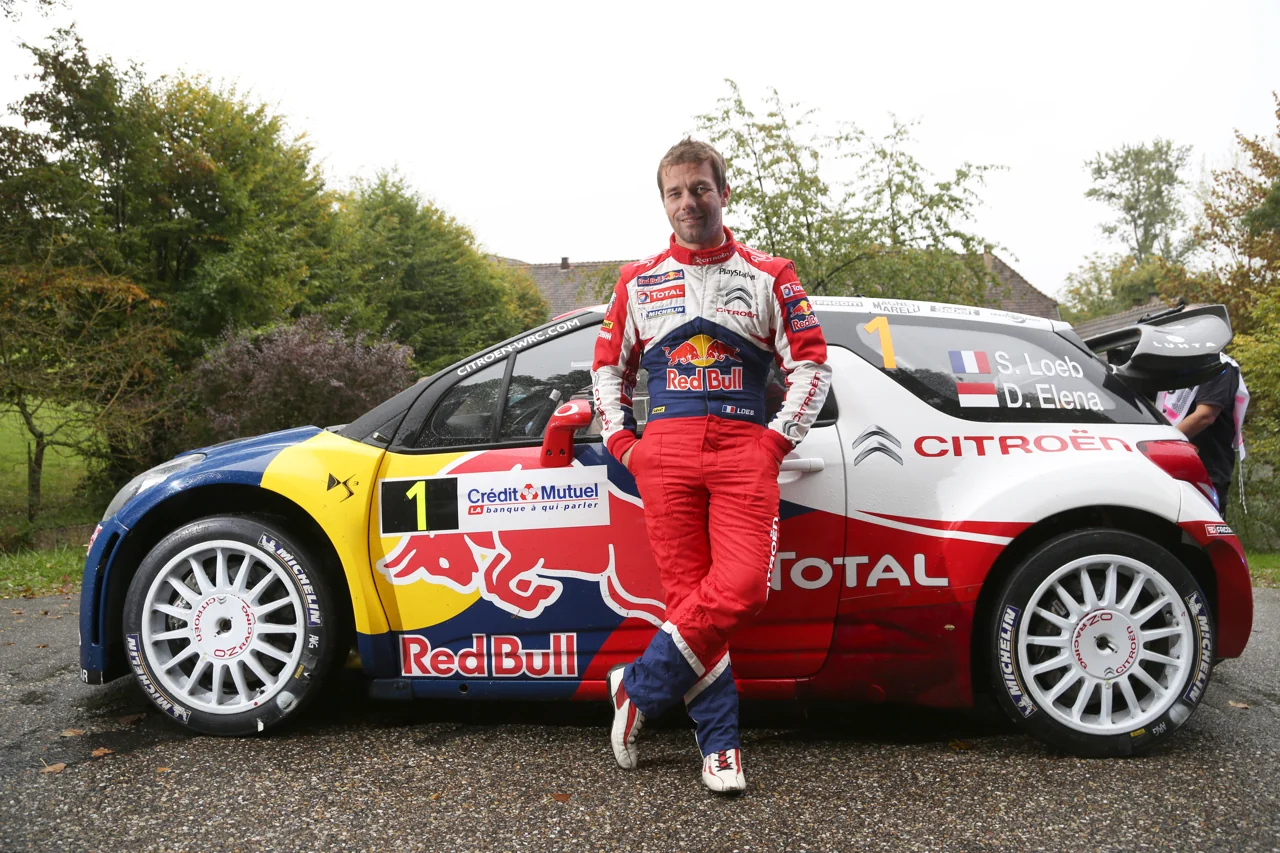
A new fan opening today's WRC manufacturers' standings may no longer find Citroën. Move the camera back a little over a decade, though, and the red Xsara, C4 and DS3 were opponents every other team had to reckon with. The years of Loeb's nine consecutive titles were closely bound to the marque's racing department.
Late in 2019, Citroën announced the end of its factory WRC programme. A name with eight manufacturers' titles and 102 WRC victories paused its place in top-level world rallying. It left a compelling question: how did such a successful team establish its advantage, and why could that advantage not last forever?
Before becoming a WRC force, it learned to face long journeys
Citroën's competition story predates the familiar World Rally Championship. In 1959, the DS won the Monte Carlo Rally. Different models and forms of competition gradually connected the marque with the challenge of long-distance road events. The meaning of rallying needs care here: conventional stage rallies and the later long-distance rally raids across desert and wilderness are not exactly the same form of competition.
In 1989, Citroën Sport made Dakar an important objective. Ari Vatanen won in the ZX Grand Raid in 1991, and Pierre Lartigue won Dakar in 1994, 1995 and 1996. For a racing organization, these programmes test more than speed. They demand reliability, long-distance logistics, vehicle maintenance and a crew's ability to face the unknown together.
Rally raid and WRC are not two names for one calendar. The former entails longer distances, desert terrain and navigation; the latter concentrates competition into a series of closed, timed special stages. The ZX's Dakar success gave Citroën experience in organizing expedition-like events. When the Xsara arrived, however, the team still had to develop a car afresh for asphalt and gravel.
That also explains why Citroën's team history cannot begin only when Loeb became champion. The racing department, testing and logistical capabilities built through earlier programmes existed before its most famous driver. They did not translate directly into WRC points, but gave the marque the means to move gradually from selected appearances to a manufacturers' programme covering a whole season.
How could a two-wheel-drive car beat four-wheel-drive rivals?
In 1999, Philippe Bugalski won in Catalunya and Corsica in the Xsara Kit-Car. To someone new to rallying, that may seem counterintuitive: if four-wheel drive is supposed to offer an advantage, how can a two-wheel-drive car reach the top step of the podium?
The answer is that performance must be understood in the context of conditions and regulations. On grippy asphalt, a combination of weight, steering response, tyres and power characteristics can make a two-wheel-drive car highly competitive. Four-wheel drive offers important benefits on difficult, low-grip surfaces, but does not automatically cancel every other difference in every situation.
Citroën's later development of the four-wheel-drive Xsara WRC therefore did not reject the Kit Car. The earlier project asked how to be fastest under particular conditions; the later one asked how to compete across an entire calendar. For a team preparing to pursue a manufacturers' championship, those questions had different scopes.
2003: From isolated breakthroughs to a season-long threat
Jesús Puras gave the Xsara WRC its first win in Corsica in 2001. After preparation, Citroën entered its first full WRC season in 2003. The opening was striking: Loeb, Colin McRae and Carlos Sainz swept the first three places in Monte Carlo, bringing youthful potential and world championship experience into the same team.
Citroën won that year's manufacturers' championship, while Loeb lost the drivers' title to Petter Solberg by one point. It is an excellent first lesson in reading WRC history: drivers' and manufacturers' championships are separate standings. A driver may narrowly miss the greatest individual honour, while the team wins an annual trophy through crews' results counted under that year's rules.
The Xsara WRC was not merely a prop for one genius. It had to withstand different surfaces, work with different drivers and return problems discovered in testing and competition to the development process. Loeb's subsequent growth certainly mattered. Yet winning the manufacturers' title in the first full season also showed that Citroën had already established the organizational and vehicle foundations for season-long competition.
Britain 2003: Drivers' runner-up and manufacturers' champion at once
When Citroën arrived at the British finale, individual and team goals were intertwined. Solberg won, Loeb finished second and McRae fourth, and Citroën took its first manufacturers' title. Loeb ended the year one point behind Solberg. The two trophies did not go to the same garage.
The rally helps explain how a manufacturers' title campaign works. A driver considers the gap to the opponent ahead, while the team also watches whether its other scoring cars can finish. McRae's fourth place was not among the most eye-catching results of his career, but helped complete Citroën's most important task of the year. Only by looking beyond the sole leader does the full shape of a team result emerge.
Behind nine consecutive titles: Driver, co-driver and team
In 2004, Loeb and Daniel Elena began their nine-year championship sequence. The drivers' title belonged to Loeb, the co-drivers' title to Elena, while the manufacturers' crown depended on Citroën's full-season results under the applicable rules. The three dimensions supported one another, but their awards were not interchangeable.
The distinction also reveals how rallying works. The driver acts on the stage; the co-driver uses pace notes to help him understand the road in advance. The team handles the cars, tyre choices, servicing and organization of the entire event. A few seconds gained on a mountain road may be the final expression of extensive preparation. Cameras easily follow only the person behind the wheel; team history should restore the other roles to the picture.
Citroën's dominance did not unfold identically every year. In 2006, Loeb still won the drivers' title in a Xsara, but Ford took the manufacturers' championship. The C4 entered competition in 2007 and Loeb won again, yet the manufacturers' crown again did not go to Citroën. These years remind us that Loeb's nine straight titles and Citroën's eight manufacturers' titles are not contradictory: they record different achievements.
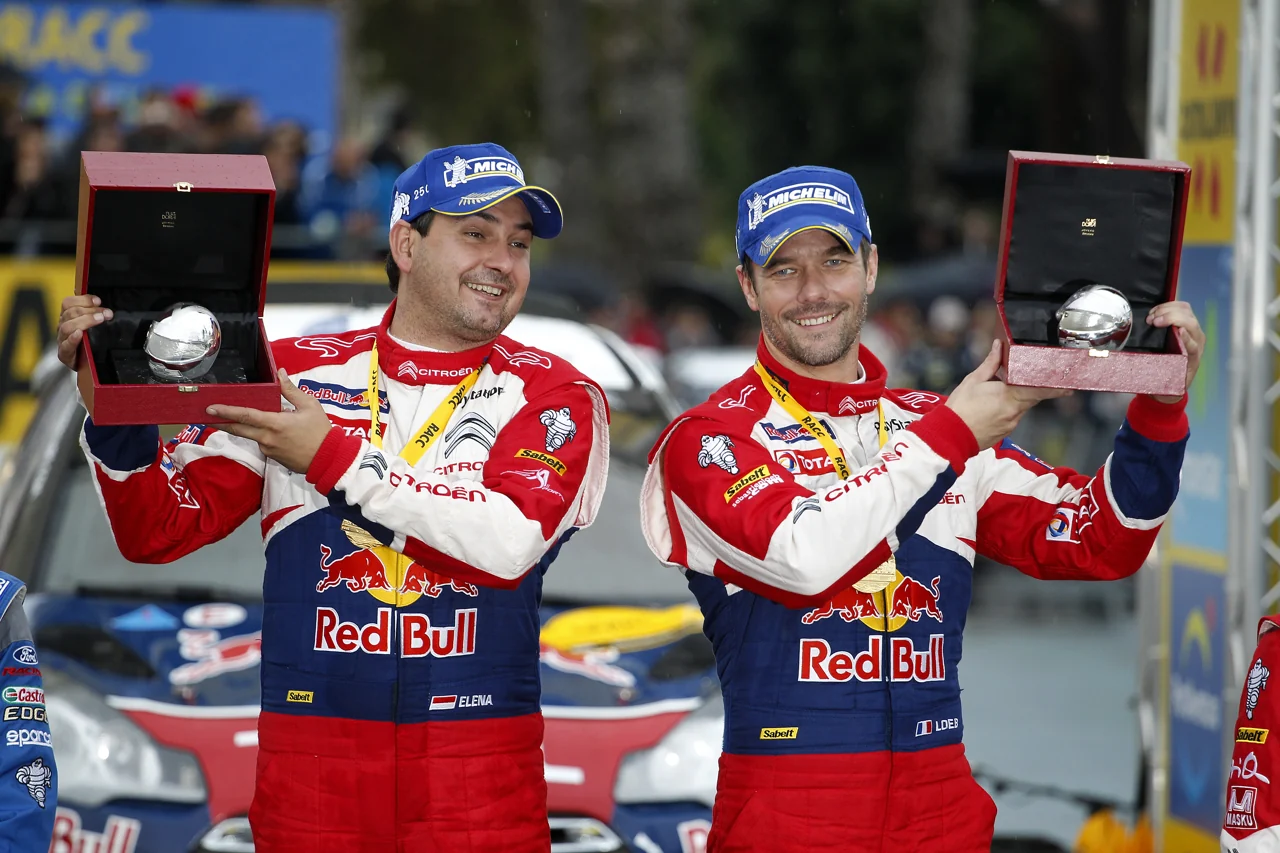 Photo: FIA.com
| Honour | Who is counted | Results in Citroën's golden era |
|---|---|---|
| Drivers' championship | Driver | Loeb: 2004–2012, nine consecutive titles |
| Co-drivers' championship | Co-driver | Elena: 2004–2012, nine consecutive titles |
| Manufacturers' championship | The manufacturer's competition results | Citroën: 2003–2005 and 2008–2012, 8 in total |
The 2006 transition: The old car raced while the new one was prepared elsewhere
Citroën did not contest 2006 with its previous factory-team structure. Loeb and Elena competed in a Xsara run by Kronos, while the marque prepared the C4 for the next year. Spectators still saw the familiar driver and car name on the stages; behind the programme, the competing organization and development arrangements had changed.
This transition is essential to understanding the nine consecutive titles. Loeb won the drivers' championship again in 2006, but Citroën did not take that year's manufacturers' crown. The brand of car, the team actually running it and the allocation of manufacturers' points must be identified separately. Describing the period simply as nine unchanged years of factory Citroën dominance erases the adjustments that really occurred.
When the C4 took over in 2007, Citroën faced more than a change of body shape. Repeatable speed in testing had to be tested anew over long distances, varying surfaces and servicing schedules. Loeb's experience offered an important reference, but fresh results still had to establish whether the new car could remain competitive all year.
From Xsara to DS3: How do you keep winning when the rules change?
Remembering only one red Citroën can create the impression that the nine titles were won in the same machine. In fact, Loeb's championships spanned the Xsara WRC, C4 WRC and DS3 WRC. Each model change meant maintaining competitiveness across different base cars, new regulatory demands and fresh development work.
The C4 WRC debuted in 2007 and later helped Citroën win consecutive manufacturers' titles from 2008 to 2010. In 2011, a new generation of WRC technical rules brought changes including 1.6-litre turbocharged engines. The DS3 WRC took over, and Citroën added two more manufacturers' titles in 2011 and 2012. Being champion did not make the regulations stand still. Every technical turning point could give a rival a chance to close the gap.
New readers can regard each car as a new exam question. Previous success gives direction, not an automatic guarantee that the next car will work. Engineers must bring surface adaptability, reliability and crew requirements together again; drivers and co-drivers must understand a different car's responses. The real difficulty of consecutive titles lies in repeatedly adapting while continuing to deliver results.
| Model period | Key years | A guide to this part of the history |
|---|---|---|
| Xsara Kit-Car | 1999 | Two-wheel drive wins two WRC rounds |
| Xsara WRC | First win in 2001; full season in 2003 | From a specialized advantage to season-long competition |
| C4 WRC | From 2007 | A new model sustains the title-winning system |
| DS3 WRC | From 2011 | Continuing to fight for titles under new WRC technical rules |
| C3 WRC | From 2017 | An attempt to return to an all-out factory title challenge |
When Loeb stopped competing full-time, winning momentum could fade too
The 2012 season was Loeb's last full WRC campaign. He continued to make selected appearances and take important victories, but the team could no longer assume he would be present all year. At the same time, the WRC landscape changed as other manufacturers entered or strengthened their challenges with new cars, drivers and organizational capabilities.
Citroën also directed part of its motorsport programme toward the World Touring Car Championship. The C-Elysée succeeded from 2014 to 2016, with the team and José María López taking consecutive titles. Another statistical trap must be avoided here: WTCC success demonstrates the racing department's ability in a different category. It does not extend Citroën's WRC championship timeline.
For an organization, the ability to run multiple programmes is an asset, but also demands a reallocation of resources and objectives. Spectators see a season's podium results; the team makes technical and business choices over much longer cycles. The fluctuations after a golden era cannot necessarily be explained only by one driver's arrival or departure. Development pace, rivals' progress and brand plans also change outcomes.
C3 WRC: Starting again is harder than continuing to win
In 2017, the C3 WRC carried Citroën's plan to return to serious contention. New rules allowed more substantial power and aerodynamic changes, and the cars became wider and more aggressive in appearance. Fans found this generation visually exciting. For the team, it meant converting the newly available performance into something usable and reliable in competition.
Eight previous manufacturers' titles did not let the new car skip development difficulties. The C3 programme won important rallies, but did not rebuild the sustained championship advantage of the old days. In Spain in 2018, the part-time Loeb and Elena combined their tyre choice with a strong final day to win by 2.9 seconds. It was the team's first win of the season and Loeb's 79th WRC victory.
It was a moving rally, and an easy one to misread. An old champion returning to win once did not mean the whole team's problems had been solved. Instead, it showed that WRC could still produce a remarkable breakthrough within a particular window of weather, surface and tyres. Fighting for the annual title required repeating that standard in more conditions. One-event speed and a season-long system are different tests.
Spain's mixed surfaces were particularly revealing of the C3 programme's workload. The same car had to switch between gravel and asphalt, with changes to suspension, braking and tyre requirements. The driver also had to adapt to the new grip. The same red bodywork in the photographs could not conceal the preparations made in service for different surfaces.
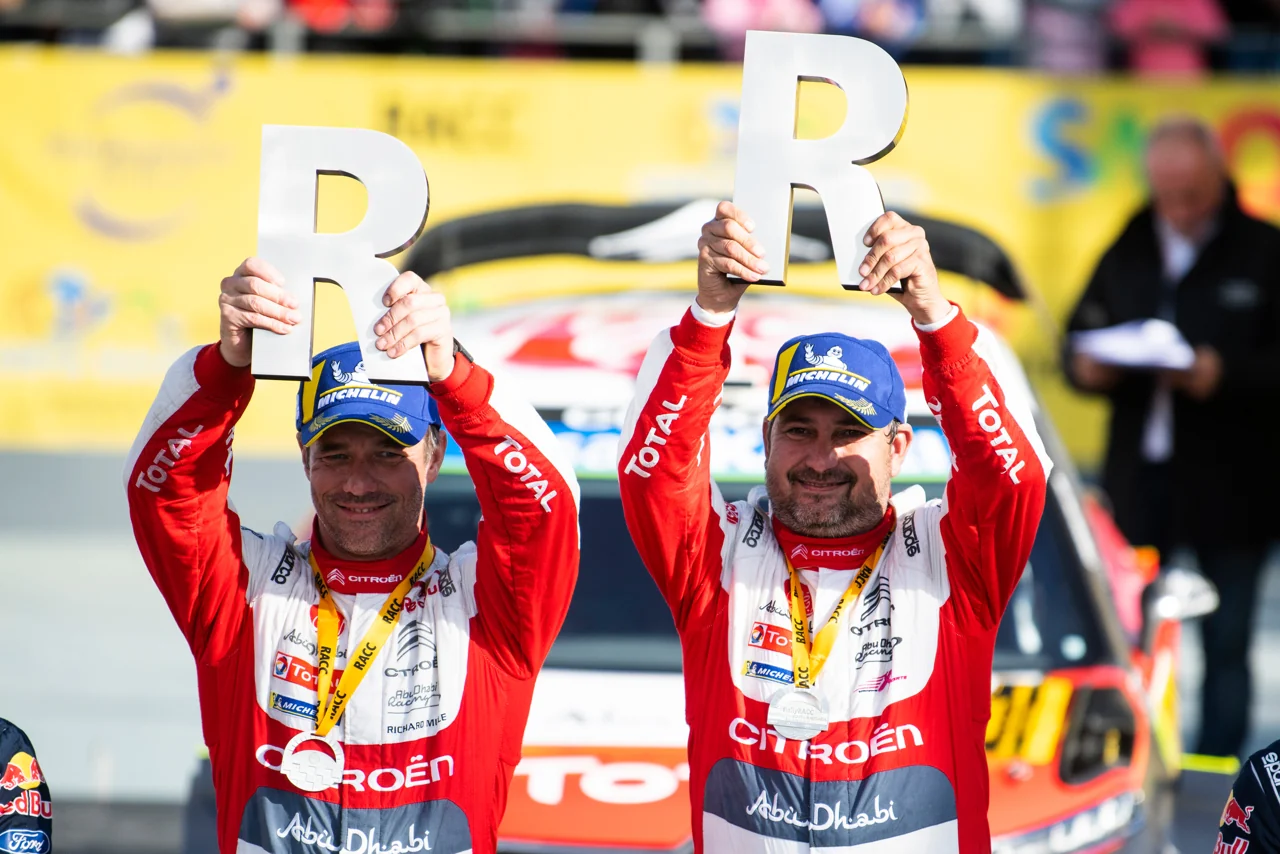 Photo: FIA.com
The 100th win arrived, but the story did not follow expectations
At the 2019 Monte Carlo Rally, Sébastien Ogier and Julien Ingrassia won in the C3 WRC, giving Citroën its 100th WRC victory. It was a major milestone for the marque and raised hopes that the new partnership could restore the strength to fight for the annual title.
The journey from the first win to the 100th spanned several cars, different regulatory eras and generation after generation of opponents. A round number can prompt spectators to pause and revisit history; it cannot guarantee future competitiveness. However handsome the accumulated statistics, they do not remove the problems to be solved the following weekend.
In November 2019, Citroën announced the end of its factory WRC programme. Its official statement cited Ogier's early departure and the lack of an available leading replacement driver as the background to the decision. At that point, the official WRC totals stood at 102 wins and 8 manufacturers' titles.
A factory withdrawal does not end every story
A factory team ending its top-level WRC programme is not the same as every rally car built by the marque immediately ceasing competition. Citroën's 2019 withdrawal statement explicitly referred to continued support for C3 R5 customer racing. Customer-car programmes, independently entered crews and a factory bid for the top manufacturers' title differ both in organization and in the scope of their statistics.
That explains why Citroën may still appear in rally reports today without being placed straight back into that season's top-level manufacturers' standings. Look first at the class, model and entry status, then at the badge, and it becomes easier to identify the competition being reported.
Looking back, three lines can be read together: organizational growth from selected-round breakthroughs to manufacturers' titles; the succession from Xsara through C4 and DS3 to C3; and personnel changes before and after the Loeb era. Citroën's peak came when these lines aligned closely for a period. Its later difficulties also need to be understood through those specific relationships.
Asphalt, gravel, ice and snow: Why strong teams must keep rethinking
Circuit racing often teaches spectators to compare successive lap times on the same track. WRC takes crews onto roads with greatly differing conditions, and even stages within one rally can change with weather, preceding cars and contamination of the surface. A strong team's problem is not taking the fastest setup everywhere, but understanding exactly what each start will bring.
Spain in 2018 offers a clear example. Reading the drying surface made Loeb's tyre choice a major factor in fighting for victory. Citroën's pre-event material also described the service preparations needed to convert a car from gravel to asphalt setup at such events, showing how garage work affects the contest. Behind the car leaving service on camera is teamwork with limited time and actions planned in advance.
To understand Citroën's golden era, focus on what happens before each rally: how reconnaissance information prepares the crew, how weather judgements affect tyres, and how service planning protects performance on later stages. The driver delivers the final result, but earlier choices may already have quietly changed the chances of success. Details that do not always appear in highlights make team history more complete than a table of wins.
Eight manufacturers' titles are clearer in two periods
Citroën's eight WRC manufacturers' titles fall into two periods, 2003 to 2005 and 2008 to 2012. The first began with its first full season, when the Xsara WRC proved the team's year-round capability. The second spanned the C4 and DS3, linking success across new models and regulations. The years 2006 and 2007 do not appear in that manufacturers' title list, even though Loeb still won the individual crown.
This is not a minor statistical footnote; it is the real structure of the team's story. A change in a manufacturer's programme need not immediately end a leading driver's personal results. Nor can one exceptionally strong driver automatically replace the other crews whose results count. Reading history through the difference between the championships reveals both individual consistency and changes in the manufacturer programme.
The later C3 WRC won rallies, but did not add to those eight manufacturers' championships. Thus, a more dramatic, modern-looking car in a photograph does not necessarily have a more successful annual record. Technical rules set the field; teams and opponents decide the result. Model evolution and the title timeline must be read together to avoid substituting one impression for a different fact.
| Manufacturers' title period | Total | Corresponding model |
|---|---|---|
| 2003—2005 | 3 | Xsara WRC |
| 2008—2010 | 3 | C4 WRC |
| 2011—2012 | 2 | DS3 WRC |
| Total | 8 | Counted separately from Loeb's nine drivers' titles |
Citroën left more than a long row of trophies
What most deserves to be remembered about Citroën is how closely it once combined car development, leading crews and execution across a whole season. The progression through Xsara, C4 and DS3 shows that success does not mean freezing one answer in place. Loeb and Elena's partnership shows that rallying is not fundamentally one person facing a mountain road alone.
The fluctuations of the later C3 era make the preceding glory easier to understand: an advantage needs constant upkeep, and new rules and rivals continually pose new problems. Having solved something once does not mean having solved it forever.
Turn now to Loeb's individual career, and another line appears, interwoven with team history but not identical to it. All nine of his titles came with Citroën, yet his 80th WRC win came in a Ford with a different co-driver. People and teams create an era together, and can continue along separate paths after it.
View sources · 15 entries
- Citroën: A century in motorsport
- Citroën: The C3 WRC and the team's history
- Citroën: Bugalski's racing career
- Loeb's official website: Career
- Pirelli: The 2003 Rally GB report and Solberg's title
- FIA: Loeb's farewell to a full-time WRC career
- WRC: History of the World Rally Championship
- Citroën: Its Sardinia history and the Kronos team in 2006
- Citroën: Ending the factory WRC programme in 2019
- FIA: An interview with Loeb after the 2012 season
- Citroën: Loeb's 2018 Spanish victory and tyre choice
- FIA: Loeb's 79th win in Spain in 2018
- Citroën: Surface changes and service preparation in Spain
- Citroën: The 100th win at Monte Carlo in 2019
- FIA: Loeb wins Monte Carlo in 2022
 Photo: FIA.com
Loeb: Beyond nine straight titles, how do we understand rallying's king?
Continue reading · 13 minutes →