
Expand the Chapter List
- Starting in a Sydney Workshop
- To Britain, and a Small Team Changing the Layout of Racing Cars
- 1959: Building a World Title from Monaco
- Sebring's Last Lap: The Championship Beyond the Pushing Scene
- 1960: Five Straight Wins Answer Questions About Speed
- Taking a Cooper to Indianapolis
- Working with Tauranac: Turning Independence into a Factory
- 1966: A Forty-Year-Old Driver in the New Three-Litre Era
- In the Same Year, F2 Racing Continued
- 1967: A Team-Mate Becomes Champion, the Owner Keeps Competing
- 1970: A Final Win, and the Victory Lost at Monaco
- INKA SPORTS Analysis: Why His Record Means More Than “Building His Own Car”
- Timeline
- Honours and Career Record
What can a driver leave in F1? A lap time, a wet-weather race, a world championship trophy. Jack Brabham left something broader. He helped Cooper's rear-engined cars become champions, then built a manufacturing business with Ron Tauranac and finally won another title in a car carrying his own surname.
No other F1 driver has repeated the 1966 distinction. Yet remembering him only as “the man who became champion in a car he built himself” misses his two earlier titles, the 1961 Indianapolis venture and the speed that still won a grand prix in his final season. It also omits the people who built the cars with him, making an undertaking of precise cooperation look like a miracle performed alone in a garage.
Jack's distinction lay in spending so much of his career at the connections between different roles. He could drive and understood machinery; he needed engineers' expertise and could carry track feedback back to the factory. He owned the team while still bearing every driver's risk at the start. His three world titles were not one kind of success repeated three times. In a changing F1, he found three ways to bring people and car together.
Starting in a Sydney Workshop
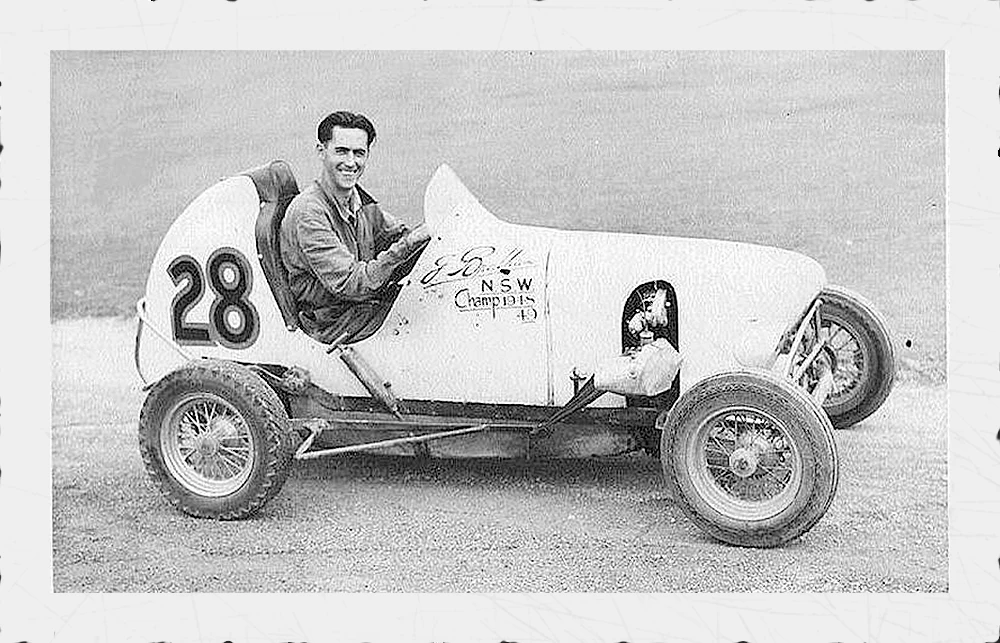 Image source: Brabham
John Arthur Brabham was born on April 2, 1926, in Hurstville, south of Sydney. He became better known by the nickname Jack. His father ran a fruit-and-vegetable business, and its delivery vehicles gave him an early introduction to machinery. After school, he gained engineering and repair experience, then served as a mechanic in the Royal Australian Air Force during the Second World War.
These experiences do not mean he knew as a boy that he would become world champion. They were first practical skills for earning a living: understanding machinery, finding faults and getting equipment running again. After leaving military service in 1946, he opened a small Sydney workshop; racing entered his life afterwards. Unlike later, highly professionalised junior pathways, he reached driving through an environment where manufacture, repairs and local competition overlapped.
His friend Johnny Schonberg raced small dirt-track cars. Jack helped build one and later took the wheel himself. Midgets, also called speedcars, raced on dirt ovals: small cars running close together, requiring constant corrections as they slid. Jack succeeded in Australian events and gradually moved into hillclimbing and road racing.
Dirt racing, road racing and F1 require different driving methods. What persisted through those transitions was his involvement with mechanical work. Before becoming an international driver, he was already used to treating a racing car as a tool he needed to understand and care for himself. That experience became immediately useful inside the Cooper factory.
To Britain, and a Small Team Changing the Layout of Racing Cars
Jack arrived in Britain in 1955 and made his F1 world championship debut at that year's British Grand Prix. Earlier racing with Cooper cars had brought him into contact with Charles and John Cooper. For an Australian driver far from home, this offered both a racing opportunity and an environment in which he could participate in work on the cars.
Cooper placed the engine behind the driver. Large front-engined cars were still present in grands prix, and the change altered weight distribution, body shape and driving feel. Jack's value in construction and development lay in bringing practical problems from the cockpit back to the factory, then using the next test to check whether changes worked.
The technical shift was not completed by one person or one race. In 1958, Stirling Moss won the Argentine Grand Prix in a Cooper entered by Rob Walker's private team, proving the type could win in the world championship. Jack's subsequent title expanded a single victory into a full season of competitiveness. Different drivers and entrants contributed to a process that ultimately changed F1's dominant layout.
This explains why Jack's early achievements cannot be reduced to podium totals in one season. His Cooper work included both driving and making the car a more effective racing tool. For a driver seeking lasting competitiveness, understanding development direction mattered as much as driving quickly on the weekend. The ultimate test, however, remained official racing, not confidence in a new idea inside the factory.
1959: Building a World Title from Monaco
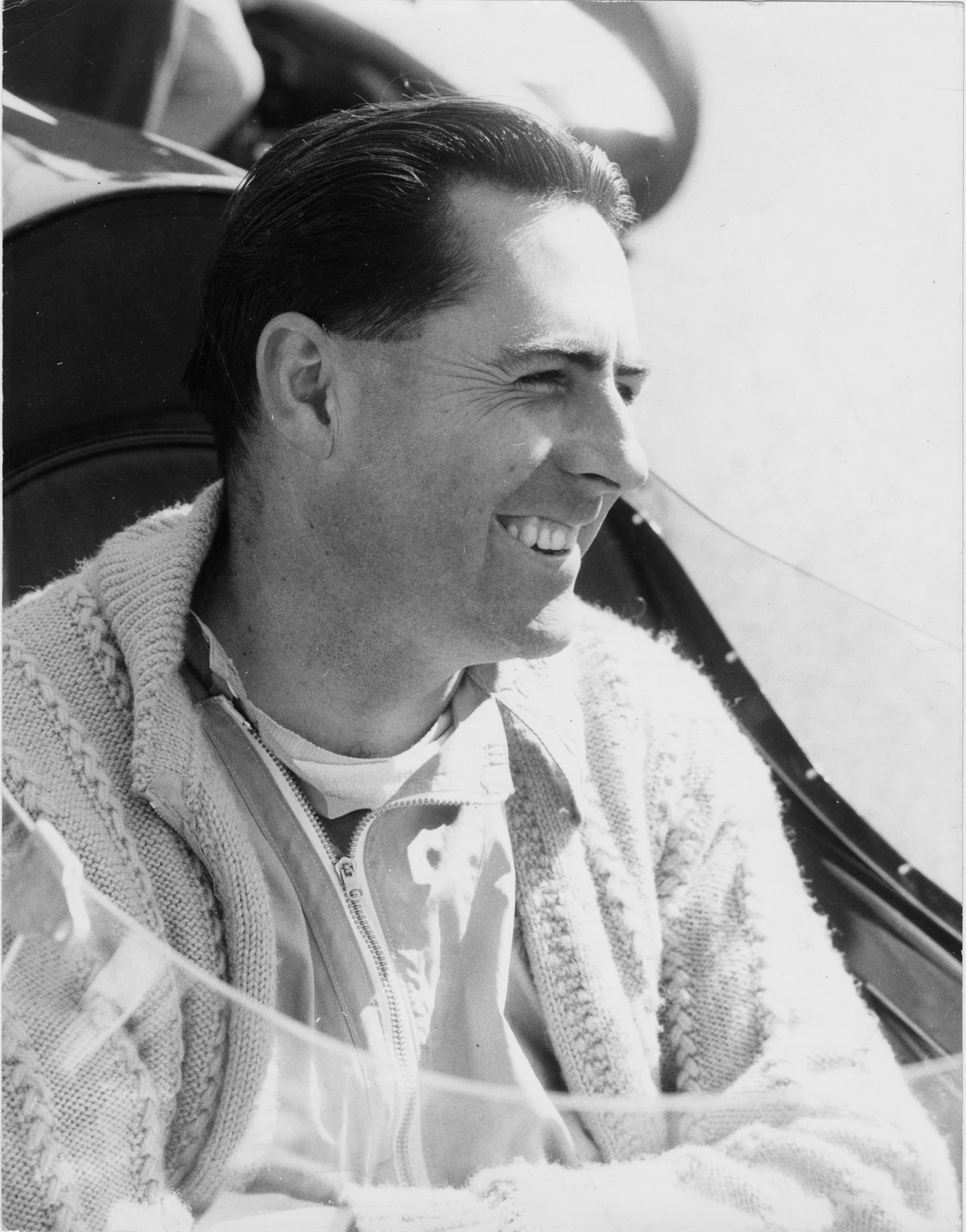 Image source: Brabham
On May 10, 1959, Jack took his first F1 grand prix victory at Monaco. He then finished second in the Netherlands, third in France and won again in Britain. Strong finishes beyond the two wins made the season a continuous accumulation of points. He remained in the title fight without winning every round.
The season helps explain “consistency” in racing. It does not mean conservatism on every lap, nor is it a substitute for missing speed. Monaco and Britain showed that Jack could lead the field; podiums elsewhere reduced losses when victory was unavailable. Speed sets the ceiling, while finishes and points determine how much of that potential is realised.
There were mistakes and setbacks too. Germany and Portugal brought no points, before third in Italy restored effective championship momentum. Unpacking the results is more accurate than saying he won through reliability. He experienced fluctuations and reached the finale through a combination of wins and high finishes, rather than avoiding competition all year while waiting for rivals to retire.
Cooper won both drivers' and constructors' titles that year. Jack became the first Australian F1 world champion, while the rear-engined car moved from challenger to season-long winner. For Australian motorsport, this meant more than a compatriot winning one European race. Someone had now completed the entire contest at the sport's highest level.
Sebring's Last Lap: The Championship Beyond the Pushing Scene
On December 12, 1959, the United States Grand Prix took place at Sebring, Florida. Jack's Cooper ran out of fuel on the last lap. He climbed out and pushed it over the remaining distance, finishing fourth. The scene became one of racing history's most famous championship moments: a driver relying on his own body rather than the engine to get the machine to the finish.
Another tense contest was unfolding at Sebring. Bruce McLaren beat Maurice Trintignant by 0.6 seconds for his first world championship grand prix win. Ferrari's Tony Brooks finished third and Jack fourth, while Moss had retired early. The results of several title contenders and race-win challengers together shaped the final day.
For Cooper, it was a complex but successful picture: a young team-mate's first victory and Jack's championship, reached through entirely different endings. The official results show both factory cars completing 42 laps, with Jack almost five minutes behind the winner. That huge gap records the difficulty of the last lap without erasing his advantage accumulated over the year.
The wins and podiums already accumulated were Jack's foundation on arriving at Sebring. The pushing scene gave the season a vivid ending. A year's work and several hundred metres of perseverance met on the same afternoon.
Pushing to the finish also shows a direct quality of early racing: when the machine stopped working, the driver still tried to complete the race. Today, the image conveys human effort while revealing the particular environment created by reliability and the rules of that period. His first world title became inseparable from a Cooper with no fuel.
1960: Five Straight Wins Answer Questions About Speed
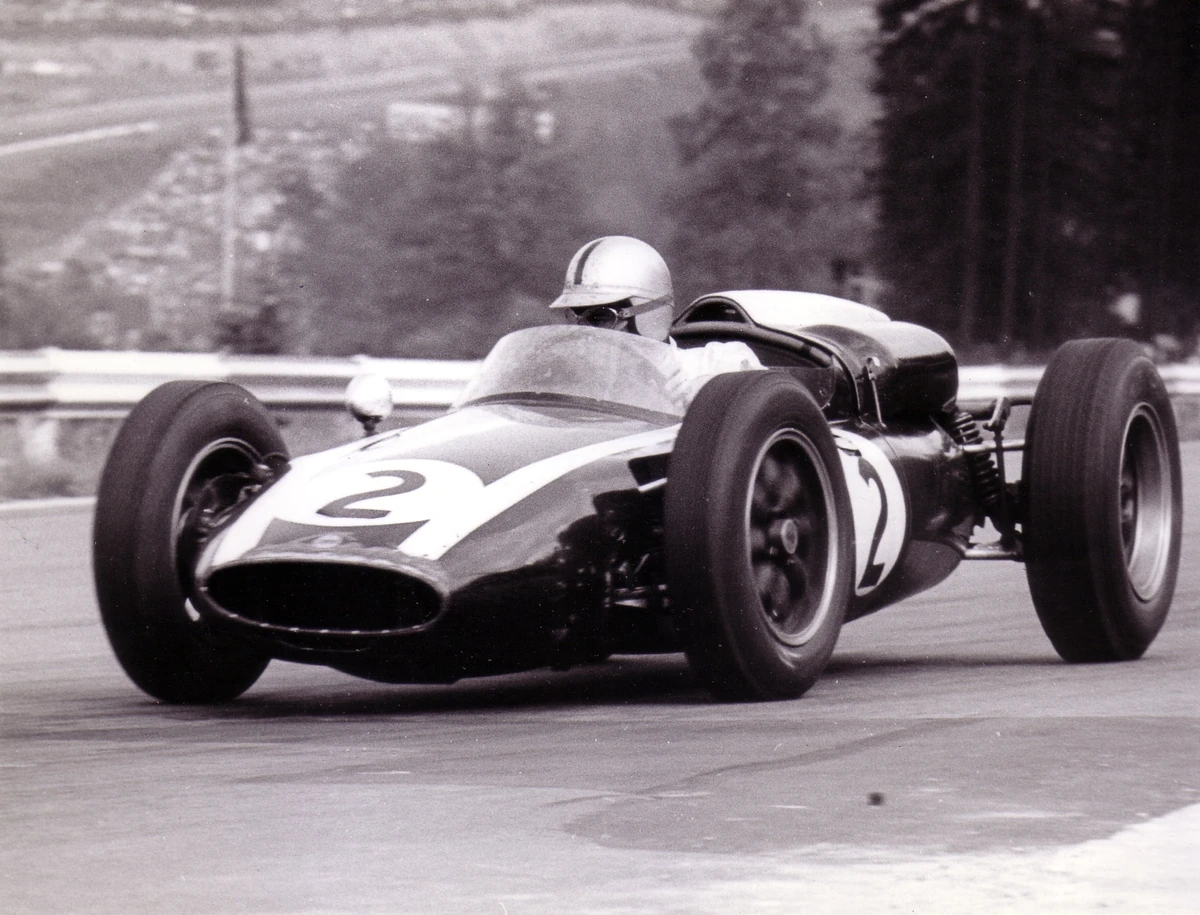 Image source: Brabham
The second title took a different shape. In 1960, driving the Cooper T53, Jack began in the Netherlands and won five consecutive rounds, adding Belgium, France, Britain and Portugal. A year earlier, discussion could centre on how he accumulated points. This sequence put his speed directly before everyone.
The five races were not on one kind of circuit. Winning repeatedly at different venues showed that car and driver had a broad range of adaptability. One win may reflect particular conditions; five in succession require renewed preparation and delivery across several weekends. It is among the strongest pieces of result-based evidence for Jack's driving ability.
The year's record also shows a difficult start: a retirement in Argentina and disqualification at Monaco. The five wins that followed created the decisive progress. Setbacks followed by repeated victory are closer to reality than a portrayal of effortless control from the first day of 1960. Even a championship season can begin without points; the subsequent car and race performance matters.
Comparing 1959 and 1960 reveals two ways the same driver could become champion. The first year combined two wins with repeated high finishes; the second applied a more concentrated force through consecutive victories. Jack was not dependent on one racing pattern. The later description of a “mechanic champion” contained both engineering judgement and race-winning pace.
Taking a Cooper to Indianapolis
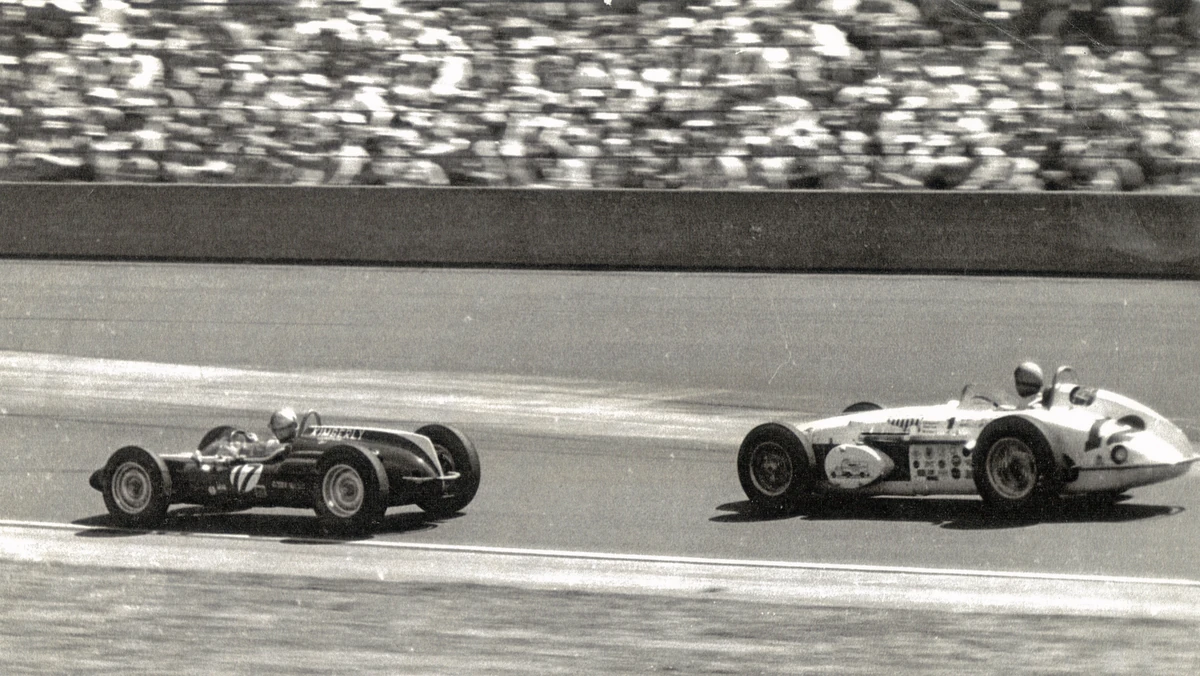 Image source: Brabham
In 1961, Jack entered the Indianapolis 500 in a rear-engined Cooper and finished ninth. Traditional front-engined cars still dominated American oval racing. A lightweight European-style machine arriving there faced speeds, distance and operating conditions different from European road racing.
Ninth was not victory, nor proof of superiority over traditional rivals in every respect. It mattered as a competitive practical demonstration: this layout could run for a sustained distance at Indianapolis and achieve a result worth taking seriously. Suitability for another form of racing had to be answered through competition, not by simply transplanting F1 results.
Rear-engined cars had entered the Indianapolis 500 before, but the event's museum records that none had completed more than 47 laps. Jack's 1961 entry broke through that limit, carrying a still-unconventional approach over a fuller race distance. Ninth place was both a personal result and a technical demonstration grounded in actual running.
Indy cars later completed a gradual layout shift, making Jack's Cooper an important precursor. The full transformation also involved other teams, designers and drivers. Taking an idea mature in Europe into a different racing environment and accepting practical examination already showed an engineering interest beyond that of an ordinary entrant.
Working with Tauranac: Turning Independence into a Factory
Ron Tauranac, whom Jack had met in Australia, came to Britain in 1960 to begin their Motor Racing Developments partnership. The Formula Junior BT1 appeared in 1961, and the BT3 debuted at the German Grand Prix in 1962. From initial cooperation to F1 entry, the project gradually established a business, a product and a racing operation.
Moving from Cooper to his own manufacturing business widened Jack's responsibilities. A driver normally focuses on the next race's car; a manufacturer must also consider how customers use and service their cars and how the next parts batch is made. Independence meant more than writing his name on the bodywork. It meant responsibility for an organisation's ability to keep delivering.
Tauranac was indispensable, advancing design and manufacture to the point of runnable, reproducible cars. Jack supplied driving, mechanical judgement and racing experience, with their abilities connecting. Saying that Brabham won in a car he built means the team he founded and helped run completed the machine; it does not mean he performed every engineering task himself.
In 1964, Dan Gurney won in France and Mexico for the team. To Jack, these victories meant something different from personal success: another driver could reach the top step in a car from this factory. The manufacturer's value was growing beyond its founder's results, while Jack still awaited his own world championship victory at the wheel of a Brabham.
1966: A Forty-Year-Old Driver in the New Three-Litre Era
F1 adopted new three-litre naturally aspirated engine rules in 1966. Jack worked with Repco to develop racing power around the idea of an Oldsmobile aluminium V8 block, paired with Tauranac's BT19 chassis. Engineers including Phil Irving and Frank Hallam completed crucial work. This partnership across Britain and Australia was the actual source of the championship-winning car.
Choosing Repco combined Jack's judgement as driver and businessman. Under the new rules, an engine needed sufficient performance, but also had to be finished on time, fit the car and last a grand prix. Peak power was only one factor. Weight, dimensions, reliability and the team's ability to sustain development all affected the result.
Jack won in France on July 3, then Britain, the Netherlands and Germany. Four victories within five weeks turned the new car's potential into a championship advantage. He secured his third drivers' title with 42 counting points, while Brabham took the constructors' crown. He was already forty in 1966, but age was not the only significance: his responsibilities beyond driving were broader than during either earlier championship.
This defines his unique record precisely. He became the first, and through the end of 2025 remained the only, driver to win the F1 drivers' world championship in a car built by a team he had founded. Stating it clearly preserves the rarity while giving the people who designed, built and ran the car with him their proper place.
In the Same Year, F2 Racing Continued
Jack's racing life in 1966 did not revolve only around F1. Brabham's F2 partnership with Honda also achieved notable results. The BT18 used a roughly one-litre Honda four-cylinder engine, and Honda's historical archive records eleven consecutive wins for the combination that year. For readers used to drivers concentrating on one series, this shows the more overlapping careers of the period.
F2 and F1 results are counted separately, but belonged to the same racing life: combining driving and feedback across different capacities, cars and opponents. The manufacturer could also establish a partnership with another engine company and prove its chassis' value beyond F1.
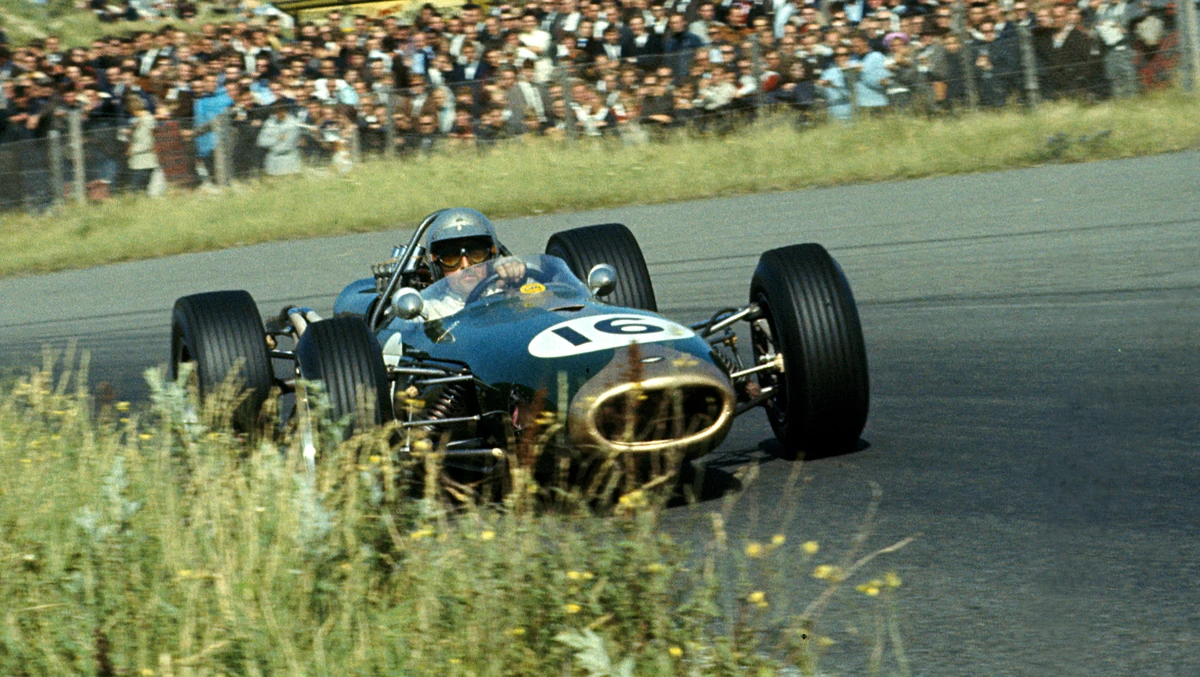
This completes the story of the 1966 “championship in his own car”. Brabham was more than one BT19 and two F1 drivers; it was a company carrying out several racing tasks at once. Jack's fame drew attention, while customer cars and results in other categories gave the name a wider technical and commercial foundation.
Honda's F2 engines and Repco's F1 involvement placed Brabham chassis in different technical circumstances. Jack and Tauranac had to prepare cars for each category's rules and allocate limited factory capacity across programmes. Behind a championship season lay manufacturing and coordination that would never appear in F1's points table.
1967: A Team-Mate Becomes Champion, the Owner Keeps Competing
The 1967 drivers' champion was Denny Hulme, with 51 points to Jack's 46. Brabham also won the constructors' title for a second consecutive year. Jack could not defend his individual crown, but remained a title contender and won in France and Canada.
The French race took place on Le Mans' Bugatti circuit, where Jack beat Hulme by 49.5 seconds for a team one-two. At Mosport in Canada, the two Brabhams finished in the same order again. Driver rivalry and team success coexisted in both races. The owner's seat had not become merely symbolic.
Jack also finished second in the Netherlands, Germany, Italy and Mexico. Two wins and those high finishes still left him five counting points behind Hulme. At season end, the individual and team titles offered two perspectives: he had not defended his own crown, but the team he built still possessed a world champion.
Hulme's success further showed that the 1966 championship was not a special combination only the founder could reproduce. The car had to suit another driver, race operations had to last the season, and both cockpits ultimately supported the team's result. Jack's business was acquiring the ability to win beyond his personal peak.
Meanwhile, F1 technology continued advancing. New engines, tyres, chassis and aerodynamics kept changing the terms of competition. Last year's title added no speed to next year's car, and experience could not replace fresh development. Jack kept racing as his career entered its final phase, but his last victory was still to come.
1970: A Final Win, and the Victory Lost at Monaco
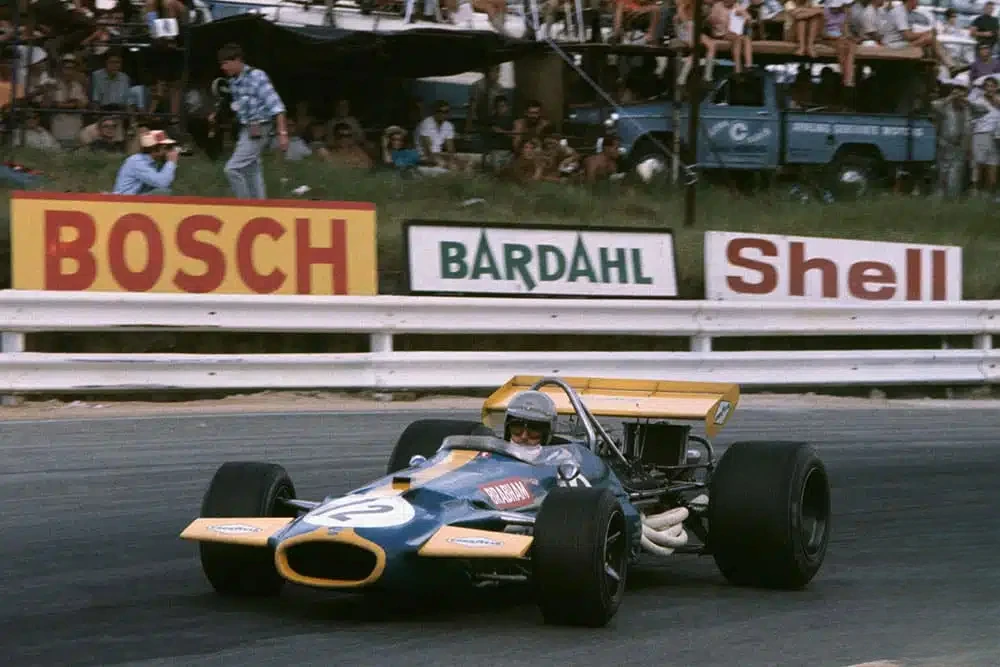 Image source: Brabham
On March 7, 1970, Jack won the season opener at Kyalami in South Africa. His April 2 birthday was still weeks away, making him 43 at the time. It was his 14th and final F1 world championship victory, almost eleven years after the first at Monaco in 1959.
That win also made him a grand prix winner across three different decades: Cooper in the 1950s, the two championship periods of the 1960s and the beginning of the 1970s. Technology and opponents had changed. Continuing to win showed he could still adapt to new racing tools, rather than rely only on an established reputation.
Two months later, Monaco brought the opposite ending. Jack remained in contention for victory late in the race, but made a mistake at the last corner of the last lap, allowing Jochen Rindt through to win. Jack still completed 80 laps in second rather than retiring. The final-corner image can become the only memory of the race; the official result restores what the drama obscures.
Together, that win and loss reveal his final season more accurately than a simple claim that the veteran remained heroic. He still had pace to win and fight for the lead, yet could lose victory at the decisive moment. Age, experience and three championships did not make him immune to mistakes, just as one error could not negate a competitive season.
At season end, Jack retired from F1 driving and returned to Australia. Tauranac took over the business and team before selling after 1971, with Ecclestone taking charge in 1972. Jack leaving the cockpit did not mean the Brabham name leaving the circuit. Piquet later won the team's 1981 and 1983 titles, carrying the name to victory in another generation's hands.
INKA SPORTS Analysis: Why His Record Means More Than “Building His Own Car”
Jack's three world titles demonstrate three things. In 1959, he and Cooper made a new layout into a tool capable of winning across a season. In 1960, five consecutive victories directly showed the combination's pace. In 1966, he, Tauranac, Repco and the whole team connected organisation, car and results under new rules.
The thread connecting them is his ability to work between driving and engineering. Drivers know where a car prevents them performing, but need design and manufacturing ability to turn problems into practical changes. Engineers have technical methods but need feedback from actual racing. Jack's mechanical background shortened the distance between these worlds without ever removing the value of others' expertise.
The achievement belongs to a particular era. Modern F1 has larger development departments, more complex power units, simulation tools and operating structures. A modern driver cannot simply be expected to follow his path. The record's difficulty to reproduce also reflects a changed sport. Understanding that does not diminish him; it clarifies the unusual responsibilities he carried at the time.
Jack was knighted in 1979. He died in Australia on May 19, 2014, aged 88. The FIA's tribute recognised his contributions as both driver and constructor. Together, those identities approach the full picture: a man who could drive a car to the finish and help build the team needed to get it to the start.
His history lives not only in the 1966 trophy, but in fourth at Sebring in 1959, five straight wins in 1960, ninth at Indianapolis in 1961 and the final victory in 1970. Preserving those specific races reveals the long work behind the unique record, rather than only the legend's most quotable sentence.
Timeline
| Year | Event | Significance |
|---|---|---|
| 1926 | Born in Hurstville on 2 April | The beginning of his life |
| 1940s | Mechanical work and air-force service, followed by midget dirt-track racing | Driving and mechanical experience developed together |
| 1955 | Moved to Britain; made his F1 debut at the British Grand Prix | Entered Europe's top level of racing |
| 1959 | First victory at Monaco; fourth at Sebring to secure his first world title | Australia's first F1 world champion |
| 1960 | Five consecutive wins from the Netherlands to Portugal; retained the title | His second drivers' title |
| 1960—1962 | Began the MRD partnership with Tauranac; the BT1 and BT3 followed | A driver became a racing-car constructor |
| 1961 | Finished ninth in the Indianapolis 500 in a Cooper | An important demonstration of the rear-engined approach |
| 1964 | Team-mate Gurney won two Grands Prix for Brabham | A breakthrough for his own team |
| 1966 | Won the title in the Repco-powered BT19 | His third drivers' title and his own team's first championship |
| 1967 | Runner-up in the drivers' standings to team-mate Hulme | The team took both titles for a second consecutive year |
| 1970 | Final victory in South Africa; retired from F1 driving at the end of the season | His Grand Prix victory total stood at 14 |
| 1979 | Received a knighthood | Recognition of his contribution to motor racing |
| 2014 | Died on 19 May, aged 88 | Left a legacy as both driver and constructor |
Honours and Career Record
| Category | Record |
|---|---|
| Name | John Arthur “Jack” Brabham |
| Nationality | Australian |
| Born–died | 2 April 1926–19 May 2014 |
| F1 drivers' world championships | 3: 1959, 1960, 1966 |
| Title-winning teams | Cooper in 1959–1960; Brabham in 1966 |
| F1 Grand Prix victories | 14, counting world championship races only |
| First Win | 10 May 1959, Monaco Grand Prix |
| Final Win | 7 March 1970, South African Grand Prix; aged 43 |
| Unique record | As of the end of 2025, the only person to win the F1 drivers' world championship in a car built by a team he founded |
| Notable Indianapolis 500 result | Ninth in 1961, driving a rear-engined Cooper |
| Statistics cutoff | 31 December 2025 |
Sources and Further Reading
- FIA: a retrospective on Jack Brabham's career
- F1: Jack and Tauranac's car-building partnership
- Official F1: Jack's 1959 season
- Official F1: Jack's 1960 season
- Official F1: Jack's 1966 season
- F1 Official: 1967 Drivers' Standings
- Official F1: 1970 Monaco results
- Indianapolis Motor Speedway Museum: Jack Brabham
- Honda racing archives: the BT18 and F2 in 1966
- National Museum of Australia: the first world title
- National Portrait Gallery of Australia: the knight and mechanic
- Official F1: 1959 Sebring results
- Official F1: the 1967 French Grand Prix
- Official F1: the 1967 Canadian Grand Prix
- Official F1: race winners in the 1970 season
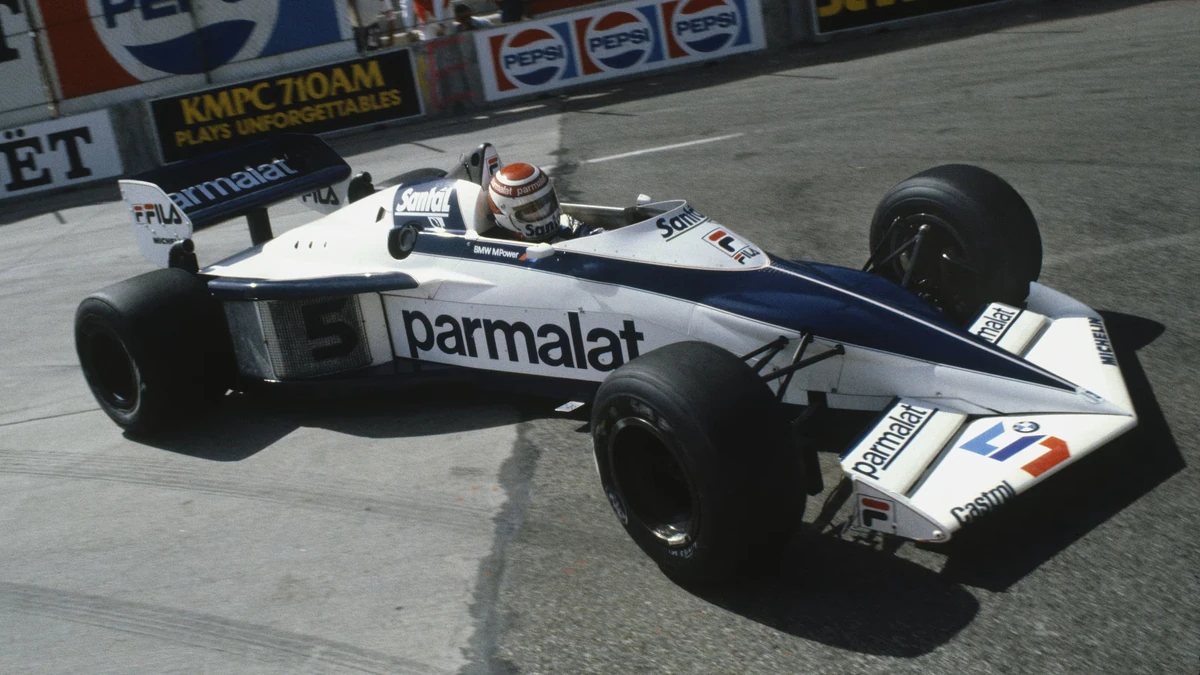 Image source: Brabham
Brabham: From Customer-Car Factory to Turbo Champion — Thirty Years of a Team
From customer cars and Repco doubles to the fan car and BMW turbo, tracing how one team repeatedly changed the way it competed.
Continue Reading · About 18 Minutes →